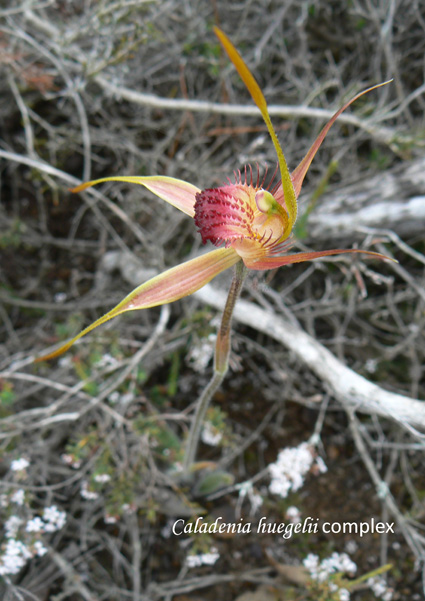
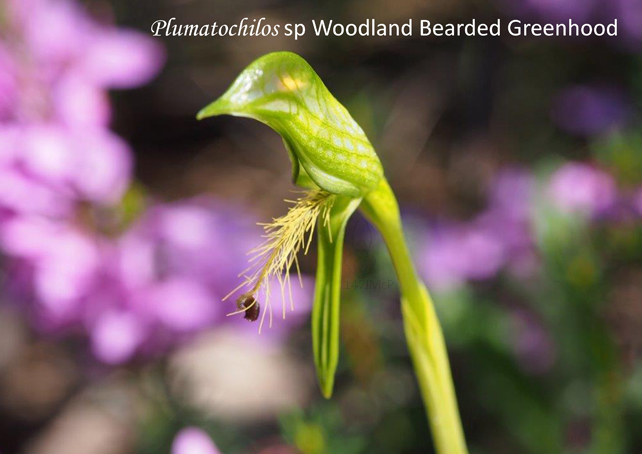
Five photos were entered for the September competition and there was a draw, Pauline Meyers’ flower of a plant from the Caladenia hueguelii complex from Western Australia and Jill McPherson’s Plumatichilos sp. Woodland Bearded Greenhood from Scott Creek Conservation Park. The other three by Chris Davey were photographed on Yorke Peninsula (see Letter to the Editor in this September Journal).
As winners they showcase the great diversity that are found in our Australian terrestrial orchids.
Plumatichilos belongs to the greenhoods but the features that set it apart from the other greenhoods are the long thin bristled labellum, the galea pinched in the middle resulting in two openings and the rosette of leaves growing a short way up the stem. Nationally there are thought to be several species but only a small handful have been named. In South Australia, there may be a few distinct species but currently they are usually identified with a phrase name such as Plumatichilos sp Woodland Bearded Greenhood.
Mainly flowering in spring the flowers of the Caladenia huegelii complex are characterised by the thickened clubs on the three sepals, petals shorter than the long sepals, fringed (either short or long) labellum with four or more rows of calli. All of these features can be seen in Pauline’s photograph but the leaf is not so easily seen which should be long, hairy and curve inward. In all there are said to be twenty two species within this complex of which twenty are named.
References:
Brown et al (2013) Field Guide to the Orchids of Western Australia, Floreat, WA Simon Nevill Publications.
Jones, David L (2006) A complete Guide to Native Orchids of Australia, Frenchs Forest, NSW: Reed New Holland
Jeans, Jeffrey & Gary Backhouse (2006) Wild Orchids of Victoria, Seaford Vic: Aquatic Photographics.
Bates, R. J. (2011) South Australia’s Native Orchids NOSSA DVD, Adelaide
100 years ago on 15 July 1915, the state government declared Morialta a National Pleasure Resort. The Friends of Black Hill and Morialta have been holding a series of public events to celebrate the Centenary of Morialta. As part of the celebrations, the Native Orchid Society of South Australia has conducted some orchid walks in the park.
In 2004, an interim Flora Species List was produced by the then Department for Environment and Heritage and 39 orchid species were listed. It is an interim list and considering that the park is 5.33 square kilometres with a range of different habitats, it is possible that there are more species than originally listed.
One native species not included on the list is Caladenia latifolia but its presence is well known to members of the Native Orchid Society. Unfortunately the South African weed orchid Disa bracteata (Monadenia bracteata) hasalso been found in the park.
In this video most of the shots have not been taken at Morialta but it does showcase some of the orchids that can be found in the park.
In 1983, Ron Robjohns, NOSSA’s first treasurer, wrote a comprehensive series of articles about growing epiphytes in South Australia. Thirty years on Ron’s information for growing is still helpful and applicable for today. Any updates or extra information are in black text.
NATIVE ORCHID SOCIETY OF SOUTH AUSTRALIA JOURNAL
Volume 7, No. 7, August, 1983
GROWING EPIPHYTIC ORCHIDS IN SOUTH AUSTRALIA – R.T. Robjohns
Dendrobium pugioniforme (Dagger Orchid)
This is an epiphyte frequently growing into large pendulous masses on the branches or trunks of trees, mainly in the rain forest areas from Mt. Dromedary on the south coast of New South Wales northwards to the Bunyah Mountains in south eastern Queensland. The stems are slender, wiry and branching, often quite long and usually tangled. Thin creeping roots develop freely from nodes at the branches.
The distinguishing feature of the numerous shiny, thick flat, ovate to lanceolate leaves is the sharply pointed tip.
The flowers are usually single but sometimes 2 or 3 per inflorescence and are 2 to 2½ cm in diameter. The petals and sepals are light green, the labellum pale with bright red or purple markings. The flowering season is September to November.
It is a reasonably hardy plant which will respond to cultivation on quite a variety of hosts. I have had success using Melaleuca, and find that it responds to a position having plenty of shade and moisture, particularly during our summer. Although in the wild it will tolerate cold conditions, (being found from near sea level to around 1300 metres), it will require shelter from our winter frosts
Most authorities designate it an epiphyte, however, in “The Orchadian” Vol. 4, No. 2, p. 24 (1972) D.L. Jones reports having found a bleached and tough looking plant growing on Alum Mountain with its roots amongst leaf litter in a crevice. Again in “The Orchadian” Vol. 7, No. 7, p. 164 (1983) G. Walsh describes ‘inter alia‘ lithophytic forms of D. pugioniforme growing in the Illawarra District of New South Wales.
In view of this it could possibly be grown in a pot, but as it grows quite readily on a slab I have felt it pointless to possibly waste a plant just to grow it in a pot. Fertilise in the growing season with foliar fertiliser at half the recommended strength.
Two naturally occurring hybrids of D. pugioniforme have been recorded – D. pugioniforme x D. tenuissimum and D. pugioniforme x D. beckleri but they are relatively rare (Ford, “The Orchadian”, Vol, 3, No. 7, p.88: Dockerill, Aust. Indig. Orch. Vol. 1, pp 370-371) and as yet it has not yet attracted the hybridists as there does not appear to be any registered crossings.
Of the five entries this month, three were spider orchids and the winner was from this group. It was Rob Pauley’s Arachnorchis cardiochila (syn Caladenia cardiochila), Heart Lip Spider Orchid which can be found across South Australia and into western Victoria. At one time a specimen was found on Flinders Island, Tasmania but as it was collected in 1947 it is considered extinct in that region.
This lovely flower is quite variable in colour and form.
The heart shape labellum is a distinctive feature of this spider orchid, so it is not surprising that this is reflected in the name. Cardio means heart and chila lip.
What probably is surprising is that the traditional heart shape symbol has come full circle. It had a botanical origin. According to cardiologist Professor Armin Dietz the symbol was originally a stylized vine/ivy leaf as evidenced from paintings on goblets from the 3rd millennium. In the Middle Ages, doctors and anatomists used the shape to represent the heart. As at that time Latin and Greek were both the international languages of scholars, including doctors, the word associated with the symbol was the Greek word kardia (ie cardio) meaning heart. Consequently, by the time Ralph Tate names this species in 1887, the shape has become intrinsically linked with the heart and so it must have appeared to him as an obvious descriptive name.
There are several field guides which give a detailed description of the species including South Australia’s Native Orchids DVD-ROM which is available for sale from NOSSA.
The texts published on this website are taken from his book “Ewige Herzen – Kleine Kulturgeschichte der Herzbestattungen” (“Eternal Hearts – a short cultural history of heart burials”), published 1998 in MMV Medien und Medizin Verlag, Munich. (English translation by Pauline Liesenfeld.)
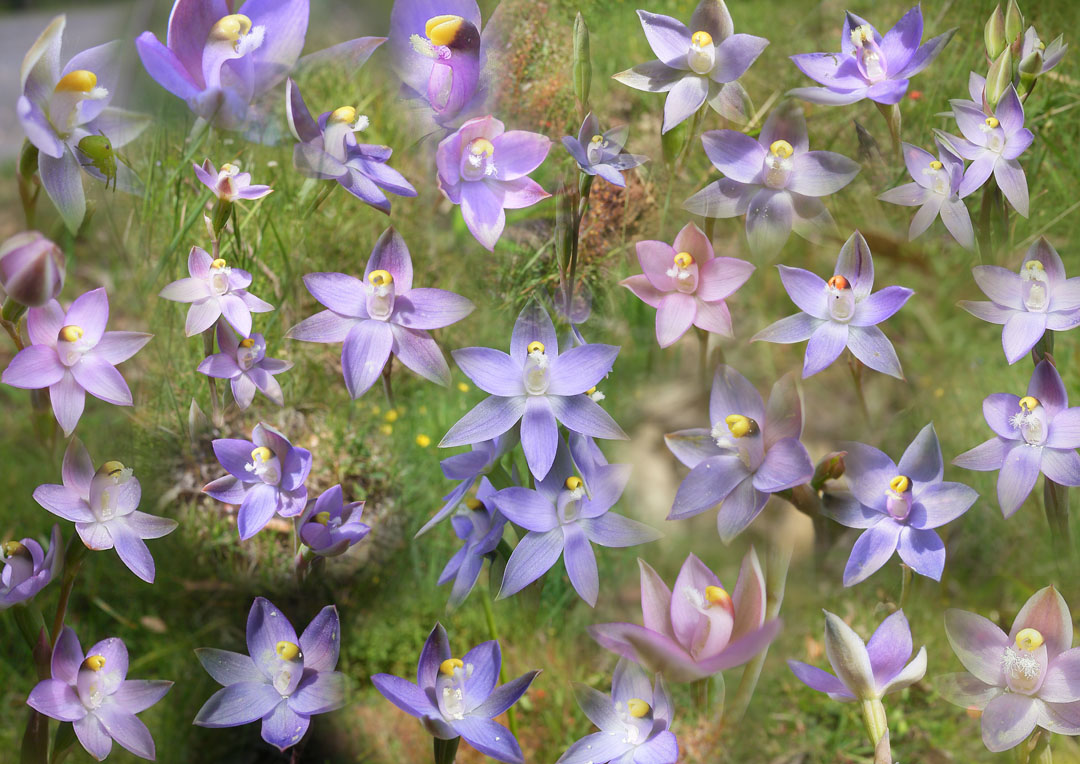
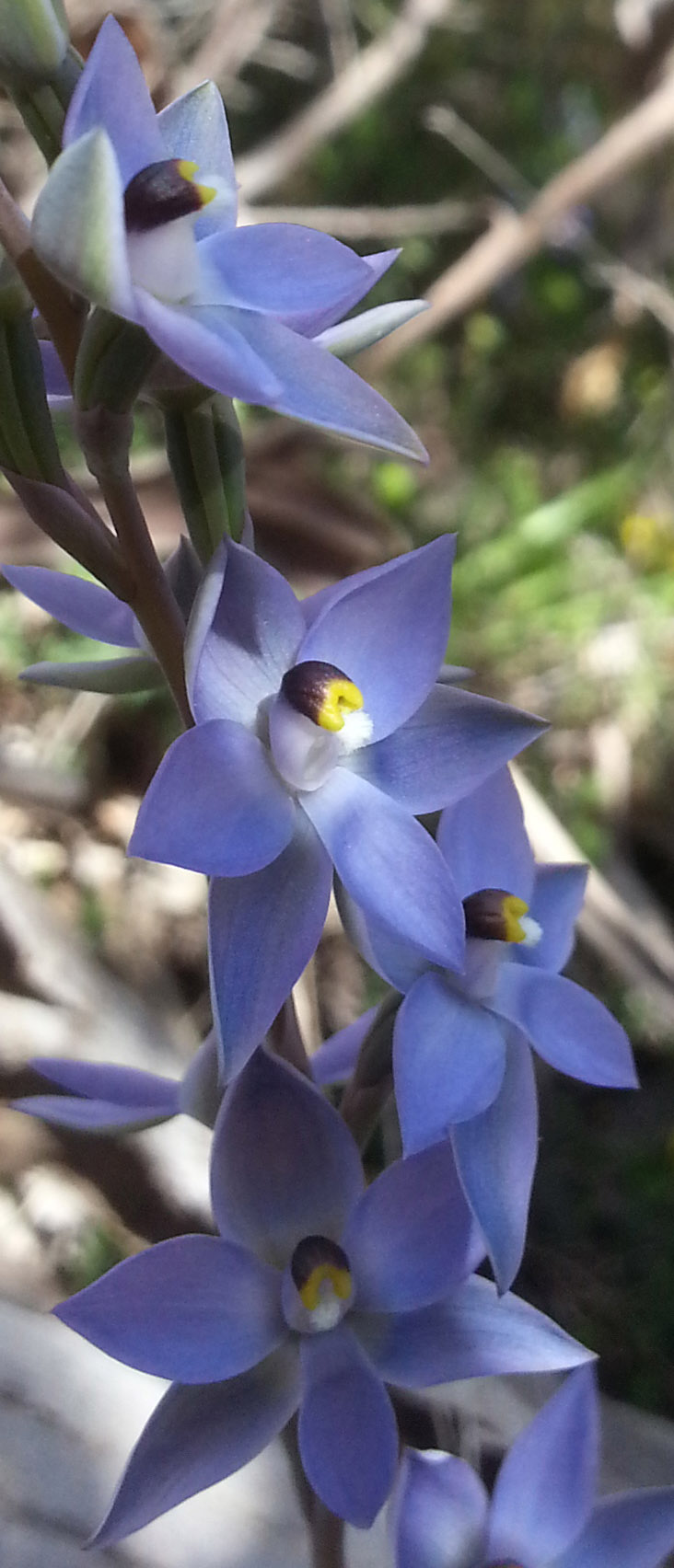
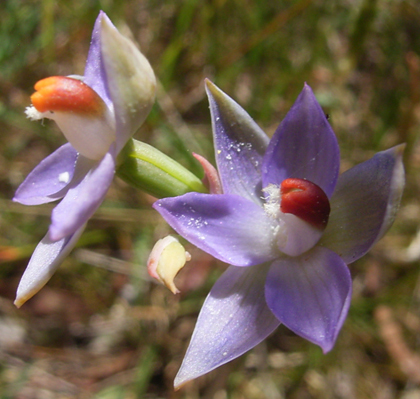
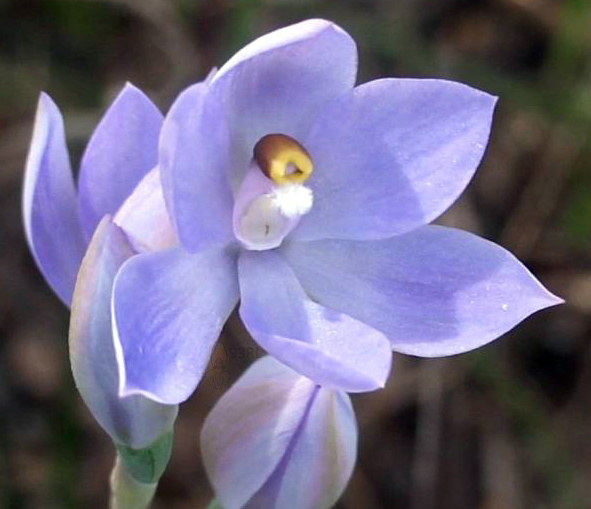
Orchids can be incredibly easy to identify or frustratingly difficult. For instance, the Flying Duck orchid is easily recognizable. The name says it all. But for many other orchids, particularly the ubiquitous blue sun orchids, it is necessary to make careful observations.
In this collage there are several species, but which is which?
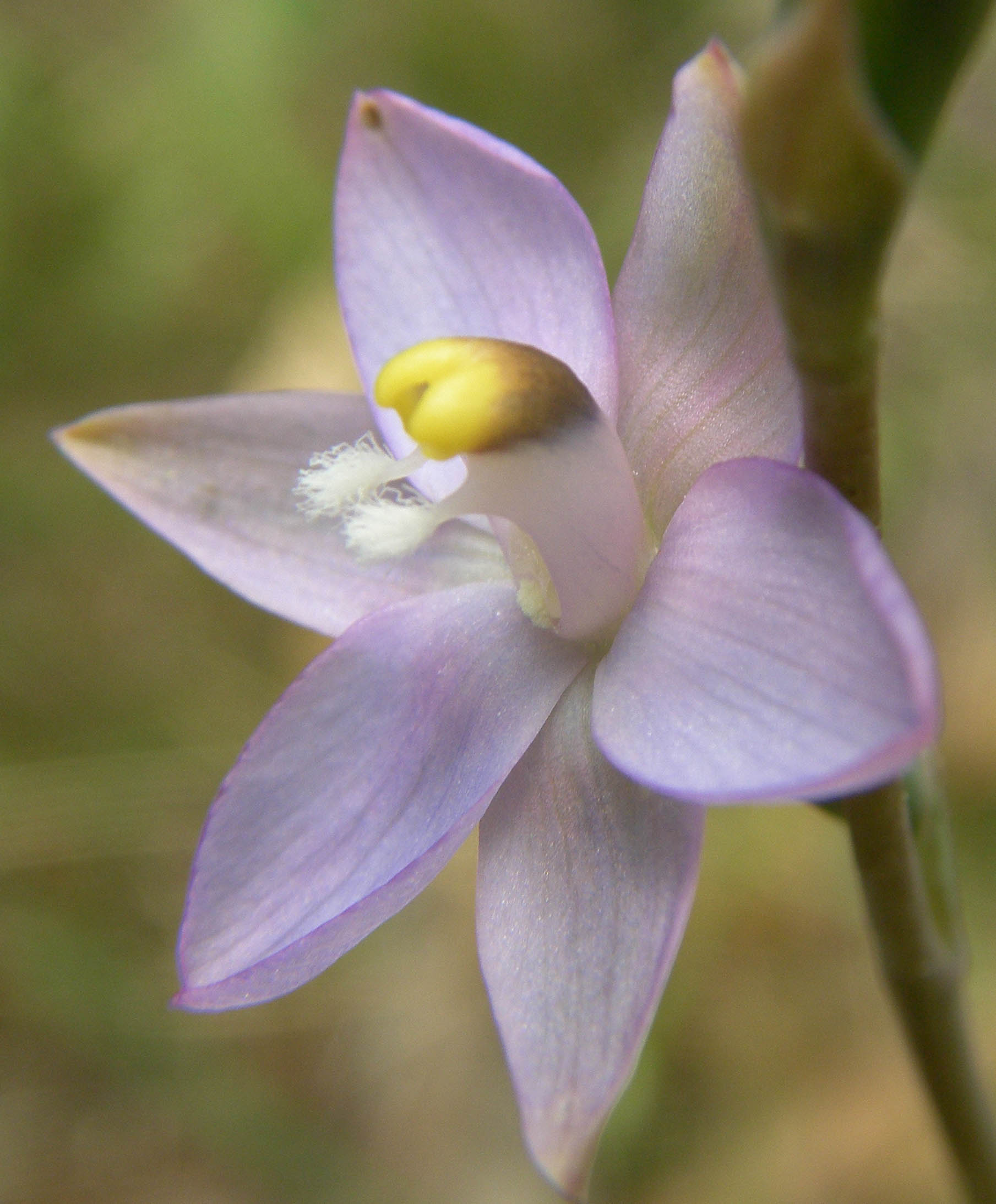
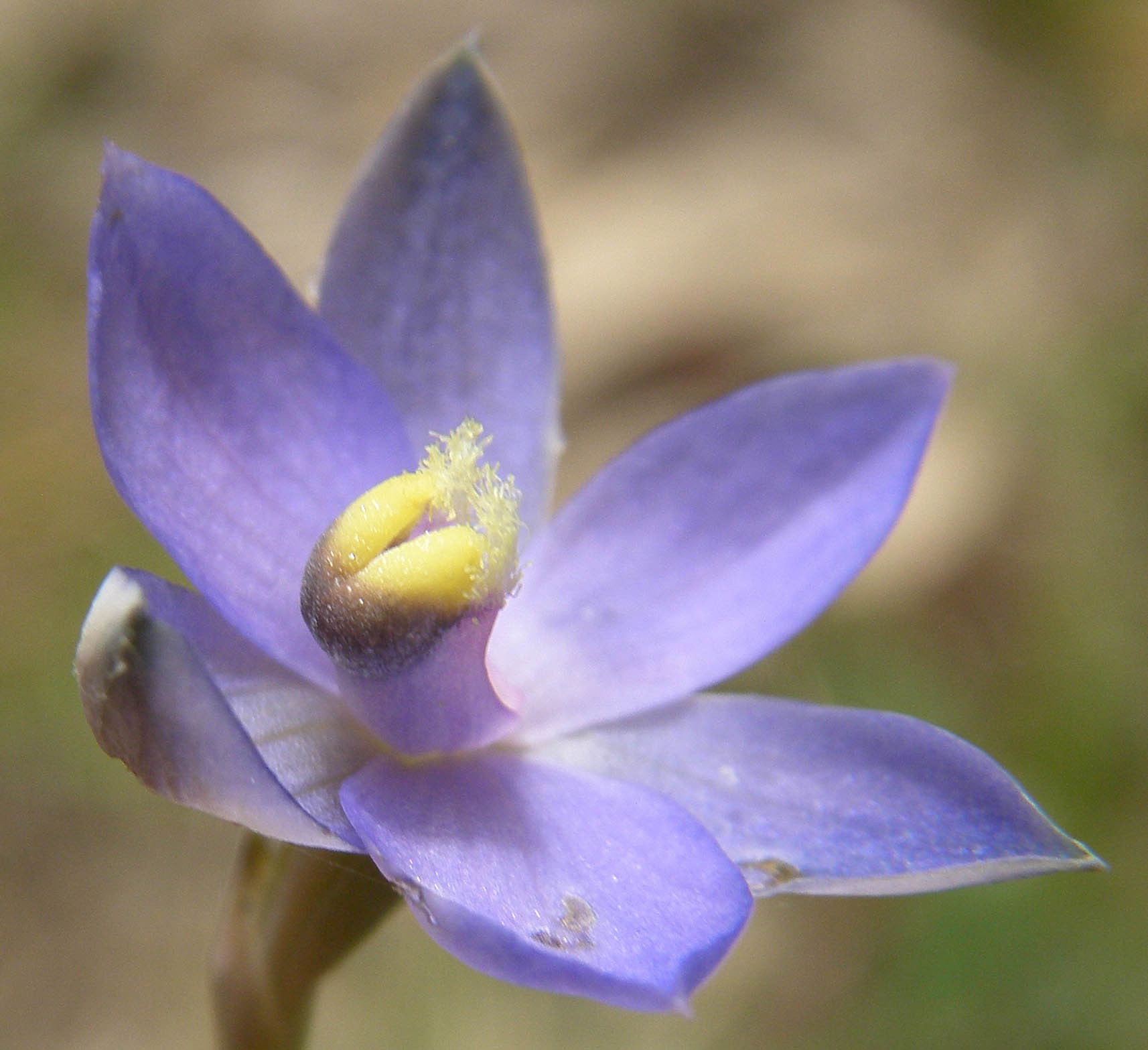
For sun orchids the most important distinguishing feature will often be the column, details of which are described or illustrated in orchid keys. For example Bates and Weber, Orchids of South Australia (1990) has an illustrated dichotomous keys showing the different types of columns.
Images from Bates & Weber, Orchids of South Australia, pages 147 to 150; courtesy of the Board of the Botanic Gardens and State Herbarium.
With today’s cameras, it is possible to photograph the column, preferably from front, side and above. This helps greatly with identification.
The following photographs illustrate the variety of columns.
Thelymitra megcalyptraThelymitra X truncata – a natural hybrid
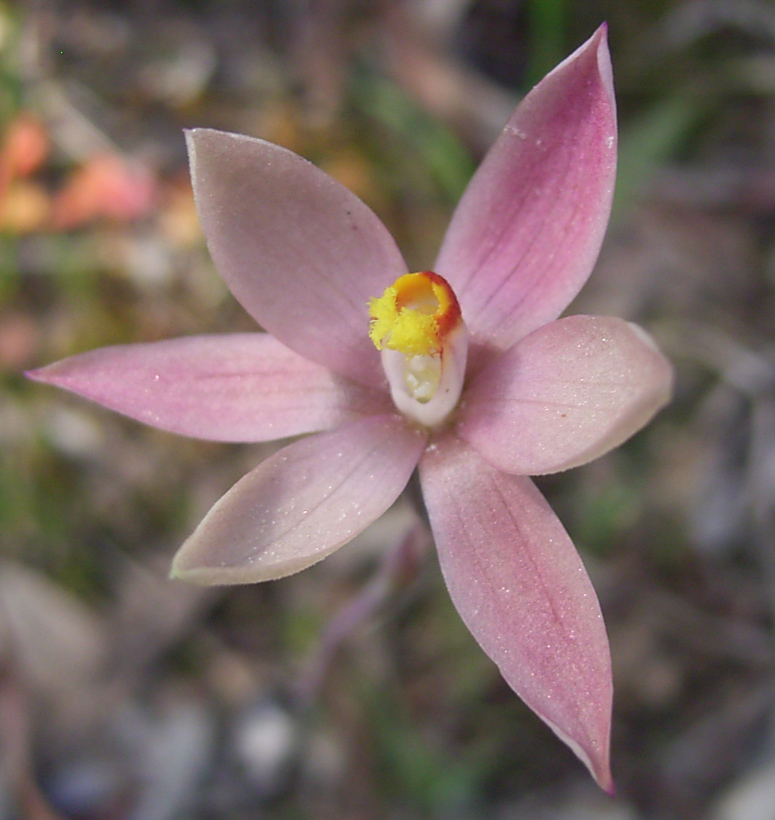
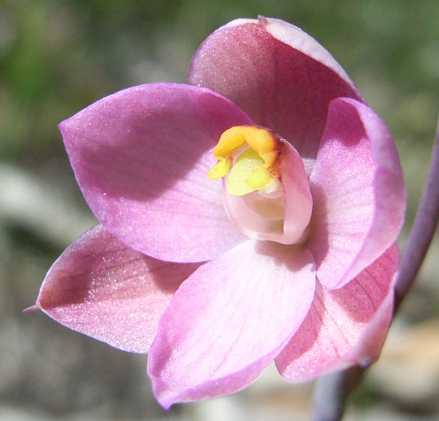
And it is not only the blue orchids that can be a problem, in South Australia; there are three pink orchids which are different in size and flowering time, features that are not obvious in a photograph, so the column is a helpful identification tool.
Thelymitra luteocilium – has tufted hairy column armsThelymitra rubra – has finger-like column arms and no tuftThelymitra carnea – has smooth column arms
And just what is the column? It is the reproductive organ of the orchid flower and is unique amongst plants because it is the fusion of the male (stamens) and female (pistil) parts. It is usually found in the centre of the flower and both releases and receives the pollen sac.
One of the orchids currently flowering is Nemacianthus caudatus (syn Acianthus caudatus). The common name is Mayfly orchid. Robert Lawrence’s post in OrchidNotes gives an interesting background to the resemblance of the flower both to the Mayfly’s three tails and its mass swarming.
The Mayfly Orchid is a small orchid with very dark reddish brown flowers with long, hair-like sepals. It flowers from late July to August. One might question what sort of insect was behind the naming of this orchid, which does not even flower in May. Mayflies are an insect with which many of us are not acquainted.
Close view of a typical flowering Mayfly Orchid
One source attributed the naming or the orchid being similar to the long legs of a Mayfly. However, a quick search in the Internet revealed that Mayflies have fairly short legs, as in the image below:
It turns out that it is the appendages on the end of the abdomen that the sepals of the Mayfly Orchid resemble. Mayflies usually have three tails (two cerci, one middle filament), although the middle tail is rarely reduced or absent. …
In 1983, Ron Robjohns, NOSSA’s first treasurer, wrote a comprehensive series of articles about growing epiphytes in South Australia. Thirty years on Ron’s information for growing is still helpful and applicable for today. Any updates or extra information are in black text.
NATIVE ORCHID SOCIETY OF SOUTH AUSTRALIA JOURNAL
Volume 7, No. 6, July, 1983
GROWING EPIPHYTIC ORCHIDS IN SOUTH AUSTRALIA – R.T. Robjohns
Dendrobium tetragonum (Tree Spider Orchid)
A variable epiphytic species growing mainly in rainforest areas from Illawarra in New South Wales to the Endeavour River in Queensland. A favourite haunt is on trees overhanging water, often in deep shade. It has a variety of hosts (including Myrtles, Eugenias, Water Gums and occasionally Melaleuca) on which it grows into small clumps. Altitude is of little concern as it is found from near sea level to approximately 1000 metres.
The stems, which are semi-pendulous and from 6 to 45 cm long, arise from a prostrate and branching rhizome They are round, thin and wiry at the base but thickening to become rectangular (hence the name tetragonum – derived from the Greek “tetra” meaning “four-sided”), then tapering slightly before the leaves. There are from 2 to 5 leaves up to 8 cm long at the end of the stems. They are deep green in colour and often with crinkled or wavy margins.
The racemes appear from between the leaves but are short and have from 1 to 5 flowers which are widely spreading and spidery in appearance. The colour is greenish/yellow with irregular and variable brown, red and purple markings. In size the flowers are from 4 to 9 cm from the top of the dorsal sepal to the tip of the lateral sepal and they have quite a pronounced fragrance.
The var giganteum is the tropical species and ranges from the Fitzroy to the Endeavour Rivers. The flowers are usually larger, but not always, and have a slightly different colour pattern.
The plant does not lend itself readily to pot culture and should be mounted. I have it growing on Melaleuca and cork slabs, but best results have been with one mounted on a hardwood slab.
I find that it needs little more than 50% shade plus humidity and, of course, plenty of air movement. Protect from frosts. Fertilise in the growing period with foliar fertiliser at half recommended strength. A number of interesting hybrids have been produced using D. tetragonum as one of the parents. They mostly flower well and have reasonably large flowers.
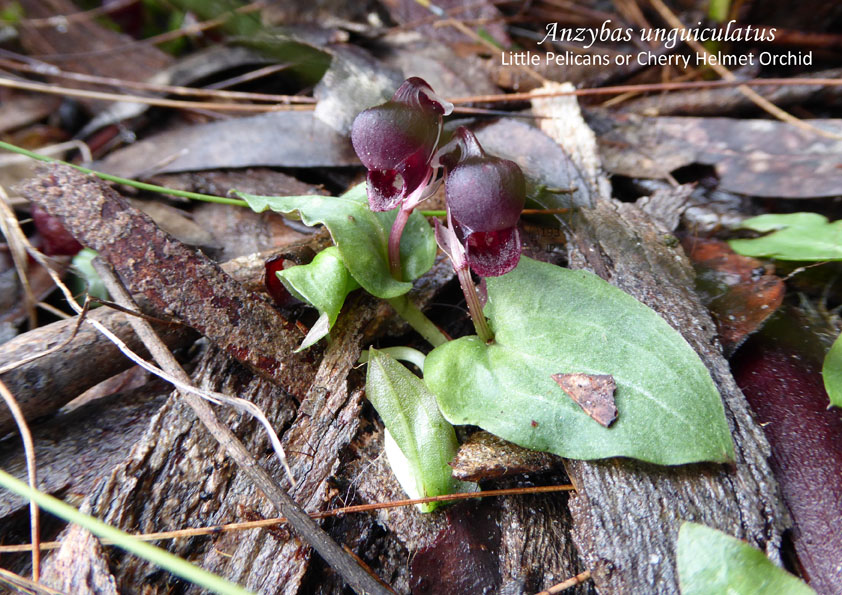
Anzybas unguiculatas (common name Little Pelican or Cherry Helmet Orchid) was the main focus for this month’s competition with three photographs of this diminutive flower.
The other photographs were Ed Lowrey’s close-up of a triggered Urochilus sanguineus labellum, John Badger’s first Diuris palustris sighting for this year and Pauline Meyer’s mass flowering of Leptoceras menziesii post fire. Of the Anzybas, Jenny Pauley entered two and Lorraine Badger one. Jenny Pauley’s photograph of two flowers was the outstanding winner.
Originally named Corysanthes unguiculata (1810), then Corybas unguiculatus (1871), the genus name was changed in 2002 to Anzybas in recognition of its distribution both in Australia in New Zealand. Since 1945 it had been recognised that the New Zealand species Corybas cheesemanii was a synonym for Corybas unguiculatas although the juvenile plant can have two leaves unlike the Australian species which is single leafed.
An interesting feature of this flower is the prominent white ears at the rear of the helmet (not clearly seen in this photograph) which are part of the labellum.
These plants are small. The gum leaves and twigs give an idea of size but the engagement ring shows it very clearly. Note also the prominent ‘white ears’ of the labellum.
An unusual aspect of this photograph is that the colour of the underside of one of the leaves. It lacks the characteristic distinguishing feature of the purple underside of the leaves. According to orchid growers, the light affects the leaf colour. Heavy shade produces green leaves. It is possible that the heavy leaf litter where this plant was growing provided enough deep shade to cause the colour loss.
Bates (1990) states that it (has) not proved amenable to cultivation, but it has, on rare occasions, been benched at NOSSA meetings with the most recent occurrence was in July 2010 but it remains a very difficult plant to cultivate. The electronic version Vol 34 No 7 has a photograph of the plant just visible within the moss.
It is not always easy to photograph this species as not only is it rare with limited numbers but there are very few sites where it can be found. Added to that is that the window of opportunity is short in South Australia with a flowering time from June to August compared with those interstate which can range from May to October.
There has always been an interest in Australian orchids. Over the years there have been many photographs of orchids. This stereographic postcard from 1928 is a study in beauty –
This postcard is held by the State Library of Victoria.
Although the distribution covers the Southern Lofty, Kangaroo Island and the South East regions of South Australia, it has become increasingly rare due to loss of habitat which consists of leaf litter on damp soils. As a result, there are very limited localities where they can now be found.
It is one of our earliest helmets to flower which is from June to July.
Rupp, HMR and Hatch, ED (1945) Relation of the Orchid Flora of Australia to that of New Zealand in Proceeding of the Linnean Society of New South Wales Vol 70 1945, pages 53 – 61
Part One – Attracting Pollinators looked at pollination strategy, but the fourth aim of the paper was to establish that Corunastylis littoralis reproduced by xenogamy or geitonogamy and that the species was not autogamous or apomictic, that is, pollinated, self pollinating or non pollinating plants.
Xenogamy or geitonogamy that is vector mediated pollination or out-crossing is when fertilization occurs by the transfer of pollen from one flower to another flower usually by the means of insect.
Autogamy or self-pollinating is when the flower is pollinated by its own pollen.
Apoximis is when reproduction occurs without pollination, that is, vegetative reproduction.
As explained in the paper, there are visual clues for determining which process is used by the plant.
Xenogmay
Autogamy
Apoximis
Pollinia removal and pollen deposition
Pollinia not removed
Lacks pollen or it is tightly bound
Pollinia weakly attached to the viscidium
If pollinia present, then unable to be removed
Not all the ovaries are fertilized
All the ovaries are fertilized and have viable seeds
Swelling of the ovaries can occur whilst in bud
Perfumed
Likely to have no perfume
Attracts insects
Flowers short lived
More detailed information was gained by dissecting the flower.
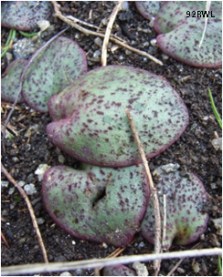
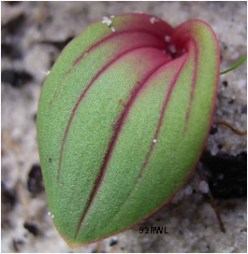
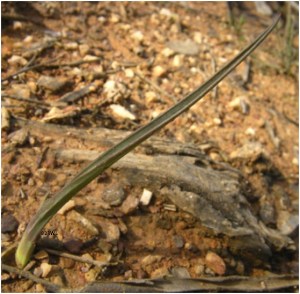
In 2006 the electronic version of the Journal of the Native Orchid Society of South Australia Volume 30 No 2 March contained a quiz – Do you Know Your Leaves? It featured photographs of the leaves of 15 different orchid. In 2011 Robert Lawrence produced a book titled Start With the Leaves which was based upon the premise that the flower is not always present but identification is still possible.
Many but not all can be identified to species level by the leaf alone.
So here is the web version of the original quiz – how well do you know your leaves?
Hint – 20 of them are South Australian, more specifically, the Mount Lofty Ranges region. One is a weed.
Did you get them? Click on the image to go to the name and pictures of the flower. As a couple of the links are not working and until I have time to rectify them, click here to find the all answers in the Journal.
It will be on the last page.












 Close view of a typical flowering Mayfly Orchid
 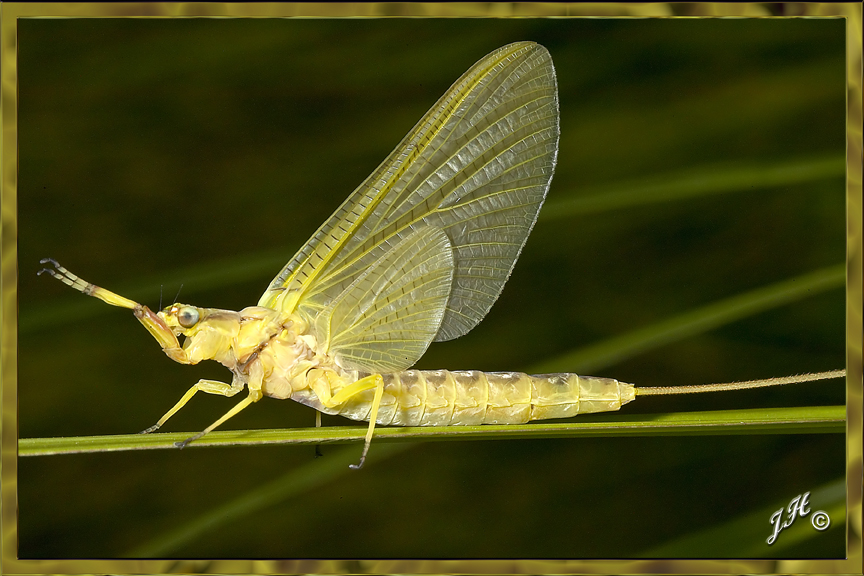 Mayflies have relatively short legs … Source: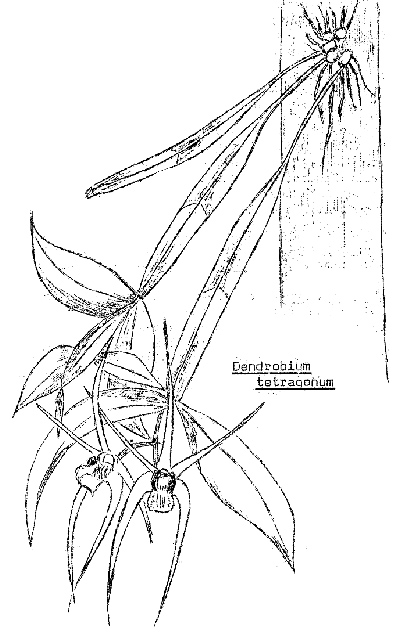








 NOSSA
NOSSA 