Do we meet or not meet? -Basal Flanges in Subgenera Bunochilus

The following article by Rosalie Lawrence appeared in the electronic version of the Native Orchid Society of South Australia Journal, Vol 47 #6 July 2023. For the purpose of this article, the segregate genera Bunochilus was used to narrow it down and differentiate it from the rest of the Pterostylis genus. This article includes additional information not in the Journal article

Recently Robert & I visited Diamond Creek, Victoria where we photographed a Bunochilus which we thought looked remarkably similar to our hills B viriosus. Anyway it was subsequently identified on iNaturalist as B smaragdynus. In the iNats comments, the Victorians often mentioned the meeting together of the broad basal flanges within the flower as an identifying feature.

So on our recent NOSSA trip to Hardy’s Scrub, Robert made it a point to photograph the basal flanges of the Bunochilus. I too did the same. Lo and behold, we had flowers with the flanges touching and others where it did not! So did we have two species of Bunochilus at Hardy’s Scrub?

Well when we get home we read June’s descriptions for the two species and note that she has underlined the touching of the basal flanges for B smaragdynus but mentions in the description of  B viriosus that they can also touch. Puzzlement! Solution – give June a call! It’s always great chatting with June because it is hard to get everything into one small volume and with talking a better picture emerges.

After talking to June, keeping in mind what we discussed, I then spent time on iNaturalist viewing all 285 observations of B smaragdynus and 115 B viriosus observations but I soon noticed from the Victorian commentators that I also needed to look at the 41 B chlorogramma and some of the B melagramma observations (1,619 was way too many to go through!).  I also viewed Vicflora pages on the description of their three species.

Basal flanges of Bunochilus viriosus not touching

Photographer Robert Lawrence


The following is what I noticed

  • The Victorians were often using the flanges as an identifying feature for identifying B melagramma
  • There was great difficulty in separating out B chlorogramma from B smaragdynus. To quote one Victorian –  ‘It is notoriously difficult to tell the difference between P smaragdya  & P chlorogramma’
  • B melagramma has small basal flanges (appear parallel) and never touch but the other three species have well developed basal flanges (triangular shaped) and may or may not touch (see Vicflora’s descriptions).
  • Published descriptions of the species occurred

~ Pterostylis smaragdyna 1993

~ B chlorogramma 2002

~ B melagramma 2002

~ B viriosus 2006

But it was the differences between B smaragdynus and B viriosus that I needed to look up and particularly whether the flanges were of significance or not. Also, June has always stressed that features are not hard and fast, so I needed to keep that in mind as I made my comparison.

My general observations of the observations of B smaragdynus and B. viriosus are~

  • B smaragdynus
    • Although most flowers opened at once, there was still a large proportion that didn’t
    • Flowers mainly a few and tended to be top heavy
    • There were some pollinated flowers
    • Along the way, I noticed the growth habitat (when I could see the background), was at the most one or two, or to quote Gary Backhouse – “small, sparse colonies”
    • Basal flanges did not always touch but were always a wedge shape
  • B viriosus
    • Most flowers opened consecutively but there were some where all the flowers opened at once.
    • Mainly lots of flowers on an inflorescence but there was a reasonable amount with just one or two flowers.
    • Growth habit, probably the most notable difference, colonies consisted of several flowering plants (sparse would not be the word to apply!)
    • Did not see any pollinated flowers
    • Rare to find an image of the flanges, but they were variable concerning touching yet always wedge shape

Basal flanges of Bunochilus viriosus touching

Photographer Rosalie Lawrence

Conclusion

There doesn’t appear to be a reason to include observing the flanges as there is no difference between these two species. But when there is a possibility of B melagramma being present such as in the South East and on Kangaroo Island, then it becomes necessary to include looking at the flanges when making an observation.

A surprise was to notice that the growth habit is significant point of difference between B viriosus and B smaragdynus as I was mainly looking at the flanges. Of course, there are some other features to be considered but that is for another time.

A curiosity, whilst researching this article I discovered that Diamond Creek is the type location for B smaragdynus

For images of basal flanges see page 202 of June’s book.
2020 September Talk – Orchids and Fire

The Native Orchid Society is involved in many different activities, one of them being to assist researchers. In 2020, Covid 19 struck bringing many university projects to a halt. But in South Australia, NOSSA members were able to help PhD candidate Alex Thomsen, University of New South Wales, set up her project titled Impacts of Changing Fire Seasons on Orchids. The following video is her brief presentation of her planned research that she gave to the general membership at the September meeting.

Orchid Code of Ethics or How I can conserve our native orchids

So many of us are interested in preserving our native flora and fauna, and for NOSSA it is the native orchids. But many of us may not be aware of how we can play a significant role in minimising our impact upon the environment so that they are still around for our children and grandchildren

The following video is a brief overview of two documents that NOSSA has produced. They are guidelines to help individuals know how they can minimalize their impact on the environment and so assist in the conservation of our beautiful and unique native orchids.

Below are the links to the documents referred to in the video:

Code of Ethics – Sensitive Sites 2 page
Code of Ethics – Sensitive Sites 3 page
Code of Ethics – Photography

Ethical Nature Photography in Tasmania

Petalochilus – when use of a segregate or common name is helpful

The following article is from the Native Orchid Society of South Australia Journal Volume 44 No 7, author Rosalie Lawrence.

Over the years there have been many orchid name changes (particularly at genus level), some quite drastic, some multiple times and for many there can be a reversion back. Yes, this creates confusion but there are times when some of these name changes, known as segregates (both at species and genus level) can be useful.

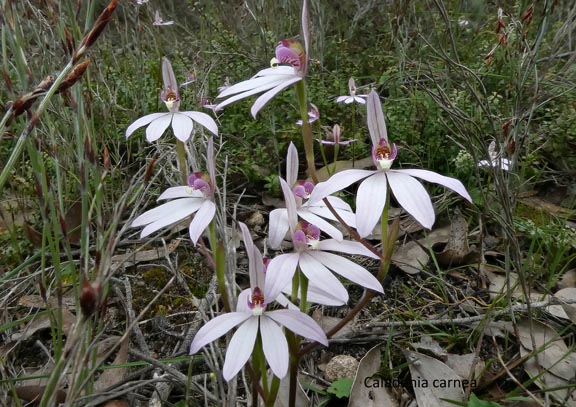
Caladenia carnea (synonym Petalochilus carneus) Photographer Lindsay Ames

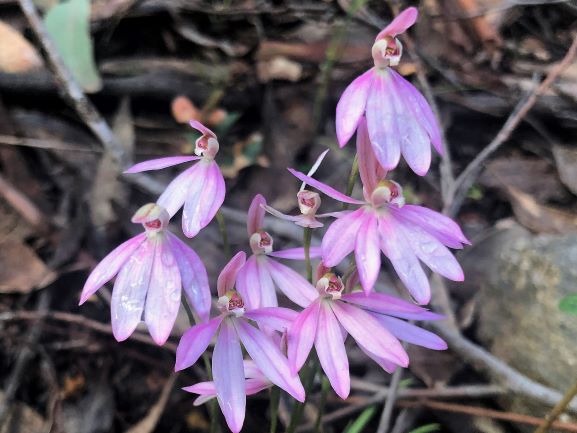
A case in point, is Lindsay Ames’ winning photograph (June) – Caladenia carnea synonym Petalochilus carneus. Petalochilus was proposed as a genus in 2001 by DL Jones, MA Clements, et al. It was one of many proposed genera changes. Many discussion papers followed but in 2015 after further taxonomic and DNA work, Mark Clements et al published a paper that “points to Lindley’s 1840 interpretation of Caladenia (…..) as being the most accurate reflection of the group.” Hence the discontinued use of Petalochilus and the other segregate genera.

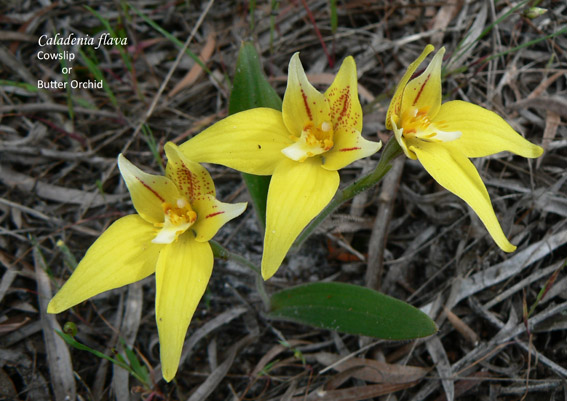
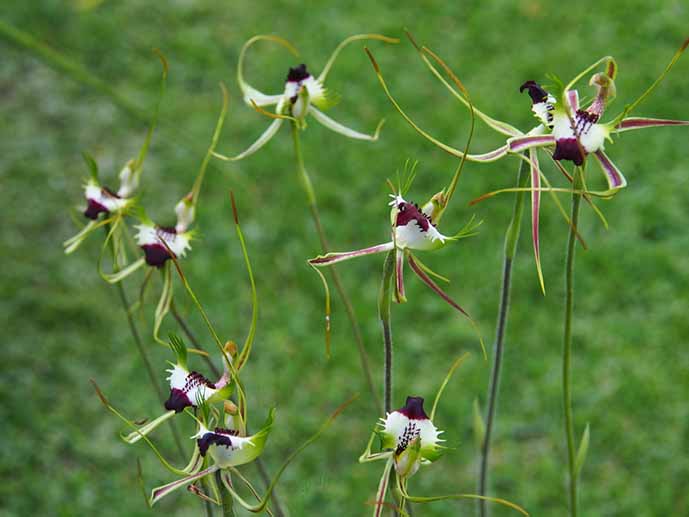
So, it currently belongs with Caladenia, a large genus with over 350 species (mainly in Australia). It is a genus with great morphological (visual) diversity – compare Caladenia tentaculata with C. cucullata or C. flava. But Caladenia
subgenera Caladenia (synonym Petalochilus*), as a much smaller segregate genus allows us to visualize a specific group within the Caladenia genus.

Caladenia flava Photographer Pauline Meyer

Caladenia sens. lat. are characterised by single hairy leaf, lacking lobes or serrations; hairy stem; showy flowers with similar sepals & petals. The labellum is highly modified consisting of three lobes with calli on the middle lobe.

Caladenia tentaculata (synonym Arachnorchis tentaculata) Photographer Jane Higgs

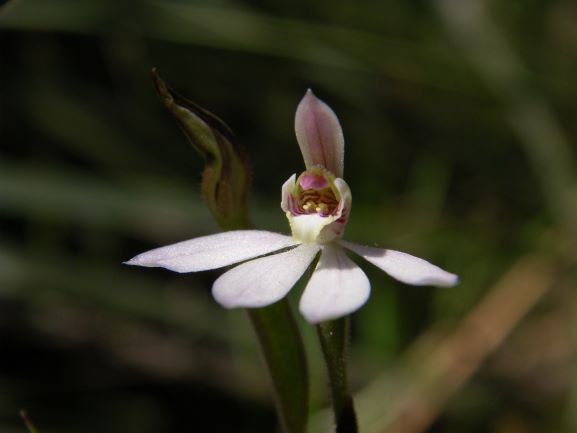
Petalochilus is further characterised by small (1 – 5 cm) pink to white flowers,
short broad forward projecting tepals; erect to slightly incurved dorsal sepal,
distinct trilobe labellum, hinged, with calli and red transverse bars, column
green to pink with red to purple bars.

Caladenia carnea (synonym Petalochilus carneus) Photographer: Rob Pauley

Yet within Petalochilus itself there can be further groupings of which P carneus is most likely the main one. This consists of at least 8 species – P carneus (C carnea), P catenatus (C catenata), P coactilis (C coactilis), P fuscatus (C fuscata), P ornatus (C ornata), P prolatus (C prolata) , P. vulgaris (C vulgaris) and P xantholeucus (C xantholeuca). When a specimen cannot be identified to species level, it may be helpful to refer to it as a complex.

This is where comes the fun of trying to identify the specific species in the field (or for that matter from a photograph). To help myself understand, I often produce comparison charts based on descriptions found in the literature. The chart comparing the eight species is available as a pdf.

Caladenia prolata (Petalochilus prolatus) Photographer: Helen Lawrence

*Throughout the article the synonym Petalochilus is used for Caladenia subgenera Caladenia to make a clear distinction from Caladenia sens lat. It needs
to be noted C carnea is considered the type specimen for Caladenia so with any splits, it will remain in Caladenia.

References

Backhouse G et al,Bush Gems: a guide to the Wild Orchids of Victoria 2016
Bates R B South Australia’s Native Orchids 2011
Clements MA, et al, Caladenia Revisited: Results of Molecular Phylogenetic Analyses of Caladeniinae Plastid and Nuclear Loci 2015
Jones DJ, A Complete Guide to Australian Orchids including it Territories and Islands 2006
https://en.wikipedia.org/wiki/Caladenia Accessed 3 August 2020
https://www.pacificbulbsociety.org/pbswiki/index.php/Petalochilus Accessed 3 August 2020

Thank you to Andrew Brown for reviewing this article.

South Australia’s Arachnorchis cardiochila

The following article, March Winning Photograph, is from Volume 44 no 4, May 2020 Native Orchid Society of South Australia Journal.

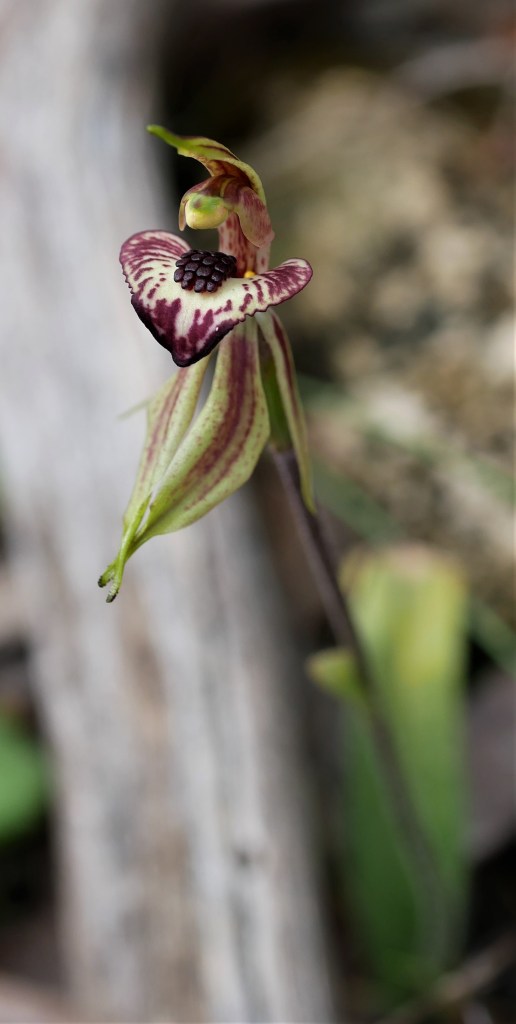
Pauline Myers’ Arachnorchis cardiochila was the winning picture. Synonyms for Arachnorchis cardiochila are Caladenia cardiochila, Phlebochilus cardiochilus and Caladenia tessellata. Common names include Heart Lipped Spider Orchid, Thick Lipped Spider Orchid, Fleshy Lipped Caladenia.

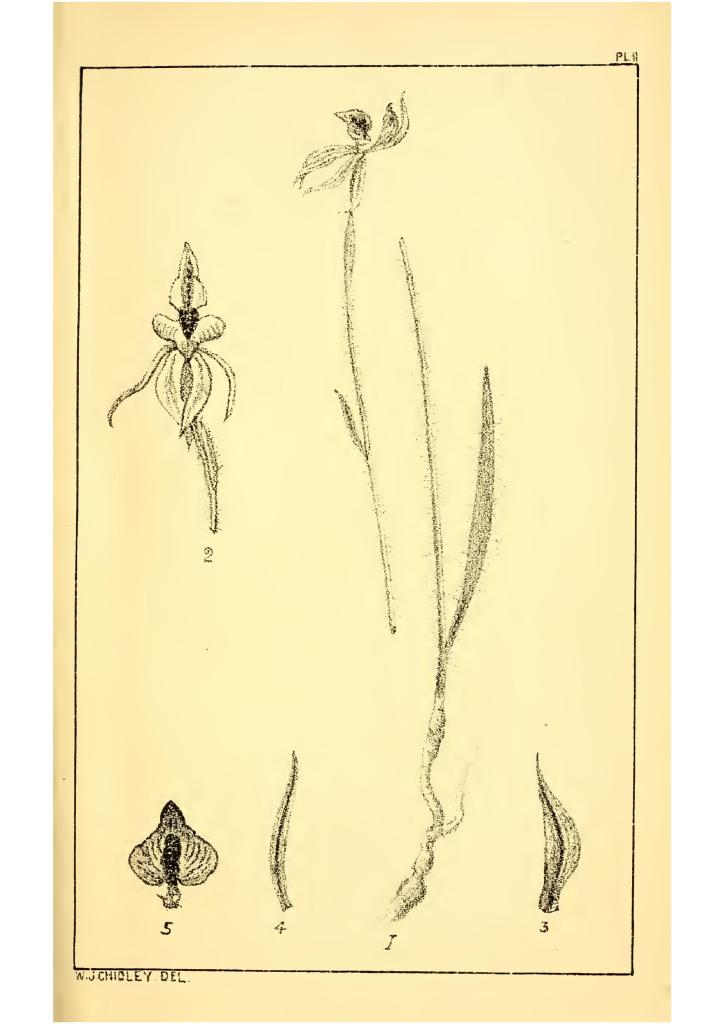
This species was named in 1886 by Professor Tate who presented it at the Royal Society of South australia at the October meeting. He did the original drawing.

The type specimen was collected at Golden Grove on October 2 1886 but it had also been collected much earlier (1865) at Barraba Scrub which is in the region of Mallalla.

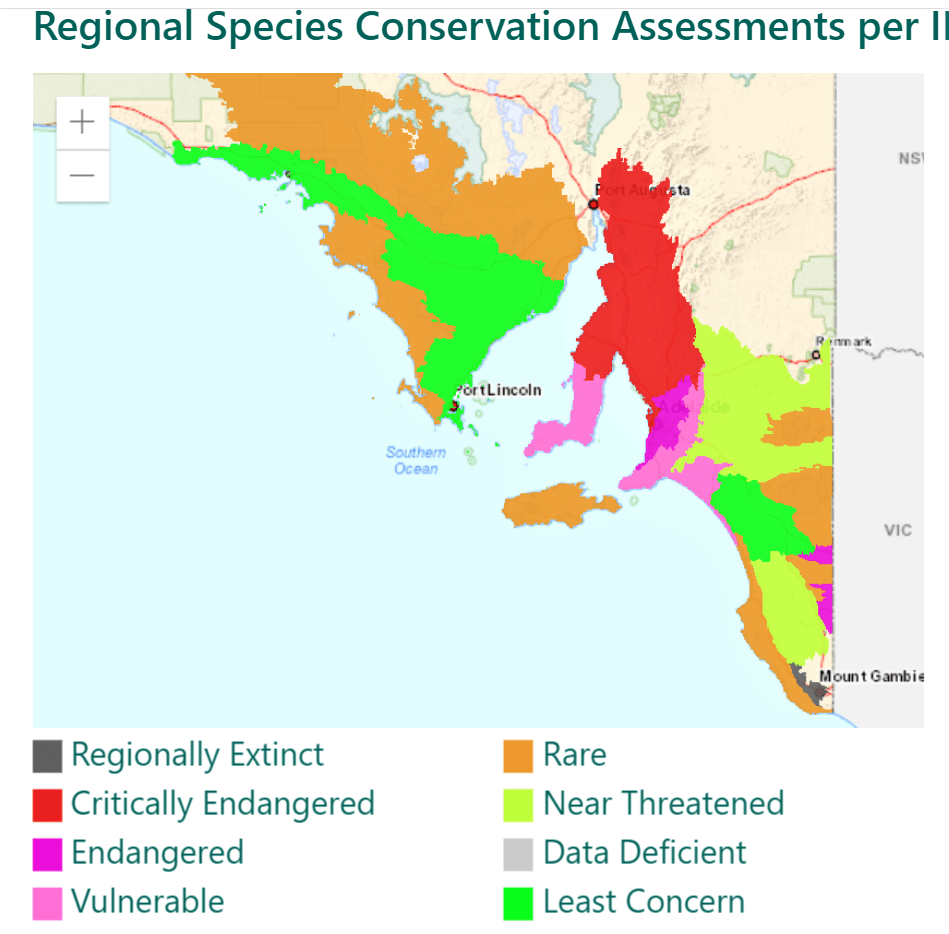
Its fate in both these areas has not been good; it is extinct in Golden Grove and critically endangered in the region containing Barabba Scrub. Although, it is considered to be a reasonably common orchid throughout its range in South Australia, Victoria and Southern New South Wales, there are areas of concern as seen the Seedbank of South Australia map below.

It should be noted that though Caladenia tessallata is listed as a synonym that this was used incorrectly, as C. tessallata is a separate but similar species found in the eastern states. Its main difference from C. cardiochila is that the edge of the labellum (lip) is toothed, not smooth as seen in Pauline’s photo.

End with the Pods #1

In 2011, Robert Lawrence wrote a book titled Start with the Leaves, a beginners guide to orchids and lillies of the Adelaide Hills. Bob Bates, editor of South Australia’s Native Orchid 2011, suggested that the next title should be End with the Pods. Well another field guide has not been written but following Bob’s suggestion, it might be interesting to see how far one can go with orchid identification based upon the pods, or finished seed capsules.

As most of the orchids for the Adelaide Hills and Fleurieu Peninsula have finished, it might be worth a look at some capsules found this year and see how far we can go with identification.

Here is the first one:
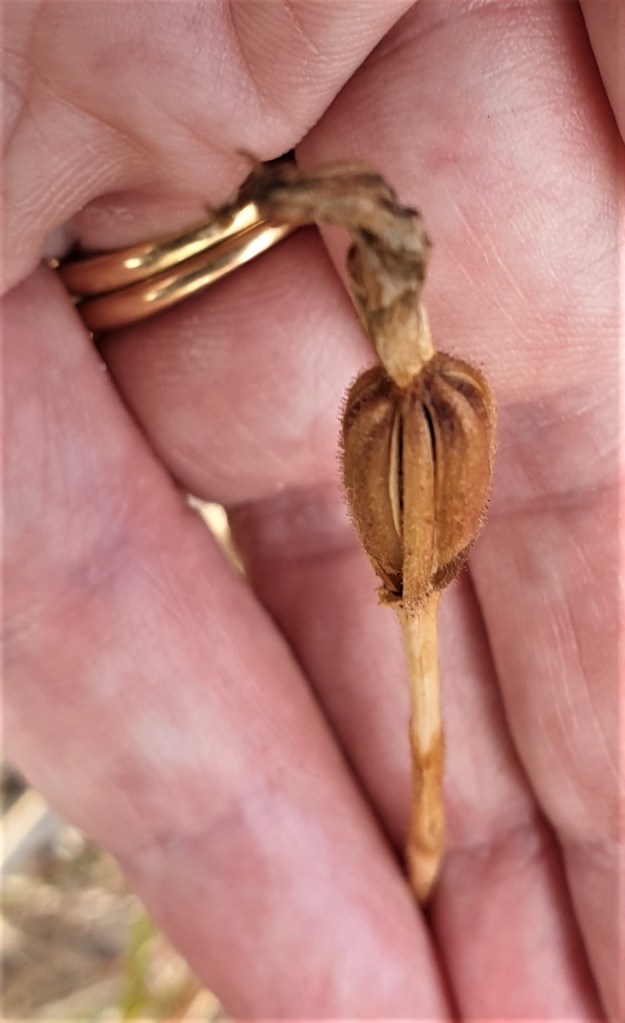
These pictures were taken on a mobile phone on the 30th November, 2019 on the Fleurieu Peninsula. There were several plants with single pods scattered across the park. The stems were reasonably tall (est 30cm) and surprisingly easy to spot.

The habitat is open forest consisting of Eucalyptus leucoxylon (Blue Gum), E. baxteri (Brown Stringybark) and E. fasciculosa (Pink Gum).

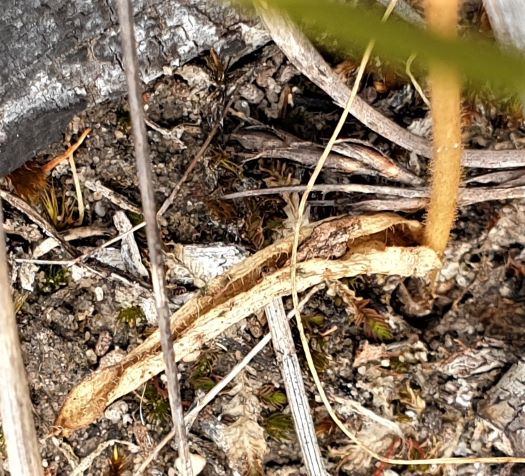
Seed pod
Senensced leaf of the same plant above

Is there enough information to identify this plant to species level?
Comment on what you think it is and why.

Caged For A Reason

Sadly many of our orchids are under threat of extinction.

Fortunately, conservationists and researchers are putting in a lot of effort in an attempt to save them. Part of this work consists of caging and tagging individual plants.

Most people do the right thing and do not disturb the cages/tags. Unfortunately some, hopefully mainly through lack of knowledge, do move them. Sadly, too many of them are being moved. Sometimes they are re-positioned but not always.

There are a good reasons for the individual plants to be tagged/caged. And there are good reasons for not moving either the tags or the cages.

Tags

Tags are usually numbered. These numbered tags are reference locations from which the distance and bearing of plants are measured. If the pin is moved the record for that individual plant is invalidated. Position of pins are used to determine if plants reappear in succeeding years.

Replacing the pins can also result in inadvertently spearing, and thus destroying, the tubers.

Cages

Cages are used to protect individual plants from grazing. Moving cages, even if returned, can result in damage to the plant, as well as damage to any emerging juvenile plants.

NOSSA & Conservation

One of the main activities of NOSSA is conservation. Many of our members assist in the work of monitoring, caging and tagging of plants. They know of the time and effort required for this work. They know why it is important not to move tags or cages, not even for taking photographs.

But we are aware that there are those who do not know and so would ask that others pass this message onto friends who may be unaware of the significance of cages/tags.

So simply put, “Cages & tags are not to be moved under any circumstances”.

Selecting Photographs for 2020 NOSSA Calendar

It’s time to vote again!

Following the success of 2019 NOSSA calendar, we are continuing with the same format of inviting people to vote for the twelve orchids that they would like to see in the 2020 calendar.

All the entries are South Australian orchids that were from the NOSSA monthly photograph competition.

To enter:

  •  Select the numbers corresponding to the twelve images that you would most like to see in your calendar
  • Email your twleve votes – nossa.enquiries@gmail.com (Subject Heading – Calendar)
  • Voting closes on Friday 9 August 2019

The results will be collated to determine the twelve most popular images that will go into the calendar. We plan to have the calendars available for purchase at the NOSSA Spring Show, September.

If you would like more details or see the images in a higher resolution, use the above email address to contact NOSSA.

These calendars make great gifts to those who love flowers and are greatly appreciated by orchid enthusiasts not connected to a club.

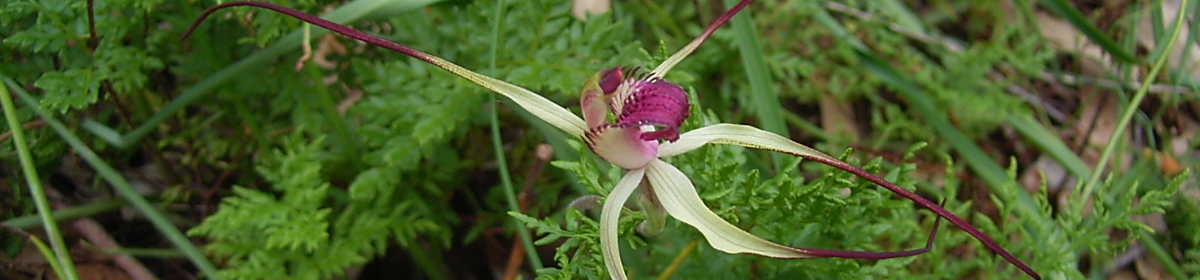
Caladenia plicata – April Winning Photograph

Shane Grave’s winning photograph for April was the spring flowering Caladenia plicata which is endemic to the South West of Western Australia.

Caladenia is a very large genus with over 330 species, 39 of these currently unnamed. In addition, there are 58 named subspecies and varieties. Caladenia plicata would belong under the subgenus Calonema or the segregate genus Arachnorchis which, although not generally recognised by State herbaria is commonly accepted by many amateur enthusiasts. Yet even this subdivision is still large with 192 species. As a result, some authors have created further groups/complexes, for example C. dilatata complex, C. longicauda complex, etc. However, according to Andrew Brown, C. plicata doesn’t seem to fit neatly into any of these categories, although David Jones does include it within the clubbed spider orchids.

Various authors consistently refer to the labellum as being unusual. In Fitzgerald’s formal description (1882) he states that the labellum tip is “recurved so as to become plicate and touch the under surface of the disc”. Plicate means to fold. The labellum tip of many other Arachnorchis species are known to curl under but none fold under in the way that this species does. The sharp fold with the spreading horizontal fringed margins (edges) combined with a central band of tall dense calli (wart-like structures) gives a distinctive shape reminiscence of a crab, hence the common name Crab Lipped Spider Orchid. The effect of this is best seen from a front, rather than a side, view.

The very mobile labellum is sufficient to identify this species, but it is also possible to identify when in bud “due to the prominent short osmophores (clubs) on the sepals”. The sepals narrow halfway along to form thick brown clubs and when the flower is open both the lateral sepals and petals are downswept. This is clearly seen in Shane’s photograph.

Finally, for those interested in pollination, it is pollinated by an undescribed male thynnine wasp of the genus Zeleboria. This has been captured on video https://ars.els-cdn.com/content/image/1-s2.0-S0960982217306310-mmc6.mp4


Thank you to Andrew Brown for assisting me with this article.

References:

Brown A, et al, Field Guide to the Orchids of Western Australia 2013

Brown A, personal communication

Caladenia accessed 24 May 2019

https://en.wikipedia.org/wiki/Caladenia

Caladenia plicata Wikipedia accessed 24 May 2019

https://en.wikipedia.org/wiki/Caladenia_plicata

Haiyang Xu et al Complex Sexual Deception in an Orchid Is Achieved by Co-opting Two Independent Biosynthetic Pathways for Pollinator Attraction 2017

https://www.sciencedirect.com/science/article/pii/S0960982217306310

Jones DL, A Complete Guide to Native Orchids of Australia including the Island Territories 2006

Jones DL, et al, Australian Orchid Genera CD-ROM 2008 CSIRO accessed 24 May 2019

https://www.anbg.gov.au/cpbr/cd-keys/orchidkey/html/genera/Arachnorchis.htm

Pelloe, EH, West Australian Orchids 1930

http://gutenberg.net.au/ebooks04/0400681h.html#page50

Orchids of South-West Australia website

http://chookman.id.au/wp_orchids/?page_id=2424


Australian Orchids: The How, Where, When & Why

It’s been a little while in coming, but here is the second of a three part educational video about Australian Orchids.

Orchids are special.

They are unique but even more they are important. Orchids are the barometer to the health of the ecosystem.

So, watch and enjoy the video …

To watch the first video click here.