A general medical practitioner in Ipswich and Warwick (Queensland) and, after 1862, in Germany; in 1860, he travelled with the Burke and Wills expedition as a doctor–botanist and expeditioner in Victoria and New South Wales.
In the NOSSA Constitution (2007) the aims of NOSSA “are to promote and engage in activities for the promotion and furtherance of :
the culture, propagation, conservation, knowledge and scientific study of the native orchids of southern Australia and the Australasian region;
the preservation of orchids as a species and their preservation within their native habitat.”
The article following is about one of the ongoing conservation activities with which NOSSA members were and are currently involved. Quoted verbatim from SA Veg on the Edge, Vol 7, No. 1, 2007
Recovery Plan for 12 Threatened Orchids in the Lofty Block Region released
Since 1998, the Lofty Block Threatened Orchid Recovery Project (LBTORP) has been implementing recovery actions for threatened orchids in the Lofty Block region of SA. In late 2006, a draft recovery plan was completed for the following twelve species:
C. behrii(Pink-lipped Spider-orchid) – ENDANGERED (EPBC Act)
C. gladiolata(Bayonet Spider-orchid) – ENDANGERED (EPBC Act)
C. sp. ‘Brentwood’ (Ghost Spider-orchid) – Nominated as CRITICALLY ENDANGERED (EPBC Act)
C. macroclavia(Large-club Spider-orchid) – ENDANGERED (EPBC Act)
C. rigida(White Spider-orchid) – EPBC Act – ENDANGERED (EPBC Act)
C. woolcockiorum(Woolcock’s Spider-orchid) – VULNERABLE (EPBC Act)
C. xantholeuca(Flinders Ranges Spider-orchid) – ENDANGERED (EPBC Act)
Pterostylis bryophila(Hindmarsh Valley Greenhood) – CRITICALLY ENDANGERED (EPBC Act)
P. cucullata(Leafy Greenhood) – VULNERABLE (EPBC Act)
P. despectans(Lowly Greenhood) – ENDANGERED (EPBC Act)
P. sp. ‘Halbury’ (Halbury Greenhood) – ENDANGERED (EPBC Act)
The recovery plan describes each of these twelve species in detail including their morphology, distribution, population size, habitat, and ecology. Importantly, it also outlines the threats to each species and prescribes recovery objectives, targets, and actions for the next five years.
Determine population size and trends
Determine current extent of occurrence and number of sub-populations
Mitigate threats to sub-populations.
Recovery actions will be implemented for each of the twelve species in accordance with the recovery plan over the next five years by the LBTORP. Community involvement is recognised as a key factor in the successful delivery of on-ground recovery actions.
Fact sheets and a webpage that provide up to date information on the program were recently completed … Joe Quarmby, Lofty Block Threatened Orchid Recovery Project Officer , SA DEH
(NB Joe Quramby now is theThreatened Flora Ecologist Natural Resources, Adelaide & Mount Lofty Ranges Partnerships and Stewardship and DEH is now Department of Environment, Water and Natural Resources, 2014)
The article may be seven years old but it is a good overview of some of the conservation work that NOSSA members have done with Joe Quarmby.
South Australia has some very interesting and unique orchids but it is not always possible see them either because one cannot get out to see them or the season has been poor with inadequate rain at the right time. So, one of NOSSA’s member has produced a video. It starts in autumn and goes through to summer.
October is Orchid Month with the greatest number of species flowering throughout South Australia; so it is worth considering the role of orchids in the Australian bushland. Hence this week’s blog is an article written by Belinda Newman, Western Australia.
Orchids: The Canary in the Coal Mine was published in the Friends of Kings Park magazine For Plants and People, Issue 70 p 22-24, 2010. The article is both a good introduction to, and summary of, her 2009 thesis Orchids as Indicators of Ecosystem Health in Urban Bushland Fragments
Orchids: The Canary in the Coal Mine
Belinda Newman – Research Scientist BGPA
What could orchids and canaries possibly have in common?
Before occupational health and safety and ventilation systems were commonplace in the mining industry, a caged canary would be bought down to the coal seam by the miners. Canaries are particularly sensitive to methane and carbon dioxide which made them excellent indicators for the build-up of dangerous gases. A singing canary meant everything was fine, a dead canary spelt trouble and an immediate evacuation.
Although orchids can’t sing, they do possess a number of traits that make them sensitive ecological indicators. The relationships that orchids have with their surroundings form part of a complex ecological web. Orchids have specific relationships with mycorrhizal fungi, which they require both for germination of their dust-like seed and ongoing growth of plants in adulthood. These fungi in turn rely on the appropriate soil moisture content and carbon sources. Above ground, the majority of terrestrial orchids in the south west of Western Australia rely on pollinators for successful seed set. For some orchids this plant-pollinator relationship has become so highly evolved that removal of the pollinator would spell the end of the orchid. The pollinators also have specific requirements for habitat, appropriate food sources and nesting sites. These above and below ground links to the ecosystem make orchids particularly sensitive to disturbances and changes in their surroundings.
The potential for orchids to be used as indicators of ecosystem health formed the basis of a study between Kings Park and Botanic Gardens and Murdoch University. The coal seam was eleven urban reserves of varying condition on the Swan Coastal Plain. The canaries were seven orchids common to Perth’s urban bushlands; the Carousel spider (Caladenia arenicola), Cowslip orchid (Caladenia flava), Pink Fairy orchid (Caladenia laitfolia), Pansy orchid (Diuris magnifica), Dark Banded Greenhood (Pteryostylis sanguinea), Purple Enamel Orchid (Elythranthera brunonis) and the Mignonette orchid (Microtis media). Before it was possible to see which orchids made the best canaries, it was important to determine the health of each of the bushland sites. A number of environmental variables were chosen that best reflected the health of the ecosystems. Extensive surveys and analysis of species composition, plant functional groups against these environmental variables revealed a range of site conditions from close to pristine to highly degraded. This provided the backdrop against which to determine the effectiveness of orchids as indicators through the measured responses of the orchid species.
Firstly orchid presence and abundance was measured across sites to determine if particular orchid species showed a preference for particular site conditions. Diuris magnifica and Microtis media showed strong correlations and were most abundant in poor condition sites and Pteryostylis sanguinea showed strong correlations to sites in good condition. While the abundance and presence of orchids appeared to correlate with site condition, we wanted to know what other aspects of the orchid we could measure as a means of judging the health of an ecosystem.
Successful seed set in plants reflects a healthy ecosystem and the reproductive success of the seven orchid species was investigated to determine the effects of declining site condition on seed set. Pollination trials were set up to measure natural and artificial pollination events across all sites. Widespread depression in pollination across all species and sites was found to be occurring, rendering seed set a poor measure of ecosystem health.
Investigations into the below-ground links orchids have with the ecosystem were undertaken by determining the presence and abundance of orchid mycorrhizal for the seven orchid study species across all sites. Mycorrhizal distribution was found to be patchy within urban reserves and also revealed unoccupied niches capable of supporting orchid germination. A greater abundance of Microtis media mycorrhizal at sites of poor condition supported earlier correlations of plant abundance at sites of poor condition. The higher abundance of mycorrhizal symbionts for Caladenia arenicola at sites of very good condition also suggests its potential as an indicator species.
The study also looked at seedling growth in urban reserves. This was the first time that biomass allocation in orchids has been investigated in light of ecosystem health. In poor condition sites, Diuris magnifica and Caladenia arenicola increased growth effort to the above ground leaf. In sites of very good condition, these two species increased growth to the tuber to take advantage of being able to store starch as a result of both fungal and photosynthetic activity taking place. Most importantly this shows a measurable change over a short period time. Although it is effort intensive, planting orchid seedlings of a standardised size into the field may provide a useful and rapid measure of ecosystem health, much like caged canaries were used in the past.
This research into using orchids as an indicator species is the first of its kind and suggests that orchids can be used as an indicator of ecosystem health. Future research will need to focus on the thresholds of the species identified as potential indicators in this study. What aspect of the orchid’s ecology will give clear and repeatable data linked to ecosystem health? Following the canary analogy, how long can orchids hold their breath? Future studies would need to focus on testing these thresholds. The results of this study suggest that orchid presence and abundance, orchid growth and orchid symbionts can be used as indicators of ecosystem health, although work needs to be undertaken to refine the understanding of their response to specific disturbances. This study provides a baseline for investigating the utility of orchids as indicators of ecosystem health in highly fragmented systems. Perhaps orchids and canaries have more in common than first thought.
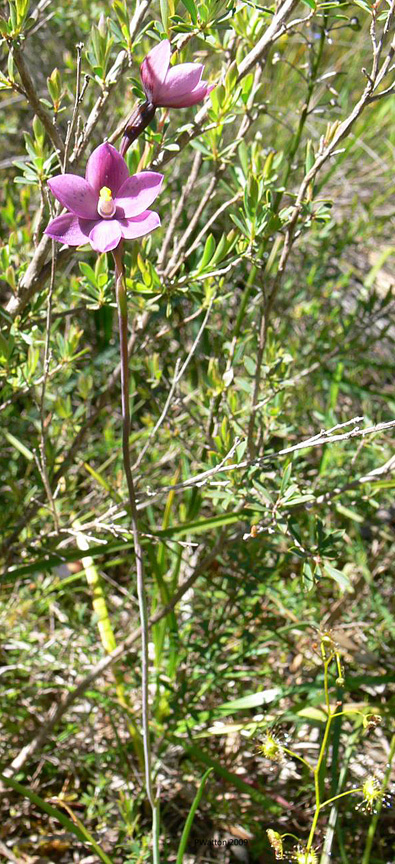
This week, a local radio station introduced a segment with the phrase “our rarest sun orchid” and that it was called Thelymitra irregularis or Spotted Pink Sun Orchid. However it certainly is not our rarest sun orchid.
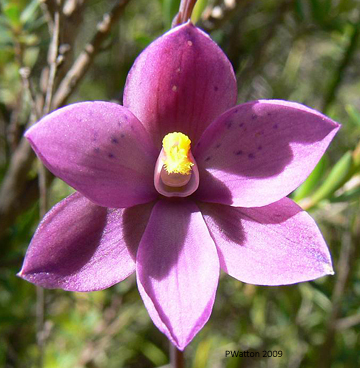
Thelymitra x irregularis, Peter Watton, 2009
True, it is not common, but that is partly because it is a hybrid and, correctly speaking, the name should be written as Thelymitra x irregularis (the “x” indicates that it is a hybrid).
For a hybrid to occur, the two parent species need to grow in close proximity, the flowers need to open at the same time that the pollinator is visiting flowers, either to collect or to deposit the pollen and, in the case of self pollinating species, before the individual flower has pollinated itself.
The majority of hybrids are sterile, but occasionally some are fertile. When hybrids occur the majority will only last a few years before disappearing although sometimes colonies are formed which may last for decades. Hence, it is not usual to name hybrids, but the more common and recurring ones have been named formally. T. x irregularis is one of them.
Several species of Thelymitra have been proposed as parent species of Thelymitra x irregularis. Jeanes & Backhouse (2006) give T. ixioides and T. carnea as parents; Weber & Entwisle (1996) and Jones (2006) suggest T. ixioides and T. carnea and/or T. rubra; Bates & Weber (1990) state that in South Australia the parents are T. ixioides and T. rubra, but T. ixioides and T. carnea in the Eastern states; in contrast, Bates (2011) states that in South Australia it is a hybrid between T. juncifolia and T. rubra. However, without detailed genetic studies or breeding experiments these all remain suggestions.
Due to the transient nature of hybrids and the conditions needed to produce them, the named hybrids are not common, but since the 1890s specimens of Thelymitra x irregularis have been collected in every decade, which suggest that this hybrid readily occurs. The 71 specimens held in the Australian herbaria have been collected from four states – which gives a good indication of the distribution but not necessarily the frequency of occurrence. See Australia’s Virtual Herbarium (AVH) for details. The AVH lists 12 herbarium records for South Australia with specimens collected from the Adelaide Hills, the Barossa Valley, Kangaroo Island and near Naracoorte.
This Thelymitra x irregularis or Pink Spotted Sun Orchid was photographed by Peter Watton in 2009 near Macclesfield, South Australia
The botanical name “irregularis” refers to the description of the column. With many sun orchids, it is often necessary to observe the column to distinguish one species from another. In this instance the top of the column is irregularly toothed. Retired Aussie has some very good photographs with one in particular showing the column detail.
Thanks to Juergan Kellermann, State Herbarium of South Australia for his help with this post.
References
Bates (2011). South Australia’s Native Orchids. DVD-ROM
Bates & Weber (1990). Orchids of South Australia.
Jeanes & Backhouse. Wild Orchids of Victoria, Australia
Jones (2006), Native Orchids of Australia, 2nd edn.
An important first lesson to learn when out orchid hunting is to watch where you put your feet. In this video the Orchid Hunter explains the how and why for watching where you step.
“So fair, so sweet withal so sensitive, Would that the little flowers were born to live, Conscious of half the pleasure which they give”
I found this quote of Samuel Taylor Coleridge in A Collection of Australian Wildflower Illustrations by Patricia Weare 1984. The only text for the painting’s section were for identification but at the end of the Orchid section there was this one poem. It was appropriately placed as one could easily substitute the word orchids for flowers.
“So fair, so sweet withal so sensitive, Would that the little orchids were born to live, Conscious of half the pleasure which they give”
The exquisite paintings of Patricia Weare combined with this quote do homage to these dainty plants of our Australian bush. It is a reminder that though at times it can be seen as harsh, there is in these jewels a hidden delicateness and gentleness of the bushland.
Petite point work showcasing the delicacy of our South Australian Orchids; worked by Lorraine Badger; Design by Jan Woodman from her book ‘Australian Wildflowers for Embroiderers’



 NOSSA
NOSSA 