2014 November Photograph Competition Part 2

Part Two of the November competition consisted of photographs of insects on orchids. There was quite a range of insects but the winner was a draw between Cyrtostylis robusta (Winter Gnat Orchid) with an ant and Pterostylis curta (Blunt Greenhood) with a midge fly; both taken by Doug Castle.

With today’s technology it is not only easier to take crisp images but fine details can be seen particularly when enlarging the image. Hence when the pictures are enlarged it is possible to see hairs on the ant and feathered antennae on the midge fly.

With identifying orchids, it is often the detail that is important. Both of these orchids are distinctive and can be readily identified but it is good to examine why this is the case.

Pterostylis curta (Blunt Greenhood)

With the greenhood, there is enough detail to see that the dorsal sepal and lateral petals have united to form a galea, ie hood, and that the lateral sepals are semi-fused and erect resulting in lateral orifices (side gap) between the two structures. These are some of the features that separate Pterostylis* from the other greenhoods such as Diplodium, Speculantha and Taurantha. This becomes apparent when browsing through the greenhood photographs, pages 286 to 339, in Jones “A Complete Guide to Native Orchids of Australia”. Having established that the plant is a Pterostylis, the twisted labellum is diagnostic of a P. curta as it is the only one that is described with a twisted labellum. Although not all the identifying features are present, enough information is available in this picture for identification.

In contrast the photograph of the Cyrtostylis robusta only has sufficient data to confidently identify it as a Cyrtostylis species, having a distinctive labellum that is larger than the lateral sepals and petals. In South Australia there are only two species and according to Bates (2011), the distinguishing features between the two

Cyrtostylis robusta (Winter Gnat Orchid)

appear to be the leaf, the bud and the labellum. In this picture, the angle of the image does not give a clear view of the labellum (it could possibly be damaged) and of course there is no bud or leaf. It is possible that the pale edges of the dorsal sepal may give a clue to species identification as C. reniformis has mainly darker buds than C. robusta. Obviously Doug was able to identify it from his observations of the other features not present in this photograph.

In summary, one image is not always sufficient for identification. As was discussed on the night, to confirm identification, orchids should always be photographed from more than one angle, including pictures of other parts of the plant.

*In South Australia, Pterostylis foliata is a possible exception as it has no obvious lateral orifice.

References

Jones, D.L., T. Hopley, S.M. Duffy, K.J. Richards, M.A. Clements & X. Zhang (2006) Australian orchid genera. An information and identification system. CSIRO Publishing: Collingwood, Vic.

Bates, R.J. (2011) South Australia’s Native Orchids. DVD-ROM. Native Orchid Society of South Australia Inc.: Adelaide.

Jones, D.L. (2006) A complete guide to native orchids of Australia, including the island territories. New Holland Publishers: Sydney.

2014 November Photograph Competition Part 1

11 sm CD Arachnorchis sp with hover fly

With a theme of Orchids and Insects for the November meeting it was hoped that there would be some entries with pollinators and therefore there would be two categories Insect Visitors and Pollinators. This month’s article will feature the Pollinator section and Insect Visitors in the next month.

In all there were four potential pollinator photographs. The insects were either scrounging around at the base of the column or else they had the pollinia attached to them. Unfortunately only one was a true pollinator so the category became Insects with Pollinia. The winning photograph of Arachnorchis brumalis with an unidentified hoverfly was taken by Chris Davey. Interestingly the other two pictures also featured Arachnorchis species with the hover fly Simosyrphus grandicornis. Resembling a wasp but minus the sting, this species is one of the common hover flies native to Australia.

Called Hover Flies owing to their ability to hover motionless in one spot, they are also known as Flower Flies because they are often found hovering around as well as pollinating flowers. It is not surprising, therefore, to find them around orchids. Yet instead of being called pollinators they are non-pollinators (Bates & Weber 1990). They visit the orchids, forage inside the flower and may even manage to collect some pollinia but that is all. They may not necessarily visit another flower of the same species but if they do, they will fail to deliver the pollinia to the stigma2.

Rudie Kuiter agrees with Bates that hover flies are not orchid pollinators but just when we think we have worked it out he adds “but we have at least one orchid in Victoria that is pollinated by hoverflies and witnessed now several times and this is Caladenia catenata” (synonym Petalochilus catenatus). Notwithstanding the case for this species, it would appear that in most cases hoverflies remove pollinia so that it is not available to a more specific pollinator.

Why then are the hover flies attracted to the orchids? Is it for food? An internet image search revealed that hover flies visit the flowers of many different genera including Thelymitra and Diuris. This is interesting because flowers are the food source for hover flies but though many orchids promise food, many species do not produce the nectar and pollen (as a food source) that they desire. Diuris and Thelymitra belong to this group of non-nectar producing flower. Other orchids that don’t produce nectar include Gastrodia, Dipodium and the Duck orchids. Again, there are orchids such as Crytostylis which produce minimal nectar and with Prasophyllum the nectar is hidden in cells that require puncturing – not a good food source!

Having discussed hover flies as non-pollinators, in this month’s competition, which photograph had a pollinator? – It came last and was Robert Lawrence’s photograph of a native bee on a Dipodium pardalinum, another non-nectar producing orchid. The story of this photograph was featured in Photographing Orchid Pollinators, April 2014 Journal as well as in a previous blog on Photographing Pollinators.

References:

Smith James, Information Centre, South Australian Museum, personal communications

Kuiter Rudie personal communications

Bates and Weber, Orchids of South Australia, 1990

Australian Museum, http://australianmuseum.net.au/Hover-flies Accessed 4th December 2014

Brown, et al, Field Guide to the Orchids of Western Australia, 2013

Jones, Native Orchids of Australia Including the Island Territories, 2006

Bates, South Australia’s Native Orchids 2011 DVD-ROM

Martin, The Vocabulary of Orchids: An Amateur’s Perspective, 2005

1Pollinia is basically a coherent compact mass of pollen that allows the pollen to be transported as a single unit

2The stigma is a sticky depression (or swelling) at the front of the column, the receiving surface for the pollinia that is necessary for germination.

October 2014 Winning Photograph

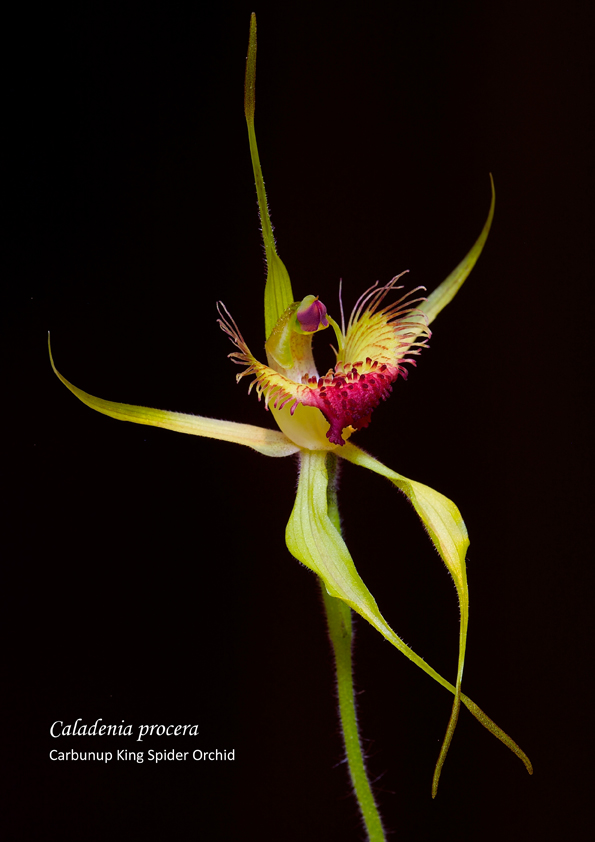
 Caladenia procera

This month’s entries of Oligochaetochilus arenicola, Caladenia flava, Calochilus robertsonii , Diuris palustris and Caladenia procera illustrated the variety of shapes to be found in orchids.

All but one are reasonably common; all but one were photographed in situ and that one was the winning picture by Kris Kopicki – Caladenia procera. Its common name, Carbunup King Spider Orchid, reflects its location near Busselton Western Australia. This species has a severely limited distribution with a small population and is threatened by land clearing for development. Consequently it is rated as critically endangered.

The other aspect of this plant is that it is a photograph of a plant in a pot not the bush. Kris benched the original plant at the September Tuesday meeting when it was still in bud. By Saturday it was in glorious flower.

This picture exemplifies the two objects of NOSSA which “are to promote and engage in activities for the promotion and furtherance of:

  1. the culture, propagation, conservation, knowledge and scientific study of the native orchids of Southern Australia and the Australasian region;
  2. the preservation of orchids as a species and their preservation within their native habitat.”

Some terrestrial orchids are relatively easy to grow but not this one. It takes time patience and skill to grow them. C procera is one of the fungi dependent species and though capable of living many years, it can take up to six years before flowering, although under ideal condition it could mature in as little as two years.

Being able to grow the different terrestrial orchids is one of the ways NOSSA can help in their conservation. NOSSA has a Growers’ Forum each meeting night where members can attend and learn from experienced growers how to grow both epiphytes and, importantly, the terrestrials.

Reference:

Native Orchid Society of South Australia Inc. (NOSSA) Rules of Association 2007

Caladenia procera – Carbunup King Spider, Orchid Species Profile and Threats Database (SPRAT) – http://www.environment.gov.au/cgi-bin/sprat/public/publicspecies.pl?taxon_id=68679 – access 6th November 2014

Remember November’s theme is Orchids and Insects (Spiders and other critters accepted as Honorary Insects)

PHOTOGRAPHING ORCHID POLLINATORS

The theme for the November Photograph Competition will be Orchids and Insects (spiders and other similar small critters will be honorary insects).  The April Journal of the Native Orchid Society of South Australia Vol 38 No3 had an article on how to photograph pollinators which is reprinted here below along with some pictures of orchid pollinators.


For most of us trying to photograph a pollinator is a hit or miss event.

Back in 2007 when Robert and I were still fairly new members, Bob Bates suggested we visit Talisker to photograph Dipodium – “and while you are there, photograph a bee pollinator” and “It has to be this weekend, or you will miss it” – from me “What is a bee pollinator?” So on a hot January day, the family spent the morning at Talisker. Robert busily photographing every Dipodium he saw. By early afternoon, the children were hot and tired but Robert wanted another half an hour. After more than a hundred photographs and in that last half hour Robert spotted a bee on one of the flowers only to have it disappear when it heard the shutter sound of the camera. Fortunately when we looked at the picture it showed the pollinia of the D. pardalinum on the head of a native bee – we had our bee pollinator!

Native Bee taking pollinium from Dipodium pardalinum (Spotted Hyacinth Orchid)

The lesson we learnt from that day was to turn the shutter sound off.

Talking to Rudie Kuiter and reading his book Orchid Pollinators of Victoria 2nd edition 2013, the other factors contributing to our success were:

  • a hot day,
  • flowers in the sun
  • after lunch

This is when the bee pollinator is most likely to be active, see page 110. Although, Rudie’s book is a compilation of his observations for specific Victorian species, there are many clues to help us successfully photograph pollinators; of which follows (direct quotes from his book are in quotation marks):

  • His most important point is observation.
    • “Working out how and when to catch the insects in the act of pollination is a question of finding the right flowers and figuring out about the insect’s likely visiting times. To observe the action means watching the plants for many hours and have some idea when the creatures are flying.” (Page 110)
    • “Temperature and air movement play a major role in the pollination processes. On windy days the pollinator is usually not active, whilst temperatures effect (sic) the flying ability of the insects and controls the scent produced by the orchids.” (Page 110)
  • Cryptostylis
    • His notes infer searching before 10 am. (Page 2) 
  • Thynniid Wasps
    • Most species become active when temperatures rise above 16⁰ C. Look for freshly opened flowers or visible pollinia. Check either the day before or in the morning. Several cool days preceding a warm day are more likely to aid success. (Page 10)
  • Green combed spider orchid
    • The best time seems to be a short period of not more than 30 minutes in the early morning between 10 and 11 am. In summer, the temperature can be a few degrees higher than the 16⁰ C of spring before the wasps are active. Also see note above for wasps. (Page 17)
  • Mictotis sp
    • “pollinators are rarely seen or photographed ….” (Page 54)
  • Acianthus
    • As temperature rises, the labellum develops a glossy surface which attracts the pollinator. Whilst still warm after dark, the pollinator remains active, suggesting at nocturnal pollination. See also Page 59. (Page 110)
  • Cyrtostylis
    • “The fungus gnats were usually seen during late mornings when temperatures rose above 11⁰ C.” (Page 64)
  • Gastrodia
    • “The smell becomes strongest above about 25⁰ C.” (Page 76)
  • Calochilus
    • “seems the wasp is only seen on the orchids when temperatures reach about 27⁰ or more.” (Page 79)
  • Thelymitra
    • “I watched a large number of Thelymitra peniculata on a very hot day in early November. It was coolish early in the morning and warming quickly. Flowers were still closed at 10 am, and by 11 am most were open. As a flower was about to open, one could wait for a small bee to arrive. It seemed every flower was visited within a few minutes.” (Page 80)
  • Dipodium spp
    • “One has to be very patient to wait for bees on these flowers. I’ve found a very hot day was best to see bees showing an interest.” (Page 84)
  • Pterostylis nutans
    • Pollinators are seen in the early afternoon when mid-day temperatures are 12⁰ C or more and the flowers are in the sun. (Page 94)
    • Pollinators are attracted to the fresh flowers and pollination takes place within half an hour of insects flying. Once inside the flower it may take 6 – 12 minutes before they are ready to leave. (Page 110)
  • Spiranthes australis
    • Requires temperatures of about 29⁰ C but need to be photographed from a distance as pollinators may be easily disturbed. (Page 106) 
  • When looking for pollinators and wanting to get close, insect repellents should not be used and also strong perfumes may be a problem as most insects are touchy to approach.

In summary, the most likely time to photograph pollinators is when they are most active, when:

  • There is a warm day following a few cooler days.
  • Day time temperature has risen (relative to the season), ie late morning to early afternoon but there are exceptions.
  • Flowers are freshly opened.
  • Flowers are in sun, not shade.
  • There is no wind.

Photographing pollinators takes planning, observation and patience but it is well worth the effort.

Rudie Kuiter’s book is available for loan from the NOSSA library.

Special thanks to Rudie for taking the time to read through and respond to this article.

Thank you to Rudie for allowing us to use two of his photographs showing pollinators.

NB The genus Genoplesium has also been known as Corunastylis.

Pollinator and Corunastylis archeri
Notice the yellow pollinia sacks, containing the pollen, on the head of the small vinegar fly. The orchid is Genoplesium archeri.
Corunastylis sp. Intermediate Billiat Conservation Park Photo: Rob Bates
Corunastylis sp. Intermediate
Billiat Conservation Park
Photo: Rob Bates
Pollinator and Corunastylis morris
The flowers of Genoplesium morris are only about 7 or 8 mm, but the pollinator is much smaller.

2014 September Winning Photograph

The winning picture was a single flower of Thelymitra epipactoides (Metallic Sun Orchid) taken by Rosalie Lawrence. This picture was cropped from a photograph taken on a mobile phone. Phones have come a long way since the days of Alexander Graham Bell!

Thelymitral epipactoides or Metallic Sun Orchid

T. epipactoides is a special orchid both in its beautiful colourings and that it is one of our rarest orchids. This endangered species has been well studied in an effort to prevent its demise with the result that there is an abundance of information about it. Recently, with the knowledge gained, Dr Nouska Reiter of the Australian Network for Plant Conservation (ANPC) and her team have managed to cultivate 3,000 plants with the plan to re-introduce them back into the bush in the Wimmera area.

Following are some interesting points from two good sources, which are the

  1. Biodiversity Information Resources Data page  (quotes in blue)
  2. Species Profile and Threats Database page  (quotes in brown)


Life Cycle

  • (2)……can remain dormant as a tuber in the soil for up to nine years ……….

(But once a plant has flowered)

  • (2)…….Plants can produce flowers from their second year of growth onwards for up to four consecutive years, but no more. Individual plants can remain dormant for up to two years then grow to produce flowers, but if dormant for four years or more, plants generally do not reappear. …..
  • (2)…… Detailed monitoring suggests that mature plants only live for about 10 years before dying (Cropper 1993). ……..
  • (2)……..flowers open when the relative humidity is lower than 52%, air temperature is above 15 °C, and there are clear skies ………….
  • (2)……..Flowers remain for up to four weeks but wither a week after pollination ……
  • (2)……. fungus is required to initiate successful seed germination (Calder et al. 1989) and seeds cannot survive more than two weeks without associating with the fungus ………

Plant Information

  • (1)…….Flower colour is highly variable, brown, copper, blue and green being the main colour groups which are determined by the proportion of red, blue and green epidermal cells, some of which are reflective giving a metallic appearance. …….
  • (2)….The leaf is loosely sheathing ………
  • (2)…Mature non-flowering plants have slightly narrower leaves to 51 cm long and not sheathing …
  • (1)………Flower colour is highly variable, brown, copper, blue and green being the main colour groups which are determined by the proportion of red, blue and green epidermal cells, some of which are reflective giving a metallic appearance. ………

Topography:

  • (2)…. is undulating plains, crests of hills, gentle slopes of low broad ridges and at the bottom of broad, shallow swales (Obst 2005). It grows in sandy soils over a clay subsoil, with these soils having a tendency to become waterlogged in winter and spring, and drying out in summer and autumn ……
  • (2)…..This species is a post-disturbance coloniser, utilising early successional stages after disturbance events such as human activities, fire, animal activities such as scratching of the soil, or associated vegetation disturbance. ……
  • (2)……..requires open sites for flowering and seedling recruitment (Calder et al. 1989). ………

Population Size

  • (1)……Population estimates vary from about 1050 plants in Australia (DEH 2006), to less than 3,000 plants (Coats et al 2002). More recent assessments suggest the population could be less than 1500 plants in the wild …….
  • (2)……In the Murray Darling Basin and South East Regions of South Australia there were ten populations of the Metallic Sun-orchid recorded in 2004 by Obst ……..


Reminder – November theme is Orchids and Insects (Spiders and other such critters are honorary insects)

August 2014 Winning Photograph

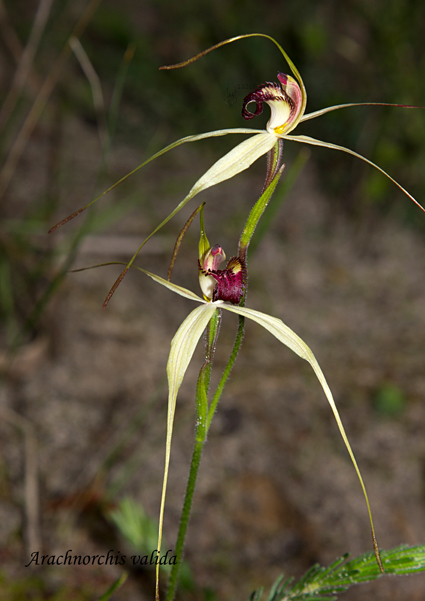
08 sm CC Caladenia valida

Claire Chesson’s Arachnorchis valida (common name Robust Spider Orchid) was the winning photograph for August.

The name Arachnorchis valida was not validated until 2002; synonym Caladenia valida. Previously it had been included under Caladenia huegelii (a Western Australian species) and Caladenia reticulata.

A. valida grows in sandy or sand over red clay soil, in sheltered clearings within heathy woodland or mallee but within a very restricted and disjunct distribution on Fleurieu Peninsula and Kangaroo Island in South Australia; and Otway Plain, Victoria. Rated Endangered in South Australia, it is not listed nationally.

Although A. valida shares some similar features with A. reticulata (ie 1 to 2 flowers, clubbed sepals, calli on the labellum) it also has quite distinctive features (see chart below) that help to differentiate between the two as they can sometimes be found growing together.

Comparison of A. valida and A. reticulata

Features

A. valida

A. reticulata

Pollinating wasp Phymatothynnus pygidialis Phymatothynnus victor
Leaf Felted Leaf – dense, short hairsSemi erect Very long silky hairs; purplish at the baseErect
Flower Stem Taller – 40 cm, hairy 30 cm, green & purplish red with long silky hairs
Flower Size Though variable, larger – 7 cm 5 cm
Flower Greenish when first opened fading to white or cream as the flower matures Red-brown
Perianth Stiffly spreading – broad based sepals; backswept petalsNo stripes Dorsal sepal erect; perianth spreading downwardRed stripes
Labellum Can be red but without veining Red with veining


NB: November Picture Competition Theme – Orchids and Insects

See the 2014 April Journal for hints of photographing orchid pollinators.

References:

http://www.rbg.vic.gov.au/dbpages/dev/vicflora/index.php/viclist/name/4677 accessed 4th September 2014

Threatened Species Profile Fact Sheet Caladenia valida Department for Environment and Heritage, South Australia

International Plant Name Index – http://www.ipni.org/

Personal communications with Claire Chesson

South Australia’s Native Orchids DVD 2011 Bates

Spider-orchids the Genus Caladenia and it Relatives in Australia CD 2011 Gary Backhouse


July 2014 Winning Photograph

07 JB T antennifera sm

A photograph of a  yellow sun orchid is July’s winning photograph and was taken by John Badger.

It is not difficult to identify a yellow sun orchid because amongst all of the Australian Thelymitras there are only two true yellow sun orchids.  These are Thelymitra antennifera and the less common and very different, smaller T. flexuosa.

T. antennifera has a distinctive column with two reddish brown appendages resembling rabbit’s ears henc the connom name of Rabbit Ears Sun Orchid.  Another common name Lemon Sun Orchid refers to the faint but recognisable lemon scent produced by the flower but as to why it should ever have been singled out from the other sun orchids to be called Women’s Caps1, I cannot tell.

Prior to flowering, the leaf distinguishes this sun orchid from others.  Though having a red base like some of the other sun orchid, it is thin and rounded ie filiform and terete.  Further, the closed buds are dark pink with lemon yellow margins of the sepals.

It should be noted that both T. carnea and T. rubra can on rare occasions produce a pale yellow variety but they will have all the features of their respective species.  Also a T antennifera hybrid, T. x macmillanii, can on occasions produce yellow flowers.

References

  •  R. Bates (2011) South Australia’s Native Orchids DVD
  • David L. Jones (2006) A Complete Guide to Native Orchids of Australia
  • 1The Australian Zoologist 1945 – 1951 Vol II Issued by the Royal Zoological Society of  NSW http://biodiversitylibrary.org/page/39059910#page/7/mode/1up accessed 1st August 2014

June 2014 Winning Photograph


06 DM A leptochila sm
Arachnorchis leptochila spp. leptochila (syn. Caladenia leptochila)

There were many more entries than usual this month but the winner was a photograph by David Mangelsdorf.

Looking back over the last three winners, a royal theme emerges.  In April it was the elegant Queen Orchid, in May the flamboyant Queen of Sheba and this month it is the dignified Queen Spider Orchid (a statelier name than the more usual common name of Narrow Lipped Spider Orchid).

The botanical name for this species is Arachnorchis leptochila spp letptochila (syn. Caladenia leptochila).  An endemic species of South Australia, it is mainly found in the Mount Lofty Ranges where it favours leached stony soils.  Flowering in spring, it is easily recognised by the upswept segments and narrow labellum.

Usually these orchids are characterised by dark clubs which can be seen even in bud, but in this picture they are light coloured.  This could be due to variation with the species, as occasionally pale coloured flowers have been found.  Interestingly in doing an image search on the web I found none with light coloured clubs.


May 2014 Winning Photo

05 PM T pulchemirra sm

Pauline Meyer’s winning photograph is a whole plant picture of Western Australia’s flamboyant Queen of Sheba Orchid.  It was taken at Eneabba, north of Perth and identified by a local as Thelymitra variegata but in consulting the books it would appear that it is the Northern Queen of Sheba, T. pulcherrima.  There are three species known as Queen of Sheba orchids in Western Australia – T. varigata, T. pulcherrima and T. speciosa.

T. variegata was originally named in 1839 by John Lindley but under the genus Macdonaldia.  In 1865 Ferdinand Mueller moved it to Thelymitra, later people began to separate it out to three different species* but it wasn’t until 2009 that Jeff Jeanes describeds T. pulcherrima and T. speciosa as distinct species from T. variegata.

All three species have a single thin spiral leaf and showy multi-coloured flowers.

T. pulcherrima and T. speciosa differ from T. variegata in the following points.

  • T. speciosa, begins flowering earlier, is a slightly shorter plant with fewer flowers (one, more rarely two) and although the flowers are a similar size to T. variegata they are even more colourful and the petals and sepals are distinctly different colours.
  • T pucherrima is similar in height to T. variegata but has smaller flowers with yellow, red, purple mauve sepals and pink purple mauve petals.  It too begins flowering earlier than T. variegata.
They all have distinct separate locations as reflected in the common names – Southern Queen of Sheba (T. variegata), Eastern Queen of Sheba (T. speciosa) and Northern Queen of Sheba (T. pulcherrima).  For some good images go to Retired Aussies or the Chookman
 
Finally there is one other species that is similar to these three and it is called Cleopatra’s Needle, T. apiculata.
 
  Thelymitra pulcherrima Theylmitra speciosa Thelymitra variegata
  Northern Queen of Sheba Eastern Queen of Sheba Southern Queen of Sheba
Distribution North of Perth between Lancelin and Dongara Between the Stirling Range and Condingup Between Perth & Albany with disjunct populations near Hyden
Flowering late June – early September late June – September August to September
Flower numbers 1 to 5 1 to 2 1 to 5
Flower height 150 – 350 100 – 200 mm 100 – 350 mm
Flower size 25 – – 35mm 30 – 50 mm 30 – 50 mm
Sepals Yellow, red, purple and mauve Yellow, red, purple and mauve Deep pink purple blotched
Petals Pink or purple and mauve Pink or purple and mauve Deep pink or purple and darker purple blotched
 
References:
Field Guide to the Orchids of Western Australia 2013, pages 425 & 427
I would like to thank Andrew Brown, co-author, for his help with this article.
 
* The name T. puchemirra is mentioned in the Western Australian Native Orchid Study and Conservation Group 2008 field trip report

April 2014 Winning Photo

Thelymitra crinita

With a common name of Queen Orchid, Thelymitra crinita is aptly named, for the flower has a quiet regal air of elegance and delicacy that would appeal to many people. Lorraine Badger who took this photograph was one of those people.

T crinita is a common Western Australian orchid that can be found from Perth around to Albany with a disjunct area near Esperance. Back in 1839, it was one of 60 orchids named by John Lindley in ‘Appendix to the first twenty-three volumes of Edwards’s Botanical Register together with A Sketch of the Vegetation of the Swan River Colony’ page xlix. Though the register is written in English the species description is in Latin, here reproduced for all those Latin buffs –

(214)  helymitra crinita; folio radicali oblongo apiculato glabro, raceme cylindraceo, floribus purpureis, cuculli laciniis lateralibus barbatis unguiculatis intermediâ fornicatâ emarginatâ dorso glanduloso-villosâ

On a recent visit to the South Australian State Herbarium, Michelle Waycott, Chief Botanist, explained that there is a strict botanical standard for describing a species. You may  be pleased to  know  that  at  the  18th  International  Botanical Congress in Melbourne, Australia in July 2011, it was determined  that  from  the  1st January  2012  it  was  no longer mandatory for descriptions to be in Latin only. English can now be used.