The following article is the beginning of a series of discussions on identifying features of various orchid species/genera.
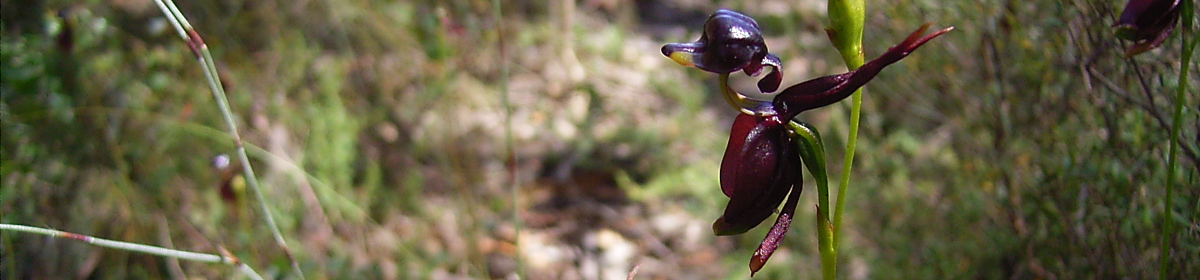
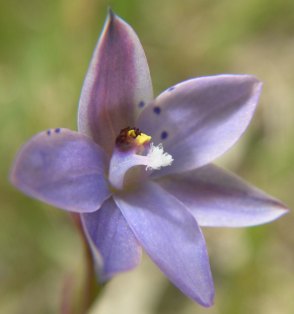
Thelymitra juncifolia
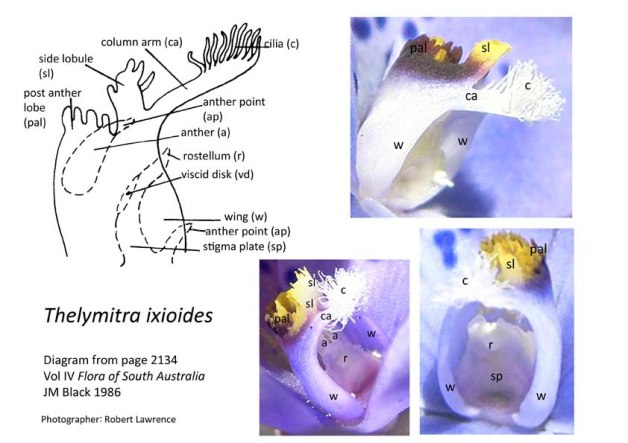
A previous blog (see here) referred to the importance of the column in Thelymitra but did not give details of the parts of the column which is the subject of this blog.
The columns in a Thelymitra (Sun Orchid) may be one of the main identifying features of a sun orchid and so this article looks at those features that botanists will often refer to in their descriptions.
Though we cannot physically dissect an individual flower, we can make use of photographs to spot the various features.
The diagram below is that of T. ixioides (based on the taxonomy of 1984) column whilst the photographs are that of T. juncifolia column (as T. ixioides is now considered to be limited to the eastern states). The column of these two are similar. One photograph will not give all of the features hence in this article the three photographs show all of the features except the viscid disk where the pollinia is stored. The stigmatic plate is sticky and receives the pollen for fertilization.
Most of the variations between the Thelymitra columns occur within the upper portion of the column. The post anther lobe can be quite varied. For instance, with T. ixioides/T. juncifolia the post anther lobe is not hooded. Some with hoods may have deep splits, whilst others form a broad fringe. Yet again, others have variations within the column arms such as having no cilia. This will be dealt with in further articles.
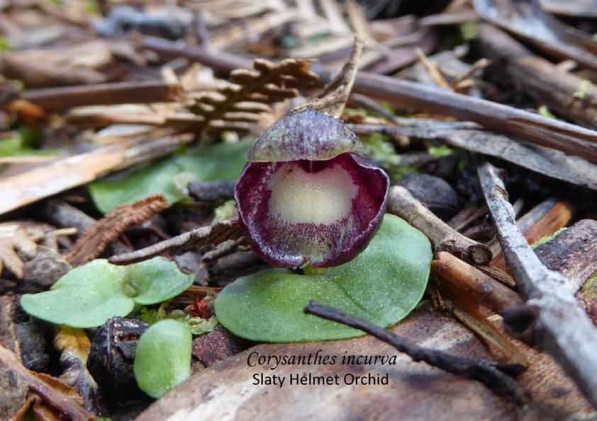
This month’s winner was Jenny Pauley’s photograph of a Corybasincurvus (syn Corysanthesincurva).
Before looking specifically at the species, it might well be worthwhile looking at the features that distinguish the Corysanthes (Toothed Helmet Orchid) group from Corybas (Spurred Helmet Orchid). The major difference appears to be in the flowers. The Corybas flower is dominated by the dorsal sepal which hides the labellum whereas with the Corysanthes the dorsal sepal and labellum are equally prominent although sometimes the dorsal sepal may be the less dominant. A less obvious difference occurs in the leaves. Corysanthes leaves have a fine point but this is absent in Corybas. Based on this only Corysanthes (Toothed Helmet Orchid) occurs in South Australia.
C. incurva, as part of the Corysanthes group, is interesting because the flower does not appear flared or toothed. But though the labellum curves in, it does initially start to flare, and it does have fine short teeth. In fact, in the early stages of the flower opening it can be possible to confuse it with the opening bud of C. diemenica. One of the differences between these two species is that the flower of C. incurva sits on the leaf with no clearly visible stem whilst C. diemenica is raised above the leaf with a visible stem.
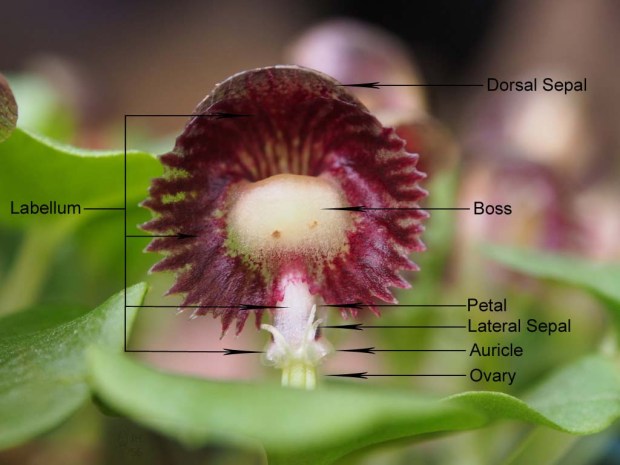
This image of a typical Corybas from Colin Rowan, retiredaussie.com , helps to see the difference between Corysanthes and Corybas.
This image of C. diemenica (syn Corybas diemenicus) is a good comparison. Note the difference between the stems.
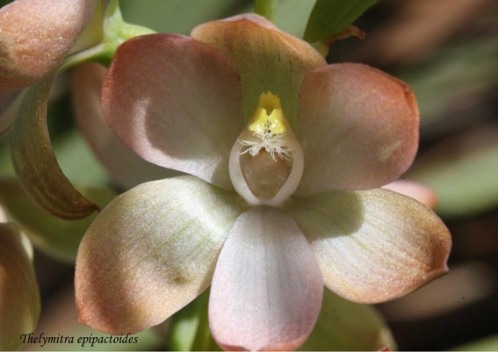
An advantage of entering a photograph is that it does not need to be in season. This month John Fennell entered an autumn flowering Corunastylis fuscoviride and a late spring/early summer flowering Diuris sulpherea, Robert and Rosalie Lawrence both entered the winter flowering Diplodium robustum and the winning picture, John Badger’s Thelymitra epipactoides is an early spring flowering orchid.
Sun Orchids are another popular winner of the competitions and as there was a comprehensive article written on Thelymitra epipactiodes and as some have asked “what, actually, is a sun orchid?”, it is time to answer the general question about Sun Orchids.
Of all the Australian terrestrial orchids Thelymitra or Sun Orchid is the one that looks the least like an orchid as all the segments – the sepals and petals including the labellum – are very similar in appearance. They mimic the flowers of the Lilliaceae and Goodeniaceae families.
Nevertheless, it is an orchid as evidenced by the column. Columns are a unique feature of orchids. They are the combination of the reproductive organs into one structure. Between the different Thelymitra species, it is the column that is often the main distinguishing feature used in identification. Because, the column is quite detailed and so important in identification, we plan to feature this in future Journals.
Other general features of Thelymitra are single, non-hairy, mainly linear leaf (of course, there are always exceptions) with a single flower stem. Flowers range from being singular to having multiple flowers which come in a range of colours from yellow to pinks to blues. Despite the lack of nectar, most Thelymitra are bee pollinated but there are some that are self-pollinated. The pollinia instead of being yellow are white and it is not unusual to see the white pollen on the self-pollinating flowers.
Reference
Bates, R. J., ed. (2011). South Australian Native Orchids. Electronic version, 2011. NOSSA
Jones, D. L., A Complete Guide to Native Orchids of Australia Including the Island Territories. Reed New Holland
Jones, D. L.; Hopely, T; Duffy, S. M.; Richards, K. J.; Clements, M. A and Zhang X, Australian Orchid Genera an information and identification system. Electronic version, 2006, CSIRO
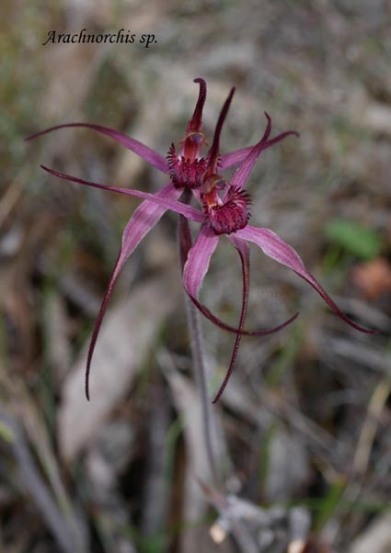
One never knows what species will be entered each month – this month’s entries included Andrew Primer’s Eriochilus collinus, John Fennell’s Prasophyllum elatum, Marg Paech’s Pterostylis nutans and the winning picture, Pauline Meyer’s Arachnorchis sp. (which has subsequently been identified as Arachnorchis sp.)
In the last six years there have been over a dozen photo competition articles (the most recent April 2018) written on some aspects related to Spider Orchids. So, with another Spider Orchid winning the competition it is about time to answer the question – What Is A Spider Orchid?
Around the world, the common name Spider Orchid has been bestowed upon a number of orchids in different genera. In Australia, they have principally been applied to a large group within the genus Caladenia, a highly diverse cumbersome genus.
Caladenia in the broad sense is distinguished by erect flower stem and single linear, ovate to lanceolate leaf, (both hairy), labellum distinctly different from the other segments, generally fringed, curved and decorative calli. But within this genus it has been recognised for a long time that there are several distinct but varied groups, which has been reflected in the common names – Dragon, Pink Fingers, Hare, Spider, Wispy Spider, etc.
Consequently in 2001, several segregate genera were published including Arachnorchis for the common named Spider Orchids. This was not widely accepted, as reflected by the Herbaria of Australia. Indeed the original authors are no longer using the segregate names.
Yet despite all that, the segregate names have proved to be very practical for fieldwork. By using the segregate name when species is unknown, extra information is communicated. This was the case with Pauline’s picture. Yes she photographed a Caladenia but which one? It was an Arachnorchis species.
With that in mind, it is time to consider the features that make up a Spider Orchid or Arachnorchis.
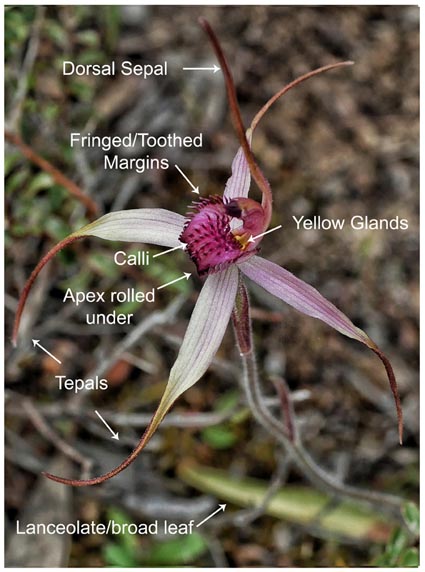
In following through a dichotomous key Arachnorchis is immediately separated out from the rest of the Caladenia by the presence of two yellow waxy glands at the base of the column. As this is not the immediate feature seen, the following chart comparing it with the very similar looking Joneseopsis should assist with recognising some of the main distinguishing features.
SPIDER ORCHIDS (ARACHNORCHIS)
WISPY SPIDER OR DADDY LONG LEGS
(JONESIOPSIS)
Leaf
Sparse to densely hairy
Narrow to broad lanceolate
Red base
Sparsely hairy
Slender
Red base
Stem
Wiry densely hairy
Hairy wiry
Flower
Dorsal sepal
Erect
Erect
Tepals
(Petals & Sepals)
Long & slender with long slender glandular tails or thickened short to long clubs*
Petals and sepals similar size
Narrow, end in very long thin threadlike glandular tails*
Labellum
Trilobed
obliquely erect lateral lobes
Midlobe often differently coloured to the base
Small indistinctly lobed
Narrow
Hinged
Hinged
Apex
Rolled under at the apex
Rolls under*
Margins
Fringed with short to long teeth*
Short, blunt teeth to smooth
Calli
Vary from short rounded crowded to long curved and widely spaced
Short blunt congested lamina calli*
2 or more rows
2 rows*
Basal Gland
2 yellow at base of the column
None
Growth Habit
Loose groups*
Clumping
*Exceptions in all these descriptions
Labelled Features of a Spider Orchid
Reference
Backhouse, G, (2018) Spider Orchids: The Genus Caladenia and Its Relatives in Australia ISBN: 978-0-9946489 Electronic version
Bates, R. J., ed. (2011). South Australian Native Orchids. Electronic version, 2011. NOSSA
Jones, D. L., A Complete Guide to Native Orchids of Australia Including the Island Territories. Reed New Holland
Jones, D. L.; Hopely, T; Duffy, S. M.; Richards, K. J.; Clements, M. A and Zhang X, Australian Orchid Genera an information and identification system. Electronic version, 2006, CSIRO
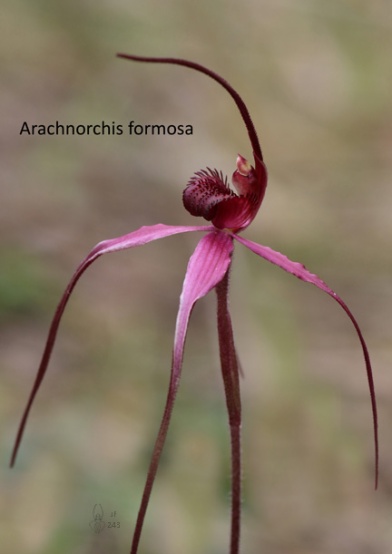
Four very different species were entered this month. Ricky Egel’s autumn flowering Coryunastylis fuscoviridis (see February Journal for name usage), Rosalie Lawrence’s winter flowering Diplodium bryophilum and John Fennell’s spring flowering Stegostyla cucullata and Arachnorchis formosa.
It was no surprise that John’s A. formosa (syn. Caladenia formosa) was the winning photograph. Words such as stunning, spectacular, wonderful and attractive are used in the description of this rare orchid and is reflected in its common names – Scarlet Spider Orchid, Elegant Red Spider Orchid, Elegant Spider Orchid and Blood-red Spider Orchid. It is truly a stunning red flower with its drooping petals and sepals (tepals).
A. formosa is part of the large patersonii alliance which is characterised by white to reddish flowers with (mainly) drooping tepals ending in long, slender (sometimes thickened) sparsely to densely glandular (hairy) tails, labellum with short to long marginal teeth. The features that separate A. formosa from others in the complex are the large (~60 mm across) deep red flowers with long (~80mm) tapering, drooping tepals. Similar species to A. formosa is the smaller once common but now extremely rare Caladenia ‘Fleurieu Peninsula’ In Victoria there are some other similar species.
A. formosa is confined mainly to the South East and into south western Victoria.
References:
Backhouse, G., (2011). Spider-orchids – the Genus Caladenia and its Relatives in Australia, Melbourne, Electronic version.
Backhouse, G., et al, (2016). Bush Gems: A Guide to the Wild Orchids of Victoria, Australia, Electronic version.
Bates, R. J., ed. (2011). South Australian Native Orchids. Electronic version. NOSSA
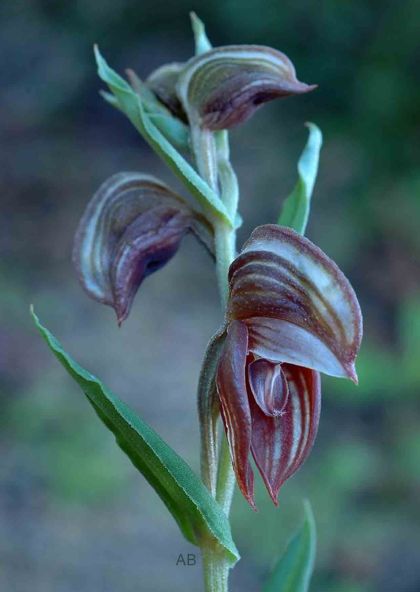
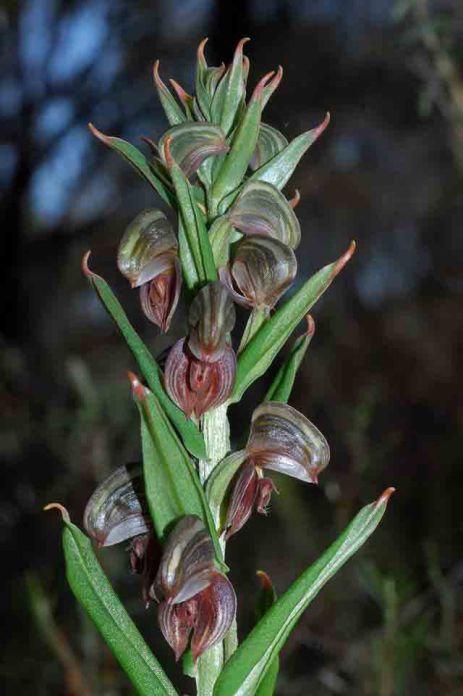
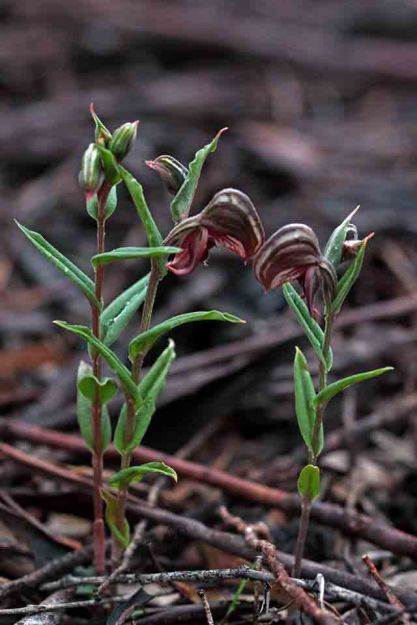
Here in South Australia we often have only one or two species of a complex or a genus but this is not necessarily the case in the rest of the country. One such instance is Urochilus sanguineus (syn Pterostylis sanguinea) or Maroon Banded Greenhood. It is possible that we may have a subspecies or possibly the Mallee form but nothing like the occurrence of this species in Western Australia where it is but one of many in a complex of several – the Pterostylis vittata complex or Banded Greenhoods*.
Below, with permission, is Andrew Brown’s post on Facebook with notes and images about the complex as it is understood in Western Australia.
The Banded Greenhood complex in Western Australia
Members of this complex grow 150 to 450 mm high and have up to 20 green, brown or reddish-brown white banded flowers characterised by their, short, broad lateral sepals which are joined at the base and a small, insect-like labellum which flicks up when touched. In all species, flowering plants lack a basal rosette of leaves while non-flowering plants have a flattened, ground hugging, rosette of leaves.
Banded greenhoods are found over a wide geographic range between Binnu north of Geraldton and Eyre on the Great Australia Bight, growing in shrublands, woodlands, forests and shallow soil pockets on granite outcrops.
There are ten Western Australian species in this complex, seven of which are formally named. However, as two were named as species of Urochilus, a genus not recognised in Western Australia, only five of these names are currently recognised here. In Western Australia, all members of the complex are considered to be in the genus Pterostylis.
All are winter flowering.
Pterostylis concava
Distinguished from other members of the complex by its prominently cupped lateral sepals and the upturned projection near the base of the labellum. Found between Bindoon and Mt Barker.
**********
Pterostylis crebriflora
Distinguished from the similar Pterostylis sanguinea by its often shorter stature and slightly larger flowers which are crowded in a dense spike near the top of the stem. Found on the Darling Scarp near Perth.
**********
Pterostylis sanguinea
A very common species that is also found in South Australia, Tasmania and Victoria. It was named from specimens collected in South Australia. The species is similar to Pterostylis crebriflora but is usually taller with smaller, more widely spaced flowers. Flower colour is variable and it is not uncommon to find brown and green flowered forms growing alongside one another. Found over a wide area between Mullewa and Eyre on the Great Australian Bight.
**********
Pterostylis sanguinea (Mallee form)
An unnamed member of the complex distinguished from Pterostylis sanguinea by its short stature and few flowered inflorescence. Found over a wide range from the Stirling Range to the north of Esperance.
**********
Pterostylis sp. Coastal
Some consider this to be a form of Pterostylis sp. small bands but it is usually taller with more widely spaced flowers. The sepals are also narrower and often slightly cupped. Found mostly in near coastal areas between Dongara and Bunbury. Similar looking plants have also been found further inland between Brookton and Mt Barker.
**********
Pterostylis sanguinea (green flowered form)
**********
Pterostylis sargentii
A common, widespread species, distinguished from other members of the complex by its smaller flowers and fleshy, tri-lobed, frog-like labellum. Found over a huge geographic range between Northampton and Mt Ney, north of Esperance.
**********
Pterostylis sp. Crowded
A widespread species named Urochilus atrosanguineus in June 2017. Distinguished from the similar Pterostylis sanguinea by its more robust habit and larger dark reddish-brown flowers. It is also similar to Pterostylis crebriflora but generally flowers earlier and has more widely spaced flowers in a longer spike. Found between Wongan Hills and Katanning with rare, scattered populations on the Swan Coastal Plain.
**********
Pterostylis sp. Eyre
A distinctive member of the complex distinguished from others by its pale coloured flowers. Like Pterostylis sanguinea (mallee form) it has a short stature and few flowered inflorescence. Found along the coast between Toolinna Cove and Eyre on the on the Great Australian Bight.
**********
Pterostylis sp. small bands
A northern species named Urochilus orbiculatus in June 2017. It is regarded by some researchers to be a form of Pterostylis sp. coastal but is usually shorter with a more densely crowded spike of flowers. Its sepals are also broader, more rounded and flattened rather than slightly cupped. Found north of Perth between Cataby and Binnu.
**********
Pterostylis vittata
A widespread species distinguished from other members of the complex by its less fleshy, paler coloured, predominantly green flowers and narrower, elongated, slightly cupped sepals. The flowers also have a more translucent appearance. The typical form is found between Bindoon and Balladonia. There is a northern form with a shorter spike of often fawn coloured flowers found between Cataby and Binnu.
**********
It should be noted that in South Australia and Victoria U. sanguineus was originally called P. vittata but that species is now recognised as being endemic to Western Australia.
*As an aside, the common name Banded Greenhoods is used in South Australia for the subgenus Bunochilus (previously Pterostylis longifolia which is now considered endemic to New South Wales).
At this time of the year there are not many orchids flowering in South Australia but one that is just finishing is Spiranthes alticola. The genus Spiranthes, commonly known as Ladies Tresses, is found throughout Australia, Eurasisa and the Americas.The following description is an extract from South Australia’s Native Orchids 2011 DVD which is available from the Native Orchid Society of South Australi.
Spiranthes alticola D.L.Jones
Swamp Spiral Orchid
Etymology: The name alticola means high dweller, referring to its distribution in Eastern Australia, in west Victoria and South Australia’s South East. It also grows near sea level.
Synonyms: Previously included in Neottia australis R. Br., S. sinensis (Pers.) Ames and S. australis R.Br.
ASCII
(These two pictures show the variation in colour.)
Description:Leaves 3-5, narrow lanceolate, shiny, erect at the base, to 15 cm long. Flowerstem to 45 cm tall, slender, flexible, with several sheathing bracts. The flowers are numerous in a dense spiral, pink with a white labellum, rarely all white. Segments are 6-10 mm long, sepals somewhat triangular, petals lanceolate, together forming a short tube, the tips free and recurved, and the lateral sepals divergent. Labellum with a broad, decurved crisped, pellucid mid-lobe, side-lobes erect small. The flowers are faintly fragrant.
(Leaves of Spiranthes alticola)
Flowering: Dec – Jan – Feb.
Similar Species:S. australis, S. sp. Late selfing-white.
Distribution:SL, KIx, SE; NSW, Vic, Tas.
Confined in South Australia to a few high rainfall, near coastal, often mountain locations, southward from the Adelaide Hills in the Southern Lofty region, extinct on Kangaroo Island, (one record only), and South East; also in New South Wales, Victoria and Tasmania.
Habitat: Restricted to peaty bogs and swampy creek-sides, often in locations that are inundated throughout winter; in some areas surviving in paddocks grazed by stock.
Distinguishing Features: S. australis, which is from the eastern states and is not strictly a swamp plant, has smaller darker pink flowers with a narrow labellum.
The two South Australian forms treated here are regarded as distinct species as where they are sympatric they begin flowering at different times and do not intergrade. S.alticola is the more delicate of the two.
Notes: The best specimens are found on mowed firebreaks adjacent to swamps.When vegetative reproduction produces two clonal plants next to each other the spiral arrangement of one is often a mirror image of the other. See Gallery.
Native bee pollinators work the spikes from the bottom upward but as the stigma becomes receptive well after the pollinia have matured this mechanism helps ensure outcrossing.
Plants do well in cultivation if kept moist over summer.
Conservation Status:
Status in Legislation: Not listed nationally, rare in South Australia.
Suggested Status: Rare in South Australia but more common in the Eastern States
Mad dogs and Englishmen are not the only ones to go out in the midday sun. For orchidologists to see Sun Orchids flowering, then it is out into the midday sun on a hot day because that is when they open. There is no point going much before 11am and by 2pm most are closing and no point going out on a cool or windy day.
But for those who don’t want to go out (or cannot get out) into the midday sun, here is a video to be viewed in the cool of the shade.
This video features the Leopard Sun Orchid (Thelymitra benthamiana) an uncommon Sun Orchid in South Australia. Unlike many sun orchids which requires a view of the flower to confirm identification, this one can be identified by the leaf alone. At the beginning of the video take note of its distinctive leaf.
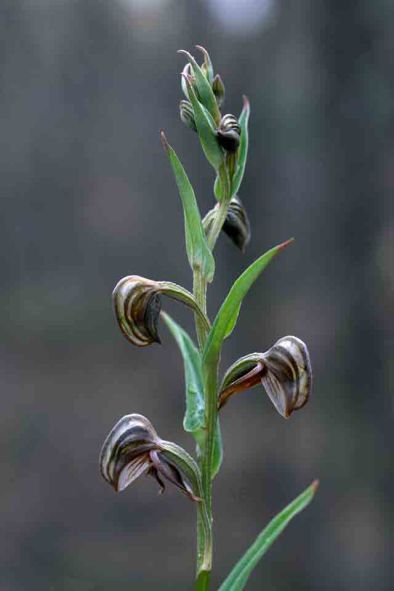
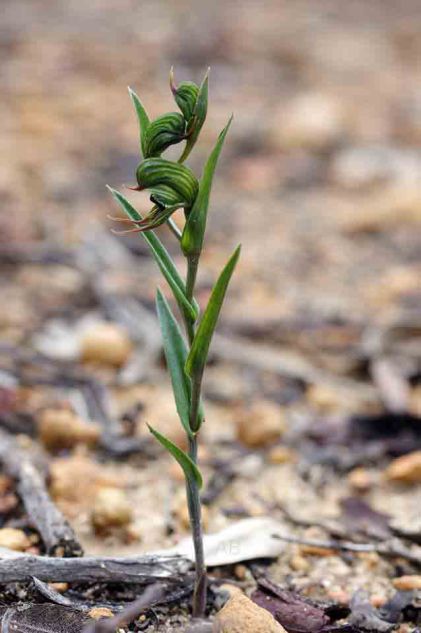
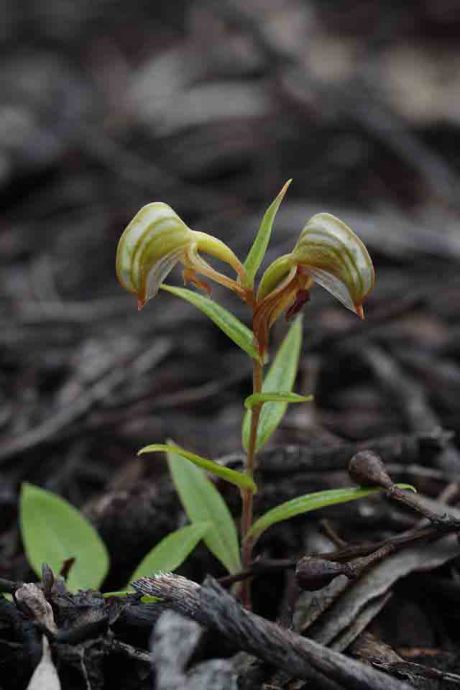
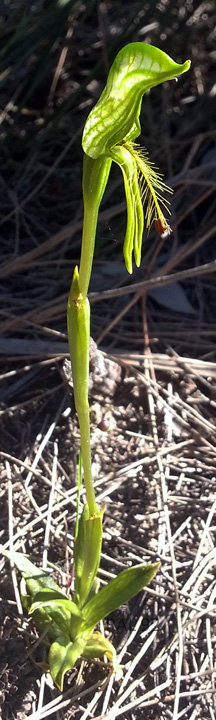
If you are out and about this week, keep an eye out for this attractive and unusual greenhood with its bottle brush labellum and rosette of “pineapple” like leaves.
Commonly known as Woodland Plumed or Bearded Greenhood, or Plumatochilos sp. Woodland Bearded Greenhood. The reason for the phrase name is because many consider that it is a separate species, in this instance, from Plumatochilos plumosum (syn Pterostylis plumosa). Originally all of the Bearded Greenhood were considered as one species – Pterostylis barbata but then Leo Cady named Pterostylis plumosa as a separate species. David Jones in his 2006 tome listed four species, P. barbatum, P plumosum, P. tasmanicum and P. turfosum.
Here in South Australia, Bates lists P. tasmanicum and two with phrase names suggesting that they are distinct from P. plumosum.
Peter Fehre recently posted on the Tasmanian Native Orchids Facebook page some helpful hints differentiating between P. tasmanicum and P. plumosum. Very similar information is found in Bates South Australia’s Native Orchids. These differences are:
P. tasmanicum – a short plant: short flower stem (not more than 14 cms), short labellum (to 15mm) , short ovary; short blunted galea (hood) to 25mm. It prefers damp, sandy areas and swamp margins.
P. plumosum – has length; long flower stem (10 – 30 cm), galea to 40mm with a long tip, long labellum (to 25mm). It is a plant of the woodlands and forests growing on well drained soil.
The differences between the two phrase named species are more subtle
References:
R J Bates, 2011, South Australia’s Native Orchids DVD, NOSSA
D L Jones , 2006, A Complete Guide to Native Orchids of Australia
In the past week there has been some Facebook conversation on the identification of some Thelymitra (Sun Orchids) here in South Australia. Sun Orchids can be problematic particularly when there is only one photograph. If the photograph has a clear view of a diagnostic feature, then identification becomes simpler but there are many species for which careful observations are necessary to determine the correct one. This is important when considering some of the complexes, eg T. nuda and T. pauciflora which have several similar species. Colour is not always helpful as there can be either variation in colour or no colour at all. Further complicating identification is that Sun Orchids readily hybridise, far too easily sometimes!
When Robert Lawrence wrote his book, Start With the Leaves, he realised the difficulty in identifying some orchids, so he included a checklist of observations. The checklist is extensive but was developed to be used with the electronic version of South Australia’s Native Orchids by RJ Bates which covered all the known South Australian orchids in 2011.
To assist in orchid identification, take as many photographs as possible, showing different parts of the plant and habitat from as many different angles. But remember, photograph the typical plants.
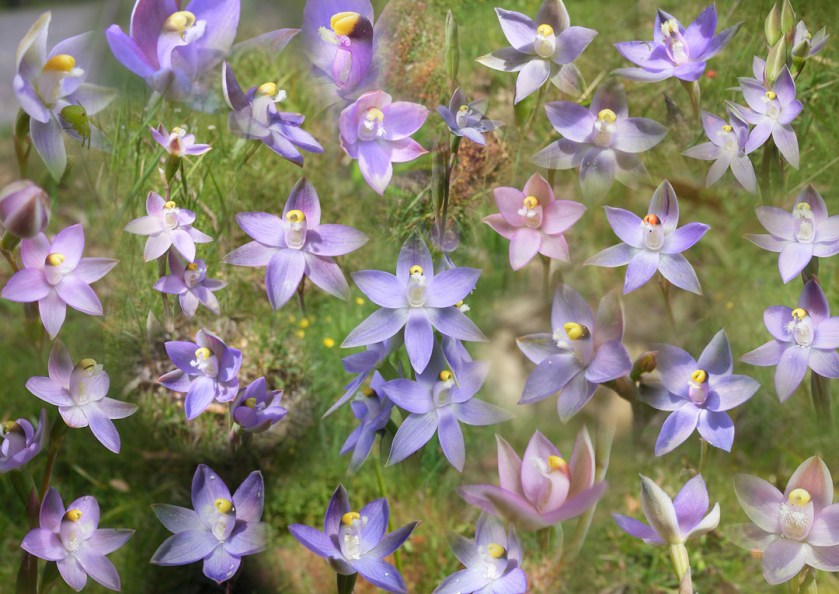
In this collage there are several species but which is which?
At the bottom of the post is a picture showing the parts of the flower.
The following extract is from pages 185 – 187
Thelymitra species (Sun Orchids)
Habitat features
Describe the habitat where the plants are found
Is the species confined to swamps or very moist sites?
Was the site burnt in the last year or two? (Find out when if possible)
Are the plants restricted to a particular habitat or is there a range of situations where it grows?
Has it multiplied following disturbance?
Does it prefer wet or dry sites?
What other plants are growing with the orchids, including the trees forming the canopy?
Number of plants
Estimate the number of plants or describe the distribution of the plants at the site
Do plants occur in small clumps?
Do plants occur in colonies and if so how large are they?
Size of the plant
What is the height of the flower stem and width of the flower stem?
Leaf features
What are the length, width and shape of the leaf?
Is the leaf flat, channelled (u-shaped) or tubular in section?
Does the leaf change shape along its length?
Does the leaf have parallel ridges?
Is the leaf thick and fleshy or thin and papery?
What colour is the leaf?
Does the leaf have a reddish base and is the red colouration in parallel lines?
Are there any hairs on the leaf and are they confined to the margins?
Is the leaf rigid and upright or is it weak at the tip and falling under its own weight?
What is the tip of the leaf like and does it have a pointed apex?
Are the leaves shiny or to they have a powdery covering?
Stem features
What is the diameter of the stem?
What is the colour of the stem?
How high is the fistula, the point the point where the stem separates from the leaf?
Sterile bracts
(Bracts are leaf-like structures along the flowering stem)
How many bracts are there on the stem (ie those that are not immediately below a flower)?
How long is each of these bracts?
What colour are the bracts?
Are the bracts tightly or loosely wrap around the stem?
Fertile bracts
(Fertile bracts are leaf-like structures at the base of each flower)
How long are the bracts?
What colour are the bracts?
Ovary features
(The ovary is the structure immediately below the petals and sepals that becomes the seed capsule after the flowers are pollinated)
What colour are the ovaries?
How long are the ovaries?
How wide are the ovaries?
Flower features
What time of the year are the flowers open
What is the length and width of each flower?
Do the petals and sepals open widely, or does the flower remain almost closed?
What colour are the petals and sepals?
Do the petals have spots or darker coloured veins?
Is the labellum larger or smaller than the other segments (petals and sepals)?
Are segments rounded, pointed or cup shaped?
What colour is the outside of the buds?
What conditions are required for the flowers to open? Are they only open in hot, humid conditions?
Column features
What colour is the main part of the column?
Describe the post-anther/mid-column lobe
Is there a tubular structure on the top of the column? What colour is this and does it have a collar of a different colour?
Does the lobe have a cleft in the apex and how deep is this?
Does the column have lateral lobes (arms) reaching in front of the column?
Are there trichomes (hair-like structures) in a mop or toothbrush arrangement?
Is there a sharp bend in the column arms?
If there is not a tubular lobe, are there three levels of structures on the column?
Are there papillae (rows of narrow bumps)? How many and what colour are they?
What colour is the crest, if present?
Fragrance
Describe the fragrance of the flower or whether there is none








 NOSSA
NOSSA 