2015 June Winning Photograph

06 sm PM Arachnorchis argocallaOf the five entries this month, four featured winter orchids. Lorraine Badger entered a Diplodium robustum, whilst Claire Chesson, Robert and Rosalie Lawrence all entered Urochilus sangineus. Though not the winning photographs it was interesting to see the differences between the U. sangineus with one being no taller than the small Acianthus pusillus next to it and another being taller than the rapier sedge.

But the winning photograph was the spring flowering Arachnorchis argocalla (White Beauty Spider Orchid) by Pauline Meyers. This is amongst our most threatened orchids and is dealt with in depth in the Recovery Plan For Twelve Threatened Orchids in the Lofty Block Region of South Australia 2010. This fungi dependent endemic orchid is rated Endangered both at State and National level.

Found in the Southern and Northern Lofty regions, it range has been severely reduced by possibly 80%. Since 1918 no plant has been found south of Adelaide.

Flowering from September to October, it is often found in grassy woodlands often growing on gentle southerly-facing hill slopes. The soil is a clay loam with a high humus content.

This beautiful orchid has one to two non-perfumed white flowers with thickened but not clubbed drooping lateral sepals and petals. The strongly recurved broad labellum is usually white, sometimes crimson, fringed with short teeth.

This is one of our larger spider orchids reaching a height of 60cms. The size of the plant flower and leaf help to distinguish it from other similar appearing orchids such as A. brumalis and albino flowers of A. behrii.

Like many of the spider orchids it takes 2 – 5 years to reach maturity and then has a potential reproductive life of 10 years. With an average pollination rate of less than 10%, the potential to increase the population is low and any threat to survival of the individual plants needs to taken seriously.

Some threats are obvious such as weed invasion including the garden escapees such as Topped lavender (Lavandula stoechas spp. stoechas) and action is being taken to curb the spread of weeds through targeted weeding programs.

Another threat is habitat loss. This has been the result of land clearing but sites are being protected either through conservation legislation or Heritage Agreements. Habitat loss can also occur indirectly and that is through Phytophthora being introduced into the sites. Although the direct effect of Phytophtora on the orchid is unknown, it is known that it can affect the plants that grow in association with this orchid. This threat can be reduced by all of us implementing good hygiene practices.

These were some of the threats noted in the Recovery Plan. This plan was not just defensive, ie attempt to halt and minimalize the damage; but it was also proactive with measures outlined to increase the population. These included seed and fungi collection eventually resulting in germination and cultivation with a view to re-introduction.

It is good to see that there is a plan and active steps are being taken to bring this orchid back from threat of extinction.

June 2015 other entrants
Photographers from L to R: Claire Chesson, Rosalie Lawrence, Lorraine Badger, Robert Lawrence

References

Websites accessed 1 July 2015

White Beauty Spider Orchid (Caladenia argocalla) Recovery Plan
http://www.environment.gov.au/archive/biodiversity/threatened/publications/recovery/c-argocalla/index.html
Caladenia argocalla – White-beauty spider-orchid, biodiversity species Profile and Threats Database
http://www.environment.gov.au/cgi-bin/sprat/public/publicspecies.pl?taxon_id=54991
Recovery Plan For twelve threatened Orchids in the Lofty Block Region of South Australia
http://www.environment.gov.au/system/files/resources/e362cfd2-a37b-443a-b007-db3a2b7b64dd/files/lofty-block-orchids-recovery-plan.pdf

Bates R J, South Australia’s Native Orchids 2011 DVD

2014 November Photograph Competition Part 1

11 sm CD Arachnorchis sp with hover fly

With a theme of Orchids and Insects for the November meeting it was hoped that there would be some entries with pollinators and therefore there would be two categories Insect Visitors and Pollinators. This month’s article will feature the Pollinator section and Insect Visitors in the next month.

In all there were four potential pollinator photographs. The insects were either scrounging around at the base of the column or else they had the pollinia attached to them. Unfortunately only one was a true pollinator so the category became Insects with Pollinia. The winning photograph of Arachnorchis brumalis with an unidentified hoverfly was taken by Chris Davey. Interestingly the other two pictures also featured Arachnorchis species with the hover fly Simosyrphus grandicornis. Resembling a wasp but minus the sting, this species is one of the common hover flies native to Australia.

Called Hover Flies owing to their ability to hover motionless in one spot, they are also known as Flower Flies because they are often found hovering around as well as pollinating flowers. It is not surprising, therefore, to find them around orchids. Yet instead of being called pollinators they are non-pollinators (Bates & Weber 1990). They visit the orchids, forage inside the flower and may even manage to collect some pollinia but that is all. They may not necessarily visit another flower of the same species but if they do, they will fail to deliver the pollinia to the stigma2.

Rudie Kuiter agrees with Bates that hover flies are not orchid pollinators but just when we think we have worked it out he adds “but we have at least one orchid in Victoria that is pollinated by hoverflies and witnessed now several times and this is Caladenia catenata” (synonym Petalochilus catenatus). Notwithstanding the case for this species, it would appear that in most cases hoverflies remove pollinia so that it is not available to a more specific pollinator.

Why then are the hover flies attracted to the orchids? Is it for food? An internet image search revealed that hover flies visit the flowers of many different genera including Thelymitra and Diuris. This is interesting because flowers are the food source for hover flies but though many orchids promise food, many species do not produce the nectar and pollen (as a food source) that they desire. Diuris and Thelymitra belong to this group of non-nectar producing flower. Other orchids that don’t produce nectar include Gastrodia, Dipodium and the Duck orchids. Again, there are orchids such as Crytostylis which produce minimal nectar and with Prasophyllum the nectar is hidden in cells that require puncturing – not a good food source!

Having discussed hover flies as non-pollinators, in this month’s competition, which photograph had a pollinator? – It came last and was Robert Lawrence’s photograph of a native bee on a Dipodium pardalinum, another non-nectar producing orchid. The story of this photograph was featured in Photographing Orchid Pollinators, April 2014 Journal as well as in a previous blog on Photographing Pollinators.

References:

Smith James, Information Centre, South Australian Museum, personal communications

Kuiter Rudie personal communications

Bates and Weber, Orchids of South Australia, 1990

Australian Museum, http://australianmuseum.net.au/Hover-flies Accessed 4th December 2014

Brown, et al, Field Guide to the Orchids of Western Australia, 2013

Jones, Native Orchids of Australia Including the Island Territories, 2006

Bates, South Australia’s Native Orchids 2011 DVD-ROM

Martin, The Vocabulary of Orchids: An Amateur’s Perspective, 2005

1Pollinia is basically a coherent compact mass of pollen that allows the pollen to be transported as a single unit

2The stigma is a sticky depression (or swelling) at the front of the column, the receiving surface for the pollinia that is necessary for germination.

October 2014 Winning Photograph

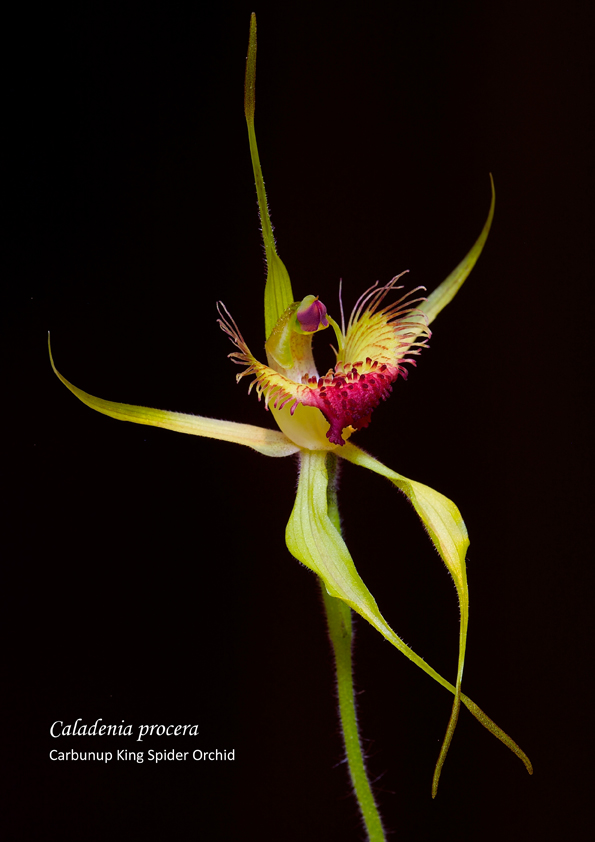
 Caladenia procera

This month’s entries of Oligochaetochilus arenicola, Caladenia flava, Calochilus robertsonii , Diuris palustris and Caladenia procera illustrated the variety of shapes to be found in orchids.

All but one are reasonably common; all but one were photographed in situ and that one was the winning picture by Kris Kopicki – Caladenia procera. Its common name, Carbunup King Spider Orchid, reflects its location near Busselton Western Australia. This species has a severely limited distribution with a small population and is threatened by land clearing for development. Consequently it is rated as critically endangered.

The other aspect of this plant is that it is a photograph of a plant in a pot not the bush. Kris benched the original plant at the September Tuesday meeting when it was still in bud. By Saturday it was in glorious flower.

This picture exemplifies the two objects of NOSSA which “are to promote and engage in activities for the promotion and furtherance of:

  1. the culture, propagation, conservation, knowledge and scientific study of the native orchids of Southern Australia and the Australasian region;
  2. the preservation of orchids as a species and their preservation within their native habitat.”

Some terrestrial orchids are relatively easy to grow but not this one. It takes time patience and skill to grow them. C procera is one of the fungi dependent species and though capable of living many years, it can take up to six years before flowering, although under ideal condition it could mature in as little as two years.

Being able to grow the different terrestrial orchids is one of the ways NOSSA can help in their conservation. NOSSA has a Growers’ Forum each meeting night where members can attend and learn from experienced growers how to grow both epiphytes and, importantly, the terrestrials.

Reference:

Native Orchid Society of South Australia Inc. (NOSSA) Rules of Association 2007

Caladenia procera – Carbunup King Spider, Orchid Species Profile and Threats Database (SPRAT) – http://www.environment.gov.au/cgi-bin/sprat/public/publicspecies.pl?taxon_id=68679 – access 6th November 2014

Remember November’s theme is Orchids and Insects (Spiders and other critters accepted as Honorary Insects)

NOSSA and the Lofty Block Threatened Orchid Recovery Project

In the NOSSA Constitution (2007) the aims of NOSSA “are to promote and engage in activities for the promotion and furtherance of :
  1. the culture, propagation, conservation, knowledge and scientific study of the native orchids of southern Australia and the Australasian region;
  2. the preservation of orchids as a species and their preservation within their native habitat.”

The article following is about one of the ongoing conservation activities with which NOSSA members were and are currently involved.  Quoted verbatim from SA Veg on the Edge, Vol 7, No. 1, 2007

Recovery Plan for 12 Threatened Orchids in the Lofty Block Region released
Since 1998, the Lofty Block Threatened Orchid Recovery Project (LBTORP) has been implementing recovery actions for threatened orchids in the Lofty Block region of SA. In late 2006, a draft recovery plan was completed for the following twelve species:
  • Caladenia argocalla (White Beauty Spider-orchid) – ENDANGERED (EPBC Act)
  • C. behrii (Pink-lipped Spider-orchid) – ENDANGERED (EPBC Act)
  • C. gladiolata (Bayonet Spider-orchid) – ENDANGERED (EPBC Act)
  • C. sp. ‘Brentwood’ (Ghost Spider-orchid) – Nominated as CRITICALLY ENDANGERED (EPBC Act)
  • C. macroclavia (Large-club Spider-orchid) – ENDANGERED (EPBC Act)
  • C. rigida (White Spider-orchid) – EPBC Act – ENDANGERED (EPBC Act)
  • C. woolcockiorum (Woolcock’s Spider-orchid) – VULNERABLE (EPBC Act)
  • C. xantholeuca (Flinders Ranges Spider-orchid) – ENDANGERED (EPBC Act)
  • Pterostylis bryophila (Hindmarsh Valley Greenhood) – CRITICALLY ENDANGERED (EPBC Act)
  • P. cucullata (Leafy Greenhood) – VULNERABLE (EPBC Act)
  • P. despectans (Lowly Greenhood) – ENDANGERED  (EPBC Act)
  • P. sp. ‘Halbury’ (Halbury Greenhood) – ENDANGERED (EPBC Act)
The recovery plan describes each of these twelve species in detail including their morphology, distribution, population size, habitat, and ecology.  Importantly, it also outlines the threats to each species and prescribes recovery objectives, targets, and actions for the next five years.
  • Determine population size and trends
  • Determine current extent of occurrence and number of sub-populations
  • Mitigate threats to sub-populations.
Recovery actions will be implemented for each of the twelve species in accordance with the recovery plan over the next five years by the LBTORP.  Community involvement is recognised as a key factor in the successful delivery of on-ground recovery actions.
Fact sheets and a webpage that provide up to date information on the program were recently completed … Joe Quarmby, Lofty Block Threatened Orchid Recovery Project Officer , SA DEH
(NB Joe Quramby now is the Threatened Flora Ecologist Natural Resources, Adelaide & Mount Lofty Ranges Partnerships and Stewardship and DEH is now Department of Environment, Water and Natural Resources, 2014)

The article may be seven years old but it is a good overview of some of the conservation work that NOSSA members have done with Joe Quarmby.

The full 176 page report can be found here.


Arachnorchis behrii (Pink Lipped Spider Orchid)


August 2014 Winning Photograph

08 sm CC Caladenia valida

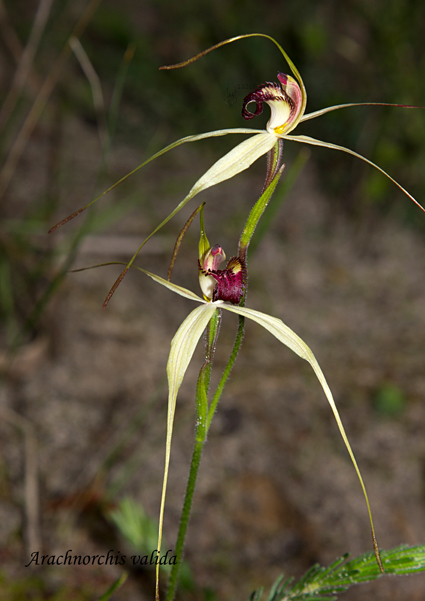
Claire Chesson’s Arachnorchis valida (common name Robust Spider Orchid) was the winning photograph for August.

The name Arachnorchis valida was not validated until 2002; synonym Caladenia valida. Previously it had been included under Caladenia huegelii (a Western Australian species) and Caladenia reticulata.

A. valida grows in sandy or sand over red clay soil, in sheltered clearings within heathy woodland or mallee but within a very restricted and disjunct distribution on Fleurieu Peninsula and Kangaroo Island in South Australia; and Otway Plain, Victoria. Rated Endangered in South Australia, it is not listed nationally.

Although A. valida shares some similar features with A. reticulata (ie 1 to 2 flowers, clubbed sepals, calli on the labellum) it also has quite distinctive features (see chart below) that help to differentiate between the two as they can sometimes be found growing together.

Comparison of A. valida and A. reticulata

Features

A. valida

A. reticulata

Pollinating wasp Phymatothynnus pygidialis Phymatothynnus victor
Leaf Felted Leaf – dense, short hairsSemi erect Very long silky hairs; purplish at the baseErect
Flower Stem Taller – 40 cm, hairy 30 cm, green & purplish red with long silky hairs
Flower Size Though variable, larger – 7 cm 5 cm
Flower Greenish when first opened fading to white or cream as the flower matures Red-brown
Perianth Stiffly spreading – broad based sepals; backswept petalsNo stripes Dorsal sepal erect; perianth spreading downwardRed stripes
Labellum Can be red but without veining Red with veining


NB: November Picture Competition Theme – Orchids and Insects

See the 2014 April Journal for hints of photographing orchid pollinators.

References:

http://www.rbg.vic.gov.au/dbpages/dev/vicflora/index.php/viclist/name/4677 accessed 4th September 2014

Threatened Species Profile Fact Sheet Caladenia valida Department for Environment and Heritage, South Australia

International Plant Name Index – http://www.ipni.org/

Personal communications with Claire Chesson

South Australia’s Native Orchids DVD 2011 Bates

Spider-orchids the Genus Caladenia and it Relatives in Australia CD 2011 Gary Backhouse


Australian Orchids & the Doctors they Commemorate Part 9 of 20

Hans Herman Behr (1818 – 1904)

A physician, botanist, entomologist, lepidopterist, poet, writer, humourist and linguist.

Orchid species: Arachnorhis behrii  Synonym: Caladenia behrii

Diuris behrii (also known as Golden Cowslips)

June 2014 Winning Photograph


06 DM A leptochila sm
Arachnorchis leptochila spp. leptochila (syn. Caladenia leptochila)

There were many more entries than usual this month but the winner was a photograph by David Mangelsdorf.

Looking back over the last three winners, a royal theme emerges.  In April it was the elegant Queen Orchid, in May the flamboyant Queen of Sheba and this month it is the dignified Queen Spider Orchid (a statelier name than the more usual common name of Narrow Lipped Spider Orchid).

The botanical name for this species is Arachnorchis leptochila spp letptochila (syn. Caladenia leptochila).  An endemic species of South Australia, it is mainly found in the Mount Lofty Ranges where it favours leached stony soils.  Flowering in spring, it is easily recognised by the upswept segments and narrow labellum.

Usually these orchids are characterised by dark clubs which can be seen even in bud, but in this picture they are light coloured.  This could be due to variation with the species, as occasionally pale coloured flowers have been found.  Interestingly in doing an image search on the web I found none with light coloured clubs.


March 2014 Winning Picture

03 PM Arachnorchis c

Taken at the same site as February’s winning photograph – Ramsay Conservation Park on Yorke Peninsula, the winning photograph was of an Arcahnorchis sp. by Pauline Meyers.

A positive identification was not possible due to a number of factors making firm identification difficult.  Most likely it is a hybrid of the Green-combed group of spider orchids and though not positively identified there are some things that can be observed.  The Green-combed group according to Gary Backhouse consists of three sub-groups, A dilatata (largest sub-group), A concinna and A integra, but David Jones has them as three separate gorups.

Some features of this group are

  • One of two flowers
  • Flowers mainly green or greenish and red
  • Labellum
    • Hinged and mobile
    • Maroon apex
    • Green comb-like teeth on the margins (edges)
  • Tepals (petals and sepals)
    • Green to greenish with red stripes
    • Brown to yellow clubs at the tips

From the photograph it can be seen that all the green-comb features are visible except for the clubs,  The dorsal sepal is obviously thickened but it is not as clear for the other two sepals.  This could be due to the angle of the photograph.

Another observation to note is that it is a freshly opened flower as suggested by the elongated appearance of the labellum.  As the flower ages the labellum curls further under itself.  It is important to remember that an old flower and a young flower of the same species could be mistaken as two different species.

In South Australia, species belonging to the green-comb groups are

  • A dilatata sub-group consisting of
    • A aurulenta, A clavula, A dilatata, A interanea, A macroclavia, A necrophylla,  A parva,
      A phaeoclavia, A septuosa, A stricta, A tensa, A tentaculata, A verrucosa, A villosissima
  • A concinna sub-group consisting of
    • A toxochila, A conferta
  • A integra sub-group consisting of none in South Australia

To iterate from last month – Orchids are an interesting group concerning identification.  Some are extremely easy to identify but others not so.

References:

Backhouse,  G.  (2011).  Spider-orchids  –    the  Genus Caladenia and its Relatives in Australia on CD Rom.
Jones, D. L. (2006). A Complete Guide to Native Orchids of  Australia  including  the  Island  Territories,  (2nd  ed.).  Frenchs Forest, N.S.W., Reed New Holland.
R.J.Bates.  (2011).  South  Australia’s  Native  Orchids (DVD) [Electronic Version]

Thank you to Thelma Bridle for reviewing the article.


2014 February Winning Picture

 02  85PM Arachnorchis brumalis x conferta

This month’s winner photographed by Pauline Meyers was a spider hybrid identified by Bob Bates as Arachnorchis brumalis x A conferta.

Orchids are an interesting group concerning identification.  Some are extremely easy to identify but others specifically the sun orchids, but also the spider orchids, can be difficult to identify partly due to the ease with which they are able to hybridise.

A frequent hybrid occurrence across Australia (see map for Arachnorchis distribution) is the pairing of the green comb spider orchids of the A dilatata complex with the white spider orchid of the A patersonii complex as seen in this picture.  A brumalis belongs to the A patersonii complex and A conferta to the green comb orchid.

Hybrids will be variable but obviously they will have characteristics of both parents.  By looking at the two parents it can be seen that this picture of Pauline’s contains features of both.  From the A conferta parent, the inherited features are the wide labellum of the green comb, thickened calli and the red on the segments whilst the long thin segments, glandular tips (osmophores) long and thin, not clubbed are from the A conferta.

I would like to thank Bob Bates for his helpful comments with writing this article and also Colin for his helpful website www.RetiredAussie.com with its many images of both A conferta and A brumalis which enabled me to view both species at the same time making it much easier to see the characteristics of both parents within the hybrid

ARACHNORCHIS Distribution Map sm

Reference for the map.

Australian Orchid Genera: an information and identification system
Electronic series: ABRS Identification Series
Publishers: Australian Biological Resources Study/CSIRO Publishing
Year: 2006
Authors: D.L.Jones, T.Hopley, S.M.Duffy, K.J.Richards, M.A.Clements, X.Zhang
ISBN-10: 0 643 09336 2
ISBN-13: 978 0 643 09336 2
Although originally from the disk quoted above, the map was accessed from this site
https://www.anbg.gov.au/cpbr/cd-keys/orchidkey/html/genera/ARACHNORCHIS_map.htm