Mayfly Mystery

One of the orchids currently flowering is Nemacianthus caudatus (syn Acianthus caudatus). The common name is Mayfly orchid. Robert Lawrence’s post in OrchidNotes gives an interesting background to the resemblance of the flower both to the Mayfly’s three tails and its mass swarming.

Robert Lawrence's avatarOrchidNotes

The Mayfly Orchid is a small orchid with very dark reddish brown flowers with long, hair-like sepals.  It flowers from late July to August.  One might question what sort of insect was behind the naming of this orchid, which does not even flower in May.  Mayflies are an insect with which many of us are not acquainted.

Nemacianthus caudatus Close view of a typical flowering Mayfly Orchid
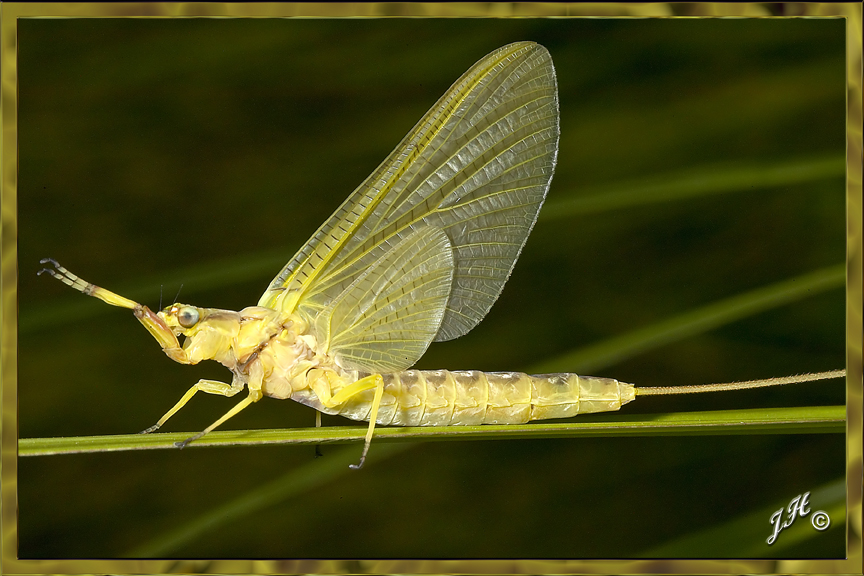
One source attributed the naming or the orchid being similar to the long legs of a Mayfly.  However, a quick search in the Internet revealed that Mayflies have fairly short legs, as in the image below:

Mayflies have relatively short legs … Source: http://www.empirepestcontrol.co.uk/wp-content/uploads/ephemerella_subvaria.jpg
It turns out that it is the appendages on the end of the abdomen that the sepals of the Mayfly Orchid resemble.  Mayflies usually have three tails (two cerci, one middle filament), although the middle tail is rarely reduced or absent. …

View original post 137 more words

2015 July Winning Photograph

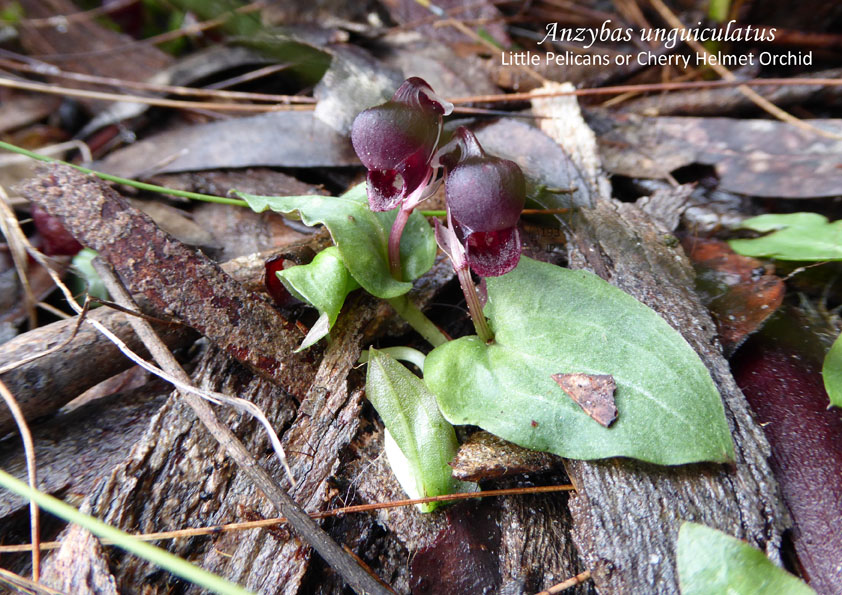
07 sm JP Anzybas unguiculatus 2

Anzybas unguiculatas (common name Little Pelican or Cherry Helmet Orchid) was the main focus for this month’s competition with three photographs of this diminutive flower.

The other photographs were Ed Lowrey’s close-up of a triggered Urochilus sanguineus labellum, John Badger’s first Diuris palustris sighting for this year and Pauline Meyer’s mass flowering of Leptoceras menziesii post fire. Of the Anzybas, Jenny Pauley entered two and Lorraine Badger one. Jenny Pauley’s photograph of two flowers was the outstanding winner.

Originally named Corysanthes unguiculata (1810), then Corybas unguiculatus (1871), the genus name was changed in 2002 to Anzybas in recognition of its distribution both in Australia in New Zealand. Since 1945 it had been recognised that the New Zealand species Corybas cheesemanii was a synonym for Corybas unguiculatas although the juvenile plant can have two leaves unlike the Australian species which is single leafed.

An interesting feature of this flower is the prominent white ears at the rear of the helmet (not clearly seen in this photograph) which are part of the labellum.

These plants are small. The gum leaves and twigs give an idea of size but the engagement ring shows it very clearly.
These plants are small. The gum leaves and twigs give an idea of size but the engagement ring shows it very clearly.  Note also the prominent ‘white ears’ of the labellum.

An unusual aspect of this photograph is that the colour of the underside of one of the leaves. It lacks the characteristic distinguishing feature of the purple underside of the leaves. According to orchid growers, the light affects the leaf colour. Heavy shade produces green leaves. It is possible that the heavy leaf litter where this plant was growing provided enough deep shade to cause the colour loss.

Bates (1990) states that it (has) not proved amenable to cultivation, but it has, on rare occasions, been benched at NOSSA meetings with the most recent occurrence was in July 2010 but it remains a very difficult plant to cultivate. The electronic version Vol 34 No 7 has a photograph of the plant just visible within the moss.

It is not always easy to photograph this species as not only is it rare with limited numbers but there are very few sites where it can be found. Added to that is that the window of opportunity is short in South Australia with a flowering time from June to August compared with those interstate which can range from May to October.

There has always been an interest in Australian orchids.  Over the years there have been many photographs of orchids.  This stereographic postcard from 1928 is a study in beauty – https://i0.wp.com/www.slv.vic.gov.au/pcards/0/0/4/im/pc004332.jpg

This postcard is held by the State Library of Victoria.

Although the distribution covers the Southern Lofty, Kangaroo Island and the South East regions of South Australia, it has become increasingly rare due to loss of habitat which consists of leaf litter on damp soils.  As a result, there are very limited localities where they can now be found.

It is one of our earliest helmets to flower which is from June to July.

References

http://www.flora.sa.gov.au/cgi-bin/speciesfacts_display.cgi?form=speciesfacts&family=&genus=corybas&species=unguiculatus&iname=&submit=Display accessed August 5 2015

Les Nesbitt personal communication

Jones, David L (2006) Native Orchids of Australasia, Frenchs Forest, NSW: Reed New Holland.

Bates, R.J. & and Weber, J.Z. (1990). Orchids of South Australia, Adelaide: Flora and Fauna of S.A. Handbooks Committee

https://biodiversity.org.au/nsl/services/instance/apni/499184 accessed August 5 2015

https://www.anbg.gov.au/cpbr/cd-keys/orchidkey/html/genera/Anzybas.htm accessed August 5 2015

Bates R, (Editor) 2011 South Australia’s Native Orchids (CD-ROM), Adelaide: NOSSA

Journal of the Native Orchid Society of South Australia Vol 34 No 7 August 2010

http://rsnz.natlib.govt.nz/volume/rsnz_76/rsnz_76_04_007280.html accessed August 5 2015

Rupp, HMR and Hatch, ED (1945) Relation of the Orchid Flora of Australia to that of New Zealand in Proceeding of the Linnean Society of New South Wales Vol 70 1945, pages 53 – 61

https://archive.org/stream/proceedingsoflin70linn#page/60/mode/2up accessed August 5 2015

Orchid Identification Quiz #1

In 2006 the electronic version of the Journal of the Native Orchid Society of South Australia Volume 30 No 2 March contained a quiz – Do you Know Your Leaves? It featured photographs of the leaves of 15 different orchid. In 2011 Robert Lawrence produced a book titled Start With the Leaves which was based upon the premise that the flower is not always present but identification is still possible.

Many but not all can be identified to species level by the leaf alone.

So here is the web version of the original quiz – how well do you know your leaves?

Hint – 20 of them are South Australian, more specifically, the Mount Lofty Ranges region.  One is a weed.

Arachnorchis tentaculataThelymitra benthamiana Thelymitra antennifera Pyrorchis nigricans Plumatochilus sp Woodland Bearded Greenhood  Oligochaetochilus bisetusOrthoceras strictum Nemacianthus caudatus Eriochilus sp Hills Woodland  Leporella fimbriata Diuris palustrisGlossodia major

Diuris orientis

Diuris behrii

Cyrtostylis reniformisDisa bracteata - weed  Corunastylis spCaladenia prolata Calochilus robertsonii  Bunochilus sp non-fertile plant

Corysanthes diemenica

Did you get them?  Click on the image to go to the name and pictures of the flower. As a couple of the links are not working and until I have time to rectify them, click here to find the all answers in the Journal.
It will be on the last page.

More to come another time ………

2015 June Winning Photograph

06 sm PM Arachnorchis argocallaOf the five entries this month, four featured winter orchids. Lorraine Badger entered a Diplodium robustum, whilst Claire Chesson, Robert and Rosalie Lawrence all entered Urochilus sangineus. Though not the winning photographs it was interesting to see the differences between the U. sangineus with one being no taller than the small Acianthus pusillus next to it and another being taller than the rapier sedge.

But the winning photograph was the spring flowering Arachnorchis argocalla (White Beauty Spider Orchid) by Pauline Meyers. This is amongst our most threatened orchids and is dealt with in depth in the Recovery Plan For Twelve Threatened Orchids in the Lofty Block Region of South Australia 2010. This fungi dependent endemic orchid is rated Endangered both at State and National level.

Found in the Southern and Northern Lofty regions, it range has been severely reduced by possibly 80%. Since 1918 no plant has been found south of Adelaide.

Flowering from September to October, it is often found in grassy woodlands often growing on gentle southerly-facing hill slopes. The soil is a clay loam with a high humus content.

This beautiful orchid has one to two non-perfumed white flowers with thickened but not clubbed drooping lateral sepals and petals. The strongly recurved broad labellum is usually white, sometimes crimson, fringed with short teeth.

This is one of our larger spider orchids reaching a height of 60cms. The size of the plant flower and leaf help to distinguish it from other similar appearing orchids such as A. brumalis and albino flowers of A. behrii.

Like many of the spider orchids it takes 2 – 5 years to reach maturity and then has a potential reproductive life of 10 years. With an average pollination rate of less than 10%, the potential to increase the population is low and any threat to survival of the individual plants needs to taken seriously.

Some threats are obvious such as weed invasion including the garden escapees such as Topped lavender (Lavandula stoechas spp. stoechas) and action is being taken to curb the spread of weeds through targeted weeding programs.

Another threat is habitat loss. This has been the result of land clearing but sites are being protected either through conservation legislation or Heritage Agreements. Habitat loss can also occur indirectly and that is through Phytophthora being introduced into the sites. Although the direct effect of Phytophtora on the orchid is unknown, it is known that it can affect the plants that grow in association with this orchid. This threat can be reduced by all of us implementing good hygiene practices.

These were some of the threats noted in the Recovery Plan. This plan was not just defensive, ie attempt to halt and minimalize the damage; but it was also proactive with measures outlined to increase the population. These included seed and fungi collection eventually resulting in germination and cultivation with a view to re-introduction.

It is good to see that there is a plan and active steps are being taken to bring this orchid back from threat of extinction.

June 2015 other entrants
Photographers from L to R: Claire Chesson, Rosalie Lawrence, Lorraine Badger, Robert Lawrence

References

Websites accessed 1 July 2015

White Beauty Spider Orchid (Caladenia argocalla) Recovery Plan
http://www.environment.gov.au/archive/biodiversity/threatened/publications/recovery/c-argocalla/index.html
Caladenia argocalla – White-beauty spider-orchid, biodiversity species Profile and Threats Database
http://www.environment.gov.au/cgi-bin/sprat/public/publicspecies.pl?taxon_id=54991
Recovery Plan For twelve threatened Orchids in the Lofty Block Region of South Australia
http://www.environment.gov.au/system/files/resources/e362cfd2-a37b-443a-b007-db3a2b7b64dd/files/lofty-block-orchids-recovery-plan.pdf

Bates R J, South Australia’s Native Orchids 2011 DVD

Moving Labellums

The following article titled Moving Lablellums written by Helen Lawrence is reproduced from the NOSSA Journal Volume 36 (1) February 2012

Labellums are fascinating. Well I think they are fascinating, especially the ones that move.

Bunochilus viriosus labellum down
Bunochilus viriosus with the labellum down

Why do these labellum move? You may have observed that the orchids which have labellums often have “hoods” and inside these “hoods” are the pollen. It is quite simple, the pollinator lands on the labellum, triggers it and is held captive by the labellum. As it struggles to free itself it pollinates the orchid. Clever, isn’t it?

Bunochilus viriosus labellum up
Bunochilus viriosus with the labellum up

So that these labellums can capture the insect they need to be sensitive. Consequently they can easily be “set off.” This can happen with of a gust of wind, or if the plant is in a pot, the labellum may trigger if the plant is moved/knocked.

It is easy to see these labellums as they move up into their “triggered position.” They move reasonably quickly, so the insect does not have time to respond.

However, how does the labellum return to its “normal” position? Does it slowly return to the position, or does it happen in a sudden movement in the same manner as when it is triggered?

One day when I was travelling in the car with a Pterostylis curta (Blunt Greenhood), I observed something very interesting. When I looked at the flower, the labellum was up, but then when I looked at it a minute or two later, the labellum was down. The labellum had to move quickly. However was it the bumps in the road which caused it to move? I had to find out.

I devised an experiment to satisfy my curiosity, and find out what these fascinating labellums actually do.

First I had to find an orchid with a labellum that could be triggered. I ended up using an Oligochaetochhilus bisetus (Two-bristle Greenhood).

Oligochaetochilus arenicola

Second I had found a good camera that could take high definition video. I placed it on a “tripod” (a pile of books).

So I had set up my apparatus, set the camera rolling, triggered the labellum, and left the room.

So what happened?

For the first six minutes after I had triggered the flowers nothing happened. There was no movement that I could see.

In the next five minutes, the labellums of the two flowers slowly moved downwards until they were half way down.

After twelve minutes of the flower being triggered, the labellum returned rapidly to its original position. This final stage of the labellum moving lasted for less than five seconds, and appeared to move at the same speed as when it was triggered.

So it looks like the labellum returns to it normal position first moving slowly and then in a rapid final movement which returns the labellum to its original position.

Urochilus sanguineus

If I thought it would be that simple, I was mistaken.

As I briefly looked through the fifty minute video I took, I came upon something that made no sense to me.

A minute after the labellum had returned to its resting position, one of the labellums suddenly returned to its “triggered” position. What’s more, there was nothing in the room to trigger the labellum: no wind, no insects, and no people. So what triggered the flower?

I do not know. Six minutes after the labellum was triggered it returned to its original position, and then two minutes later the other flower’s labellum moved into the triggered position. The first flower was triggered again for no apparent reason at all, four minutes after the second flower was triggered and still remained up.

Once the labellums returned to their original position, there was no more movement.

Maybe triggering the labellum causes a chain reaction. Maybe the labellums periodically “trigger themselves.” Well, I can’t give you any answers, all I can tell you is that it looks like this is an example of how we barely know anything about these wild gems. They are beautiful but bizarre and of course fascinating!

After 7 minutes, just before the labellum moved
After 12 minutes, labellum about to fall
After 13 minutes, labellum in original position


As a 50 minute video is a bit long to watch, Helen has produced a four minute video, so watch and enjoy the music!

Why use a mulch on your potted terrestrial orchids?

Here in South Australia, it is very common to see a covering of She Oak needles (Allocasuarina sp.) on pots of terrestrial orchids.  According to Les Nesbitt, NOSSA founding member and experienced terrestrial orchid grower, there are four reasons for this

  • It keeps the leaves up off the soil.
    • Provides good air circulation
    • Helps prevent leaf rot.
  • It provides nutrients to the fungi
    • This is very important for the fungi dependent orchids.
  • It stops pitting into the soil when it rains.
    • This is most likely to occur when pots are under the drip line of a shade-cloth.
    • Pitting exposes the root system.
  • It allows the leaves to readily come through because of its small diameters.
    • Other mulches, such as gum leaves, smother seedlings.

She Oak needles are the choice of mulch because it is

  • Long lasting and takes more than year to break down
    • which means that it lasts the whole growing season.
  • Does not become mushy or spongy
    • unlike pine needles and grass cuttings which breakdown more quickly into a wet soggy mass and contribute to leaf rot.

It should be noted that it is necessary to replace this mulch yearly.

These two pots were in the same area under the shadecloth.  Notice the damage to the pot without the mulch.
These two pots were in the same area under the shadecloth. Notice the rain damage to the pot without the mulch.

An Examination of Two Rufoushoods

This week’s post is taking a brief look at a paper by Noushka Reiter, Mark Clements and Kate Vlcek which appeared in Muelleria, Volume 31: 69 – 76, 2013.

Titled “An examination of Pterostylis xerophila (Orchidaceae) and the confirmation of P. lingua as a new species in Victoria” this paper seeks to ascertain whether the records collected are correctly identified, that there are differences between them both in morphology and associated vegetation.

Both P. xerophila and P. lingua are found in South Australia where they are known, respectively, by the synonyms Oligochaetochilus xerophilus and O. linguus. In fact the type specimen for O. xerophilus is from South Australia.

In the introduction, the authors give a detailed description of Oligochaetochilus otherwise known as the ‘rufa group’ which differs from Pterostylis, in the strict sense, in several features. Some of the main features of this group are:

  • Basal rosette of overlapping stemless leaves
  • Leaves senesced, withered and died, by flowering
  • Erect multi-flowered
  • Flowers
    • Lateral sepals
      • hang down
      • basal half joined
      • tips become long and threadlike
    • Labellum
      • is very mobile
      • has obvious long white hairs and often short hairs as well
Typical of the rufus hood this Oligochaetochilus arenicola shows the sencesing leaves, pendent petals and hairs on the labellum. Photographer: H Lawrence
Typical of the rufus hood, this Oligochaetochilus arenicola shows the sencesing leaves, pendent petals and hairs on the labellum.
Photographer: H Lawrence

Later in the articles, the differences between the two species are discussed. There is much of interest concerning the two species but one outcome of the research was to establish that P. lingua (O. linguus) had been incorrectly identified in the records and by correcting the names of the specimens the authors were able to confirm that it did occur in Victoria.

To find the answer to the authors other questions, read the paper

And for those that need a glossary of the terminology used, click here

For images of P. xerophila (O. xerophilus) click here

For images of P. lingua (O. linguus) click here

2015 April Winning Photograph: Calochilus cupreus

04 sm HL Calochilus cupreusDespite having five very different but high quality photographs, Helen Lawrence’s photograph of Calochilus cupreus (Aldinga Bearded Orchid) was the clear winner with the vast majority of votes.

In South Australia it is considered endemic and endangered. Researching it was interesting. For instance, there is no mention of it in Jones extensive book (2006) yet it was named by R S Rogers in 1918 with a description appearing in Black’s Flora of South Australia (1922 edition), including a drawing by Rosa Fiveash. Between then and now there was a shift. In the Third edition of Black’s (1978) C. cupreus is absent but C. campestris present. In Bates and Weber 1990 the authors describe C. campetris (C. cupreus). Currently, the eflora of South Australia (the electronic version of 1986 Flora of South Australia) considers it a synonym of C. campestris. This is reflected in the Census.

It would appear that as C. campestris was studied and its variations documented (e.g. article by Jones 1976 Orchadian 5:83) the distinction with C. cupreus was lost. Clements and Jones (2006) state “Calochilus cupreus R.S.Rogers = Calochilus campestris” which means that they are not using C. cupreus. But in Jones’ book an anomaly occurs – he does not include South Australia in the distribution of C. campestris and as result Bates, from 2008, states that it is not recognized as occurring in South Australia.

Though C. cupreus disappeared from the literature the name still continued to be discussed amongst orchid enthusiasts. So when in 1995 NOSSA members found a distinctively different colony at Aldinga they identified it as Rogers’ C. cupreus.

Below is a chart, based upon Dr Rogers’ description, of some of the differences that made him consider C. cupreus a separate species:

C. cupreus C. campestris C. robertsonii
Shorter leaf

Rather rigid or fleshy erect triangular section

Longer leaf

Crescentic section

Longer leaf

Crescentic section

Base of labellum oblong glabrous (without hairs) with several raised longitudinal line Base of labellum round thickened, smooth no raised longitudinal lines Whole of labellum hirsute (hairy)
8 – 15 flowers About 8 flowers maximum About 8 flowers maximum

It will be interesting to watch what happens.

References

Bates personal communications

Bates & Weber (1990) Orchids of South Australia

Bates (2011) NOSSA South Australia’s Native Orchids

Bates (2005 to present) Orchids of South Australia CDs various editions

Clements and Jones An Australian Orchid Name Index (27/4/2006)

https://www.anbg.gov.au/cpbr/cd-keys/orchidkey/html/AustralianOrchidNameIndex.pdf

Jones (2006) A Complete Guide to Native Orchids of Australia

NOSSA Journal Vol 25 No 10 November 2001

Rogers R S Transactions of the Royal Society of South Australia V42 (1918) Pages 24, 25

http://www.biodiversitylibrary.org/item/113409#page/40/mode/1up

Native Orchid Identification Poster Launched

Over the years, Natural Resources Adelaide and Mount Lofty Ranges (NRM) have been involved with providing educational resources for schools and the community.  One resource has been A3 Identification Charts.

This week has seen the release of  another identification chart – Common Orchids of the Adelaide Hills.  Produced in collaboration with the Native Orchid Society of SA, it was launched at our general meeting on April 28.

These charts are available free from the NRM website.  To get a copy of the poster, click on the image below and scroll down to Identification Charts.  Whilst there have a look at some of their other posters.

NRM & NOSSA Orchid PosterPS the chart looks good on a smart phone which makes it convenient for out in the field.


Creating a Mosquito-free Micro Climate for Epiphytes

Adelaide in summer is very dry and hot with very little humidity or rain.  Since January 2015 there has been over 60 days without any significant rainfall.  This presents a problem for growing Australian epiphytes which come mainly from the eastern seaboard with its increased humidity and summer rain.  Therefore to grow ephiphytes in Adelaide, it becomes necessary to attempt to replicate these conditions through creating a micro climate with increased humidity.  To achieve this many growers will stand the pots on gravel in water-filled trays but this presents a problem.  Mosquitoes love it and rapidly breed up to the annoyance of us all.

The following system stops mosquitoes from breeding plus prevents pots getting water logged in Adelaide’s winter, particularly when the pots are not under a solid roof but shadecloth (in this instance, 50% shadecloth).

  • Equipment
    • 10 Black trays – these were inexpensive trays from Cheap as Chips
    • Black irrigation tubing
    • 10 Grommets
    • 11 ‘T’ junctions and 2 angle junctions
    • Tap
    • Sealant
    • Gravel
    • Builders Landscape Fabric
  • Preparing the trays
    • One hole was drilled in each of the trays.  A grommet was placed in each hole and using ‘T’ and corner junctions the trays were joined with poly tubing including a tap.

      The trays connected.  To give stability the trays and hose were connected to the table top.
      The trays connected. To give stability the trays and hose were connected to the table top with the hose running under the table top. This allows free drainage as it stops the hose from being squashed.
  • Checking the system for leaks
    • The next step was to check that the water flowed into all the trays and that there were no leaks.

      Filling all the trays from one tray.
      Filling all the trays from one tray.
    • There were leaks and these were sealed with an aquarium sealant.
    • A hose with a tap was directed toward a raised garden bed on the other side of the shadecloth.

      Checking for leaks & the drainage system
      Tubing leading to the raised garden bed
  • Preparing the inner tray
    • The system requires a second tray.  Drainage holes were drilled in the trays.

      Inner (upper) trays with holes to allow the water to come up into the pots.
      Inner trays with holes to allow the water to come up into the pots.
    • Gravel was placed in the outer (lower) tray.

      Gravel to support the inner trays
      Gravel to support the inner trays
    • The reason was two-fold.  One was to make it easier to remove the inner tray with the pots insitu and the other was to hold the builder’s landscape fabric nearer the inner tray.  The purpose of the fabric is to keep the tubing clear of debris.

      Layer of cloth to stop debris entering the drainage pipes
      Layer of cloth to stop debris entering the drainage pipes
  • The finished system
    • Pots in place and ready to enjoy the new growth of those numerous plants that were divided previously – see the post Breaking up is ….. easy to do.

      The front pot originally consisted of just the pseudobulbs without leaves of Dendrobium kingianum.  After a few weeks in this system, new growth.
      The front pot originally consisted of just the pseudobulbs of Dendrobium kingianum. There were no leaves. After a few weeks in this system, new growth has appeared.
  • Using the system
    • Depending upon the conditions, the mosquito breeding cycle can be as short as four days from egg-laying to the larva emerging as a adult.  As a result, the water is fully drained every four days or less.  This regular drainage of water means that there is no stagnant water left lying around for any prolonged length of time.
    • The trays are allowed dry for a couple of days (less in a heat wave) before refilling again and the pots sit in a small amount of water.
    • By following this watering cycle there are no mosquitoes.
    • The shallow layer of water around the pots provides the necessary humidity.
    • In winter the taps are left open the whole time to prevent the plants from becoming water-logged.

NB This system is not suitable for the terrestrial orchids.