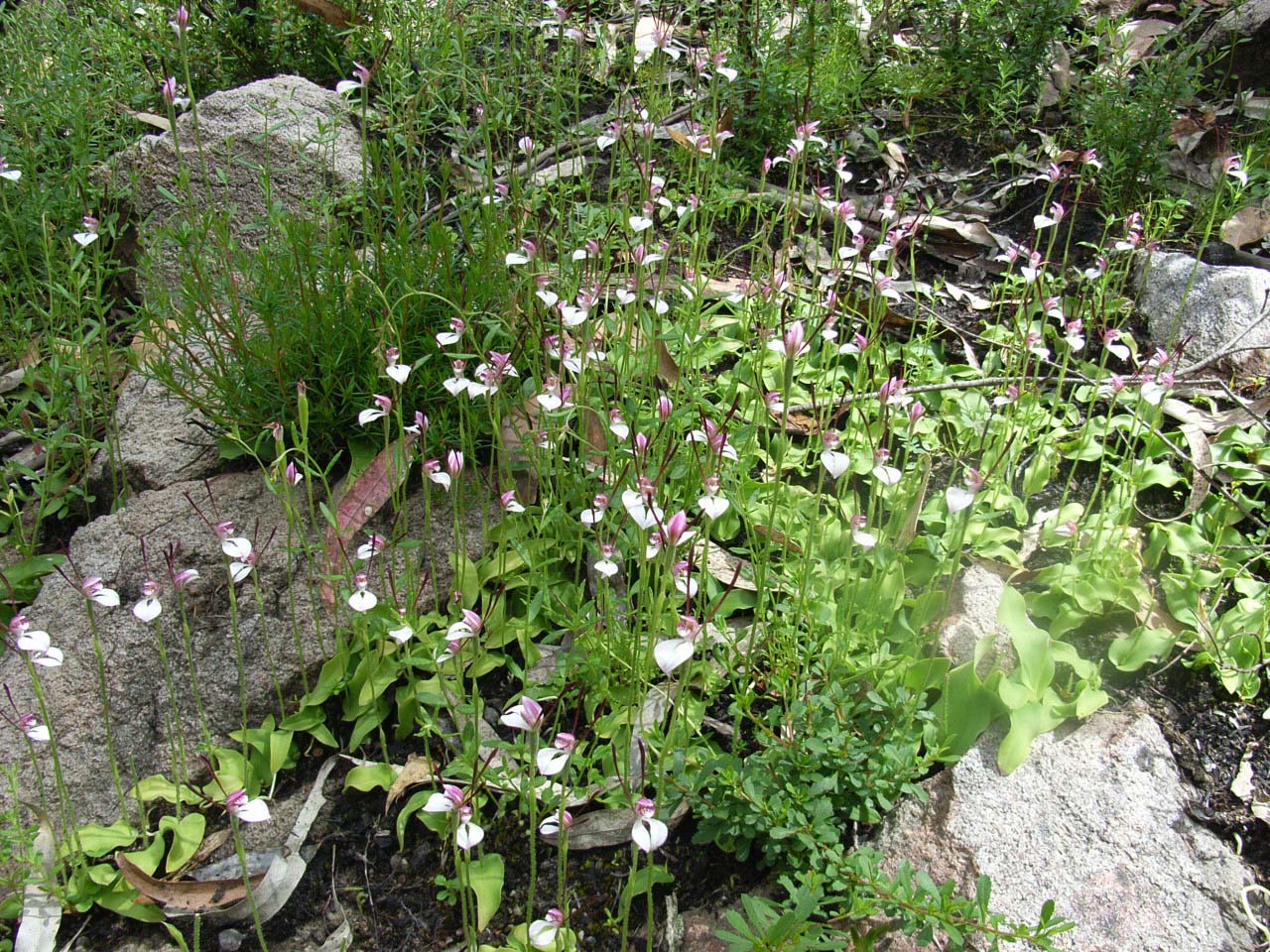
This month’s theme for the photo competition was blue and white. White flowers can occur as a result of lack of colour such as Rosalie Lawrence’s Caladenia latifolia (Pink Fairies) which is normally pink. White orchids can also occur naturally such as the Arachnorchis argocalla (White Beauty Spider Orchid) and Arachnorchis intuta (Ghost Spider Orchid) both photographed by John Fennel, or as a dominant colour such as Lorraine Badger’s Eriochiluscollinius (syn Eriochilus sp Hills Woodland).
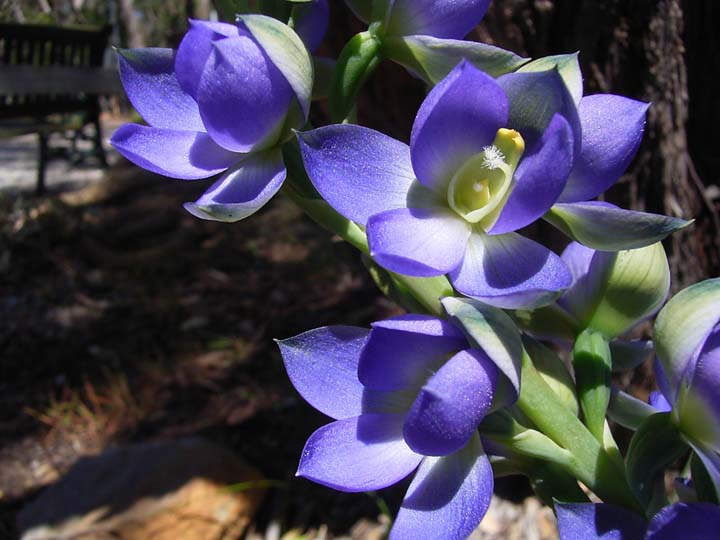
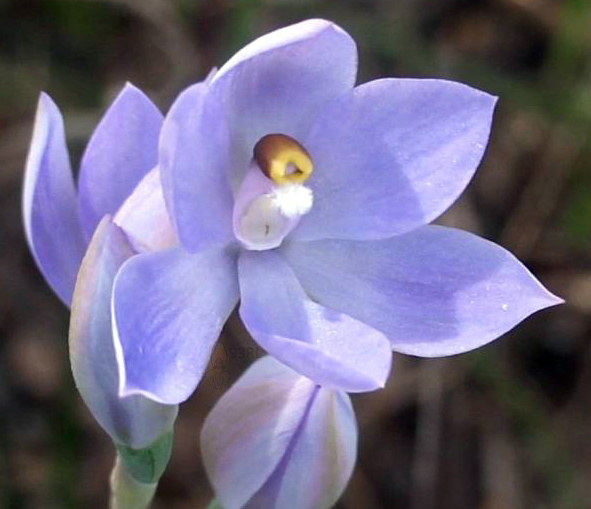
Of the blue orchids, both Ricky Egel and John Badger entered pictures of Thelymitra x truncata (Blue Spotted Hybrid Sun Orchid) whilst Robert Lawrence entered a Thelymitra grandiflora (Giant Sun Orchid) which was the outstanding winning picture.
Blue in the floral world is unusual colour in the floral world for it is not a naturally occurring colour. In fact, “[t}he key ingredient for making blue flowers are the red anthocyanin pigments. Less than 10 percent of the 280,000 species of flowering plants produce blue flowers.” (Lee, 2010 as cited in Oder 2014).
Whilst blue orchids occur outside of Australia, their “colour cannot rival” … “the intensely blue flowers” … “especially [are] unique in the orchid world” … “of their Australian counterparts. The sun orchids (Thelymitra) in particular are famous for their sky blue flowers.” (Ronse 2008: 103)
Based upon Jones 2006 tome, the following genera have true blue orchid species – Cyanicula (9 species), Pheladenia (1 species), Epiblema (1 species) and the largest group Thelymitra (about 65 out of potentially 118 species) plus one hybrid, XGlossodenia tutelata. Of the epiphytes, blue is almost non-existent except for three which Jones lists that rarely might be bluish and they are Vappodes bigibba, V. lithocola and V. phalaenopsis*.
With such rarity, is it any wonder then that the Chinese attached special significance to it as a plant that could cure lung disease and the Aztecs saw it as a symbol of strength.
*Names used as they appear in Jones 2006 tome
Reference
Jones, D. L., A Complete Guide to Native Orchids of Australia Including the Island Territories. Reed New Holland
Lee, David (2010), Nature’s Palette: The Science of Plant Color< Chicago, University of Chicago Press
The following article by Les Nesbitt was published in May 2017 Native Orchid Society of South Australia Journal Volume 41 No 4. The article relates to Australian Native Orchids.
Suggested potting mixes for potted native terrestrial orchids have changed greatly over the years as some ingredients such as peat moss have become too expensive or difficult to obtain. Basic requirements are that the mix should be free draining yet retain moisture and should have an organic component that breaks down slowly and does not go mushy in winter. Most species are not too fussy and will grow in a variety of mixes.
Those tubers that desiccate in summer do better in a heavy mix that contains clay. Examples are Diurus behrii, D. punctata and Pterostylis nutans.
Tubers that rot easily in wet soil in Spring prefer an open coarse sandy mix. An example is Thelymitra antennifera.
A dry mix containing a higher proportion of sand is usually recommended for Caladenia and Glossodia species grown in pots. In contrast these orchids grow in clay soil on my property in the Adelaide Hills but there excess water can run off. In pots, excess water has to drain through the potting mix.
An organic component is vital to feed orchid fungi.
Some Basic Ingredients:
Washed sand with rounded particles. (Not sharp sand as this sets hard in summer.)
Soil (sandy loam, clay based loam, mountain soil)
Native seedling mix (Bark based – sieve to remove splinters)
Native potting mix (can be sieve* to remove larger particles)
Chopped and sieved* gum leaves
Perlite or isolite (but will make tubers harder to identify at repotting time)
Composted leaf mould & buzzer chips (but needs to be gathered now for use next summer)
Cauarina (She-oak) needles chopped for surface mulch
Some Suggested Potting Mixes
ANOS-Vic dry mix – 2 parts coarse sand, 1 part coastal sandy loam, 1 part composted buzzer chips, 1 part leaf mould
100% native potting mix. (Works for drought resistant tubers, viz. Pterostylis curta & P. pedunculata)
Native potting mix (sieved*) and isolite
Native potting mix and sand
Les Nesbitt’s current mix of 50% sand, 20% hills soil, 25% seedling potting mix (sieved), and 5% chopped & sieved* string bark gum leaves.
Leo Davis always has some interesting insights from his orchid observations. In this article he examines the position of the tepals (petals and sepals) in particular the Moose Orchid which he saw for the first time this year.
Have a close look, next season (winter to early summer) at some of our native lilies. Start with the jolly bulbine lily (Bulbine bulbosa), no longer a true lily incidentally, because it now resides in family Aspodelaceae, along with the grass trees. You will find three yellow petals at 12, 4 and 8 o’clock and closely behind them three almost identical sepals at 2, 6 and 10 o’clock, so at first sight you see six apparently identical tepals (sepals and petals). Move on to the rush fringe-lily (Thysanotus juncifolius), as described in Ann Prescott’s ‘It’s Blue With Five Petals’. Clive Chesson is more up to date and tells me it is now T. racemoides. Again it is no longer a true lily, now sitting in family Asparagaceae. Here the tepals are noticeably different. Three wide densely fringe edged petals will be found, if you view the flower face on, at 12, 4 and 8 o’clock. The narrow non fringed sepals sit close behind at 2, 6 and 10 o’clock. These are just a generalisations because if the flower turns only about 60o a sepal will be at the top.
Most orchids, while close relatives of the true lilies and the one time lilies, do not show these arrangements. Let’s start with some that do.
In the large duck orchid (Caleana major) the petal at 12 o’clock, the dorsal petal, is modified, as in most, but as usual, not all, orchids, to become a labellum. In this charmer the labellum takes the form of a duck’s head. Its function is to snap down trapping a pollinator insect in the cup shape column below it, forcing it into contact with the sticky off white stigma and/or the yellow pollinia below it. Look closely and you will find the other two narrow petals drooping at around 4 and 8 o’clock. Two folded, twisted sepals can be clearly seen at around 1 and 11 o’clock. The third sepal, at 6 o’clock, is tucked in behind the cup shaped column. Note that, as with lilies, the top tepal is a petal.
Caleana major, Knott Hill NFR Photographer: Leo Davis
The leek orchids (genus Prasophyllum) follow this pattern and also have their labellum at around 12 o’clock. These orchid groups, which are up the right way, are said to be ‘not upside down’, using the technical term ‘non resupinate’.
Most orchids are ‘upside down’ and are called resupinate. The whole flower rotates 180o, clockwise or anti I don’t know, at the embryonic stage. But let’s start with somewhat of an exception with the sun orchids (genus Thelymitra) which do not have a petal modified as a labellum. But they are indeed upside down.
Have a close look at the Thelymitra benthamiana flower. Note that the three petals, at roughly 2, 6 and 10 o’clock, are in front of the three slightly larger but very similar sepals, at 12, 4 and 8 o’clock.
Note that the toptepal is a sepal. The flower is upside down, that is resupinate. In most orchids the petal at 6 o’clock would be modified to be a labellum.
Thelymitra benthamiana, Scott Creek CP; Photographer: Leo Davis
The Arachnorchis (possibly Caladenia to you) stricta, from Sherlock, out in the mallee, is more typical of terrestrial orchids in SA. It is upside down, that is resupinate, and has a petal modified to be a labellum.
The bottom petal has become a wide labellum, with fine edge combs and parallel rows of rich plum coloured calli covering its centre. Out at roughly 3 o’clock is a narrow petal, the other invisible on the other side. At the top, pressed tightly against the column, a sepal arches forward. Two larger sepals extend down at around 5 and 7 o’clock.
Arachnorchis stricta, Sherlock; Photographer: Leo Davis
When I saw my first, my only, moose orchid, this season, I was in such a state of excitement that it looked to me to be up the right way, that is to say upside down.
Cryptostylis subulata, Stipiturus CP; Photographer: Leo Davis
Have a look. Two narrow short roughly vertical petals at about 1 and 11 o’clock. There are two sepals at just past 3 and just before 9 o’clock. That’s OK but where is the other sepal? Are there it is, where it should be, at midday. But hang on, it’s behind the flower stem (peduncle) and where is the column?
Cyrtostylis subulata with labellum lifted; Photographer: Leo Davis
Holding the labellum up with a stick I found the column, the stigma and the pollinia, underneath the labellum. The third sepal now appears to be at 6 o’clock. And it all became clear. This flower was up the right way (non resupinate) but it has turned forward, on its peduncle, by about 180o, to become upside down, but not in the manner of resupinate flowers, because it is back to front. It is an inverted non resupinate flower. Still with me?
Mad dogs and Englishmen are not the only ones to go out in the midday sun. For orchidologists to see Sun Orchids flowering, then it is out into the midday sun on a hot day because that is when they open. There is no point going much before 11am and by 2pm most are closing and no point going out on a cool or windy day.
But for those who don’t want to go out (or cannot get out) into the midday sun, here is a video to be viewed in the cool of the shade.
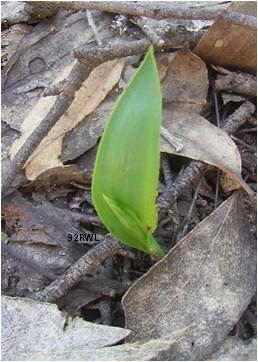
This video features the Leopard Sun Orchid (Thelymitra benthamiana) an uncommon Sun Orchid in South Australia. Unlike many sun orchids which requires a view of the flower to confirm identification, this one can be identified by the leaf alone. At the beginning of the video take note of its distinctive leaf.
The second fact sheet in Terrestrial Culture notes is about Slow Multiplying Terrestrials.
FLAGBEARER SPECIES: Thelymitra nuda
Diuris, Pterostylis and Thelymitra. They are more expensive because they have to be raised from seed in flasks. SMs are not so easy because there is less room for error. A few have a near zero increase rate and will fade away unless additional plants can be produced to make up for occasional losses from predators and disease.
GROWTH HABIT: Australian ground orchids follow an annual growth cycle comprising 6 – 8 months as growing plants under cool (5 – 20°C max, 0 – 14°C min) moist conditions and 4 – 6 months as dormant tubers in hot dry (18 – 42°C max, 12 – 30°C min) conditions. The new tuber is produced in winter – spring. Each tuber sends up a shoot to the surface in Autumn and leaves grow rapidly in late Autumn/early Winter as temperatures fall and the rains set in. Pterostylis leaves are usually the first to appear in March/April followed by Diuris and Thelymitra in April/May. Sometime in October/November the leaves go yellow and then brown and dry as the days get longer, hotter and drier in late Spring.
LIGHT/SHADE:Australian terrestrial orchids are easy to grow. In Adelaide they thrive in a shadehouse of 50% shadecloth. Some species prefer heavy shade, others full sunlight, but most will adapt to a wide range of light intensity. Sun loving species (Diuris, Thelymitra & Rufa group Pterostylis) prefer a brighter location for good growth.
If the leaves and stems are weak and limp or if the leaf rosettes are drawn up to the light then the shading is too dense and the amount of light should be increased. The spring flowering species like higher light intensities at flowering time and flowers may have pale colours if placed in heavy shade, even temporarily, when flowers are just starting to open.
In very cold areas an unheated glasshouse may be required for frost protection although light frosts do not worry the majority of species.
AIR MOVEMENT/HUMIDITY:All species like good air movement and will not thrive in a stuffy humid atmosphere especially if temperatures are high.
WATERING:The soil should be kept moist at all times during active growth by watering gently if there is no rain. Hand watering is especially necessary in spring as soil in pots dries out more rapidly than in the garden. Watering must be done slowly so that the mat of needles on the surface of the pot is not disturbed. Slugs and snails love these plants and must be kept under control. Raising the pots off the ground on galvanised steel benching is very effective in controlling these pests.
After the leaves have turned yellow, let the pot dry out completely to dry up the old roots and tubers otherwise they may turn into a soggy mouldy mess and rot may destroy the adjacent new tubers.
POLLINATION/SEEDCOLLECTING:Flowering plants are hand pollinated and the seed collected just before the pods split open and the dust-like seed blows away. The seed is sprinkled on pots of mother plants at Easter or flasked.
REPOTTING:Repot every second year in half new mix. Repotting is normally done between November and January. The best results are obtained if the tubers are repotted in half fresh soil mix each second year. A suitable soil mix is 40% loam, 50% sand and 10% organic matter with a little blood and bone fertiliser added. A 5 mm sieve is a useful tool for separating tubers from soil. Replant the dormant tubers with the tops 20 mm deep. Cover the soil surface with a mulch of sheoak needles, chopped to 20 – 50 mm lengths, to prevent soil erosion & aerate under the leaves.
INCREASING PLANT NUMBERS:The pull-off-the-tuber method can be used with some diuris and Pterostylis species to double plant numbers annually. The pots can be knocked out and the tubers examined in Summer without harm.
SUMMER CARE: Keep the pots shaded and allow the pots to dry out between light waterings until mid-February when they should be set out in their growing positions and watered a little more often. The tubers of some species will rot if kept wet during the dormant period, others will produce plants prematurely which are then attacked by pests such as thrip and red spider and fungal diseases in the warm weather.
FERTILIZING:SMs will benefit from weak applications of folia feed in the early growth stages.
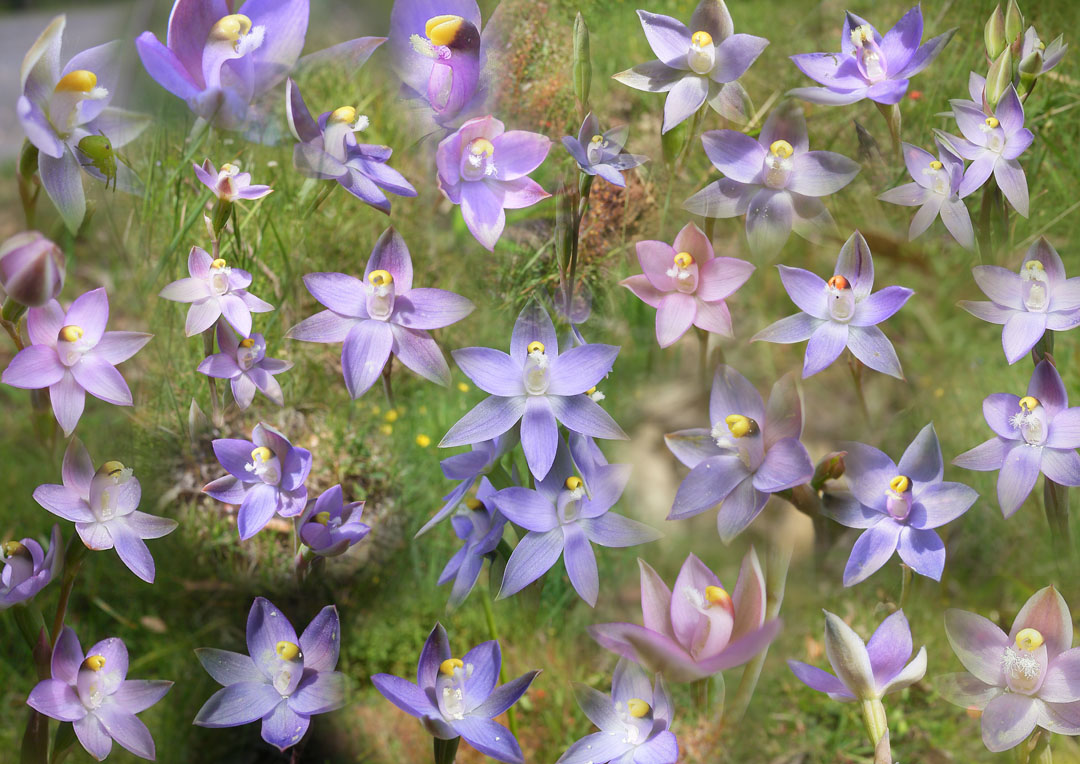
In the past week there has been some Facebook conversation on the identification of some Thelymitra (Sun Orchids) here in South Australia. Sun Orchids can be problematic particularly when there is only one photograph. If the photograph has a clear view of a diagnostic feature, then identification becomes simpler but there are many species for which careful observations are necessary to determine the correct one. This is important when considering some of the complexes, eg T. nuda and T. pauciflora which have several similar species. Colour is not always helpful as there can be either variation in colour or no colour at all. Further complicating identification is that Sun Orchids readily hybridise, far too easily sometimes!
When Robert Lawrence wrote his book, Start With the Leaves, he realised the difficulty in identifying some orchids, so he included a checklist of observations. The checklist is extensive but was developed to be used with the electronic version of South Australia’s Native Orchids by RJ Bates which covered all the known South Australian orchids in 2011.
To assist in orchid identification, take as many photographs as possible, showing different parts of the plant and habitat from as many different angles. But remember, photograph the typical plants.
In this collage there are several species but which is which?
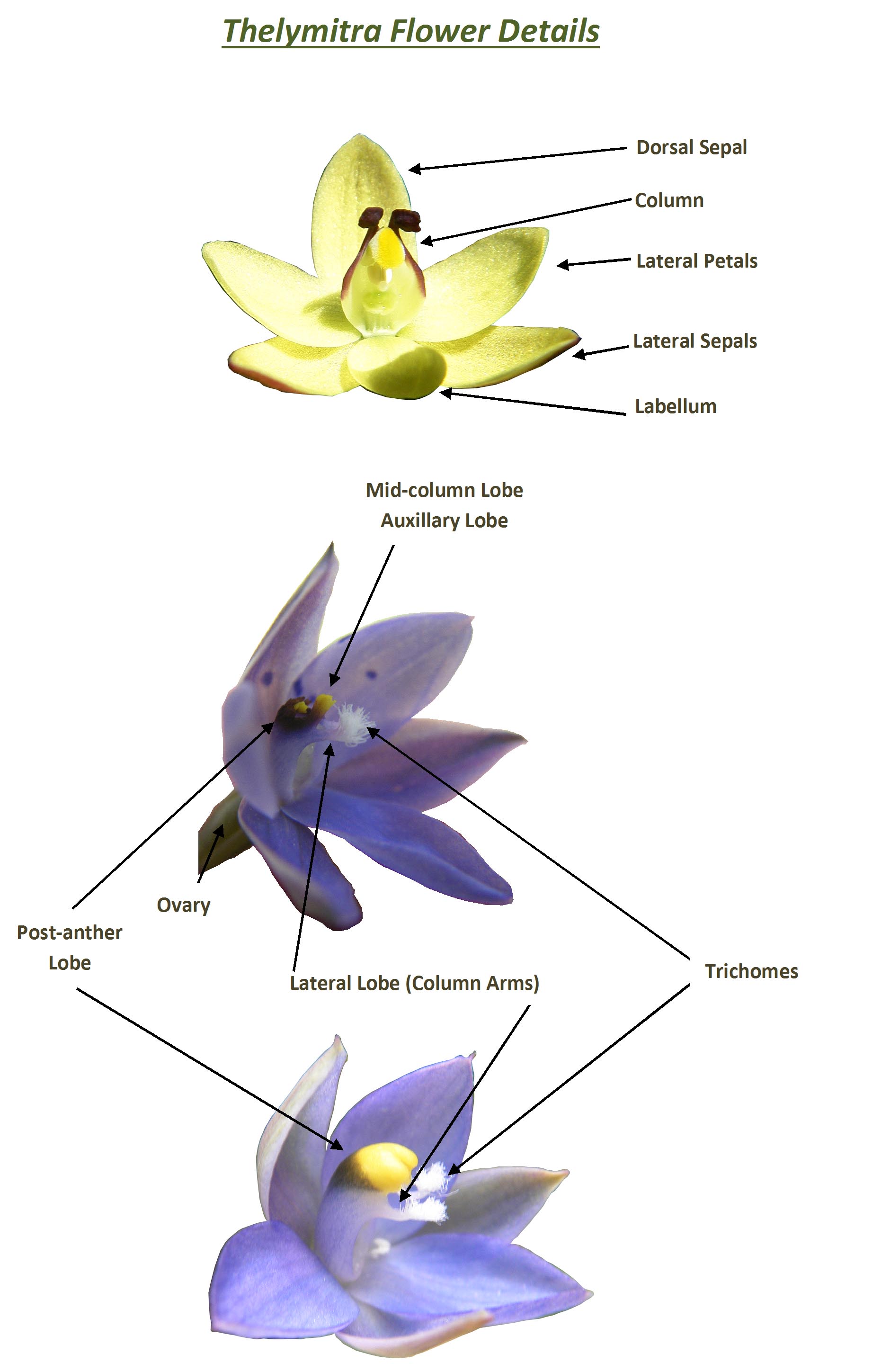
At the bottom of the post is a picture showing the parts of the flower.
The following extract is from pages 185 – 187
Thelymitra species (Sun Orchids)
Habitat features
Describe the habitat where the plants are found
Is the species confined to swamps or very moist sites?
Was the site burnt in the last year or two? (Find out when if possible)
Are the plants restricted to a particular habitat or is there a range of situations where it grows?
Has it multiplied following disturbance?
Does it prefer wet or dry sites?
What other plants are growing with the orchids, including the trees forming the canopy?
Number of plants
Estimate the number of plants or describe the distribution of the plants at the site
Do plants occur in small clumps?
Do plants occur in colonies and if so how large are they?
Size of the plant
What is the height of the flower stem and width of the flower stem?
Leaf features
What are the length, width and shape of the leaf?
Is the leaf flat, channelled (u-shaped) or tubular in section?
Does the leaf change shape along its length?
Does the leaf have parallel ridges?
Is the leaf thick and fleshy or thin and papery?
What colour is the leaf?
Does the leaf have a reddish base and is the red colouration in parallel lines?
Are there any hairs on the leaf and are they confined to the margins?
Is the leaf rigid and upright or is it weak at the tip and falling under its own weight?
What is the tip of the leaf like and does it have a pointed apex?
Are the leaves shiny or to they have a powdery covering?
Stem features
What is the diameter of the stem?
What is the colour of the stem?
How high is the fistula, the point the point where the stem separates from the leaf?
Sterile bracts
(Bracts are leaf-like structures along the flowering stem)
How many bracts are there on the stem (ie those that are not immediately below a flower)?
How long is each of these bracts?
What colour are the bracts?
Are the bracts tightly or loosely wrap around the stem?
Fertile bracts
(Fertile bracts are leaf-like structures at the base of each flower)
How long are the bracts?
What colour are the bracts?
Ovary features
(The ovary is the structure immediately below the petals and sepals that becomes the seed capsule after the flowers are pollinated)
What colour are the ovaries?
How long are the ovaries?
How wide are the ovaries?
Flower features
What time of the year are the flowers open
What is the length and width of each flower?
Do the petals and sepals open widely, or does the flower remain almost closed?
What colour are the petals and sepals?
Do the petals have spots or darker coloured veins?
Is the labellum larger or smaller than the other segments (petals and sepals)?
Are segments rounded, pointed or cup shaped?
What colour is the outside of the buds?
What conditions are required for the flowers to open? Are they only open in hot, humid conditions?
Column features
What colour is the main part of the column?
Describe the post-anther/mid-column lobe
Is there a tubular structure on the top of the column? What colour is this and does it have a collar of a different colour?
Does the lobe have a cleft in the apex and how deep is this?
Does the column have lateral lobes (arms) reaching in front of the column?
Are there trichomes (hair-like structures) in a mop or toothbrush arrangement?
Is there a sharp bend in the column arms?
If there is not a tubular lobe, are there three levels of structures on the column?
Are there papillae (rows of narrow bumps)? How many and what colour are they?
What colour is the crest, if present?
Fragrance
Describe the fragrance of the flower or whether there is none
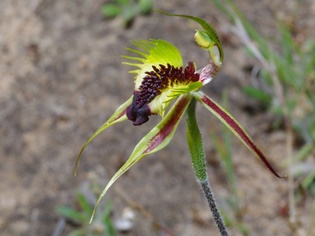
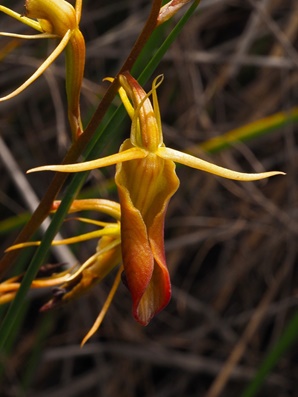
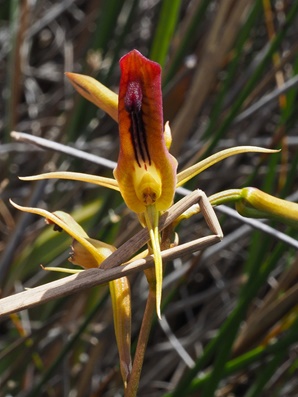
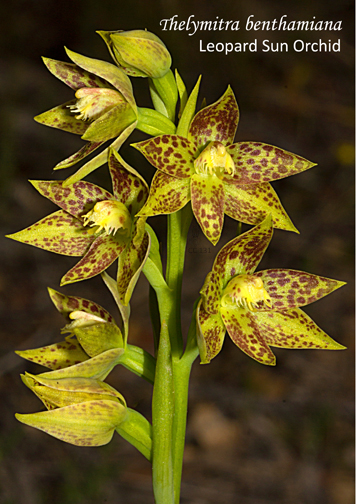
Five entries were received, again spanning the country from east to west. John Badger entered a Chiloglottis reflexa recently photographed in Tasmania, Pauline Meyers an unidentified Western Australian Spider orchid, Judy Sara had two entries from the latest field trip, Eriochilus collinus (previously phrase name Adelaide Hills) and Leporella fimbriata and Claire Chesson’s Thelymitra benthamiana.
T. benthamiana, the winning picture, is a beautiful sun orchid that is found across the southern Australia from Western Australia through South Australia to Victoria and Flinders Island. More common in west than elsewhere it is the only one of the seven species in the T. fuscolutea complex to be found in the east.
Since the early days confusion, which persisted into this millennium, has occurred. In 1871 Reichenbach recognised 3 species one of which was T benthamiana but Bentham after whom the orchid was named disagreed and consider it but a synonym of T. fuscolutea. There were many twists and turns in the names but in effect, for over a hundred years, most authors followed Bentham’s taxonomy rather than Reichenbach’s until 1989 when Mark Clements after studying the drawings, literature and orchid type material came to the same conclusion as Reichenbach that T. benthamiana was a distinct species from T. fuscolutea. Since then, authors have followed Reichenbach/Clements taxonomy.
Over the decades, the number of species in this complex varied considerably. By 1938 three separate species were recognised, but between then and 1989 it fluctuated between recognizing one, three and four species and in 1998 the orchidologist were considering a possible seven species. These were all confirmed and named in Jeans’ 2006 paper. Today, according to Orchids of Western Australia there is potentially an eighth member in this group.
Jeanes highlights some of the issues involved in determining which species is which. Some of the issues are lack of accurate/detailed information such as location, type of terrain, habitat, surrounding plants, date of collection, etc. Dried specimens by themselves are inadequate as important features may be lost in the drying process.
This complex is but an example of a widespread problem across many of our Australian orchids indicating not only the need for careful observations in the field but meticulous record keeping that others can access.
References
Jeans J A, Resolution of the Thelymitra fuscolutea R. Br. (Orchidaceae) complex of southern Australia. Muelleria 24: 3-24 (2006)
Brown A, et al, Field Guide to the Orchids of Western Australia, 2013
Thank you to Juergen Kellermann, (senior botanist for the State Herbarium) for critiquing this article.
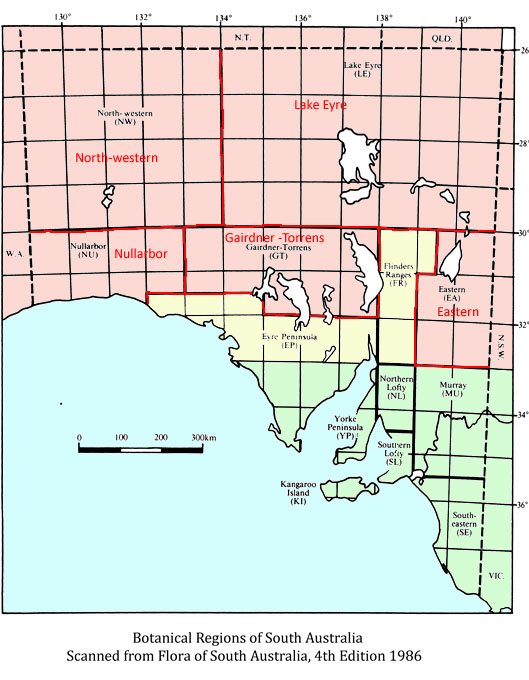
Think of deserts and the image is that of a bleak barren landscape with little to see but this is not so. The conditions are harsh but there is a myriad, though not an abundance, of hardy fauna and flora if one but looks closely.
But concerning orchids – No orchids have been found in true deserts….. They also appear to be absent from the arid mountains of the far north-west, or at least no-one has ever found orchids there.
Orchids need moisture and so they do not grow on unstable soils such as dry sand-hills, gibber plains or the many saline areas of the far north but on the desert fringes there are micro-climates where the moisture, humidity and soil structure is just right (to quote Goldilocks) for orchids. This micro-climate is created by [s]hrubland [which] is … [an] … important dryland orchid habitat. Besides providing shade and shelter for the orchids, shrubs like the many species of wattles, Acacia and hop-bush Dodonea drop fine leaves which help to hold the soil together and slowly break down into humus rich with nutrient and water storing capability. These shrublands usually form in soils too dry or shallow for trees. Orchids of course have no need for deep soils as they are shallow rooted.
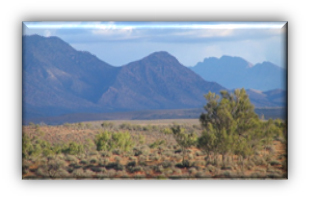
Semi-arid Shrublands, Flinders Ranges
Of the five desert botanical regions, the Eastern region contains the most number of species with over a dozen species.
Colour added to indicate the desert regions (in red)
Orchids of the Eastern Region – this region is from the east of the Flinders Ranges to the New South Wales border and includes the Olary Spur and Lake Frome.
Arachnorchis toxochila – Dry Land Spider Orchid or Bow Lip Spider Orchid.
Corunastylis tepperi – Mallee Midge Orchid
Diplodium robustum – Common green shell-orchid.
Hymenochilus pagophilus – Mountain Shell-orchid
Microtis eremaea – Desert onion orchid
Microtis frutetorum – Common woodland onion orchid.
Oligochaetochilus bisetus species complex, Rusty rufous-hoods
Oligochaetochilus sp. Blue-bush Plain – Blue Bush rufous-hood (O. bisetus complex)
The Gairdner-Torrens region includes, besides the salt lakes it is named after, the Gawler Ranges and the southern part of the Great Victoria Desert. Though not as many species as the Eastern region, it contains some different species including a Sun Orchid.
Thelymitra megcalyptra – Scented or Dryland Sun Orchid
Third of this group is the Nullabor region. Consisting of flat treeless limestone plains, this area, surprisingly, has two species both of which have been found close to the coast.
The final two regions Lake Eyre and North-Western contain the vast expanses of desert of the far north of South Australia. Definitely not a place to find orchids yet one specimen has been collected from each of these two regions.
Oligochaetochilus sp. Everard Range (L. Scott 173), Mimili Orchid (possibly O. woollsii complex) from North-Western Region.
Oligochaetochilus sp. Gammon Range (O excelusus complex) from the Lake Eyre region.
It is unusual to find orchids in the desert because they only grow when there have been good winter rains which isn’t very often. But nevertheless, here in South Australia we have over 20 possible species – an astonishingly high number for such a harsh area!
Reference:
Bates R J ed, South Australia’s Native Orchids, 2011 Native Orchid Society of South Australia
Map adapted from Flora of South Australia, Fourth Edition, 1986
Orchids are found in a wide range of habitats. One such habitat is the littoral zone or more simply the seaside. The following information is taken from the NOSSA’s CD/DVD South Australia’s Native Orchids 2011.
The Littoral Zone
Many orchid species have a linear distribution following the coastline. Here on the leeward side of sandhills the air is usually moist and mild, few frosts occur so close to the sea and sea-fogs in winter will cause water to drip into the sand which easily soaks up both the moisture and the extra nutrients provided by sea-spray. Some of the best known coastal orchids include the gnats Cyrtostylis robusta, pink fairies Caladenia latifolia, coast onion-orchids, Microtis arenaria and coastal helmet orchids Corysanthes expansa as well as C. despectans. All of these are colony forming species, mostly because the windblown sand would soon cover ‘single plant’ species which start to appear after the second line of dunes.
Coastal species can be a few kilometres from the sea but there are several that grow either at the high tide mark, within sight or sound of the sea or in coastal dunes. Apart from the ones already mentioned above, the following are some others that can potentially be found within sight and sound of the sea.
November’s theme was hybrids. Orchids, more than any other plant family, are likely to produce natural hybrids. Even though the overall occurrence of natural hybridisation in orchids is low, it occurs often enough to make some species identification challenging.
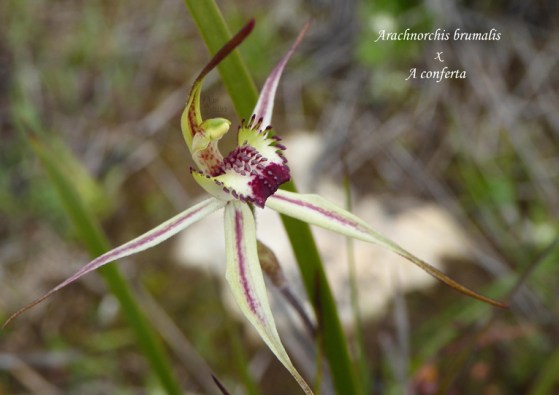
Hybrids mainly occur between species of the same genera such as Jenny Pauley’s Arachnorchis brumalis x A. conferta
Arachnorchis brumalis x A. conferta
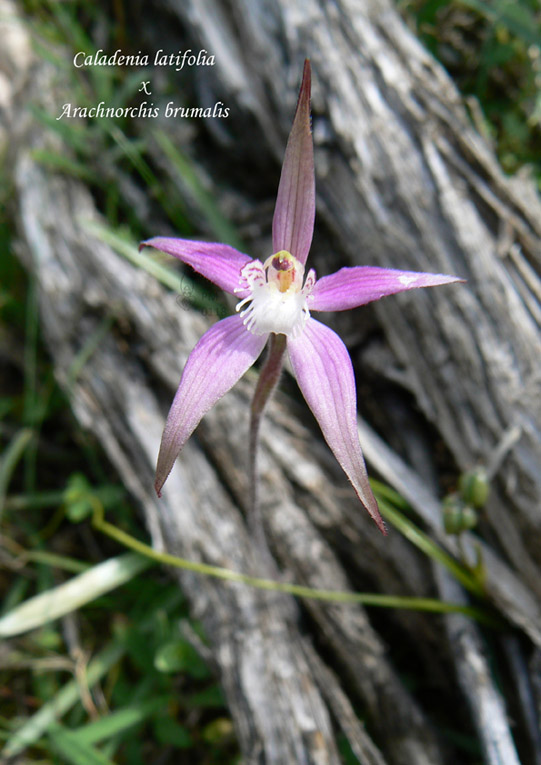
but, less commonly, it can occur between genera as seen with Pauline Meyer’s Caladenia latifolia x A. brumalis
Caladenia latifolia x Arachnorchis brumalis
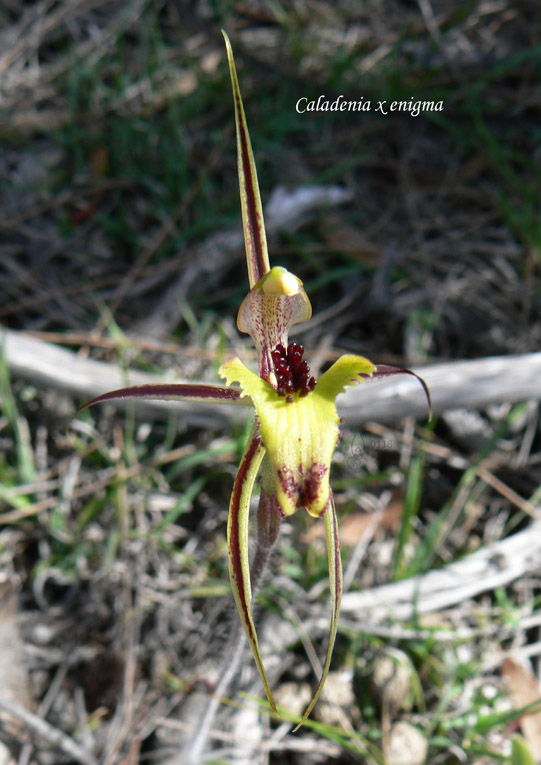
and her Western Australian photograph of Caladenia x enigma; a hybrid between C. falcata and Drakonorchis barbarossa.
Caladenia x enigma
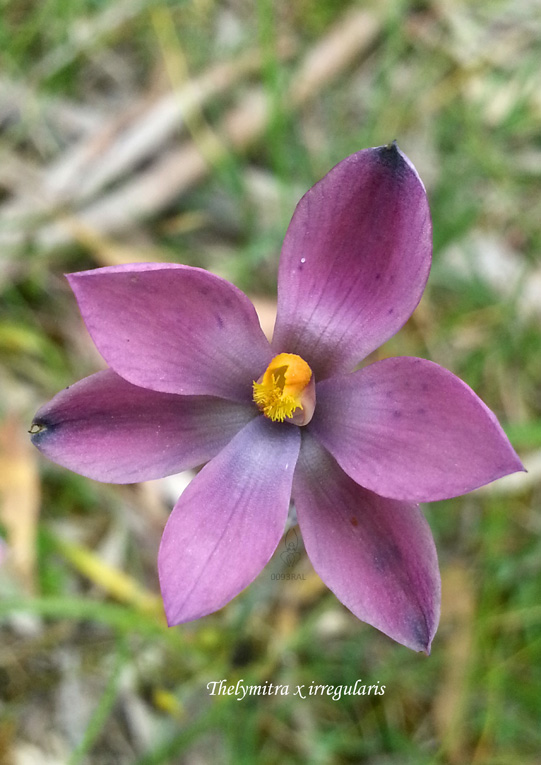
Jones (2006) states that “Natural hybrids are more common in some genera, such as Arachnorchis, Caladenia and Diuris, than in others.” To this list could be added Thelymitra as seen with both of the winning pictures T. x truncata and T. x irregularis. Interestingly with these two hybrids, the parents are not always the same; the parents for T. irregularis could be T. ixiodies or T. juncifolia with either T. carnea or T. rubra.
Thelymitra x irregularis
A similar situation occurs with T. truncata with the parents consisting of T. juncifolia and any member of the T. pauciflora (including T. albiflora, T. arenaria, T. bracteata, T. brevifolia, T. cyanapicata, T. pauciflora) or of the T. nuda complex.
Thelymitra x truncata
The conditions necessary for hybridisation are that the parents must grow in the same area, have overlapping flowering time and share the pollinator. Brown et al (2103) make the additional observation – Hybrids are more common between wasp and bee-pollinated species than between two wasp-pollinated species or two bee-pollinated species. … However, rare hybrids between species using the same pollination strategies, do occasionally occur …
Obviously hybridisation is more likely to occur when there is an abundance of the parent species. This situation can occur when there is mass flowering following fires or good seasonal rains. Site disturbances either through natural causes or clearing can result in increased incidence of hybridisation.
Hybrids are often infertile and will only last for the life of the individual plant but some have the ability to reproduce vegetatively and, provided the conditions remain favourable, may persist for several years.
One situation that can occur is hybrid swarm. When these occur they can make orchid identification challenging. Hybrids share the characteristic of both parents and by careful observation this can be deduced but swarms introduce an added complexity because the hybrid can backcross with either of the parents or cross fertilise with themselves. The result is a wide range of variation which makes orchid identification difficult.
Finally, some orchids will not hybridise even though the conditions are right. This could be due to specific pollinator or possibly chemical or genetic barriers.
References:
Brown et al (2013) Field Guide to the Orchids of Western Australia, Floreat, WA, Simon Nevill Publications
Jeans, Jeffrey & Backhouse, Gary (2006) Wild Orchids of Victoria, Seaford Vic, Aquatic Photographics
Jones, David (1988) Native Orchids of Australia, Frenchs Forest, NSW, Reed Books
Jones, David (2006) A Complete Guide to Native Orchids of Australia including the Islands and Territories, Frenchs Forest, NSW, Reed New Holland










 NOSSA
NOSSA 