Answer: Worldwide, some orchids are used medicinally but compared with other families, despite their numerical dominance in the plant world, orchids only contribute a small number of species to medicine.
Orchidaceae is the second** largest Family in the world after Asteraceae which has about 32,280* species whilst the orchids consists of about 27,753 species. In the big picture, their numbers are similar but only 2.32% (619) of all orchids species can be considered medicinal as opposed to 7.17% (2,314) of Asteraceae.
It is worth noting, that only 28,187 (6.48%) of the possible 434,910 species worldwide are recorded as being used medicinally. But of all of the world’s families it is the small Family of Moraceae (Mulberry, Figs & Mallow) that contributes the most. Of its 1,229 species 22.54% are medicinally useful.
Total number species
Percent of species used medicinally
Number of Species used medicinally
World wide
434,910
6.48%
28,187
Asteraceae
32,280
7.17%
2,314
Orchidaceae
27,753
2.23%
619
Moraceae
1,229
22.54%
277
Concerning Australian orchids only a handful are known to have been used medicinally such as Cymbidium for dysentery, Dendrobium teretifolium bruised leaves for pain relief and different parts of Dendrobium discolor as a poultice and for ringworm.
Notes:
**Many sources will state that the Orchid Family is the largest Family worldwide but for the purpose of this article, the information used is from 2017 State of the World’s Plants. Species numbers tend to be a in state of flux as botanists are discovering new and reassessing data.
*All figures in this article are based upon figures found in the 2017 State of the World’s Plants report.
April’s theme was yellow and orange. All of the entries proved to be spring flowering. There were several Diuris. Claire Chesson, Rob Pauley and John Fennel all entered D. orientis; Les Nesbitt and Rob Pauley D. behrii and Pauline Meyer D. corymbosa from Western Australia. Pauline also entered Caladenia caesaria subsp. maritima and John Thelymitra benthamiana.
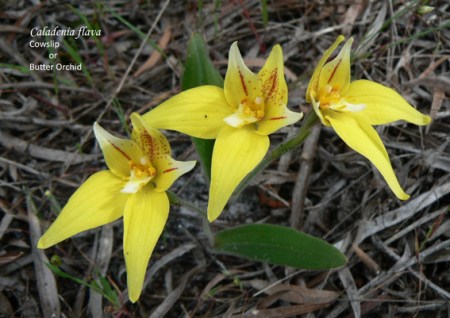
The winning picture was Les Nesbitt’s D. behrii (Cowslip Orchid) which occurs in Victoria, New South Wales, Australian Capital Territory whilst in South Australia it is rated as vulnerable.
Les Nesbitt has been working on a recovery project of these orchids for Hillgrove Resource’s flagship, the Kanmantoo Copper Mine, located almost 55 KM from Adelaide. As this orchid is often mentioned in NOSSA Journals, it might be worthwhile looking at the person after whom this species was named.
First collected by German born Dr Hans Herman Behr (1818 – 1904) who first visited* South Australia in 1844 when the colony was barely 8 years old. During his two years in South Australia he became the first person to systematically study our botany and entomology sending reports and samples back home. The results of his observations were published in various journals, and many of his collections were named and described by other botanists including his friend, Diedreich von Schlechtendal (1794 – 1866) who named Diuris behrii after Hans.
Hans Behr was an interesting man. A man of many aptitudes; medical doctor, entomologist, anthropologist, botanist, duellist, socialist, poet, novelist, linguist, member of the Bohemian Club of San Francisco and a man of wit. From the many reminiscences written about him, it would appear that he was a likeable gentleman and a generous teacher.
Unfortunately, not everyone liked him because “he was a sworn enemy of all scientific humbug, of quacks and false pretenders” and “he never refrained from expressing his opinion of them, quite regardless of person or station” but his humour shone forth in dealing with them. Once he named a “particularly obnoxious louse” after one of his enemies.
Behr revisited South Australia in 1848 during which time he became acquainted with German-Australian botanist, Ferdinand von Meuller. He maintained friendship with many of the scientific men of the time including Ferdinand Mueller and it was through this friendship that many Australian plants were introduced into California where Behr later settled after his travels.
Though the study of butterflies was his first and enduring love, he is remembered and honoured in Australia for his botanical interests. Of the twenty-two plants named after Behr, two are orchids: Diuris behrii and Arachnorchis behrii (synonym Caladenia behrii).
*The Journal incorrectly stated that he visited South Australia with his friend, Diedreich von Schlechtendal. This did not happen. As far as I am aware Schlechtendal did not visit South Australia.
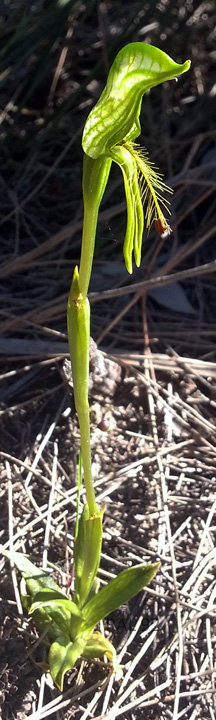
“The person who first records the whole pollination event will be very lucky indeed.” So wrote Bob Bates (South Australia’s Native Orchids, 2011). He was referring to the pollination event for Bearded Greenhoods in the genus Plumatichilos. As with many orchids there has always been a lot of conjecture about the pollination strategy involved so it is good to finally have photographic evidence of a previously unknown pollinator.
For several years now Rudie Kuiter, Mitchell Findlater-Smith and Rober Lindhe have been researching the relationship between orchids and insects, spending much time in the field observing and photographing the insects. Finally they have managed to obtain a photograph of a pollinator but it was not one of their photographs. Instead it was Neil Blair who took the photograph and observed a dagger fly pollinating a Plumatichilos. The male of these fascinating insects catches another insect and offers it for a nuptial gift to a female in order to be accepted as a mate. The photographs are amazing. It’s worth reading the paper Pollination of the Bearded Greenhoods (Orchidaceae) by Dagger Flies (Diptera: Empididae) just to see the pictures.
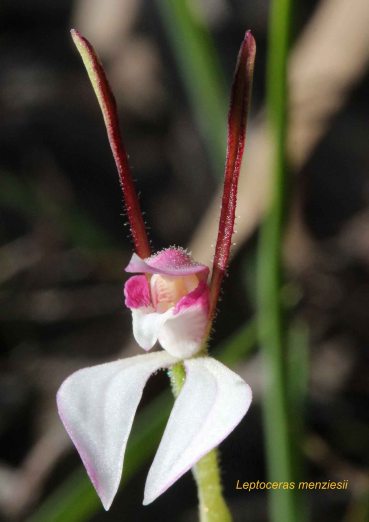
As part of 40th NOSSA anniversary, the theme for this month was Leptoceras menziesii (Hare Orchid or Rabbit Ears). Entries were received from John Badger, Pauline Meyers, Robert and Rosalie Lawrence, with John Badger’s being declared the winner.
In February 1978, it was announced that the nascent NOSSA society required an emblem. Members were invited to send in drawings, to be judged by members and then ratified by the committee. Mrs Chris Butler (Ron Robjohns’ daughter) was the winner. The first Leptoceras menziesii flowers to be benched at a NOSSA meeting were in September 1978. It appears to be an easy plant to grow but a most difficult one to flower.
This seems to be because it is fire dependent. In spring, it will flower profusely if there has been a summer fire such as occurred after the 2015 Sampson Flat (SA) fires. It is possible that the gas ethylene produced during a fire event may initiate the flowering response.
Otherwise, apart from the occasional flowering plant, it will be mainly leaves that are found when out in the field. The single leaf of this plant lying prostrate along the ground is distinctive. It is firm, boat-shaped, glabrous (no hairs), with a fine ‘snake-skin’ pattern. Interestingly, sterile plants can be mistaken for a plant with a developing bud as there will be at the leaf base a ligule (a thin membranous growth, often found on grass stems).
Reference
Backhouse, G, et al (2016) Bush Gems: A Guide to the Wild Orchids of Victoria Electronic version
Bates, R. J., ed. (2011). South Australian Native Orchids. Electronic version, 2011. NOSSA
Previously we have posted about photographing orchids for identification – see here and here. But sometimes all that is desired is a beautiful picture of these exquisite flowers. Recently, March 21, 2017, National Geographic published just such an article titled How to Photograph an Orchid. Author Alexa Keefe relates some tips from German photographer Christian Ziegler. Needless to say half of the images featured are Australian orchids.
Below is a selection of some of the entries to NOSSA’s monthly picture competition.
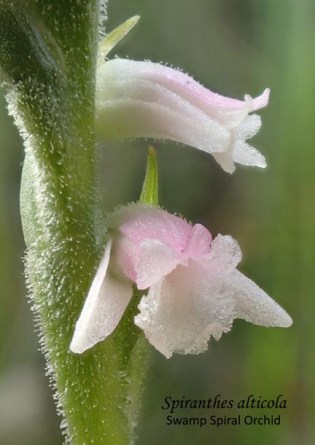
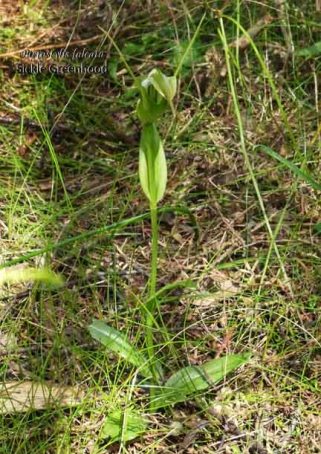
The first competition for the year followed a wet orchid theme with three of the orchids being South Australian swamp orchids and the fourth from Western Australia; though not a swamp dweller, it grows in shallow moist soil.
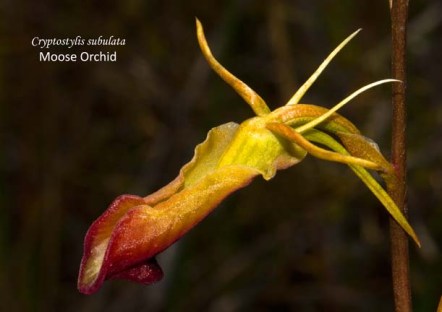
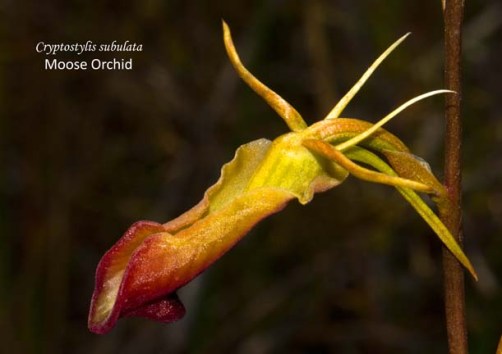
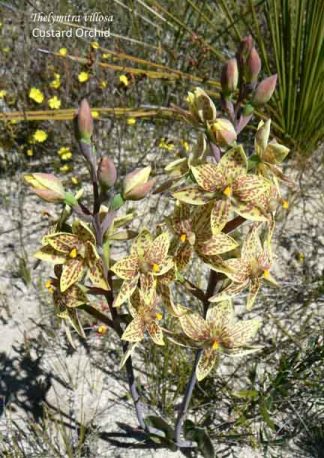
The outstanding winner was Claire Chesson’s Cryptostylis subulata, followed by Robert Lawrence’s Spiranthes alticola, Rosalie Lawrence’s Pterostylis falcata and Pauline Meyer’s Thelymitra villosa.
Known to South Australian’s as the Moose Orchid, elsewhere it is either Large Tongue Orchid or Cow Orchid. This tall (40 to 110 cms) evergreen orchid is common in the eastern states where it is commonly found in damp areas as well as swamps. but in South Australia it is limited to swamps and is rated as endangered.
Whilst not an easy orchid to grow it has been cultivated although seed set has not always occurred. Helen Richards, an experienced Victorian terrestrial orchid grower, shared in an email how she grows them.
“Cryptostylis species grow from brittle rhizomes which can be quite long and they resent frequent disturbance. Mine are potted into a pot therefore that is large enough for the long roots and which will accommodate further growth for several years. My mix is ANOS basic mix, the same as I use for Pterostylis and many other genera. They need to be kept moist all year round, especially in summer when they flower and new leaves appear, their active growing period. I grow them in an area of moderate light. Others have seen pollinators active on the flowers but I haven’t. However seed capsules frequently develop without my assistance with a toothpick. Richard Thomson says they haven’t had success germinating the seed.”
Leo Davis always has some interesting insights from his orchid observations. In this article he examines the position of the tepals (petals and sepals) in particular the Moose Orchid which he saw for the first time this year.
Have a close look, next season (winter to early summer) at some of our native lilies. Start with the jolly bulbine lily (Bulbine bulbosa), no longer a true lily incidentally, because it now resides in family Aspodelaceae, along with the grass trees. You will find three yellow petals at 12, 4 and 8 o’clock and closely behind them three almost identical sepals at 2, 6 and 10 o’clock, so at first sight you see six apparently identical tepals (sepals and petals). Move on to the rush fringe-lily (Thysanotus juncifolius), as described in Ann Prescott’s ‘It’s Blue With Five Petals’. Clive Chesson is more up to date and tells me it is now T. racemoides. Again it is no longer a true lily, now sitting in family Asparagaceae. Here the tepals are noticeably different. Three wide densely fringe edged petals will be found, if you view the flower face on, at 12, 4 and 8 o’clock. The narrow non fringed sepals sit close behind at 2, 6 and 10 o’clock. These are just a generalisations because if the flower turns only about 60o a sepal will be at the top.
Most orchids, while close relatives of the true lilies and the one time lilies, do not show these arrangements. Let’s start with some that do.
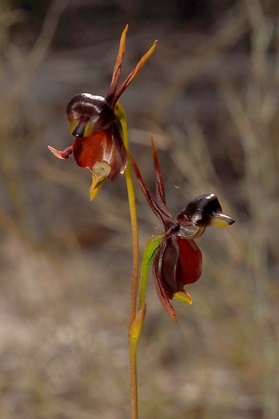
In the large duck orchid (Caleana major) the petal at 12 o’clock, the dorsal petal, is modified, as in most, but as usual, not all, orchids, to become a labellum. In this charmer the labellum takes the form of a duck’s head. Its function is to snap down trapping a pollinator insect in the cup shape column below it, forcing it into contact with the sticky off white stigma and/or the yellow pollinia below it. Look closely and you will find the other two narrow petals drooping at around 4 and 8 o’clock. Two folded, twisted sepals can be clearly seen at around 1 and 11 o’clock. The third sepal, at 6 o’clock, is tucked in behind the cup shaped column. Note that, as with lilies, the top tepal is a petal.
Caleana major, Knott Hill NFR Photographer: Leo Davis
The leek orchids (genus Prasophyllum) follow this pattern and also have their labellum at around 12 o’clock. These orchid groups, which are up the right way, are said to be ‘not upside down’, using the technical term ‘non resupinate’.
Most orchids are ‘upside down’ and are called resupinate. The whole flower rotates 180o, clockwise or anti I don’t know, at the embryonic stage. But let’s start with somewhat of an exception with the sun orchids (genus Thelymitra) which do not have a petal modified as a labellum. But they are indeed upside down.
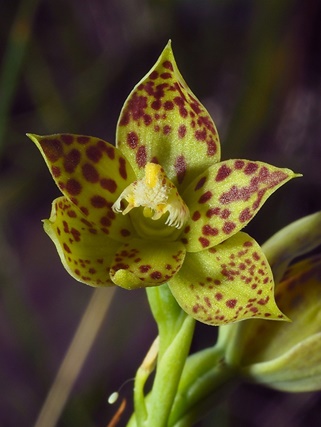
Have a close look at the Thelymitra benthamiana flower. Note that the three petals, at roughly 2, 6 and 10 o’clock, are in front of the three slightly larger but very similar sepals, at 12, 4 and 8 o’clock.
Note that the toptepal is a sepal. The flower is upside down, that is resupinate. In most orchids the petal at 6 o’clock would be modified to be a labellum.
Thelymitra benthamiana, Scott Creek CP; Photographer: Leo Davis
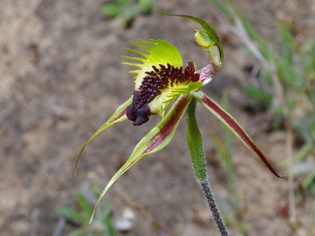
The Arachnorchis (possibly Caladenia to you) stricta, from Sherlock, out in the mallee, is more typical of terrestrial orchids in SA. It is upside down, that is resupinate, and has a petal modified to be a labellum.
The bottom petal has become a wide labellum, with fine edge combs and parallel rows of rich plum coloured calli covering its centre. Out at roughly 3 o’clock is a narrow petal, the other invisible on the other side. At the top, pressed tightly against the column, a sepal arches forward. Two larger sepals extend down at around 5 and 7 o’clock.
Arachnorchis stricta, Sherlock; Photographer: Leo Davis
When I saw my first, my only, moose orchid, this season, I was in such a state of excitement that it looked to me to be up the right way, that is to say upside down.
Cryptostylis subulata, Stipiturus CP; Photographer: Leo Davis
Have a look. Two narrow short roughly vertical petals at about 1 and 11 o’clock. There are two sepals at just past 3 and just before 9 o’clock. That’s OK but where is the other sepal? Are there it is, where it should be, at midday. But hang on, it’s behind the flower stem (peduncle) and where is the column?
Cyrtostylis subulata with labellum lifted; Photographer: Leo Davis
Holding the labellum up with a stick I found the column, the stigma and the pollinia, underneath the labellum. The third sepal now appears to be at 6 o’clock. And it all became clear. This flower was up the right way (non resupinate) but it has turned forward, on its peduncle, by about 180o, to become upside down, but not in the manner of resupinate flowers, because it is back to front. It is an inverted non resupinate flower. Still with me?
Ten years ago, the then NOSSA secretary, Cathy Houston, wrote an article reflecting upon orchid name changes. Since then there have been more name changes. The issues she raised then are still pertinent today. Whilst we continue to learn more about our orchids, name changes are going to happen.
NOSSA Journal Volume 31 No 2 March 2007
HAVE OUR ORCHIDS CHANGED? Cathy Houston (Secretary)
This month the Native Orchid Society of South Australia celebrates its thirtieth “birthday”. A review of the first five years of the Society’s Newsletters/Journals (yes, they were newsletters in the earliest days) reveals some interesting points. By 1979 “A total of 110 species [of orchids] and 14 varieties” were accepted. The following are some interesting aspects about the knowledge of, and what was then current thinking about, our orchids at that time. It must be remembered that no comprehensive book on South Australian orchids existed in those days, especially not any field guides. The most useful “tools” the members had to work with were Blacks Flora of South Australia and W.H. Nicholls “Orchids of Australia”. In 1979 “A Checklist of Orchidaceae on South Australia” by J.Z. Weber: Changes introduced in the new ‘Black’s Flora” by R. Bates, appeared as a full issue of the Native Orchid Society of South Australia Journal.
Today we sometimes struggle to grasp all the fine differences when orchid species, or species groups, are split, but spare a thought for those wanting to identify with what they have seen in the field back in about 1979. An article by R. Bates describes the “Variations within the species Caladenia dilatata R.Br. in South Australia”. “There are, at present, two recognised varieties” viz. C. dilatata var. dilatata and C. dilatata var. concinna. Within these two varieties are further more divisions into distinct sub-varieties or races! At that time there were six distinct forms recognised; how much easier today, now that they are named as species. These would now include C. tentaculata, C. verrucosa, C. stricta, C. toxochila and C. conferta.
Arachnorchis tentaculata (King spider Orchid) syn Caladenia tentaculata
Recognition of what could be species has long been apparent. Take for example the article written in 1980 about two forms of Pterostylis nana, viz. what we commonly refer to as the ‘Hills’ form and the ‘Mallee’ form. This article documents the obvious morphological differences and illustrates this with line drawings and a map showing distributions of the two. Electronic Orchids of S.A. currently recognises five possible species of P. nana for South Australia. These are probably all un-named, since David Jones, in “Native Orchids of Australia”, does not recognise true P. nana in our state. Similarly, an article written in 1981 discusses the P. alata – scabra – robusta complex. The author recognises there are “at least four species of this group in South Australia”. This is the first time the authors acknowledge they should be elevated to species, not just accepted as varieties or forms. At that time P. robusta was treated at varietal level, viz. P. scabra var. robusta or P. alata var. robusta. Ultimately most of these have been elevated to species level (P. dolichochila, P. erythroconcha, P. robusta, and P. striata).
It was noted that in 1978 David Jones and Ray Nash were currently working on Pterostylis. Further to that Les Nesbitt notes that of the sixty or so Pterostylis in Australia, South Australia has twenty-two species. One wonders what the count is now. It is well known that David Jones is currently/still working on the Pterostylis group, with more species being recognised regularly.
Thelymitra x irregularis or Pink Spotted Sun Orchid was photographed in 2009 near Macclesfield
In a series of articles produced about “Our rarest orchids” in 1977 we find the comment “Very few of our orchids are thought to be extinct… . “One wonders what that number would be considered to be today. The same article talks about the demise of Pterostylis cucullata and the possibility that it may no longer exist in the wild. Certainly this is one of our highly endangered species for which recovery actions are being undertaken these days. [N.O.S.S.A. members have an opportunity to assist with this work starting on April 14th – see diary dates.] In 1977 there was excitement when, following a field trip to Belair National Park one member returned the following day and “the elusive Pterostylis cucullata” was seen “growing in association with P. curta”. In 1981, following a discussion and review of endangered orchids in South Australia, R. Bates writes “There are a number of endangered species in S.A. which have not yet been named. It is not unlikely that some of these will become extinct before they are even described properly.” With such a large number of as yet undescribed orchids in our state, let us hope this does not happen.
Naturally occurring hybrids and the naming of such, has been debated regularly within botanical circles. In 1978 this insight is shown by Ray Nash who “guided us to a nearby patch of Thelymitramacmillanii,…… Ray’s view is that this will probably turn out to be a hybrid, possibly between antennifera (which it closely resembles) and rubra or luteocilium.” In 1980 T. decora [T. x truncata] was featured as one of South Australia’s rarest orchids. It was thought to be of hybrid origin and three forms were recognised then. The probable parents were T. ixioides x T. longifolia, T. ixioides x T. pauciflora, and T. ixioides x T. mucida. Today with the naming of many species within the T. pauciflora complex, it is now being recognised that there are even more combinations producing similar type flowers, e.g. T. juncifolia, which gives rise to the spotted features, x T. brevifolia.
Name changes always raise controversy. A brief explanation giving some insight into this complex area can be picked up when an author is expanding on the front cover illustration of Corybas. “In fact, they should never have been called Corybas in the first place. They were discovered by Robert Brown during the Flinders Expedition (1801 – 1805), and illustrated by the Austrian Ferdinand Bauer, another of the members of the expedition. Brown called them Corysanthes from the Greek “korys” (a helmet) and “anthos” (a flower), and they were known for many years by that name. However, in this instance, justice was never truly done, because the decision was made to call them Corybas, the name previously allotted by R.A. Salisbury in 1805, on the strength of seeing Bauer’s illustrations.” More recent times have seen that injustice righted with the name reverting to Corysanthes, something brought about through the work of David Jones. Similarly, the latest naming of Corunastylis tepperi follows this, The International Code of Botanical Nomenclature, a name that was recognised by R. Bates in an article written in 1981! However, Bates concludes that P. tepperi and P. nigricans are synonymous, so the latter prevails, but “further work needs to be done”! He is also the author of an article depicting some name changes in 1980. If our readers are confused by “new” names, then just think what it was like for those in 1980 when, among others, Caladenia carnea, and all its five varieties, is changed to C. catenata, with all its varieties, two of which are C.catenata var. gigantea and C. catenata var. minor. Two others were elevated to C. pusilla and C. alba.
Corysanthes diemenica (Veined Helmet Orchid)
At one time our esteemed orchidologist was asked to comment on a list of name changes being proposed for the revision of Black’s Flora of S.A. “My first reaction was to state that everyone would be happiest if no changes were made”! However, in fairness to that gentleman, it must be said that by the time he had worked through a lengthy consultation with botanists covering much of Australasia, a revision of type specimens and other material and associated literature, he was clearly of the opinion that the changes were warranted.
Have our orchids changed? Maybe, but what has really changed is our knowledge and understanding of these unique plants. Based on that knowledge, opinions, attitudes and ideas have changed. Thirty years ago it was not “policy to differentiate between the numerous forms of C. patersonii in this State …” Today we have numerous named species in this complex, without actually any Caladenia patersonii as such.
The final word must come from Peter Hornsby when he said “The ultimate aim should be for the reader to know which plant is being discussed, rather than whether or not the title is absolutely correct.”
References:
Native Orchid Society of South Australia Journal.
1. 1977 Vol. 1 #5
2. Vol. 1 #9
3. 1978 Vol. 2 #2
4. Vol. 2 #6
5. Vol. 2 #7
6. 1979 Vol. 3 #1
7. Vol. 3 #6
8. Vol. 3 #9
10. 1980 Vol. 4. #3
11. Vol. 4 #4
12. Vol. 4 #6
13. Vol. 4 #7
14. 1981 Vol. 5 #1
15. Vol. 5 #3
16. Vol. 5 #4
17. Vol. 5 #6
Black J.M. 1978. Flora of South Australia, Part 1, Third Edition. Handbooks Committee, South Australia.
Jones David L. 2006. A Complete Guide to Native Orchids of Australia, Including the Island Territories. Reed New Holland, Australia.
Nicholls, W. H. 1969. Orchids of Australia; The Complete Edition. Thomas Nelson, Australia.
A site, along Rarkang Rd, Silverton, leading into Talisker Conservation Park, was visited on December 29, 2012, January 2, 2014, January 16, 2015 and January 9, 2017.
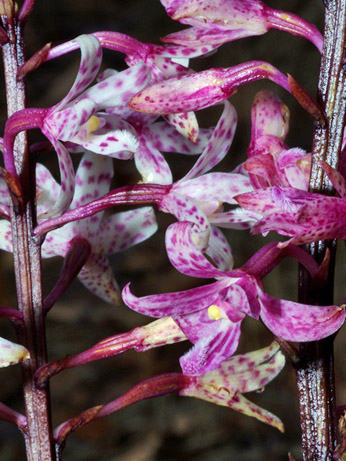
In the earlier years about 20 specimens of Dipodium pardalinum were found with 18 (plus 3 beheaded) in 2015. A small number of D. roseum was located in 2012, none in 2014, one in 2015 and none at all in 2017.
In 2017 there was bumper crop of D. pardalinum and Ed Lowrey, Helen McKerral and I counted 124 flower spikes. This may represent only 122 plants because in two instances there were two spikes emerging from one tuber (see image). It is possible that other closely placed flowers were also growing from a single tuber. This same phenomenon was observed in two cases, with D. roseum, at Hender Reserve, Stirling, on January 12 this year.
All spikes of D. pardalinum this year were found on the verges of Rarkang Road or nearby inside private property in small holdings, with houses, adjoining the road, apart from two spikes only, just inside the Talisker Conservation Park, where Rarkang Road heads into it.
The genus Dipodium is much more varied than I realised. Our DVD, South Australia’s Native Orchids, only deals with the ‘leafless saprophytes, mycophytes or hemiparasites’. If you go to ‘Native Orchids of Australia’ (Jones, 2006), you will find that among the terrestrial species there are both leafless species (as with the local D. pardalinum and D. roseum), that are impossible to cultivate and one species with leaves (D. ensifolium), found from Cooktown to Ingham, in Qld. It is easy to grow in a pot. Bob Bates told me that it is grown here in Adelaide, preferring a heated glass house, but has been grown successfully in gardens. And then there is a leaved species, D. pandanum, of limited distribution in Qld, that can be either terrestrial or epiphytic, growing up to 5 m in length. Old pieces that break off and fall to the ground, nestle in the leaf litter and put out new shoots that eventually climb into the trees. It is easy to grow in a pot (in the right climate).
Leo Davis.
Dipodium pardalinum. Rarkang Rd, Silverton, Jan 9, 2017.
Two spikes of Dipodium pardalinum emerging from one tuber.
Rarkang Rd, Silverton, Jan 9, 2017.
A clump of Dipodum pardalinum spikes with at least two emerging from one tuber; see photo above.
Rarkang Rd, Silverton, Jan 9, 2017.
Dipodium pardalinum (labellum white with dark pink spots) growing intertwined with D. roseum, (labellum pale pink with dark pink stripes).
The Native Orchid Society of SA has been involved with the Threatened Orchid Project which is attempting to propagate some of our most threatened orchids. There has been some success such as Thelymitra epicaptoides (Metallic Sun Orchids) but others are proving elusive. Marc Freestone, from the Orchid Conservation Project, Royal Botanic Gardens Victoria, is a PhD student who is researching one such difficult to grow orchid genus, the Prasophyllum.
Prasophyllum murfettii (Denzel’s Leek Orchid)
To assist with his research Marc has the sent the following request.
CAN ANYONE GROW LEEK ORCHIDS?
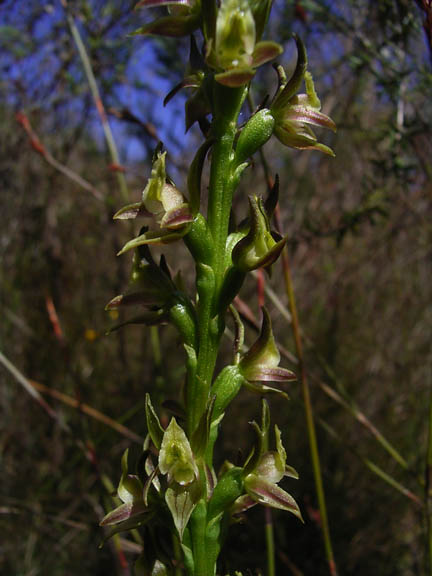
South Australia has about 40 species and Victoria about 74 species of the native Leek Orchids, Prasophyllum. Some are on the brink of extinction.
A major problem hampering efforts to prevent our Leek Orchids from going extinct is that they have proven next to impossible to grow in cultivation. They have proved extremely difficult, usually not germinating at all, or germinating but then dying soon after. Occasionally some success has been had (particularly with symbiotic germination) but successful germination trials to our knowledge have so far proved un-repeatable. Working out how to grow Prasophyllum is critical for the survival of many species at risk of extinction across southern Australia.
To try and change this, I will be studying Prasophyllum and their relationships with symbiotic mycorrhizal fungi.
But I need your help!
I am wanting to hear from as many people as possible who
have tried (either successfully or unsuccessfully) to grow Leek Orchids or the closely related Midge Orchids (Corunastylis).
have observed Leek Orchids (or Midge Orchids) recruiting from seed in the wild.
If you can help, or know of anyone who might be worth talking to, please contact me at: marc.freestone@rbg.vic.gov.au or 0428 304 299.
(Funding and support for this project: Australian National University, Federal Government National Environmental Science Programme, Royal Botanic Gardens Victoria, University of Tasmania).
I would encourage people to contact Marc with whatever information that you have, no matter how insignificant you may think it is. Every little bit helps including unsuccessful attempts.
His eventual aim is to be able to work out how to grow them reliably from seed in cultivation.



 NOSSA
NOSSA 