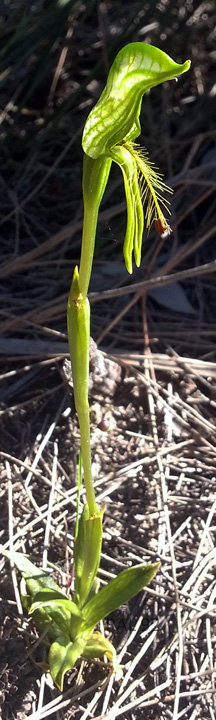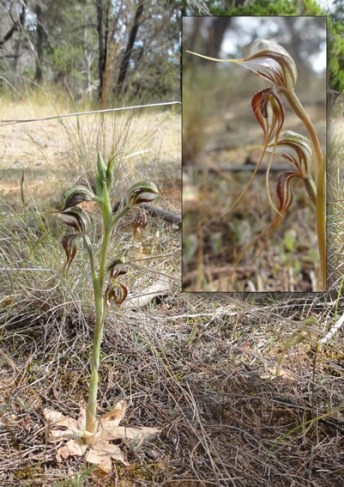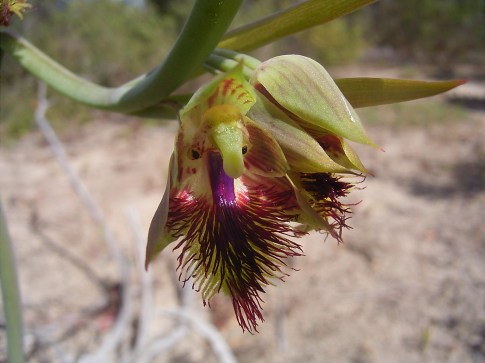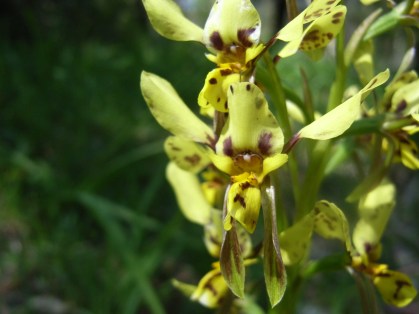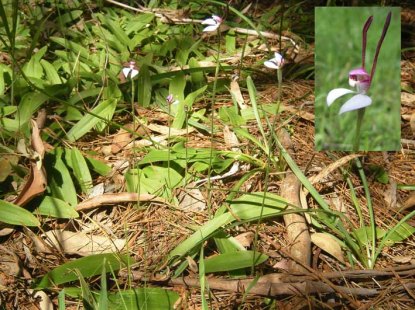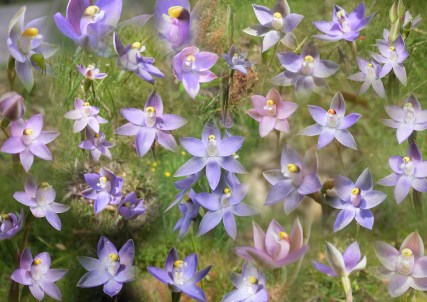
If you are out and about this week, keep an eye out for this attractive and unusual greenhood with its bottle brush labellum and rosette of “pineapple” like leaves.
Commonly known as Woodland Plumed or Bearded Greenhood, or Plumatochilos sp. Woodland Bearded Greenhood. The reason for the phrase name is because many consider that it is a separate species, in this instance, from Plumatochilos plumosum (syn Pterostylis plumosa). Originally all of the Bearded Greenhood were considered as one species – Pterostylis barbata but then Leo Cady named Pterostylis plumosa as a separate species. David Jones in his 2006 tome listed four species, P. barbatum, P plumosum, P. tasmanicum and P. turfosum.
Here in South Australia, Bates lists P. tasmanicum and two with phrase names suggesting that they are distinct from P. plumosum.
Peter Fehre recently posted on the Tasmanian Native Orchids Facebook page some helpful hints differentiating between P. tasmanicum and P. plumosum. Very similar information is found in Bates South Australia’s Native Orchids. These differences are:
P. tasmanicum – a short plant: short flower stem (not more than 14 cms), short labellum (to 15mm) , short ovary; short blunted galea (hood) to 25mm. It prefers damp, sandy areas and swamp margins.
P. plumosum – has length; long flower stem (10 – 30 cm), galea to 40mm with a long tip, long labellum (to 25mm). It is a plant of the woodlands and forests growing on well drained soil.
The differences between the two phrase named species are more subtle
References:
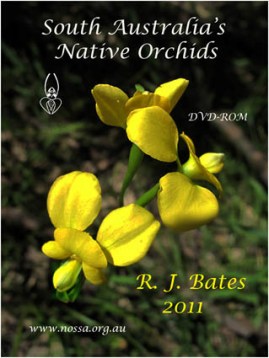
R J Bates, 2011, South Australia’s Native Orchids DVD, NOSSA
D L Jones , 2006, A Complete Guide to Native Orchids of Australia
The Native Orchid Society of South Australia (NOSSA) is affiliated with the national body of native orchid society, Australian Native Orchid Society (ANOS). NOSSA regularly sends reports of its to ANOS. This year’s report covered four years of the society’s activities and is reproduced here to give readers an idea of the many things that we do. This report was produced by Robert Lawrence (currently Vice President).
NOSSA REPORT 2012 to 2016
I believe that the last annual report from the Native Orchid Society of South Australia was in 2011 when we were just commencing a three-year plan with the establishment of a series of subcommittees. All of the committees have since ceased to exist, but not without significant accomplishments.
The Website Subcommittee had established a website, but a Webmaster has since been appointed. The website now uses WordPress and is maintained so that its management could easily be transferred to another person. The website provides a weekly educational post about Australian orchids. It has also provided a point of contact from those outside of the Society. It is linked to a Facebook page that increases the profile of NOSSA among those interested in orchids throughout Australia and beyond.
The Education Subcommittee had established a picture competition at the monthly general meetings. There is still only a small number of contributors, but many excellent pictures are shared. The winning picture from each meeting is used as a basis of one of the weekly posts on the website.
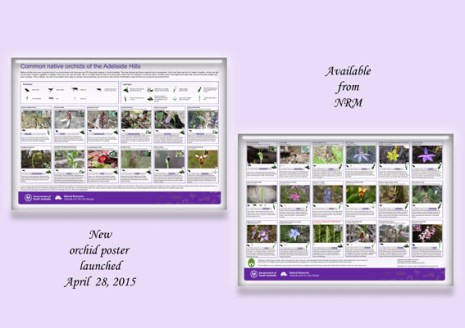
The Education Subcommittee had a vision to produce a brochure of 20 common orchids of the Adelaide region for free distribution to the general public. The NRM (Natural Resources Management) Education ran with the idea and produced a poster of Common native orchids of the Adelaide Hills. This provided brief, but comprehensive, profiles of 29 native orchids and the weedy species. This has been printed as a double-sided poster and is available from the website of Natural Resources Adelaide and Mt Lofty Ranges. NOSSA members worked with NRM staff on the details of the poster and NOSSA members contributed many of the photographs. This poster was completed and launched in April 2015.
NOSSA also provided monetary assistance as a loan with the publication of the field guide entitled, Start with the leaves. A field guide to common orchids and lilies of the Adelaide Hills. This guide covered 50 orchid species as well as native lilies and some weeds in the Iridaceae family that are sometimes mistaken as orchids. The contribution of $8,000 was recovered only 8 months after publication.
The Disc Publication Sub-editing Subcommittee saw the publication of South Australia’s Native Orchids on DVD discs in time for the Spring Show in September 2011. Both the DVD and the book were published in time for the Spring Show in September 2011. Both continue to sell.
A new subcommittee has been established in February 2016 to oversee the publication of a field guide, expected to be called Wild Orchids of South Australia. It is proving to be a challenge to be brief enough to reduce the information to a size suitable for a field guide. (Editor’s note: it has since been decided to defer this until after the development of the interactive website, see below.)
NOSSA members have being working since 2014 to establish an interactive website and database modelled on the Go Botany website run by the New England Wild Flower Society in the USA. This was supported by a grant from the Australian Orchid Foundation. The project is called Wild Orchid Watch. It is hoped to produce an interactive, web-based orchid identification tool. Recording sightings through such means as apps on mobile telephones are also being investigated.
In 2014 NOSSA made a donation to help establish the Orchid Conservation Program. This was led by Dr Noushka Reiter. Once established, staff in the Department for Environment, Water and Natural Resources began to organise a trial with four threatened orchid species from South Australia. Noushka visited South Australia during 2015 and collected samples from each of these species and isolated fungi from these. Seed was also collected and work on propagation commenced in 2015. During 2016 NOSSA sponsored the propagation of one of the four species through the Adelaide Botanic Gardens. Caladenia gladiolata, an endemic species, was selected.
Paul Beltrame, a secondary teacher at Kildare College, contacted and joined NOSSA during 2014 with the interest in getting girls at this school involved in the propagation of native orchids. A program was organised modelled in the Orchids in Schools program run by the Orchid Club of South Australia with Les Nesbitt’s involvement.
A delegation from Kildare College, ably assisted by their enthusiastic laboratory assistant Nenah McKenzie, visited Noushka in Melbourne and learnt the technique for separating and growing fungi. They have since separated fungi from two of our more common greenhood species and supplied this for seed kits that were made available to members as a trial at the start of the 2016 growing season.
The trial of seed kits was done for Pterostylis nana and Pterostylis sanguinea. A trial was conducted in this growing season of seed kits for members. Kits included a pot, growing media, seed, fungus, mulch and instructions. There seems to be limited success with the current round, but improvements are planned from the lessons learnt. One particular growing mix proved successful with a small number of seedlings appearing. The contribution of the Orchids in Schools program at Kildare College has been necessary for the isolation and production of fungi for the kits.
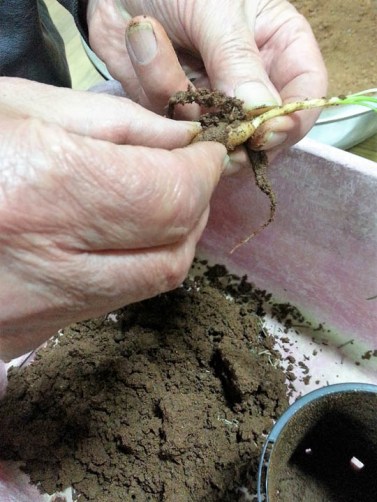
In October 2012 Cathy Houston and Robert Lawrence collected seed of Pterostylis arenicola from the only population on the Adelaide plains after monitoring in September indicated a good year for seed production. The seed was germinated in 2013 and was deflasked at a working bee at the Adelaide Botanic Gardens in early August 2016. The students from the Orchids in Schools program at Kildare College participated. Latest reports are that 40 plants look like surviving. These will be used for seed production and for reintroduction.
Typical of the rufus hood this Oligochaetochilus arenicola shows the sencesing leaves, pendent petals and hairs on the labellum. Photographer: H Lawrence
In 2012 NOSSA was asked to care for and propagate rescued Diuris behrii plants from Hillgrove Resources Mining Lease near Kanmantoo in the Mt. Lofty Ranges. The plan was to maintain the rescued orchid clones in cultivation for several years and to produce additional plants for reintroduction within the mining lease area each Autumn. A comprehensive recording and auditing system has been put in place to track each clone and any seed/daughter tubers/plants. By August 2015 there were 609 plants with 75 original mother plants. There were 95 daughter plants returned to the site for revegetation in each of the years 2014, 2015 and 2016, a total of 285 plants.
Funding from Hillgrove Resources has assisted NOSSA financially and has made it possible to consider funding conservation work. NOSSA is planning to apply for charity status so that donations can be used for tax deductions. Donations will then be feasible through our website. We are also starting an orchid seed bank. Seed will be available only to members and it is hoped that this will increase our membership. There is a demand for Australian orchids overseas and it is hoped that this will become a means for raising funds for conservation. Other means of fund-raising such as sausage sizzles and selling kits for craftwork are also being considered.
NOSSA members still continue to be involved in surveys and monitoring threatened orchids. Members have been involved in the planning of monitoring.
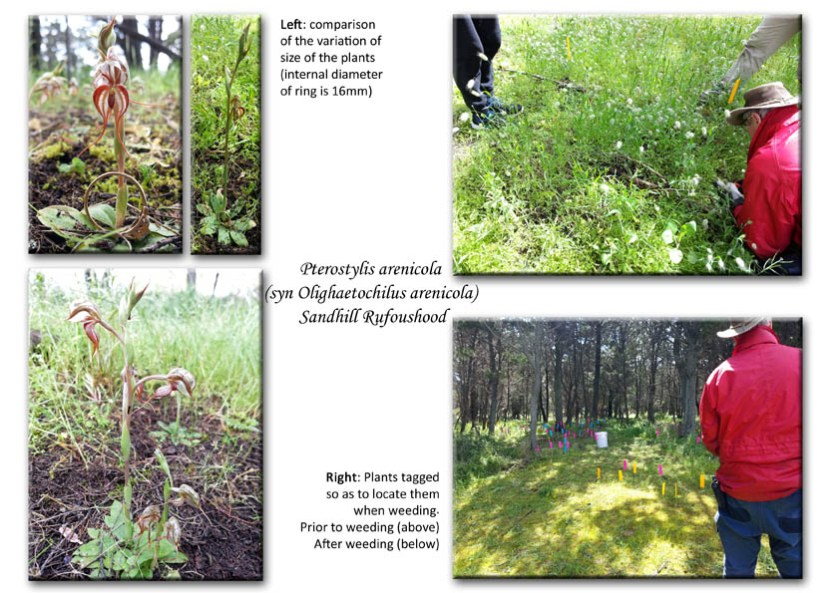
Weeding and Monitoring, two of NOSSA’s conservation activities
The management committee of NOSSA is currently working on a revision to the Rules of Association. In the current version there is a two-year limit on the term of the President of two years. In the first 16 years from 1977 there were there were eight different presidents before one had a second term. Bill Dear was president in alternate terms until he retired and moved to Western Australia in 2012. Robert Lawrence was elected president in March 2014, but for the first time in 2016 there were no nominations for president and he was nominated to the role of vice president with no other nominations. The management committee has appointed a subcommittee to review the Rules in relation to the terms of the president. Another change planned is change from having monthly general meetings to having less formal monthly meetings at which no decisions are made or minutes kept. All resolutions will require calling a formal special meeting. This idea is adapted from the approach used by ANOS Victoria.
Over the last two years NOSSA has asked new and renewing members to complete a survey of their interests. This has proved to be an effective way of getting information on the interests of our members with 79 responses, this being about half of the number of memberships. This is an overall summary of the results ranked according to number of responses:
Area of interest
Responses
Percentage
General Orchid Knowledge
53
67%
Field Trips
48
61%
Photography
47
59%
Conservation
46
58%
Growing Terrestrials
35
44%
Surveys
30
38%
Growing Epiphytes
28
35%
Citizen Science
20
26%
At its establishment NOSSA was primarily a Society of orchid growers. These figures reflect a decline in interest in growing orchids. The figures are somewhat surprising in that the numbers interested in growing orchids are much larger than the number of growers. Presumably some of these are interested in learning with a view to getting involved with growing later. At least we hope this is the case.
We are certainly noticing a decline both in our numbers of growers and in members involved in surveys due to age and health.
The greatest number expressed an interest in general knowledge and we are relying on the Journal and the Website help to keep people interested and informed. Next was field trips, but we haven’t had that many that have attended field trips in in the last few years. Only 11 of those who expressed an interested in field trips are not interested in photography, the next item of interest, and only 10 people interested in photography were not interested in field trips. Not many of these share their photographs at monthly meetings. We are hoping to get members to make their photographs available for the identification guides.
Bearded Orchid Photo: Helen Lawrence
It is pleasing that 58% are interested in conservation, thus supporting the efforts of our Conservation Officer.
Growing terrestrial orchids was next on the list; we hope that the tuber bank and the NOSSA Seed Kits are meeting the demand from members. Twenty-two of the 41 interested in growing orchids are interested in growing both terrestrial and epiphytic orchids. Only 8 of the respondents are bringing plants to meetings and a couple of others have not completed the survey. Of those interested in growing terrestrial orchids, one is a former grower and another is interested in growing them in situ at revegetation sites.
Thirty members expressed an interest in doing orchid surveys and three of these are interested in participating in the future, presumably when more time is available.
Citizen science is a new concept to many and came last in our list of interests. One who did not indicate an interest said he was monitoring orchids at a particular site; this has been taken as an interest. Surveys are certainly one form of citizen science and only 2 of those who indicated an interest in citizen science did not indicate an interest in being involved in surveys now or in the future. Thirteen of the 30 interested in surveys did not express an interest in citizen science. If these were included, interest in citizen science would be 43%.
Only seven members indicated an interest in all of the categories and one of these wants to keep in touch with the club and with old friends.
The Annual Spring Show in September 2015 was a particular success, largely due to the efforts of one our new members in promoting the show through local media and by other means. We also benefited from the donation of collections of growers who had decided not to continue with their collections.
Annual NOSSA Spring Show
NOSSA has continued to maintain a tuber bank that is available for members. A small number of our members are also members of ANOS Victoria, and have obtained tubers from their collection. This is hopefully contributing to the variety of terrestrial orchids grown by our members.
Working bees continued to be conducted in association with the Threatened Plant Action Group at Belair National Park for improving habitat for the nationally endangered Pterostylis cucullata (Leafy Greenhood), at Grange Golf Club to protect and monitor Pterostylis arenicola (Sandhill Greenhood) this being nationally vulnerable and locally endangered and on York Peninsula in conjunction with a local Friends group for the nationally endangered Caladenia intuta.
NOSSA has for many years used Australian Orchid Club (AOC) judges and knowledgeable members, who have all studied the ANOS judging rules, to judge orchids at NOSSA monthly meetings and shows. As the number of judges has fallen in recent years, judging training sessions have had to been discontinued. We wait in anticipation for a proposed ANOS judges correspondence course, as we have for more than 10 years. There are at least three AOC judges interested in the ANOS judging correspondence course. It is disappointing that ANOS Awards are still limited to Queensland, New South Wates and Victoria.
In summary, NOSSA continues to be active in many ways and these activities are working together to support each other.
Conservation of orchids takes many forms, one of which is weeding. NOSSA members often assist the Threaten Plant Action Group in this area. There are several sites where significant orchids are under threat from invasive weeds; and over the years, through consistent weeding, the weed front has been pushed back allowing the orchids an opportunity to recover and even increase in numbers. It is an ongoing task but seeing the orchids recover makes it an encouraging task BUT …
This activity is heavily reliant upon volunteers. And those who regularly volunteer deserve a big thank you from the community. BUT ….
More helpers are always needed. If you are interested in seeing the orchids, consider joining one of the weeding activities that are held throughout the year (these are advertised on this website). Often the weeding activities target a specific weed, so it is great for a beginner who does not have an in-depth knowledge of plants.
The orchids are first marked with tags as they can be difficult to see whilst weeding but afterwards they can be clearly seen.
This month’s entries are an interesting collection as it is probably the first time that all entries are currently in flower. Rosalie Lawrence entered a Pterostylis pedunculata, Ricky Egel (second) Corysanthes despectans, Robert Lawrence (third) Pyrorchis nigricans whilst both Rob Soergel and Claire Chesson (winner) entered Pheladenia deformis. All four are colony forming species.
Both parts of the scientific name for the winning orchid refer to the labellum. Pheladenia meaning false glands which is referring to the calli and deformis meaning departing from the correct shape or mis-shapen.
The labellum plays an important role in pollination; it is the landing platform for the insect. Depending on the process by which the flower is pollinated – or at least attracting the pollinator – this can attempt to mate with the labellum which it has confused for a female of its species (pseudocopulation), or can then feed on the nectar produce. Like many orchids Pheladenia does not produce nectar so the actual attractant for the insect is hard to determine.
The labellum is a distinctive feature of orchids. A modified petal, they are so amazingly varied and complex that botanists often provided detailed descriptions of the features which are present in various combinations, as a means of describing the species. Terms such as lobes, margins, gland/calli, hairs/vestiture/setae, longitudinal ridges, plates, auricles, spurs, papillae etc are used to describe the various features of the labellum.
Some of the features of the labellum of P. deformis are:
It is stiffly attached to the column, unlike Arachnorchis tentaculata which is hinged and freely moving
It is tri-lobed meaning that the labellum shape is divided into three distinct sections.
Unlike Diuris pardina where this feature is easily seen, it is obscured as the outer two lobes are erect and curved in so that it forms a trumpet like appearance with the column.
The margins or edges of the labellum have fine teeth which are slightly curved inward. The margins of Arachnorchis cardiochila are smooth-edged and curve outward from the ‘throat’ of the labellum
It has two types of calli, fleshy, non-secreting glands.
The ones at the base are not as easily seen but they are described as being papillae, e., small, irregular, pimple-like projections or bumps.
The more obvious ones that give the flower its bearded appearance are elongate and without a swollen head, like the bristles on a brush.
In contrast, Thelymitra does not have any type of calli, although it should be noted that calli do play an important role in orchid pollination.
The apex, tip of the labellum, is curved under (recurved to reflexed)
To see some of the variety of labella, Orchids of South Australia (Bates and Weber, 1990) have several drawings detailing the differences on pages 35 to 38, 81, 97, 104 to 106, 114, 119 to 124.
So why spend time looking at details of labella?
It is not important for identifying Pheladenia deformis but it can be a distinguishing feature for other species, for example, the lateral lobes of Diuris maculata are much narrower than D. pardina (Jones, in Harden (ed.) 1993); or the shape of the callus cluster on Chiloglottis which alludes to the species.
Reference:
Bates, R.J & Weber, J.Z. (1990) Orchids of South Australia, Government Printer, Adelaide
Brown, A., et al, (2013) Field Guide to the Orchids of Western Australia. Perth, WA: Simon Neville Publications
Jones DL (1993). Diuris in Harden GJ Flora of New South Wales, Volume 4. University of NSW Press, Sydney.
Jones, D L et al, (2006) Australian Orchid Genera, an information and orchid identification system, interactive CD-ROM
Thank you to Greg Steenbeeke for assistance with this article.
Orchids have fascinated people over the generations. Robert Fitzgerald was one of them. He had a lasting influence upon Australian orchids. This extract from the Brisbane Courier Saturday 27 September 1930 Page 20 gives a brief biography of him. The author of the article is Estelle Thomson.
Original article from the Brisbane Courier, Saturday 27 September 1930
Great Australian Botanists
III. – R. D. FITZGERALD
In 1830 Robert Desmond Fitzgerald was born at Tralee, in Ireland. When he was a young man of about 26 he came to Sydney and entered the surveyor-General’s office as a draughtsman; he became Deputy Surveyor-General, and held that post till he retired in 1887 to devote the rest of his life to his great work, the study of Australian orchids. He travelled all over the Commonwealth and made innumerable drawings and paintings of orchids. He drew always from the living plant (rather an exception in his day when the dried specimen was often used, even when fresh plants were available), and his drawings have grace and charm and also an unmistakable individual style.
His work was published in several huge folio volumes, called “Australian Orchids,” and in these he figures and describes over 200 species. As well as making the original drawing in colour, he made the lithographic plates for a number of the reproductions.
He kept no dried specimens, and so left no herbarium on his death (at Hunter’s Hill, Sydney, in 1892), and this is to be regretted, as he described and named a number of new species, and the type (the original specimen) not being available it is sometimes difficult to determine whether other specimens are true to this type, or variations, or actually different species.
An 1888 reprint of one of his many prints. The species featured are Caleana major (Flying Duck Orchid) and Paracaleana minor (Little Duck Orchid)
Spring has come and the bush is bursting with colour and many people are out enjoying it. One of the gems that provide some of this colour are the orchids but as is highlighted in the following poem they are often overlooked yet without them and the other delicate herbaceous flowers the bush will look grey and gloomy. So slow down, take a closer look and enjoy the hidden many coloured jewels of the bush.
Do they say that the bush is all greyness and gloom
Why, the rainbow has lent every thread from his loom
To weave into flower and shrub!
Diuris x palachila (Hybrid Doubletails or Broad Lip Orchid)
There are star-flowers blue as the deep winter sky,
Here are “Grandmothers Honeycups”, humble and shy;
And the purple of hovea bloom.
Leptoceras menziesii, Hare Orchid or Rabbit Ears
Half hiding, half peeping, the orchids appear,
The friendly and cheerful red runner creeps near –
Say, where are the greyness and glooom.
Thelymitra or Sun Orchids
Lilian Wooster Greaves
from West Australian Orchids by Emily H Pelloe, 1930
Internationally, there is concern about the decline of orchids as seen in the resolutions passed in May 2016 at the International Orchid Conservation Congress Conference. In Australia, there are many orchid conservation projects in progress both in situ and ex situ.
The following are some examples of the varied work being done around the country by volunteers, orchid enthusiasts, ecologists, conservationists, academics and government departments.
From Victoria, work headed by Dr Noushka Reiter of the Royal Botanic Gardens Victoria has seen the propagation of threatened orchids from seed returned to their habitats.
And here in South Australia there are also various projects. Dr Noushka Reiter is also working with the South Australian Seedbank to help propagate four of our very threatened orchids. Members of the Native Orchid Society are assisting as also are Paul Beltrame (teacher) and students from Kildare College through the Orchid in Schools Project.
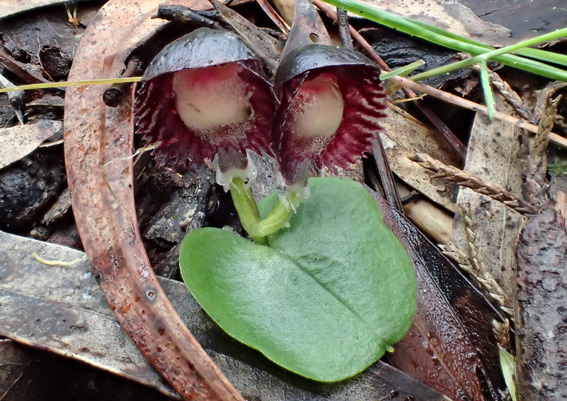
This month there were four very different species. Two were from Western Australia, Pauline Meyers’ Caladenia longicauda and Lorraine Badger’s Thelymitra pulcherrima, and the other two from South Australia, Rob Soergel’s Bunochilus viriosa and Robert Lawrence’s Corysanthes diemenicus which was the winning picture.
Corysanthes diemenicus is a very common winter orchid but this one is unique as instead of one flower as is normal there are two! So is it a new species? No, it is a freak; the technical terminology is teratologic.
Of the various plant families, the mint and orchid families (Theissen 2006) are well known for producing teratological plants, that is, plants that are grossly abnormal or deformed. Bates (2011) divides such abnormalities into five categories – peloric, teratological freaks, monstrosities, colour variants and throwbacks. All of them are congenital abnormalities which may be a result of unknown genetic malfunction or viral infection in the early developmental stages of the plant. Based upon this division, Robert’s picture is a monstrosity. This type of double flower is more likely to be found in self-pollinated plants for example Pterostylis foliata often produces more than one flower.
Most freaks are random, they come and go but peloric freaks are interesting. An early meaning of peloria was an irregular feature that becomes regular (Walker 1879) but in the orchids the meaning has been narrowed to refer to an “abnormality of the labellum that is of a similar shape and colour of the petals” (Australian Orchid Genera 2006) or more precisely an abnormality of the inner tepal whorl (the petals) wherein the petals can take on the appearance (in part or full) of the labellum, or the labellum takes on the appearance of the petals. One naturally occurring semi-peloric species is Calochilus imberbis. In recent years, orchid growers have cloned peloric freaks using a technique called mericlone to produce new cultivars eg Rhyncolaelia digbyana var. fimbripetala.
Freaks may be interesting but they are temporary so if you spot something unusual in the field look around at the surrounding orchids. If there is only the one or two individual or one colony, then it’s likely to be an abnormality rather than a new species.
Thank you to Greg Steenbeeke for checking this article.
Reference:
Bates, R. J., ed. (2011). South Australian Native Orchids. Electronic version, 2011. NOSSA
Jones, D L et al, (2006) Australian Orchid Genera, an information and orchid identification system, interactive CD-ROM
The following article is from Vol. 32 No 7 August 2008 Journal of the Native Orchid Society of South Australia Inc.
Dendrobium speciosum
Native Orchids. The Epiphytes: August. Steve Howard
Movement of our natives towards flowering is often rapid. How often do we look at our plants thinking that they will never be out in time then take a look the week after and they have doubled in size. Dendrobium speciosum is a classic example of this. One minute the plant is covered in acorn like flower buds then a week later there are bunches of flowering buds everywhere. There is the temptation to force them on but I would leave that until the last two weeks prior to show before making that call. Then we have the Sarcochilus. These can stay in bud for months and not do a thing then suddenly they are away.
On the epiphyte side we should have a heap of buds everywhere on the flowering plants. They key is to keep these under cover and away from rain and also slugs and snails that have a nasty habit of chomping into them. Rain exaggerates fungal problems that will rot out a flower spike overnight. Also avoid temperature extremes, especially once the buds start showing on a lengthening spike. Bud drop occurs quickly and the loss of even one bud will sway the judge’s decision. Even and strong light now becomes important especially for those epiphytes with Den. speciosum and Den. kingianum in the background. The reason is we need to create strong upright racemes to support the flowers. No point having the spikes hanging over the side of the plant and then have the flowers doing the same. Some species do have this trait and as such do not make very good parents if this trait is passed on in hybridisation. I like my flowers to look at me and cannot see the point in lying on the ground and looking up at the plants on the bench. Strong light will assist this spike development as does the potassium and potash in the fertiliser. This is also a reason we tend to avoid high nitrogen feeds in our feeding programme. Even light is also important in order that the flowers will be evenly distributed around the pot as opposed to all facing the one way. Hanging flowering plants is one way we can get this even light.
Now is also a good time to clean up our plants before flowering. Remove husks over the canes, remove dead leafless canes and trim and clean the leaves. It is easier to do this now whilst the spikes are on the small side. Also give the pots a scrub too. All of these tips will help make things a little easier when it comes time to prepare the plants before show. Also make sure you have some fresh topping for the pots. It’s these little things that helps improve the presentation of our plants.
Only remove leafless canes if you think they have completed their flowering potential as many will flower for years after losing leaves or if the cane affects the appearance of the plant. If the forward growths are struggling under no circumstance remove the leafless cane unless it is absolutely dead as the struggling plant would be relying on stored nutrients in this cane to survive. I would then concentrate on why is the plant in the state in the first place.
Dendrobium bigibbum
Even though we are two months away from re potting and dividing our plants it is now time to take stock of what plants will be potted on, divided or sold off on the trading table. That way we can arrange pots, mix etc in preparation. The other thing I am looking at now is where am I going to move my plants this year. Last years heat exposed many plants that are susceptible to heat and with the probability that this will happen more frequently in the future there is the need to move these prone plants from where they are at present. Leave them where they are and the same thing will happen again. There will also be the need that these tender plants be removed from the collection and the emphasis placed on more hardy species and hybrids.
Watering will be dependent on the hybrids you grow and where the parents originate from. Most of the hot/cold type have the tropical hard cane types in the breeding eg Den. bigibbum and these require dry winters so we need to take this into account here. I do not dry them out completely but then again don’t water them frequently either. I aim for slightly moist at all times to keep the roots in good condition. The others with Den. speciosum, kingianum, falcorostrum all come from cooler climates that receive winter rains and as such can handle being damp over winter. Avoid over wetness as this will be to the detriment of the plants. These plants require a short dry period after flowering to mimic the same dry spring period experienced in the areas where most of them come from. I find that with our reduced rainfall of late, nature provides my plants with enough water apart from the mounted plants that get the odd mist or squirt. Any watering should be confined to the warmer part of the day after lunch. Early morning squirts with water from a hose that has been sitting on a frozen ground all night will not do your plants any favours. Feeding during these cooler months is infrequent and if you miss them for a month or more will not cause too many issues. Plants under cover get watered every couple of weeks and these are usually the hot colds.
You will have a few late season new growths reaching full size. Keep an eye on these as they are very prone to rot when water sits in the axils of the new growths. If you notice a growth go reddish or yellow it is a good bet that it has rotted. You can cut the growth off below the infection and treat with a fungicide. I then dry the plant out as a precaution and take a mental note. This plant will always be prone to attack.
My plant of the month is Den. aemulum, the feather orchid. This compact growing epiphyte comes from central NSW (New South Wales) to Qld (Queensland) and comes in 2 forms. The iron bark form strangely enough grows on the iron bark tree, a heavily permanent barked member of the eucalyptus family. It has small cylindrical psuedobulbs that grow in a radial pattern topped with two small and rather thick leaves. Small white clusters of flowers that go pink as they age are borne apically over several seasons from the one cane. The other form commonly seen is the brush box form. This is the long caned variety and the two are found in similar areas. These are not often seen in collections and have the habit of slowly fading away in cultivation unless their requirements of light, a suitable host and conditions are met. I have several plants on different hosts and the results are mixed. The best plant grows east on a slab of hardwood in a rather protected spot and is the brush box form. The iron bark forms appear to struggle on mounts of Callistemon and paperbark. Maybe it is the acidic gummy excretions from the bark of the ironbark that are missing. These plants have not been used in hybridisation very much as they do not have the traits that hybridists are looking for. Nevertheless I find them a very attractive flower when grown into a specimen plant and they will always have a place in my collection. They are not easy to obtain and generally restricted to those that have permits to collect them from the wild.
Next month is September and with it the warming weather and a profusion of flowers. We will look at a few tips to help with the presentation of show flowers but also look back at those that did not flower well or flower at all and see where we can improve and what went wrong.
This week’s post is taken from the IUCN SSC Orchid Specialist Group Facebook post concerning Resolution decided upon at the final session of the International Orchid Conservation Congress Conference, held in May 2016 at the Kadoorie Farm & Botanic Garden, Hong Kong
It was posted by Michael Fay of Royal Botanic Gardens, Kew. He is also the Chair of the IUCN SSC Orchid Specialist Group. According to their website, “The Orchid Specialist Group is a global network of experts who volunteer their time and expertise to build a scientific and practical foundation for the conservation of orchids (Orchidaceae).”
(A list of the meanings of acronyms appears at the end of this post.)
Michael’s post follows
Here are the Resolutions from the final session of IOCC VI in Hong Kong:
Orchids are a flagship plant group with a high profile in human culture. They are known from all vegetated continents on earth but their occurrence reflects patterns in the global distribution of biodiversity and their intricate ecological associations, particularly with pollinators and mycorrhizal fungi, reflect sensitive ecosystem processes. Accordingly, orchids are indicators of ecosystem and climate health. Many orchids and their associated biota have been exposed to a variety of threats as a direct consequence of human-driven global change, with almost half of the ca. 27,000 known species now potentially at risk of extinction. Delegates of the IOCC support all efforts to research and mitigate these threats and secure environments on which orchids depend, and are committed to achieving meaningful conservation by recommending that:
The creation of orchid enhanced habitats is a priority for ecological restoration.
Enhanced in situ orchid protection requires the creation of orchid reserves. These will benefit a wide array of other species and biological communities and can be financed through various public and private sources.
The international and domestic wild plant trade is widely recognised by governments and civil society as a major threat to the persistence of many orchid species, and that its curtailment requires concerted government action and enforcement.
The propagation and cultivation of threatened orchids by small and local orchid enterprises should be supported for the sustainable production of orchids used in horticulture, medicine and food.
Orchid cultivation should be licensed and audited by government or other government-approved body through a national (or international) accreditation scheme that specifies adequate safeguards to ensure best practice. Propagated orchids should be traceable and distinguishable from wild orchids so as to minimise the risk of laundering wild plants.
National, regional and international networks should be established and strengthened for promoting in situ and ex situ orchid conservation.
The next generation of orchid taxonomists, ecologists and conservationists is nurtured through improved training, education, publicity and awareness-raising programmes.
Paracaleana minor (Little Duck Orchid) Photo: David Manglesdorf
Members shall strengthen the work of OSG by:
Facilitating and conducting national and global Red Listing of orchids, and contributing to the Sampled Red List Index (SRLI);
Monitoring and reporting on the illegal trade in orchids to national enforcement agencies and to TRAFFIC;
Reviving Orchid Conservation International as a vehicle for web-based education and channelling funding to orchid conservation programmes, along the lines of Birdlife International;
Embracing social media and other web-based interactive tools as dynamic and effective means of stimulating communication, raising awareness and building networks;
Using citizen science as an effective means of motivating individuals and amateur groups to record orchid occurrence (e.g. OrchidMap, iNaturalist) and help scale-up the collection of verifiable data;
Establishing and maintaining a global database of orchid reintroductions (including both successes and failures) and ex situ orchid collections that can be accessed and updated by members and which is linked to the IUCN Reintroduction Specialist Group;
Creating new sub-groups focusing on trade and molecular identification, to reflect important cross-cutting themes and challenges.
Thanks to Stephan Gale and Phil Cribb for producing the final version of these.
Calochilus cupreus (Bearded Orchid) Photo: Helen Lawrence
IOCC VI refers to the International Orchid Conservation Congress Conference was held in May 2016 at the Kadoorie Farm & Botanic Garden, Hong Kong
IUCN: International Union for Conservation of Nature
OSG: Orchid Specialist Groups
SSC: Species Survival Commission
TRAFFIC: Trade Records Analysis of Flora and Fauna in Commerce