Recently, Jodie Hamilton (ABC reporter) wrote a good orchid article highlighting the importance of and threats to orchids. Click on the link to read her article – Orchid enthusiasts call for greater protection for native species facing habitat threats When she emailed me with some orchid questions (28 November 2025), I gave a comprehensive answer from which she was able to take what she needed for her article.
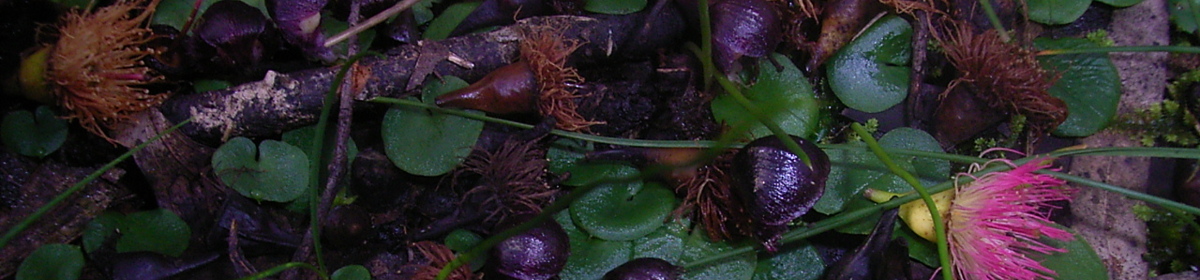
Possibly Genoplesium nigricans (Photo June Niejalke)
As there is additional information in my answer, I thought others might be interested in my reply. Here it is –
“Hi Jodie,
As to numbers, the answer to some of your questions depends upon who you ask. So the figures will vary. Orchid taxonomy is being reviewed with several researchers looking into South Australian orchids and in coming years we will see the numbers change. But regardless of the detail, it can be confidently said that over half of South Australian orchids are threatened. Threats are clearance & development, weeds, herbicide, overgrazing, isolated “island” population (orchids need room to spread).
So having said that, looking at the Atlas of Australia (ALA), there are 4,470 observations of 141 species of orchids in EP collected between 1850 and 2025. Since 2015, iNaturalist, a citizen science project, 117 observers have collected over 1,200 of those ALA observations. iNaturalist is significant because in recent years individuals are adding observations exponentially to the database, a thing we have not been able to do in the past. The more people that get involved with iNaturalist, the more data we will have and be able to have a better understanding of not only orchids, but all our other species.
My numbers are more aligned to the herbarium numbers. Approximately 12 species are endemic to EP (~162 species for the whole of SA).*
As to why orchids are important, the following information is taken from a talk I gave earlier this year – Orchids are bio-indicators of the health of the bushland. Because they have great visual appeal, we notice them and when aware of them we are able to use their presence to determine what is happening.
They have a low tolerance for change/disruption whereas other plants will show stress signs later, making them an early indicator of what’s happening.
Pollinated orchids indicate pollinator presence i.e. insects as many orchids do not provide food for the pollinators.
They have a strong reliance upon mycorrhizal fungi from germination and with some species through the whole of their life cycle.
The significance of the fungi is that they contribute to the soil health, are involved in nutrient recycling and contribute to plant growth.
This makes orchids a potential flagship for conservation work. I’ve attached a pdf of the talk.
Fun Fact you might like.
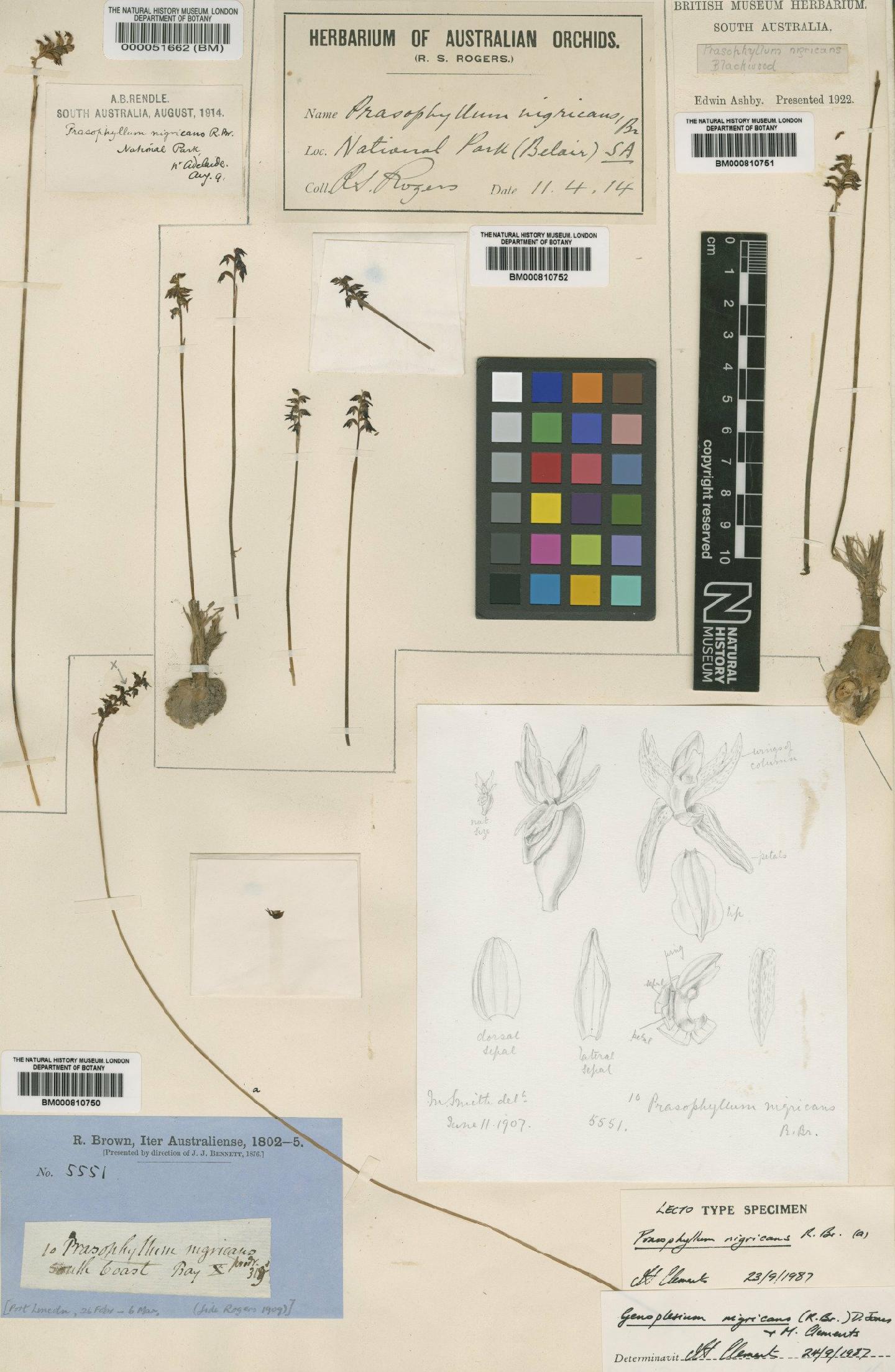
The first orchid found in South Australia was March 3,1802 by Robert Brown, botanist on the Investigator with Matthew Flinders. This was at Port Lincoln. Initially it was called Prasophyllum nigricans but today is known as Genoplesium nigricans. I find it amazing that he managed to find such a small sticklike orchid which often gets overlooked in our modern species lists.
June Nieljalke would also be able to help you.”
Close up (Photo June Nieljalke)
In giving Jodie the fun fact about the first orchid found (or rather I should say first documented), I went down a bit of a rabbit warren on the ‘net as I couldn’t find my original research material for a 2019 talk and wanted to double check the accuracy of my information.
So, I typed into Google “when was the first orchid found in south australia” only for it to give a wrong answer. I do appreciate that the Google AI gives references (other ChatBots such as Co-Pilot do not). This is important as it pointed me to an article I’d written about Caladenia cardiochila which was a few decades after settlement and therefore unlikely to be correct as other orchids would have been found before that.
Screenshot of Google’s AI reply
As a tool, AI does not do research, let alone original research. It does not understand concepts but recognises individual words and word patterns. The words it picked was “first”, “orchids” “found” and “south australia”. All four words were in the article but the concept was about when Caladenia cardiochila was first described but it was not the first orchid found in South Australia which is what the question was about.
As AI did not have a summary, it meant I needed to do some research, potentially looking for original material. This took me to the Internet Archive, the Biodiversity Heritage Library (a very useful source as it contains a lot of original source material), Digital Herbariums, etc from which I was able through deduction to come to the answer of “when was the first orchid found in south australia”
Now when you type in the same question, Google hopefully will give the correct answer.
Lectotype for Prasophyllum nigricans – note Brown’s handwriting is on the blue slip
Personal correspondence Jurgen Kellermann, South Australian Herbarium
*My figures for the endemic species numbers came from a spreadsheet, I’d initially complied years ago based upon 2011 Native Orchids of South Australia and updated.
The following article is the longer version of the summary that will appear in the September 2021 NOSSA Journal. John Eaton, the NOSSA Speaker Co-ordinaor, has written passionately on his summary of Les Nesbitt’s talk given at the August General meeting. He completes his summary with an echo of Les’ appeal for the next generation of orchid growers whose expertise is so necessary for the continuting conservation of our unique orchids.
In one of NOSSA’s most significant and challenging meetings for many years, members were treated to a talk by our Patron, Les Nesbitt – whimsically titled – “Where have all the Growers Gone?” – after the 1955 Pete Seeger song-lament. Les integrated our NOSSA history into his talk.
Les was a founding member of NOSSA which was formed on 22nd March, 1977 – 44 years ago, with 44 very keen members. NOSSA membership had grown to 100 members by the year’s end.
The fledgling Native Orchid Society of SA first met at “Goody Tech” alias Goodwood Boys Technical High School. From then on – it was “All Go!” in those early years.
NOSSA’s second meeting soon saw the formation of the Seed Bank where new members were given Ptst. curta tubers from Roy Hargreave’s wash trough.
Our first three orchid displays – between 1978-1980 – were held in conjunction with the South Coast Orchid Club at Marion. The first (judged) NOSSA Show was held in 1981 – in the Supper Room at the September monthly meeting. By the following year (1982) it had expanded into the first NOSSA Public Show –held at The Orphanage, Goodwood.
The aims of the Public Show were four-fold
To educate the public
To raise Society funds
To exhibit members plants
To obtain new members
Over one thousand people attended this first public show! – almost ten times the number we would expect nowadays.
In 1983, these NOSSA Public Orchid Shows moved to The St Peters Town Hall where they remained for many years until the venue became too expensive.
Native Orchid “Rescue Digs” to preserve native orchid species threatened by development, occurred throughout the 80’s & 90’s. Les regarded these as the “golden years” for Native Orchid growers which continued until 1996 – the year that NOSSA sponsored the Australian Native Orchid Society (ANOS) Conference at Flinders University.
Thereafter the Shows were transferred to St Bernadette’s where they remained until 2019. Les then presented some pictures of these Native Orchid exhibits and pots from previous years and from the SAROC Fairs of 2017-2019 and 2021.
Les outlined NOSSA’s many efforts to create a new cohort of growers amongst members. Early members were growers, exhibitors, bushwalkers & photographers. However our current membership seems less interested in growing and exhibiting, preferring to focus instead on recording native orchids in the field – during bushwalking.
Les stressed the importance of growing in the preservation of indigenous native orchid species, especially as we face climate change. He then threw members a challenge, stressing the importance of growing native orchids to ensure their preservation in the hard years ahead – for all things green!
To support would-be growers, he referred members to some valuable references – such as NOSSA’s Green 1985 handbook: “Native Orchids of South Australia” – an invaluable guide to members interested in growing Native Orchids. There are also numerous articles on orchid culture in the early NOSSA Journals.
Lamentably, the emphasis nowadays is more on photographing and recording terrestrial native orchids in the field.
Les also mentioned the Tuber Bank, successfully run by Jane Higgs until severe frosts killed her orchids. Sadly, there are no members prepared to organise it now.
Les also mentioned other significant initiatives such as the New Members’ Group that met before General meetings, the 2016 “Flagship Orchids” 1-day orchid workshop initiative of the Australian Association of Bush Regenerators – in creating orchid-enhanced habitats.
Les also mentioned the $2.00 seedling plant-growing competitions with annual recalls until the first plant flowerings and the 2016 and 2017 Seed kits for the culture of – (mycorrhizal) fungus-dependent terrestrial orchids. These included detailed growing instructions –still available to those willing to “give growing a go!”
Notwithstanding the Covid-19 challenges, there were the most recent propagation initiatives of 2020-2021.
In a recent talk, Robert Lawrence has described the importance of indigenous native orchids as an indicator species of a healthy bushland. If we don’t respond to the challenges Les has thrown out to our membership – it may be a matter of “Where have all the orchids gone – long time passing”! There won’t be any orchids left for us to photograph. So it’s really up to us!
Who’s prepared to step up to the challenge?
I’m rapidly approaching 80! It’s too late for me to build space-demanding infrastructure such as a temperature-regulated shade-house/green-house and benching tables. But I do want to “step up to the plate” as a native orchid mini grower! I believe that the years ahead will be challenging ones for anything green, including me! Les reminded us that our common terrestrial are most at threat as the seedbanks of researchers tend to focus on the rare and endangered terrestrials.
Les’s talk has challenged me to establish a local (indigenous) terrestrial orchid presence in my native garden – where I’ve already got a burgeoning population of Microtis – dumped accidently in one of the loads of woodchips that replaced my lawn – 30 years ago. I’m hoping this indicates the presence of sufficient mycorrhizae to help me to establish some of the common greenhoods that Les said were most at threat from climate change. And hopefully, they will keep the microtis company! Dr Teresa Lebel, a speaker I’ve scheduled for March 22nd, 2022 is a fungi expert.
I hope Les’s talk – or if you missed it – this inadequate account of it – will challenge you, also – to become a mini-grower. As Henry Schoenheimer once said of our finite, depleting – and depleted – planet – in his book of the same name – “Small is Beautiful”!
In July, NOSSA resumed face to face meetings but with an innovation. We introduced Zoom meeting as part of our face to face meeting. We are hoping that this will allow more members to become involve with the meetings.
Our first speaker, Greg Steenbeeke, spoke to the meeting from Sydney; and we had another member joining in from Victoria. Greg kindly allowed us to record his talk which is available for all to hear.
Australian Orchids: Their Role in Human Lives Speaker: Greg Steenbeeke
Anyone wanting to join our General Meeting, please contact the treasurer via email – nossa.treasurer@gmail.com
The following article, March Winning Photograph, is from Volume 44 no 4, May 2020 Native Orchid Society of South Australia Journal.
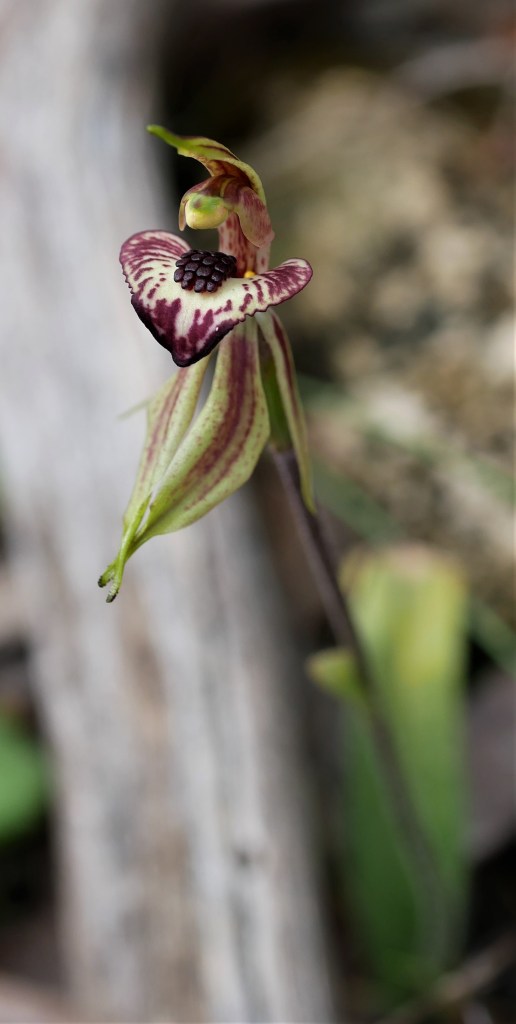
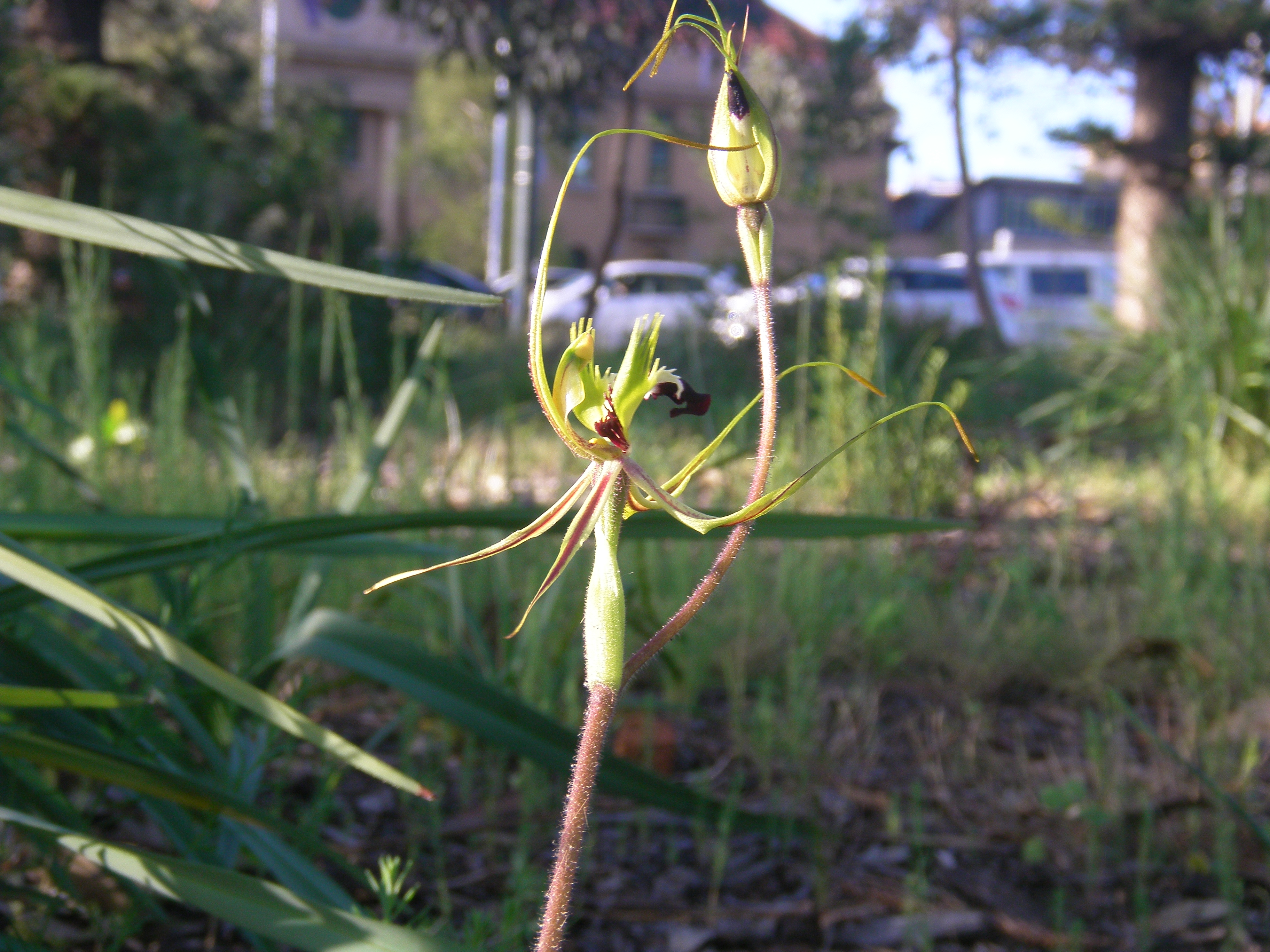
Pauline Myers’ Arachnorchis cardiochila was the winning picture. Synonyms for Arachnorchis cardiochila are Caladenia cardiochila, Phlebochilus cardiochilus and Caladenia tessellata. Common names include Heart Lipped Spider Orchid, Thick Lipped Spider Orchid, Fleshy Lipped Caladenia.
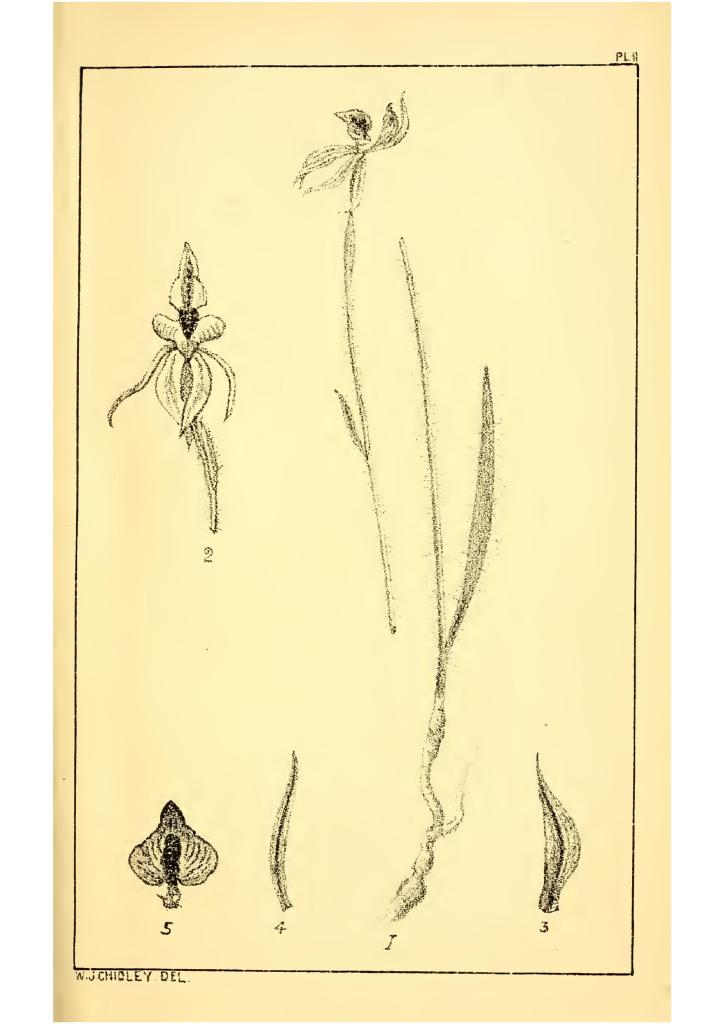
This species was named in 1886 by Professor Tate who presented it at the Royal Society of South australia at the October meeting. He did the original drawing.
The type specimen was collected at Golden Grove on October 2 1886 but it had also been collected much earlier (1865) at Barraba Scrub which is in the region of Mallalla.
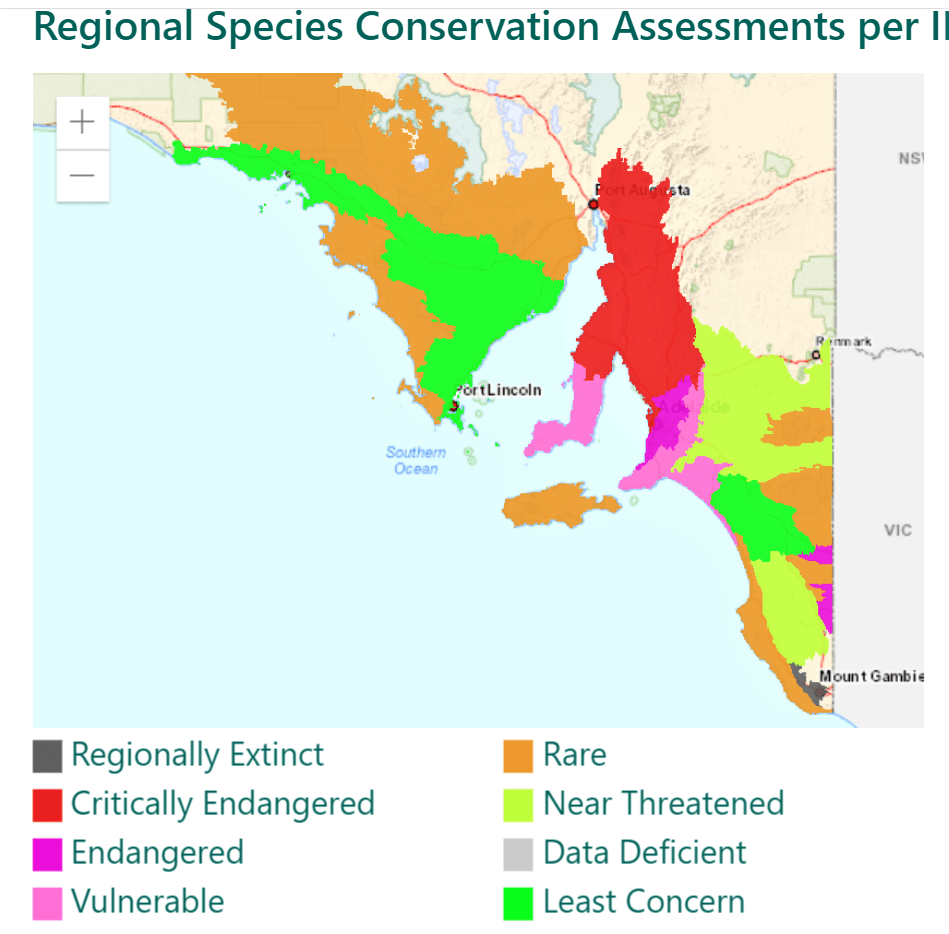
Its fate in both these areas has not been good; it is extinct in Golden Grove and critically endangered in the region containing Barabba Scrub. Although, it is considered to be a reasonably common orchid throughout its range in South Australia, Victoria and Southern New South Wales, there are areas of concern as seen the Seedbank of South Australia map below.
It should be noted that though Caladenia tessallata is listed as a synonym that this was used incorrectly, as C. tessallata is a separate but similar species found in the eastern states. Its main difference from C. cardiochila is that the edge of the labellum (lip) is toothed, not smooth as seen in Pauline’s photo.
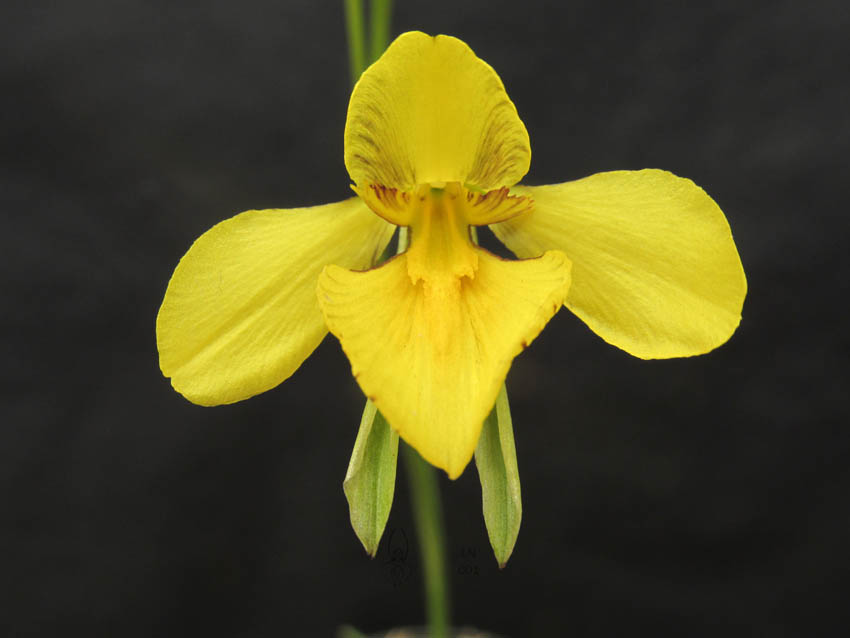
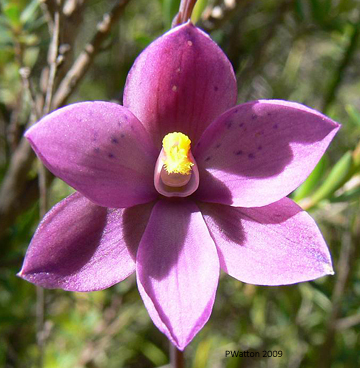
April’s theme was yellow and orange. All of the entries proved to be spring flowering. There were several Diuris. Claire Chesson, Rob Pauley and John Fennel all entered D. orientis; Les Nesbitt and Rob Pauley D. behrii and Pauline Meyer D. corymbosa from Western Australia. Pauline also entered Caladenia caesaria subsp. maritima and John Thelymitra benthamiana.
The winning picture was Les Nesbitt’s D. behrii (Cowslip Orchid) which occurs in Victoria, New South Wales, Australian Capital Territory whilst in South Australia it is rated as vulnerable.
Les Nesbitt has been working on a recovery project of these orchids for Hillgrove Resource’s flagship, the Kanmantoo Copper Mine, located almost 55 KM from Adelaide. As this orchid is often mentioned in NOSSA Journals, it might be worthwhile looking at the person after whom this species was named.
First collected by German born Dr Hans Herman Behr (1818 – 1904) who first visited* South Australia in 1844 when the colony was barely 8 years old. During his two years in South Australia he became the first person to systematically study our botany and entomology sending reports and samples back home. The results of his observations were published in various journals, and many of his collections were named and described by other botanists including his friend, Diedreich von Schlechtendal (1794 – 1866) who named Diuris behrii after Hans.
Hans Behr was an interesting man. A man of many aptitudes; medical doctor, entomologist, anthropologist, botanist, duellist, socialist, poet, novelist, linguist, member of the Bohemian Club of San Francisco and a man of wit. From the many reminiscences written about him, it would appear that he was a likeable gentleman and a generous teacher.
Unfortunately, not everyone liked him because “he was a sworn enemy of all scientific humbug, of quacks and false pretenders” and “he never refrained from expressing his opinion of them, quite regardless of person or station” but his humour shone forth in dealing with them. Once he named a “particularly obnoxious louse” after one of his enemies.
Behr revisited South Australia in 1848 during which time he became acquainted with German-Australian botanist, Ferdinand von Meuller. He maintained friendship with many of the scientific men of the time including Ferdinand Mueller and it was through this friendship that many Australian plants were introduced into California where Behr later settled after his travels.
Though the study of butterflies was his first and enduring love, he is remembered and honoured in Australia for his botanical interests. Of the twenty-two plants named after Behr, two are orchids: Diuris behrii and Arachnorchis behrii (synonym Caladenia behrii).
*The Journal incorrectly stated that he visited South Australia with his friend, Diedreich von Schlechtendal. This did not happen. As far as I am aware Schlechtendal did not visit South Australia.
Ten years ago, the then NOSSA secretary, Cathy Houston, wrote an article reflecting upon orchid name changes. Since then there have been more name changes. The issues she raised then are still pertinent today. Whilst we continue to learn more about our orchids, name changes are going to happen.
NOSSA Journal Volume 31 No 2 March 2007
HAVE OUR ORCHIDS CHANGED? Cathy Houston (Secretary)
This month the Native Orchid Society of South Australia celebrates its thirtieth “birthday”. A review of the first five years of the Society’s Newsletters/Journals (yes, they were newsletters in the earliest days) reveals some interesting points. By 1979 “A total of 110 species [of orchids] and 14 varieties” were accepted. The following are some interesting aspects about the knowledge of, and what was then current thinking about, our orchids at that time. It must be remembered that no comprehensive book on South Australian orchids existed in those days, especially not any field guides. The most useful “tools” the members had to work with were Blacks Flora of South Australia and W.H. Nicholls “Orchids of Australia”. In 1979 “A Checklist of Orchidaceae on South Australia” by J.Z. Weber: Changes introduced in the new ‘Black’s Flora” by R. Bates, appeared as a full issue of the Native Orchid Society of South Australia Journal.
Today we sometimes struggle to grasp all the fine differences when orchid species, or species groups, are split, but spare a thought for those wanting to identify with what they have seen in the field back in about 1979. An article by R. Bates describes the “Variations within the species Caladenia dilatata R.Br. in South Australia”. “There are, at present, two recognised varieties” viz. C. dilatata var. dilatata and C. dilatata var. concinna. Within these two varieties are further more divisions into distinct sub-varieties or races! At that time there were six distinct forms recognised; how much easier today, now that they are named as species. These would now include C. tentaculata, C. verrucosa, C. stricta, C. toxochila and C. conferta.
Arachnorchis tentaculata (King spider Orchid) syn Caladenia tentaculata
Recognition of what could be species has long been apparent. Take for example the article written in 1980 about two forms of Pterostylis nana, viz. what we commonly refer to as the ‘Hills’ form and the ‘Mallee’ form. This article documents the obvious morphological differences and illustrates this with line drawings and a map showing distributions of the two. Electronic Orchids of S.A. currently recognises five possible species of P. nana for South Australia. These are probably all un-named, since David Jones, in “Native Orchids of Australia”, does not recognise true P. nana in our state. Similarly, an article written in 1981 discusses the P. alata – scabra – robusta complex. The author recognises there are “at least four species of this group in South Australia”. This is the first time the authors acknowledge they should be elevated to species, not just accepted as varieties or forms. At that time P. robusta was treated at varietal level, viz. P. scabra var. robusta or P. alata var. robusta. Ultimately most of these have been elevated to species level (P. dolichochila, P. erythroconcha, P. robusta, and P. striata).
It was noted that in 1978 David Jones and Ray Nash were currently working on Pterostylis. Further to that Les Nesbitt notes that of the sixty or so Pterostylis in Australia, South Australia has twenty-two species. One wonders what the count is now. It is well known that David Jones is currently/still working on the Pterostylis group, with more species being recognised regularly.
Thelymitra x irregularis or Pink Spotted Sun Orchid was photographed in 2009 near Macclesfield
In a series of articles produced about “Our rarest orchids” in 1977 we find the comment “Very few of our orchids are thought to be extinct… . “One wonders what that number would be considered to be today. The same article talks about the demise of Pterostylis cucullata and the possibility that it may no longer exist in the wild. Certainly this is one of our highly endangered species for which recovery actions are being undertaken these days. [N.O.S.S.A. members have an opportunity to assist with this work starting on April 14th – see diary dates.] In 1977 there was excitement when, following a field trip to Belair National Park one member returned the following day and “the elusive Pterostylis cucullata” was seen “growing in association with P. curta”. In 1981, following a discussion and review of endangered orchids in South Australia, R. Bates writes “There are a number of endangered species in S.A. which have not yet been named. It is not unlikely that some of these will become extinct before they are even described properly.” With such a large number of as yet undescribed orchids in our state, let us hope this does not happen.
Naturally occurring hybrids and the naming of such, has been debated regularly within botanical circles. In 1978 this insight is shown by Ray Nash who “guided us to a nearby patch of Thelymitramacmillanii,…… Ray’s view is that this will probably turn out to be a hybrid, possibly between antennifera (which it closely resembles) and rubra or luteocilium.” In 1980 T. decora [T. x truncata] was featured as one of South Australia’s rarest orchids. It was thought to be of hybrid origin and three forms were recognised then. The probable parents were T. ixioides x T. longifolia, T. ixioides x T. pauciflora, and T. ixioides x T. mucida. Today with the naming of many species within the T. pauciflora complex, it is now being recognised that there are even more combinations producing similar type flowers, e.g. T. juncifolia, which gives rise to the spotted features, x T. brevifolia.
Name changes always raise controversy. A brief explanation giving some insight into this complex area can be picked up when an author is expanding on the front cover illustration of Corybas. “In fact, they should never have been called Corybas in the first place. They were discovered by Robert Brown during the Flinders Expedition (1801 – 1805), and illustrated by the Austrian Ferdinand Bauer, another of the members of the expedition. Brown called them Corysanthes from the Greek “korys” (a helmet) and “anthos” (a flower), and they were known for many years by that name. However, in this instance, justice was never truly done, because the decision was made to call them Corybas, the name previously allotted by R.A. Salisbury in 1805, on the strength of seeing Bauer’s illustrations.” More recent times have seen that injustice righted with the name reverting to Corysanthes, something brought about through the work of David Jones. Similarly, the latest naming of Corunastylis tepperi follows this, The International Code of Botanical Nomenclature, a name that was recognised by R. Bates in an article written in 1981! However, Bates concludes that P. tepperi and P. nigricans are synonymous, so the latter prevails, but “further work needs to be done”! He is also the author of an article depicting some name changes in 1980. If our readers are confused by “new” names, then just think what it was like for those in 1980 when, among others, Caladenia carnea, and all its five varieties, is changed to C. catenata, with all its varieties, two of which are C.catenata var. gigantea and C. catenata var. minor. Two others were elevated to C. pusilla and C. alba.
Corysanthes diemenica (Veined Helmet Orchid)
At one time our esteemed orchidologist was asked to comment on a list of name changes being proposed for the revision of Black’s Flora of S.A. “My first reaction was to state that everyone would be happiest if no changes were made”! However, in fairness to that gentleman, it must be said that by the time he had worked through a lengthy consultation with botanists covering much of Australasia, a revision of type specimens and other material and associated literature, he was clearly of the opinion that the changes were warranted.
Have our orchids changed? Maybe, but what has really changed is our knowledge and understanding of these unique plants. Based on that knowledge, opinions, attitudes and ideas have changed. Thirty years ago it was not “policy to differentiate between the numerous forms of C. patersonii in this State …” Today we have numerous named species in this complex, without actually any Caladenia patersonii as such.
The final word must come from Peter Hornsby when he said “The ultimate aim should be for the reader to know which plant is being discussed, rather than whether or not the title is absolutely correct.”
References:
Native Orchid Society of South Australia Journal.
1. 1977 Vol. 1 #5
2. Vol. 1 #9
3. 1978 Vol. 2 #2
4. Vol. 2 #6
5. Vol. 2 #7
6. 1979 Vol. 3 #1
7. Vol. 3 #6
8. Vol. 3 #9
10. 1980 Vol. 4. #3
11. Vol. 4 #4
12. Vol. 4 #6
13. Vol. 4 #7
14. 1981 Vol. 5 #1
15. Vol. 5 #3
16. Vol. 5 #4
17. Vol. 5 #6
Black J.M. 1978. Flora of South Australia, Part 1, Third Edition. Handbooks Committee, South Australia.
Jones David L. 2006. A Complete Guide to Native Orchids of Australia, Including the Island Territories. Reed New Holland, Australia.
Nicholls, W. H. 1969. Orchids of Australia; The Complete Edition. Thomas Nelson, Australia.
This week’s blog is an extract from Volume 30 No 10 November 2006. In this article of Len Field he gives not only cultural notes but also some interesting background including an orchid link with the infamous Captain Bligh.
Dockrillia linguiformis (Sw) 1800 Brieger
Dockrilla linguiformis
Len Field Common names Thumbnail orchid, Tongue orchid, and in North Queensland the Tick
orchid.
The name linguiforme is from the Latin lingu(a) as in linguiforme (a tongue). It was also claimed for many years that this was the orchid that Olaf Peter Swartz the German botanist founded the genus Dendrobiumin 1800, but this was wrong, although this was the first orchid seen by white man when they landed at the rocks area in Sydney cove, Port Jackson. It was introduced into England by Rear Admiral Bligh of Bounty fame.
Other names it has been called are Dendrobium linguiforme var. linguiforme Swartze 1800 Callista linguiforme (Swartze) Rev. Kuntze 1891 Dendrobium linguiforme (Swartze) var. huntianum Rupp 1942
There was another variety named from this species called var. huntianum by Rupp in 1942, which was named after T.E. Hunt and is a June or July flower and found near Ipswitch (sic) in Queensland, but as it reverts to type form it never reached true variety status and was considered just a variation of the type form.
This orchid has a huge range of habitat which stretches from almost the Victorian border up to North Queensland and West to the Great Dividing Range. It is very common throughout this area and equally happy as an epiphyte or a lithophyte but where as a epiphyte it likes swamp oaks (Casuarina glauca), river oaks (Casuarina cunninghamiana), in fact it will grow on most trees that will hold there bark including the tea trees (Leptospermum species). I have seen this orchid hundreds of kilometres inland from the coast still forming large mats on the rock faces, while in its more prolific growing areas these mats will cover huge areas of the rocks where it can survive and grow in extreme exposed conditions that would kill other orchids. In the dry times the leaves which are very thick, tough and numerous will shrivel and can last up to six months without water. This is a feature of a lot of Australian Dendrobium and Dockrillia Flowering is from August to October with blooms that are long lasting, up to two weeks with one raceme per leaf. Culture. If grown on slabs which is the usual way it should be hung up high and if grown in pots a very coarse open mix. In nature it likes plenty of sunlight although at times it will grow in shade. Whichever way it is grown it should have good light, humidity and air movement.
The Native Orchid Society of South Australia (NOSSA) is affiliated with the national body of native orchid society, Australian Native Orchid Society (ANOS). NOSSA regularly sends reports of its to ANOS. This year’s report covered four years of the society’s activities and is reproduced here to give readers an idea of the many things that we do. This report was produced by Robert Lawrence (currently Vice President).
NOSSA REPORT 2012 to 2016
I believe that the last annual report from the Native Orchid Society of South Australia was in 2011 when we were just commencing a three-year plan with the establishment of a series of subcommittees. All of the committees have since ceased to exist, but not without significant accomplishments.
The Website Subcommittee had established a website, but a Webmaster has since been appointed. The website now uses WordPress and is maintained so that its management could easily be transferred to another person. The website provides a weekly educational post about Australian orchids. It has also provided a point of contact from those outside of the Society. It is linked to a Facebook page that increases the profile of NOSSA among those interested in orchids throughout Australia and beyond.
The Education Subcommittee had established a picture competition at the monthly general meetings. There is still only a small number of contributors, but many excellent pictures are shared. The winning picture from each meeting is used as a basis of one of the weekly posts on the website.
The Education Subcommittee had a vision to produce a brochure of 20 common orchids of the Adelaide region for free distribution to the general public. The NRM (Natural Resources Management) Education ran with the idea and produced a poster of Common native orchids of the Adelaide Hills. This provided brief, but comprehensive, profiles of 29 native orchids and the weedy species. This has been printed as a double-sided poster and is available from the website of Natural Resources Adelaide and Mt Lofty Ranges. NOSSA members worked with NRM staff on the details of the poster and NOSSA members contributed many of the photographs. This poster was completed and launched in April 2015.
NOSSA also provided monetary assistance as a loan with the publication of the field guide entitled, Start with the leaves. A field guide to common orchids and lilies of the Adelaide Hills. This guide covered 50 orchid species as well as native lilies and some weeds in the Iridaceae family that are sometimes mistaken as orchids. The contribution of $8,000 was recovered only 8 months after publication.
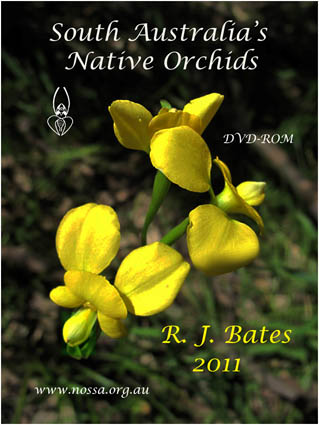
The Disc Publication Sub-editing Subcommittee saw the publication of South Australia’s Native Orchids on DVD discs in time for the Spring Show in September 2011. Both the DVD and the book were published in time for the Spring Show in September 2011. Both continue to sell.
A new subcommittee has been established in February 2016 to oversee the publication of a field guide, expected to be called Wild Orchids of South Australia. It is proving to be a challenge to be brief enough to reduce the information to a size suitable for a field guide. (Editor’s note: it has since been decided to defer this until after the development of the interactive website, see below.)
NOSSA members have being working since 2014 to establish an interactive website and database modelled on the Go Botany website run by the New England Wild Flower Society in the USA. This was supported by a grant from the Australian Orchid Foundation. The project is called Wild Orchid Watch. It is hoped to produce an interactive, web-based orchid identification tool. Recording sightings through such means as apps on mobile telephones are also being investigated.
In 2014 NOSSA made a donation to help establish the Orchid Conservation Program. This was led by Dr Noushka Reiter. Once established, staff in the Department for Environment, Water and Natural Resources began to organise a trial with four threatened orchid species from South Australia. Noushka visited South Australia during 2015 and collected samples from each of these species and isolated fungi from these. Seed was also collected and work on propagation commenced in 2015. During 2016 NOSSA sponsored the propagation of one of the four species through the Adelaide Botanic Gardens. Caladenia gladiolata, an endemic species, was selected.
Paul Beltrame, a secondary teacher at Kildare College, contacted and joined NOSSA during 2014 with the interest in getting girls at this school involved in the propagation of native orchids. A program was organised modelled in the Orchids in Schools program run by the Orchid Club of South Australia with Les Nesbitt’s involvement.
A delegation from Kildare College, ably assisted by their enthusiastic laboratory assistant Nenah McKenzie, visited Noushka in Melbourne and learnt the technique for separating and growing fungi. They have since separated fungi from two of our more common greenhood species and supplied this for seed kits that were made available to members as a trial at the start of the 2016 growing season.
The trial of seed kits was done for Pterostylis nana and Pterostylis sanguinea. A trial was conducted in this growing season of seed kits for members. Kits included a pot, growing media, seed, fungus, mulch and instructions. There seems to be limited success with the current round, but improvements are planned from the lessons learnt. One particular growing mix proved successful with a small number of seedlings appearing. The contribution of the Orchids in Schools program at Kildare College has been necessary for the isolation and production of fungi for the kits.
In October 2012 Cathy Houston and Robert Lawrence collected seed of Pterostylis arenicola from the only population on the Adelaide plains after monitoring in September indicated a good year for seed production. The seed was germinated in 2013 and was deflasked at a working bee at the Adelaide Botanic Gardens in early August 2016. The students from the Orchids in Schools program at Kildare College participated. Latest reports are that 40 plants look like surviving. These will be used for seed production and for reintroduction.
Typical of the rufus hood this Oligochaetochilus arenicola shows the sencesing leaves, pendent petals and hairs on the labellum. Photographer: H Lawrence
In 2012 NOSSA was asked to care for and propagate rescued Diuris behrii plants from Hillgrove Resources Mining Lease near Kanmantoo in the Mt. Lofty Ranges. The plan was to maintain the rescued orchid clones in cultivation for several years and to produce additional plants for reintroduction within the mining lease area each Autumn. A comprehensive recording and auditing system has been put in place to track each clone and any seed/daughter tubers/plants. By August 2015 there were 609 plants with 75 original mother plants. There were 95 daughter plants returned to the site for revegetation in each of the years 2014, 2015 and 2016, a total of 285 plants.
Funding from Hillgrove Resources has assisted NOSSA financially and has made it possible to consider funding conservation work. NOSSA is planning to apply for charity status so that donations can be used for tax deductions. Donations will then be feasible through our website. We are also starting an orchid seed bank. Seed will be available only to members and it is hoped that this will increase our membership. There is a demand for Australian orchids overseas and it is hoped that this will become a means for raising funds for conservation. Other means of fund-raising such as sausage sizzles and selling kits for craftwork are also being considered.
NOSSA members still continue to be involved in surveys and monitoring threatened orchids. Members have been involved in the planning of monitoring.
Weeding and Monitoring, two of NOSSA’s conservation activities
The management committee of NOSSA is currently working on a revision to the Rules of Association. In the current version there is a two-year limit on the term of the President of two years. In the first 16 years from 1977 there were there were eight different presidents before one had a second term. Bill Dear was president in alternate terms until he retired and moved to Western Australia in 2012. Robert Lawrence was elected president in March 2014, but for the first time in 2016 there were no nominations for president and he was nominated to the role of vice president with no other nominations. The management committee has appointed a subcommittee to review the Rules in relation to the terms of the president. Another change planned is change from having monthly general meetings to having less formal monthly meetings at which no decisions are made or minutes kept. All resolutions will require calling a formal special meeting. This idea is adapted from the approach used by ANOS Victoria.
Over the last two years NOSSA has asked new and renewing members to complete a survey of their interests. This has proved to be an effective way of getting information on the interests of our members with 79 responses, this being about half of the number of memberships. This is an overall summary of the results ranked according to number of responses:
Area of interest
Responses
Percentage
General Orchid Knowledge
53
67%
Field Trips
48
61%
Photography
47
59%
Conservation
46
58%
Growing Terrestrials
35
44%
Surveys
30
38%
Growing Epiphytes
28
35%
Citizen Science
20
26%
At its establishment NOSSA was primarily a Society of orchid growers. These figures reflect a decline in interest in growing orchids. The figures are somewhat surprising in that the numbers interested in growing orchids are much larger than the number of growers. Presumably some of these are interested in learning with a view to getting involved with growing later. At least we hope this is the case.
We are certainly noticing a decline both in our numbers of growers and in members involved in surveys due to age and health.
The greatest number expressed an interest in general knowledge and we are relying on the Journal and the Website help to keep people interested and informed. Next was field trips, but we haven’t had that many that have attended field trips in in the last few years. Only 11 of those who expressed an interested in field trips are not interested in photography, the next item of interest, and only 10 people interested in photography were not interested in field trips. Not many of these share their photographs at monthly meetings. We are hoping to get members to make their photographs available for the identification guides.
Bearded Orchid Photo: Helen Lawrence
It is pleasing that 58% are interested in conservation, thus supporting the efforts of our Conservation Officer.
Growing terrestrial orchids was next on the list; we hope that the tuber bank and the NOSSA Seed Kits are meeting the demand from members. Twenty-two of the 41 interested in growing orchids are interested in growing both terrestrial and epiphytic orchids. Only 8 of the respondents are bringing plants to meetings and a couple of others have not completed the survey. Of those interested in growing terrestrial orchids, one is a former grower and another is interested in growing them in situ at revegetation sites.
Thirty members expressed an interest in doing orchid surveys and three of these are interested in participating in the future, presumably when more time is available.
Citizen science is a new concept to many and came last in our list of interests. One who did not indicate an interest said he was monitoring orchids at a particular site; this has been taken as an interest. Surveys are certainly one form of citizen science and only 2 of those who indicated an interest in citizen science did not indicate an interest in being involved in surveys now or in the future. Thirteen of the 30 interested in surveys did not express an interest in citizen science. If these were included, interest in citizen science would be 43%.
Only seven members indicated an interest in all of the categories and one of these wants to keep in touch with the club and with old friends.
The Annual Spring Show in September 2015 was a particular success, largely due to the efforts of one our new members in promoting the show through local media and by other means. We also benefited from the donation of collections of growers who had decided not to continue with their collections.
Annual NOSSA Spring Show
NOSSA has continued to maintain a tuber bank that is available for members. A small number of our members are also members of ANOS Victoria, and have obtained tubers from their collection. This is hopefully contributing to the variety of terrestrial orchids grown by our members.
Working bees continued to be conducted in association with the Threatened Plant Action Group at Belair National Park for improving habitat for the nationally endangered Pterostylis cucullata (Leafy Greenhood), at Grange Golf Club to protect and monitor Pterostylis arenicola (Sandhill Greenhood) this being nationally vulnerable and locally endangered and on York Peninsula in conjunction with a local Friends group for the nationally endangered Caladenia intuta.
NOSSA has for many years used Australian Orchid Club (AOC) judges and knowledgeable members, who have all studied the ANOS judging rules, to judge orchids at NOSSA monthly meetings and shows. As the number of judges has fallen in recent years, judging training sessions have had to been discontinued. We wait in anticipation for a proposed ANOS judges correspondence course, as we have for more than 10 years. There are at least three AOC judges interested in the ANOS judging correspondence course. It is disappointing that ANOS Awards are still limited to Queensland, New South Wates and Victoria.
In summary, NOSSA continues to be active in many ways and these activities are working together to support each other.
Orchids have fascinated people over the generations. Robert Fitzgerald was one of them. He had a lasting influence upon Australian orchids. This extract from the Brisbane Courier Saturday 27 September 1930 Page 20 gives a brief biography of him. The author of the article is Estelle Thomson.
Original article from the Brisbane Courier, Saturday 27 September 1930
Great Australian Botanists
III. – R. D. FITZGERALD
In 1830 Robert Desmond Fitzgerald was born at Tralee, in Ireland. When he was a young man of about 26 he came to Sydney and entered the surveyor-General’s office as a draughtsman; he became Deputy Surveyor-General, and held that post till he retired in 1887 to devote the rest of his life to his great work, the study of Australian orchids. He travelled all over the Commonwealth and made innumerable drawings and paintings of orchids. He drew always from the living plant (rather an exception in his day when the dried specimen was often used, even when fresh plants were available), and his drawings have grace and charm and also an unmistakable individual style.
His work was published in several huge folio volumes, called “Australian Orchids,” and in these he figures and describes over 200 species. As well as making the original drawing in colour, he made the lithographic plates for a number of the reproductions.
He kept no dried specimens, and so left no herbarium on his death (at Hunter’s Hill, Sydney, in 1892), and this is to be regretted, as he described and named a number of new species, and the type (the original specimen) not being available it is sometimes difficult to determine whether other specimens are true to this type, or variations, or actually different species.
An 1888 reprint of one of his many prints. The species featured are Caleana major (Flying Duck Orchid) and Paracaleana minor (Little Duck Orchid)
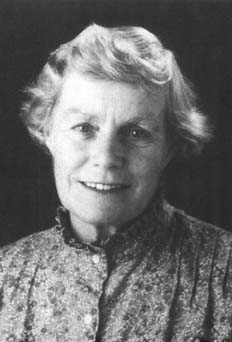
This week saw the passing of Adelaide botanist and conservationist, Enid Robertson.
Over the years Enid was associated with the Native Orchid Society of South Australia (NOSSA) both as a speaker and leader of field trips. A notable contribution to NOSSA was to alert the Society in 1989 about the invasion of the South African weed, Monadenia bracteata (Syn Disa bracteata). In 1990, she was involved in a Monadenia bracteata eradication campaign.
Reproduced below is an article written by Enid published in the Native Orchid Society of South Australia Journal, Vol 15 No 8 September 1991
Monadenia bracteata THAT AFRICAN WEED ORCHID AGAIN Enid Robertson I heartily endorse “C.H’s” sentiments in the article “If it is meant to be …” in the August issue of NOSSA Journal (Vol. 15, No.7) in which was said, “By removing these weeds from the areas of least infestation when out on our walks and as an ongoing project, we can all help keep our scrub in the beautiful way it is supposed to be.” This encourages me to bring our latest horror species to your attention yet again.
That weed-orchid, Monadenia bracteata, will be emerging from tubers late September and early October. Let’s literally nip it in the bud. Total eradication (not just control) is required. It would be a terrific achievement if we could prevent this latest African invader from taking over. Last year 100’s of plants were removed and destroyed before seed set.
Further vigilance and action is required this Spring. More help will be needed to monitor every locality where plants have been previously found and to remove any plants that sprout from tubers remaining in the soil.
This weed-orchid is yet another exotic plant to invade our diminishing remnant native vegetation. It is occupying space that belongs to Australia’s already threatened little understorey plants. As the weed-orchid produces thousands of tiny wind-borne seeds each season new infestations could occur some distance from known sites. It favours grasslands and woodlands, particularly disturbed areas, not dense sclerophyll bushland. However it has been found infiltrating into sclerophyll scrub from disturbed borders and along firetracks.
Since first recorded in South Australia in 1988 the weed-orchid has been reported from Aldgate, Belair (including Belair National Park), Blackwood, Bridgewater, Chandlers Hill, Cherry Gardens, Coromandel Valley, Craigburn Farm, Echunga, Eden Hills, Onkaparinga Recreation Park, Panorama, Scott Creek Conservation Park, Shepherds Hill Recreation Park, Sturt Gorge and three localities north of Adelaide: One Tree Hill, Mt Gawler and Mt Crawford Forest.
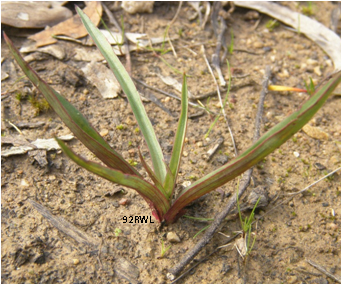
What is it like? It has a rosette of long narrow green leaves, often with a reddish tinge on the underside, which appear from the underground tuber in Spring (about October).
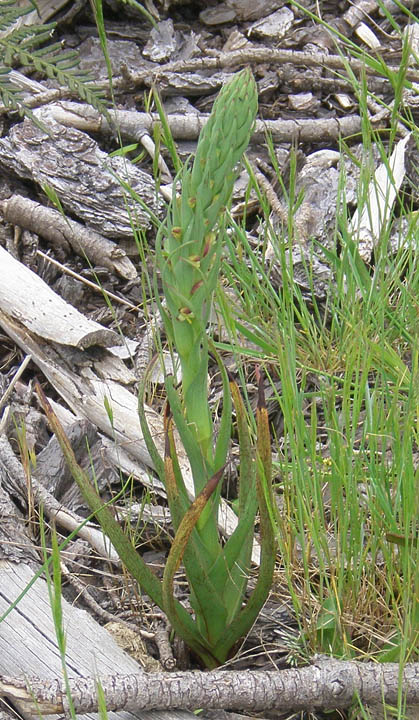
The flower spike is 15-30 cm tall and is clothed all up its stem with a series of overlapping narrow green leaves. It has up to 50 tiny flowers, brown to maroon in colour. The flowers are self-pollinating and produce prodigious quantities of dust-like seed.
Seedling Monadenia bracteata plants do not flower in the first year. It probably takes two to three years from seed before a plant produces a flower spike. It is, therefore, very important to search carefully for young plants in areas of known infestation. By mid-October new plants will be showing up and the 1991/92 campaign should begin. The whole plant, tuber and all, must be removed and destroyed.
Please, give your name and contact telephone number to the NOSSA Secretary if you can help. You will be notified of the locality where your help is most need.
Or contact me direct – Enid Robertson (She supplied her phone number at that time).
Leaves of Disa bracteata
A flowering plant of Disa bracteata
Sadly, eradication is no longer an option, whereas it appeared to be in 1991 when Enid wrote about it.









 NOSSA
NOSSA 