Natural hybrids are both fascinating and challenging. Fascinating because they don’t occur readily, (although of all the plant families, orchids have one of the greatest propensity for hybridising). Challenging because of the difficulty in determining the parents unlike the manmade hybrids where we can track which parents are being used to make the hybrid.
Obviously, the hybrid will share characteristics of both parents and this is the case of this month’s winning photograph, John Fennell’s Thelymitra x truncata. In the South Australian setting, a spotted orchid hybrid suggests that one of the parents will always be T. ixiodes/juncifolia and because it is blue it is most likely that the other parent will also be blue, from either the T. pauciflora or T. nuda complexes. This is true also for T. x merraniae. This is because there is no naturally occurring blue pigment. Whereas a pink or yellow parent and a blue parent will not produce a blue hybrid. Consider T. x chasmogama, T. x irregularis, T. x macmillanii are never blue.
Finally, it is fitting that this should be the winning photograph as this is the centenary month (September 2017) of its presentation to the Royal Society of South Australia, by Dr R S Rogers who also named this hybrid. The other hybrids entered were Jane Higgs Caladenia Harlequin and Diuris Earwig, both cultivated plants; Pauline Meyers Caladenia falcata X Drakonorchis barbarossa; John Fennell’s Caladenia x idiastes, T. x irregularis; Rickey Egels T. x macmillanii along with Lorraine Badger’s Caladenia roei hybrid and Caladenia x ericsoniae.
July is Helmet Orchid Season; and the theme for the July Picture Competition.
In Australia, the genus Corybas in the broad sense (sensu lato) has four segregate genera; three on the Australian mainland (Corybas, Corysanthes & Anzybas) and one (Nematoceras) on Macquarie Island. All three mainland segregate genera were represented this month. Robert Lawrence’s, Anzybas unguiculatus; Margaret Lee, Corybas aconitiflorus with Jane Higgs, Lorraine Badger and John Fennell all entering Corysanthes diemenica. Lorraine also entered Corysanthes despectans; and John an image of Corysanthes incurva. The clear winner was Jane Higgs’ Corysanthes diemenica (synonym Corybas diemenicus).
The flower of Corybassensu lato is characterised by a large dominant dorsal sepal and an equally dominant labellum. The other features associated with an orchid are not so obvious. The column is short and not visible. Even the ovary is barely visible whilst the other petals and sepals are but short thin filaments near the ovary. The base of the labellum wraps around to form a tube which hides the column; and the upper portion of the labellum folds back on itself and flares out. With this structure, two new features are introduced, the boss in the centre of the labellum and the auricles, two earlike openings formed from folding at the base of the labellum. Two growth features that are different from many other orchids are that the bud and leaf grow concurrently and once pollination has occurred the stem elongates so that the ovary can be raised up to 20 to 30 cms, thus allowing for seed dispersal.
Jane’s picture clearly shows these features as in the labelled image below.
Thank you to Greg Steenbeeke for reviewing this article.
Reference
Backhouse, G, et al (2016) Bush Gems: A Guide to the Wild Orchids of Victoria Electronic version
Bates, R. J., ed. (2011). South Australian Native Orchids. Electronic version, 2011. NOSSA
Jones, D. L., A Complete Guide to Native Orchids of Australia Including the Island Territories. Reed New Holland
Jones, D. L.; Hopely, T; Duffy, S. M.; Richards, K. J.; Clements, M. A and Zhang X, Australian Orchid Genera an information and identification system. Electronic version, 2006, CSIRO
Rules of entry:
The subject matter must have something to do with Australian orchids. Any format is acceptable including Photo shopped images, artwork, etc
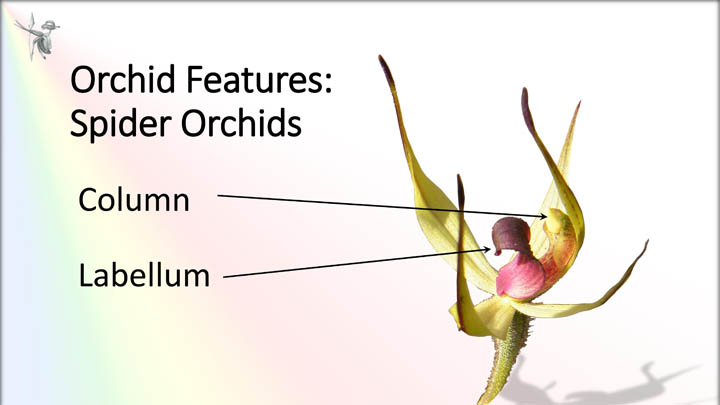
Orchids are unique in the floral world. Two distinctive characteristics that set orchids apart from other plants are the labellum and the column.
The labellum is a modified petal. It is extremely varied in appearance; “often lobed, spurred, adorned with glands, appendages of calli (callus, a hardened swelling or thickening of the skin), sometimes mobile and highly irritable and often brightly coloured”. * The labellum is important for pollination.
The column (as described by Bates and Weber) “is a distinctive feature of all orchids and a unique structure in the plant kingdom. It is formed by fusion of the male parts ‘stamens’ and female organ ‘pistil’.”*
Below are examples of the various types of labellums and columns in some South Australian terrestrial orchids. Each genus has its own characteristic labellum and column.
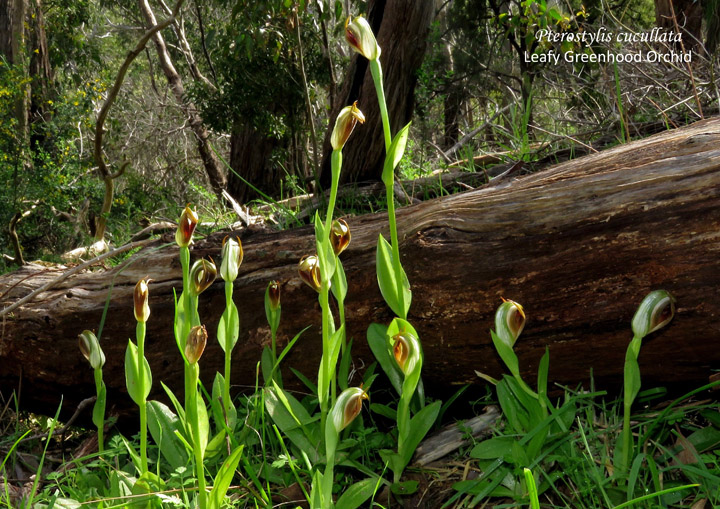
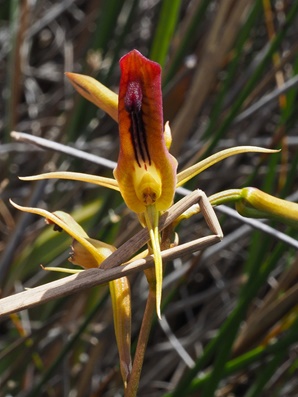
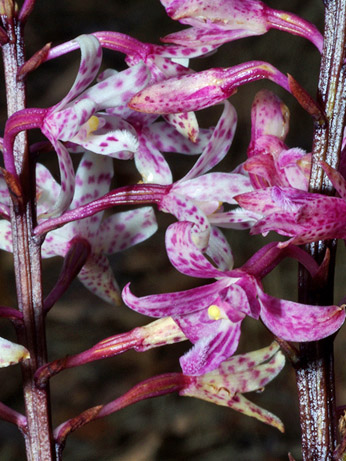
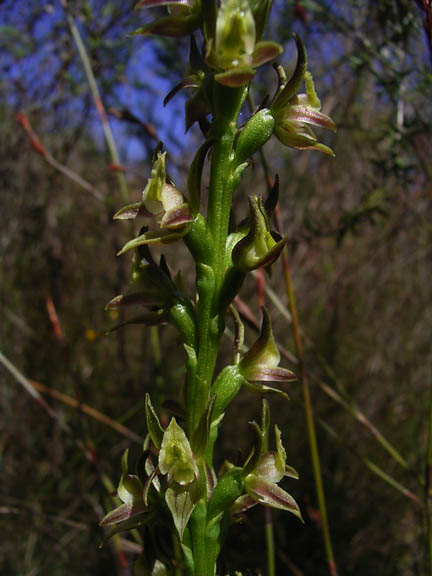
Thelymitra – though the labellum is almost indistinguishable from the other petals and sepals, the column is quite complex.Dipodium or Hyacinth OrchidPterostylis or Greenhoods – generally a simple labellum with the column hidden well back into the hood.Arachnorchis (syn Caladenia) can have quite varied and complex, mobile labellumsCorybas or Helmet Orchid – the labellum dominates and the column is hidden deep inside the flower.Diuris or Donkey Orchid – the labellum is divided giving the appearance of more than one structure.
This month’s theme for the photo competition was blue and white. White flowers can occur as a result of lack of colour such as Rosalie Lawrence’s Caladenia latifolia (Pink Fairies) which is normally pink. White orchids can also occur naturally such as the Arachnorchis argocalla (White Beauty Spider Orchid) and Arachnorchis intuta (Ghost Spider Orchid) both photographed by John Fennel, or as a dominant colour such as Lorraine Badger’s Eriochiluscollinius (syn Eriochilus sp Hills Woodland).
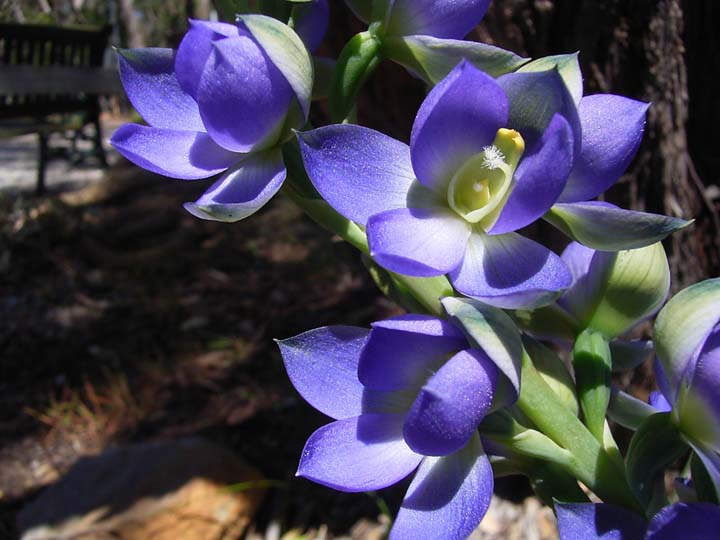
Of the blue orchids, both Ricky Egel and John Badger entered pictures of Thelymitra x truncata (Blue Spotted Hybrid Sun Orchid) whilst Robert Lawrence entered a Thelymitra grandiflora (Giant Sun Orchid) which was the outstanding winning picture.
Blue in the floral world is unusual colour in the floral world for it is not a naturally occurring colour. In fact, “[t}he key ingredient for making blue flowers are the red anthocyanin pigments. Less than 10 percent of the 280,000 species of flowering plants produce blue flowers.” (Lee, 2010 as cited in Oder 2014).
Whilst blue orchids occur outside of Australia, their “colour cannot rival” … “the intensely blue flowers” … “especially [are] unique in the orchid world” … “of their Australian counterparts. The sun orchids (Thelymitra) in particular are famous for their sky blue flowers.” (Ronse 2008: 103)
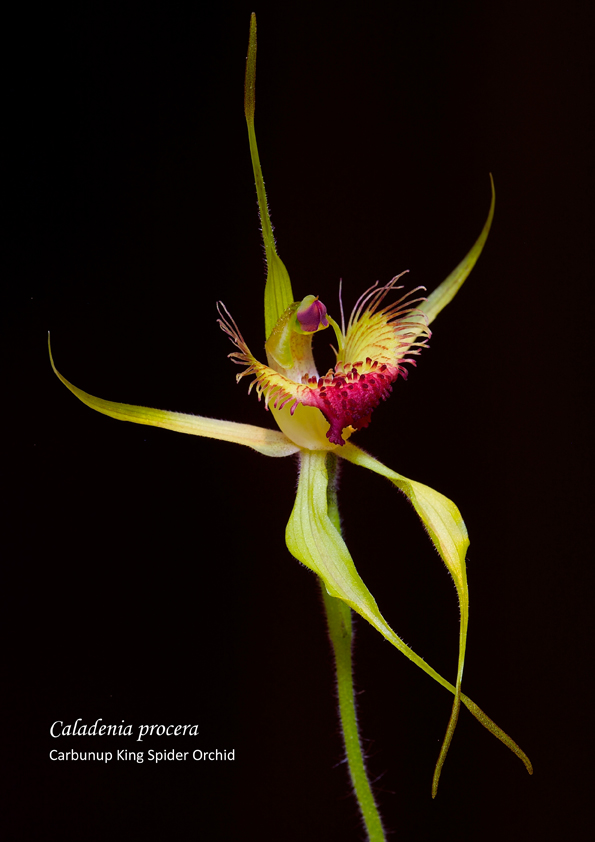
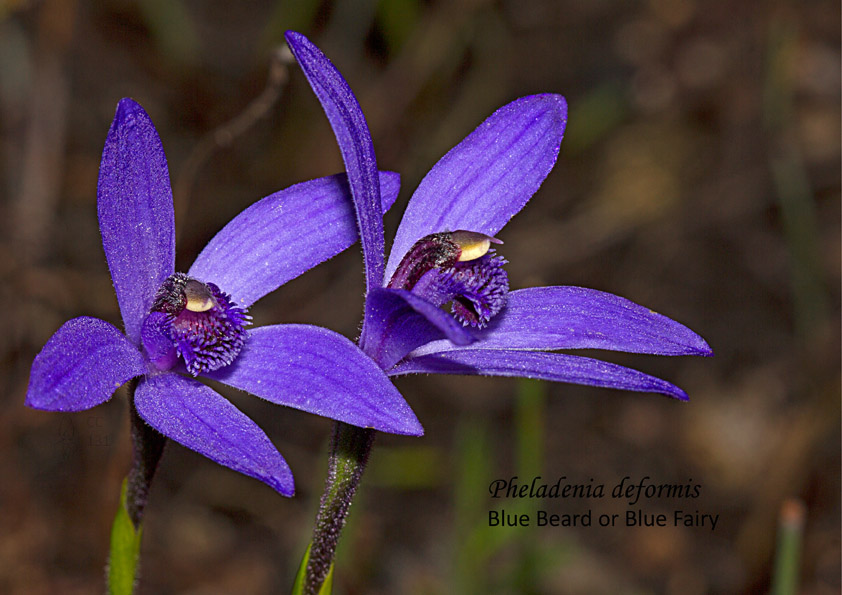
Based upon Jones 2006 tome, the following genera have true blue orchid species – Cyanicula (9 species), Pheladenia (1 species), Epiblema (1 species) and the largest group Thelymitra (about 65 out of potentially 118 species) plus one hybrid, XGlossodenia tutelata. Of the epiphytes, blue is almost non-existent except for three which Jones lists that rarely might be bluish and they are Vappodes bigibba, V. lithocola and V. phalaenopsis*.
With such rarity, is it any wonder then that the Chinese attached special significance to it as a plant that could cure lung disease and the Aztecs saw it as a symbol of strength.
*Names used as they appear in Jones 2006 tome
Reference
Jones, D. L., A Complete Guide to Native Orchids of Australia Including the Island Territories. Reed New Holland
Lee, David (2010), Nature’s Palette: The Science of Plant Color< Chicago, University of Chicago Press
Answer: Worldwide, some orchids are used medicinally but compared with other families, despite their numerical dominance in the plant world, orchids only contribute a small number of species to medicine.
Orchidaceae is the second** largest Family in the world after Asteraceae which has about 32,280* species whilst the orchids consists of about 27,753 species. In the big picture, their numbers are similar but only 2.32% (619) of all orchids species can be considered medicinal as opposed to 7.17% (2,314) of Asteraceae.
It is worth noting, that only 28,187 (6.48%) of the possible 434,910 species worldwide are recorded as being used medicinally. But of all of the world’s families it is the small Family of Moraceae (Mulberry, Figs & Mallow) that contributes the most. Of its 1,229 species 22.54% are medicinally useful.
Total number species
Percent of species used medicinally
Number of Species used medicinally
World wide
434,910
6.48%
28,187
Asteraceae
32,280
7.17%
2,314
Orchidaceae
27,753
2.23%
619
Moraceae
1,229
22.54%
277
Concerning Australian orchids only a handful are known to have been used medicinally such as Cymbidium for dysentery, Dendrobium teretifolium bruised leaves for pain relief and different parts of Dendrobium discolor as a poultice and for ringworm.
Notes:
**Many sources will state that the Orchid Family is the largest Family worldwide but for the purpose of this article, the information used is from 2017 State of the World’s Plants. Species numbers tend to be a in state of flux as botanists are discovering new and reassessing data.
*All figures in this article are based upon figures found in the 2017 State of the World’s Plants report.
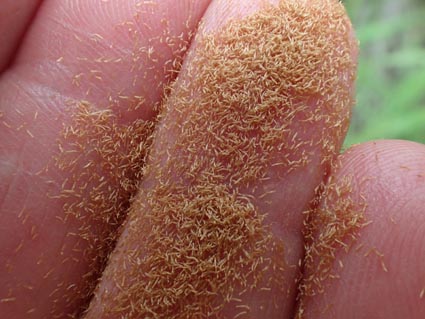
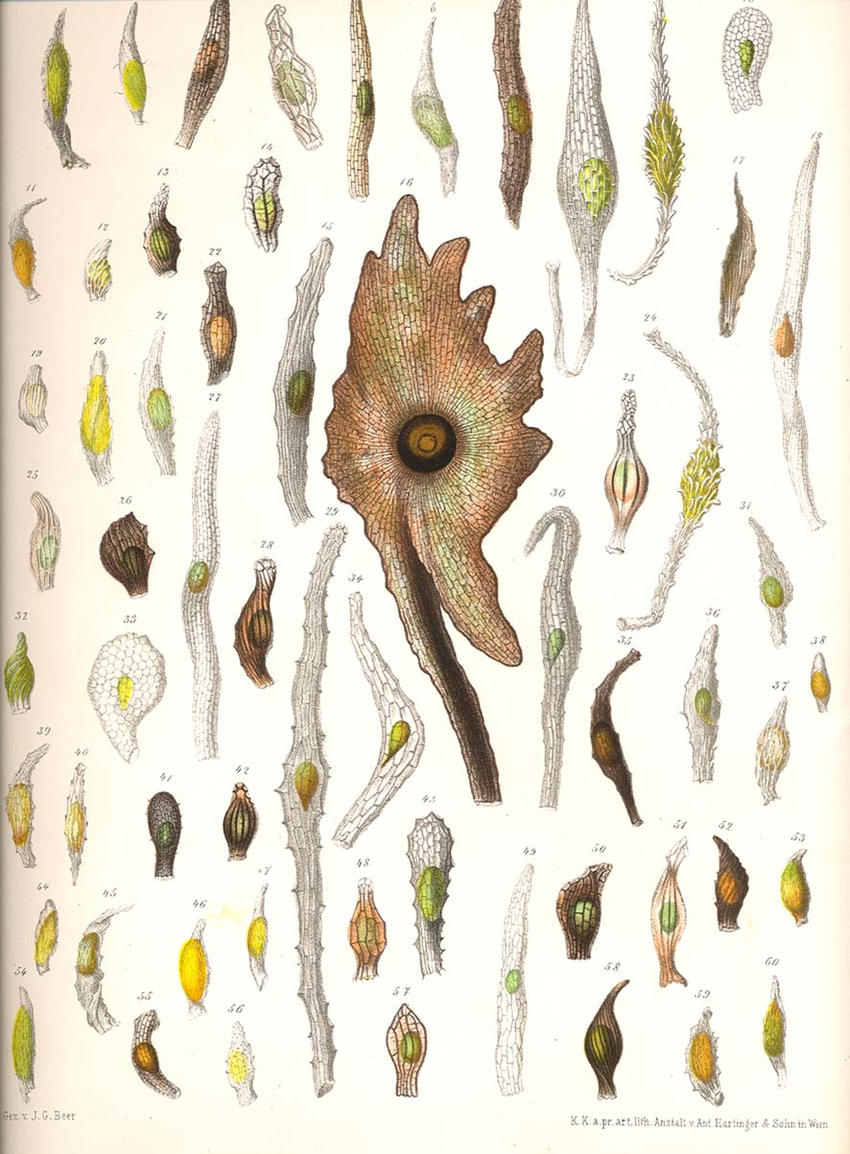
So what do they look like? Amazingly Johann Georg Beer (1803 – 1873), an Austro-Hungarian orchidologist and explorer published in 1863 Beitra ¨ge zur Morphologie und Biologie der Familie der Orchideen. In it, Beer had produced in exquisite detail illustrations of orchid seeds. Beer was not the first to draw orchid seeds but his “drawings are morphologically accurate and artistically magnificent. Beer’s artistic ability, patience, and botanical expertise are obvious. His are probably the first detailed colour renditions of orchid seeds and seedlings to be published.”*
Reference
*Arditti, J, 2008, An history of orchid hybridization, seed germination and tissue culture, Botanical Journal of the Linnean Society June 2008
Previously we have posted about photographing orchids for identification – see here and here. But sometimes all that is desired is a beautiful picture of these exquisite flowers. Recently, March 21, 2017, National Geographic published just such an article titled How to Photograph an Orchid. Author Alexa Keefe relates some tips from German photographer Christian Ziegler. Needless to say half of the images featured are Australian orchids.
Below is a selection of some of the entries to NOSSA’s monthly picture competition.
Leo Davis always has some interesting insights from his orchid observations. In this article he examines the position of the tepals (petals and sepals) in particular the Moose Orchid which he saw for the first time this year.
Have a close look, next season (winter to early summer) at some of our native lilies. Start with the jolly bulbine lily (Bulbine bulbosa), no longer a true lily incidentally, because it now resides in family Aspodelaceae, along with the grass trees. You will find three yellow petals at 12, 4 and 8 o’clock and closely behind them three almost identical sepals at 2, 6 and 10 o’clock, so at first sight you see six apparently identical tepals (sepals and petals). Move on to the rush fringe-lily (Thysanotus juncifolius), as described in Ann Prescott’s ‘It’s Blue With Five Petals’. Clive Chesson is more up to date and tells me it is now T. racemoides. Again it is no longer a true lily, now sitting in family Asparagaceae. Here the tepals are noticeably different. Three wide densely fringe edged petals will be found, if you view the flower face on, at 12, 4 and 8 o’clock. The narrow non fringed sepals sit close behind at 2, 6 and 10 o’clock. These are just a generalisations because if the flower turns only about 60o a sepal will be at the top.
Most orchids, while close relatives of the true lilies and the one time lilies, do not show these arrangements. Let’s start with some that do.
In the large duck orchid (Caleana major) the petal at 12 o’clock, the dorsal petal, is modified, as in most, but as usual, not all, orchids, to become a labellum. In this charmer the labellum takes the form of a duck’s head. Its function is to snap down trapping a pollinator insect in the cup shape column below it, forcing it into contact with the sticky off white stigma and/or the yellow pollinia below it. Look closely and you will find the other two narrow petals drooping at around 4 and 8 o’clock. Two folded, twisted sepals can be clearly seen at around 1 and 11 o’clock. The third sepal, at 6 o’clock, is tucked in behind the cup shaped column. Note that, as with lilies, the top tepal is a petal.
Caleana major, Knott Hill NFR Photographer: Leo Davis
The leek orchids (genus Prasophyllum) follow this pattern and also have their labellum at around 12 o’clock. These orchid groups, which are up the right way, are said to be ‘not upside down’, using the technical term ‘non resupinate’.
Most orchids are ‘upside down’ and are called resupinate. The whole flower rotates 180o, clockwise or anti I don’t know, at the embryonic stage. But let’s start with somewhat of an exception with the sun orchids (genus Thelymitra) which do not have a petal modified as a labellum. But they are indeed upside down.
Have a close look at the Thelymitra benthamiana flower. Note that the three petals, at roughly 2, 6 and 10 o’clock, are in front of the three slightly larger but very similar sepals, at 12, 4 and 8 o’clock.
Note that the toptepal is a sepal. The flower is upside down, that is resupinate. In most orchids the petal at 6 o’clock would be modified to be a labellum.
Thelymitra benthamiana, Scott Creek CP; Photographer: Leo Davis
The Arachnorchis (possibly Caladenia to you) stricta, from Sherlock, out in the mallee, is more typical of terrestrial orchids in SA. It is upside down, that is resupinate, and has a petal modified to be a labellum.
The bottom petal has become a wide labellum, with fine edge combs and parallel rows of rich plum coloured calli covering its centre. Out at roughly 3 o’clock is a narrow petal, the other invisible on the other side. At the top, pressed tightly against the column, a sepal arches forward. Two larger sepals extend down at around 5 and 7 o’clock.
Arachnorchis stricta, Sherlock; Photographer: Leo Davis
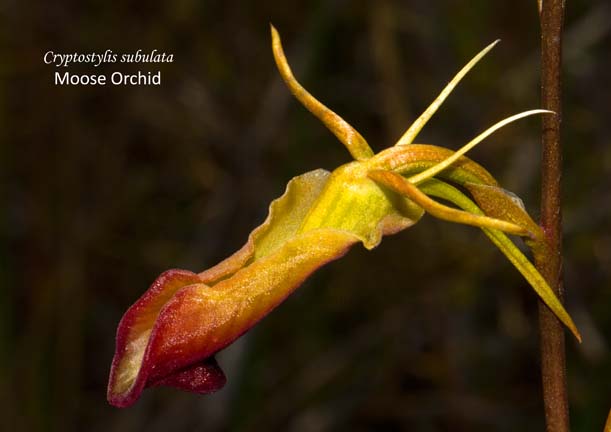
When I saw my first, my only, moose orchid, this season, I was in such a state of excitement that it looked to me to be up the right way, that is to say upside down.
Cryptostylis subulata, Stipiturus CP; Photographer: Leo Davis
Have a look. Two narrow short roughly vertical petals at about 1 and 11 o’clock. There are two sepals at just past 3 and just before 9 o’clock. That’s OK but where is the other sepal? Are there it is, where it should be, at midday. But hang on, it’s behind the flower stem (peduncle) and where is the column?
Cyrtostylis subulata with labellum lifted; Photographer: Leo Davis
Holding the labellum up with a stick I found the column, the stigma and the pollinia, underneath the labellum. The third sepal now appears to be at 6 o’clock. And it all became clear. This flower was up the right way (non resupinate) but it has turned forward, on its peduncle, by about 180o, to become upside down, but not in the manner of resupinate flowers, because it is back to front. It is an inverted non resupinate flower. Still with me?
A site, along Rarkang Rd, Silverton, leading into Talisker Conservation Park, was visited on December 29, 2012, January 2, 2014, January 16, 2015 and January 9, 2017.
In the earlier years about 20 specimens of Dipodium pardalinum were found with 18 (plus 3 beheaded) in 2015. A small number of D. roseum was located in 2012, none in 2014, one in 2015 and none at all in 2017.
In 2017 there was bumper crop of D. pardalinum and Ed Lowrey, Helen McKerral and I counted 124 flower spikes. This may represent only 122 plants because in two instances there were two spikes emerging from one tuber (see image). It is possible that other closely placed flowers were also growing from a single tuber. This same phenomenon was observed in two cases, with D. roseum, at Hender Reserve, Stirling, on January 12 this year.
All spikes of D. pardalinum this year were found on the verges of Rarkang Road or nearby inside private property in small holdings, with houses, adjoining the road, apart from two spikes only, just inside the Talisker Conservation Park, where Rarkang Road heads into it.
The genus Dipodium is much more varied than I realised. Our DVD, South Australia’s Native Orchids, only deals with the ‘leafless saprophytes, mycophytes or hemiparasites’. If you go to ‘Native Orchids of Australia’ (Jones, 2006), you will find that among the terrestrial species there are both leafless species (as with the local D. pardalinum and D. roseum), that are impossible to cultivate and one species with leaves (D. ensifolium), found from Cooktown to Ingham, in Qld. It is easy to grow in a pot. Bob Bates told me that it is grown here in Adelaide, preferring a heated glass house, but has been grown successfully in gardens. And then there is a leaved species, D. pandanum, of limited distribution in Qld, that can be either terrestrial or epiphytic, growing up to 5 m in length. Old pieces that break off and fall to the ground, nestle in the leaf litter and put out new shoots that eventually climb into the trees. It is easy to grow in a pot (in the right climate).
Leo Davis.
Dipodium pardalinum. Rarkang Rd, Silverton, Jan 9, 2017.
Two spikes of Dipodium pardalinum emerging from one tuber.
Rarkang Rd, Silverton, Jan 9, 2017.
A clump of Dipodum pardalinum spikes with at least two emerging from one tuber; see photo above.
Rarkang Rd, Silverton, Jan 9, 2017.
Dipodium pardalinum (labellum white with dark pink spots) growing intertwined with D. roseum, (labellum pale pink with dark pink stripes).
The Native Orchid Society of SA has been involved with the Threatened Orchid Project which is attempting to propagate some of our most threatened orchids. There has been some success such as Thelymitra epicaptoides (Metallic Sun Orchids) but others are proving elusive. Marc Freestone, from the Orchid Conservation Project, Royal Botanic Gardens Victoria, is a PhD student who is researching one such difficult to grow orchid genus, the Prasophyllum.
Prasophyllum murfettii (Denzel’s Leek Orchid)
To assist with his research Marc has the sent the following request.
CAN ANYONE GROW LEEK ORCHIDS?
South Australia has about 40 species and Victoria about 74 species of the native Leek Orchids, Prasophyllum. Some are on the brink of extinction.
A major problem hampering efforts to prevent our Leek Orchids from going extinct is that they have proven next to impossible to grow in cultivation. They have proved extremely difficult, usually not germinating at all, or germinating but then dying soon after. Occasionally some success has been had (particularly with symbiotic germination) but successful germination trials to our knowledge have so far proved un-repeatable. Working out how to grow Prasophyllum is critical for the survival of many species at risk of extinction across southern Australia.
To try and change this, I will be studying Prasophyllum and their relationships with symbiotic mycorrhizal fungi.
But I need your help!
I am wanting to hear from as many people as possible who
have tried (either successfully or unsuccessfully) to grow Leek Orchids or the closely related Midge Orchids (Corunastylis).
have observed Leek Orchids (or Midge Orchids) recruiting from seed in the wild.
If you can help, or know of anyone who might be worth talking to, please contact me at: marc.freestone@rbg.vic.gov.au or 0428 304 299.
(Funding and support for this project: Australian National University, Federal Government National Environmental Science Programme, Royal Botanic Gardens Victoria, University of Tasmania).
I would encourage people to contact Marc with whatever information that you have, no matter how insignificant you may think it is. Every little bit helps including unsuccessful attempts.
His eventual aim is to be able to work out how to grow them reliably from seed in cultivation.








 NOSSA
NOSSA 