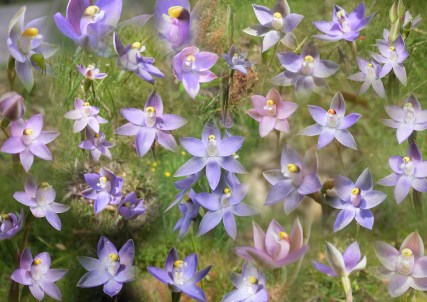
Names, Names, Names, …

Orchid names are contentious.  The reasons appear to be complex but whatever the reasons the situation exists whereby some orchidologists are naming species that may or may not be accepted by others.  The result is that there are publications using different names for the same species.  And of course, in the midst of it all, are those names that have been accepted for previous species with phrase names or manuscript names.

Whatever the name, it is helpful then to be able to match them up.  Last week’s blog covered South Australian names but in the same week Andrew Brown published on the Western Australian Native Orchid Conservation Study Group Facebook an updated list of WA orchids whereby he has linked them with significant WA Orchid field guide books.

Andrew has kindly given permission for this list to be published.  Other lists are also included and these are available on the NOSSA’s  Orchid eBook page.

It is worth reading Andrew’s introduction in ALIGNMENT of WESTERN AUSTRALIAN DIURIS AND PTEROSTYLIS NAMES.

The object of this exercise is to align the phrase names in these three publications with names published in recent taxonomic papers. Please note that most, but not all, currently recognized (described and undescribed) Western Australian Diuris and Pterostylis are included. There are other taxa that may be considered worthy of recognition but have not been included at this time as we feel further research is required.

In the case of phrase names, these are added and removed for taxa as new information comes to hand and should not be thought of as the final view. Rather, these should be thought of as current thinking that may change in the future. Taxa are only formally recognized as being distinct once their scientific names are published. Even then, later thinking may result in further changes.

Given that phrase names are a work in progress, some may think that we should not be promoting their use and that they should not be included in popular books. However, I think it is worthwhile putting them out to the wider audience so that their distinctiveness can be debated. Having a large group of people looking for (and at) these taxa provides us with a great deal of information and opinion based on firsthand experience in the field, that we may not otherwise have obtained. Then, if and when the taxon is formally described, it will be done on a much more informed basis.

As I am sure you are aware, the naming plants is an evolving process and there will be further changes as new information comes to light.

Andrew Brown

1605 sm PM Caladenia flava
Caladenia flava

Orchid Basics – A Beginner’s Guide to South Australian Orchid Name Usage

For the novice or beginner, orchid names can be a bit overwhelming.  To add to their confusion, the more knowledgeable people tend to use abbreviated terms often switching between common and botanical names & their synonyms.

This week’s post will be a brief introduction to the most common names used for the South Australian orchids and how they relate to each other.  It will not be comprehensive and it will not be a detailed discussion of orchid nomenclature but hopefully it might help the novice learn some of the names in current use.

In the past attempts have been made to split some genera.  Not everyone has agreed with the splits but there are many who find it more convenient  to use the alternate genus when working in the field.  This tends to be the case with the larger genera such as Caladenia, Corybas and Pterostylis.  Unfortunately, this has contributed to the confusion.

The names in this list are compiled from South Australia’s Native Orchids 2011 DVD.  Even with this list the use of the names varies quite a bit with some being used rarely.  Rather than considering each individual species, the list is centred around the genus name.

GENUS

ALTERNATE

GENUS NAME

or

SYNONYM


COMMON NAME

Acianthus  

Acianthus

Acianthus Mosquito

Acianthus

Nemacianthus Mayfly
Caladenia  

Caladenia

Caladenia Pink Fairy

Caladenia

Arachnorchis Spider

Caladenia

Jonesiopsis Daddy Longlegs

Wispy Spider

Caladenia

Petalochilus Pink Fingers

Caladenia

Pheladenia Bluebeard

Blue Fairy

Caladenia

Stegostyla Gremlin
Caleana  

Caleana

Caleana Duck

Caleana

Paracaleana Little Duck
Calochilus   Bearded

Beardies

Chiloglottis

Chiloglottis

Chiloglottis Bird

Chiloglottis

Myrmechila Ant

Chiloglottis

Simpliglottis Frog
Corybas  

Corybas

Corybas Helmet

Corybas

Corysanthes Helmet

Corybas

Anyzbas Pelican
Genoplesium Corunastylis Midge
Cryptostylis   Tongue

Moose

Cyrtostylis   Gnat
Dipodium   Hyacinth
Diuris   Donkey
Eriochilus   Parson’s Bands

Autumn Bunnies

Gastrodia   Potato

Cinnamon Bells

Glossodia   Purple Cockatoo

Waxlip

Leporella   Fringed Hare
Leptoceras   Rabbit Ears

Hare Orchid

Microtis  

Microtis

Microtis Onion

Microtis

Hydrorchis Mignonette

Microtis

Microtidium Yellow Onion
Orthoceras   Horned

Crucifix

Prasophyllum   Leek
Pterostylis    

Pterostylis

Pterostylis Greenhood

Pterostylis

Bunochilus Banded Greenhood

Pterostylis

Diplodium Shell

Pterostylis

Hymenochilus Tiny Shell

Pterostylis

Linguella Little Greenhoods

Nana

Pterostylis

Oligochaetochilus Rufoushoods

Pterostylis

Plumatochilos Bearded Greenhood

Pterostylis

Speculantha Tiny Greenhood

Pterostylis

Taurantha Cobra Greenhood

Pterostylis

Urochilus Maroonbanded Greenhood

Sanguinea

Blood Greenhood

Pyrorchis   Fire

Undertaker

Spiranthes   Ladies Tresses

Spiral

Thelymitra   Sun Orchid

A detailed list of SA orchid species names and their synonyms can be found here .

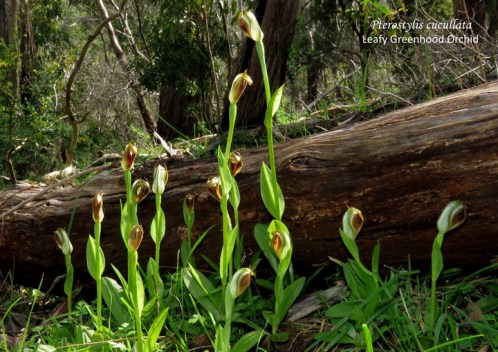
The following are all Pterostylis but not all of them are Greenhoods.  This first image is a Pterostylis Greenhood.

1609-sm-bs-pterostylis-cucullata
Pterostylis cucullata

This one is a Shell Orchid or alternately Diplodium

Diplodium dolichochilum

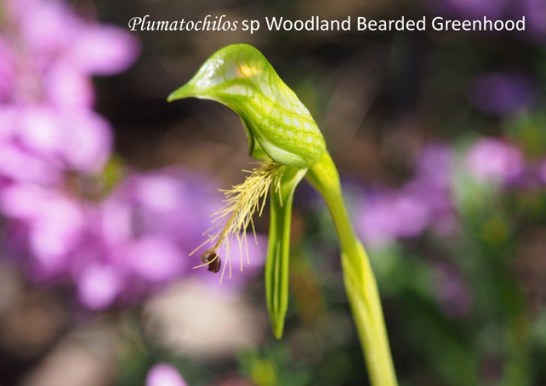
Whilst this Pterostylis is a Bearded Greenhood or Plumatochilos

09 sm JMcP Plumatochilus sp Woodlands
Plumatichilos sp Woodland Bearded Greenhood

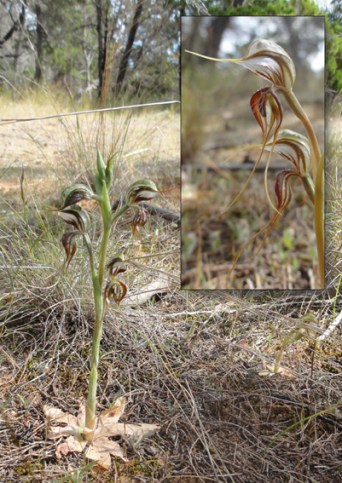
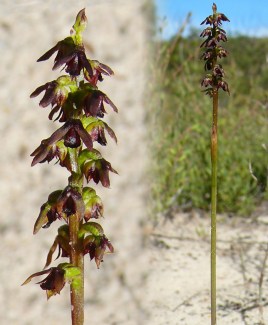
The final Pterostylis example is a Rufoushood, or Oligochaetochilus

Oligochaetochilus arenicolaHL
Typical of the Rufoushood this Oligochaetochilus arenicola shows the sencesing leaves, pendent petals and hairs on the labellum. Photographer: H Lawrence

So they could all be referred to Pterostylis or any of the other possible names whether the common name or a synonym.

ORCHID COLLECTING AND THE LAW

South Australia has some beautiful and delicate orchids.  Most are not showy.  Instead they have a subtle attractive beauty.  But they are declining; and for that reason, they are protected by the law, specifically the Native Vegetation Act 1991.  Picking the flower is illegal let alone digging up the whole plant.

The only situation where a person can legally remove an orchid or part thereof is when they hold a government authorised permit. Legitimate reasons for collecting orchid material include specimen for the State Herbarium, scientific research, rescue or salvage situations when a development is occurring, or collecting seed of threatened species to store with the Seed Conservation Centre.

Without a permit, no one can remove any part of a plant even if their reason is legitimate.

It behoves members to be cautious of any one that asks for assistance with collecting, transporting or photographing potted orchids.  Ask to see their permit.  So, what do you do if you suspect someone of picking the flowers or digging up the plants?  Contact the Department Environment and Natural Resources Investigation and Compliance Unit.

There is only a very small number of NOSSA members who hold such permits.  Thelma Bridle, NOSSA Conservation Officer, is the person who will know which members hold a permit.  For more information on plant collection permits, contact DEWNR at DEWNRresearchpermits@sa.gov.au or visit the website.

Thank you to Thelma Bridle and Doug Bickerton for their assistance and critiquing of this post.

Murray Mallee Midges_2007E_6Jun11
Corunastylis sp. Dark Midge Ngarkat Conservation Park Photo: June Niejalke

Gleanings from the Journals: Dockrillia linguiformis 2006

This week’s blog is an extract from Volume 30 No 10 November 2006.  In this article of Len Field he gives not only cultural notes but also some interesting background including an orchid link with the infamous Captain Bligh.

Dockrillia linguiformis (Sw) 1800 Brieger

Dockrilla linguiformis

Len Field
Common names Thumbnail orchid, Tongue orchid, and in North Queensland the Tick
orchid.
The name linguiforme is from the Latin lingu(a
) as in linguiforme (a tongue). It was also claimed for many years that this was the orchid that Olaf Peter Swartz the German botanist founded the genus Dendrobium in 1800, but this was wrong, although this was the first orchid seen by white man when they landed at the rocks area in Sydney cove, Port Jackson.  It was introduced into England by Rear Admiral Bligh of Bounty fame.
Other names it has been called are
Dendrobium linguiforme var. linguiforme Swartze 1800
Callista linguiforme (Swartze) Rev. Kuntze 1891
Dendrobium linguiforme (Swartze) var. huntianum Rupp 1942
There was another variety named from this species called var. huntianum by Rupp in 1942, which was named after T.E. Hunt and is a June or July flower and found near Ipswitch (sic) in Queensland, but as it reverts to type form it never reached true variety status and was considered just a variation of the type form.
This orchid has a huge range of habitat which stretches from almost the Victorian border up to North Queensland and West to the Great Dividing Range. It is very common throughout this area and equally happy as an epiphyte or a lithophyte but where as a epiphyte it likes swamp oaks (
Casuarina glauca), river oaks (Casuarina cunninghamiana), in fact it will grow on most trees that will hold there bark including the tea trees (Leptospermum species).  I have seen this orchid hundreds of kilometres inland from the coast still forming large mats on the rock faces, while in its more prolific growing areas these mats will cover huge areas of the rocks where it can survive and grow in extreme exposed conditions that would kill other orchids. In the dry times the leaves which are very thick, tough and numerous will shrivel and can last up to six months without water. This is a feature of a lot of Australian Dendrobium and Dockrillia
Flowering is from August to October with blooms that are long lasting, up to two weeks with one raceme per leaf.
Culture. If grown on slabs which is the usual way it should be hung up high and if grown in pots a very coarse open mix. In nature it likes plenty of sunlight although at times it will grow in shade. Whichever way it is grown it should have good light, humidity and air movement.

Den linguiforme drawing
Dendrobium linguiforme


Mad Dogs and …. Orchidologists

Mad dogs and Englishmen are not the only ones to go out in the  midday sun.  For orchidologists to see Sun Orchids flowering, then it is out into the midday sun on a hot day because that is when they open.  There is no point going much before 11am and by 2pm most are closing and no point going out on a cool or windy day.

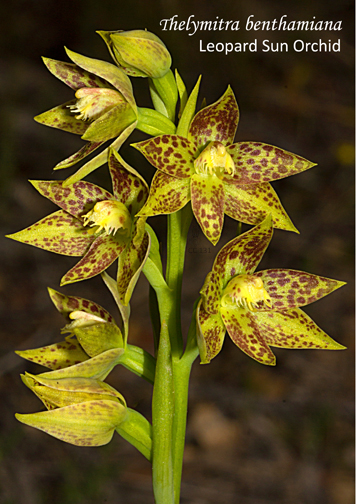
1604 sm CC T benthamaniana

But for those who don’t want to  go out (or cannot get out) into the midday sun, here is a video to be viewed in the cool of the shade.

This video features the Leopard Sun Orchid (Thelymitra benthamiana) an uncommon Sun Orchid in South Australia.  Unlike many sun orchids which requires a view of the flower to confirm identification, this one can be identified by the leaf alone.  At the beginning of the video take note of its distinctive leaf.

Thelymitra benthamiana

Half Hiding, Half Peeping the Orchids Appear, …

Spring has come and the bush is bursting with colour and many people are out enjoying it.  One of the gems that provide some of this colour are the orchids but as is highlighted in the following poem they are often overlooked yet without them and the other delicate herbaceous flowers the bush will look grey and gloomy.  So slow down, take a closer look and enjoy the hidden many coloured jewels of the bush.


Stay on the Path

Do they say that the bush is all greyness and gloom

Why, the rainbow has lent every thread from his loom

To weave into flower and shrub!

Diuris x palachila
Diuris x palachila (Hybrid Doubletails or Broad Lip Orchid)

There are star-flowers blue as the deep winter sky,

Here are “Grandmothers Honeycups”, humble and shy;

And the purple of hovea bloom.

Leptoceras menziesii in patch
Leptoceras menziesii, Hare Orchid or Rabbit Ears

Half hiding, half peeping, the orchids appear,

The friendly and cheerful red runner creeps near –

Say, where are the greyness and glooom.

Which is which
Thelymitra or Sun Orchids

Lilian Wooster Greaves

from West Australian Orchids by Emily H Pelloe, 1930

Bratz no longer …..

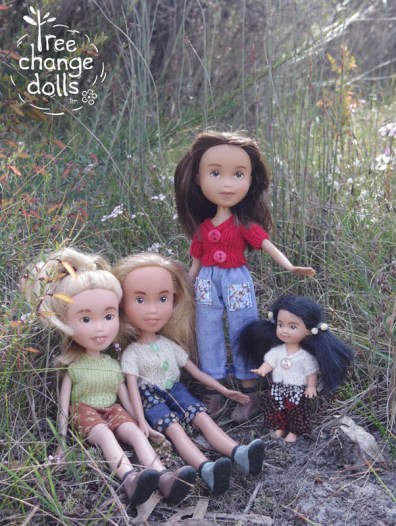
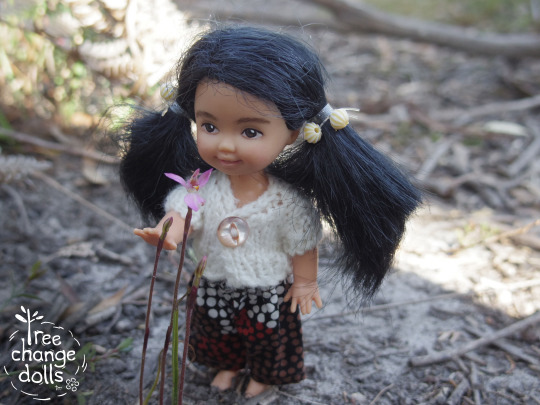
There comes a time when one needs to just sit back, relax and smell the roses …  well in this case the orchids.  This is just what the dolls from Tree Change Dolls did.

Group

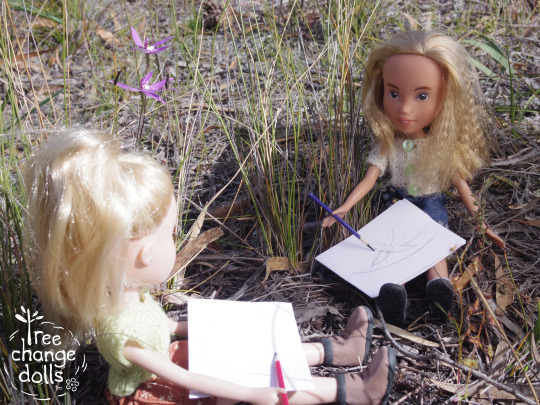
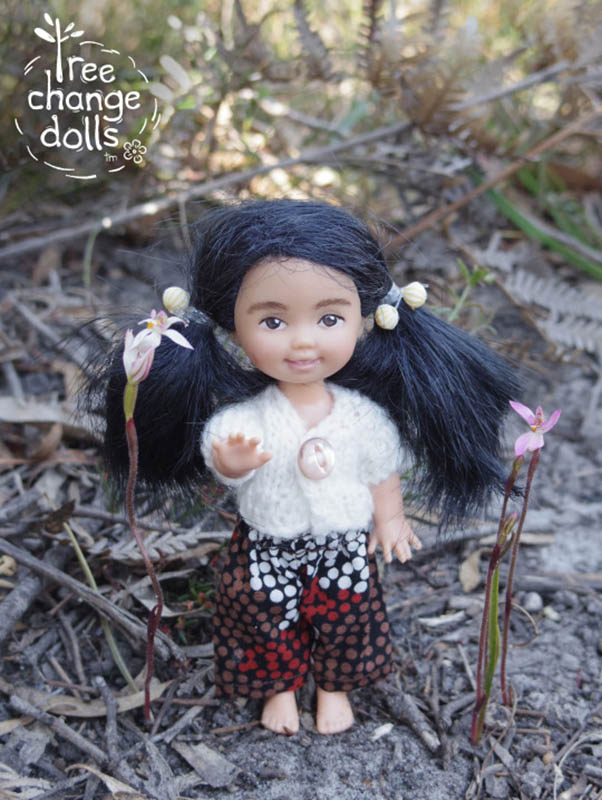
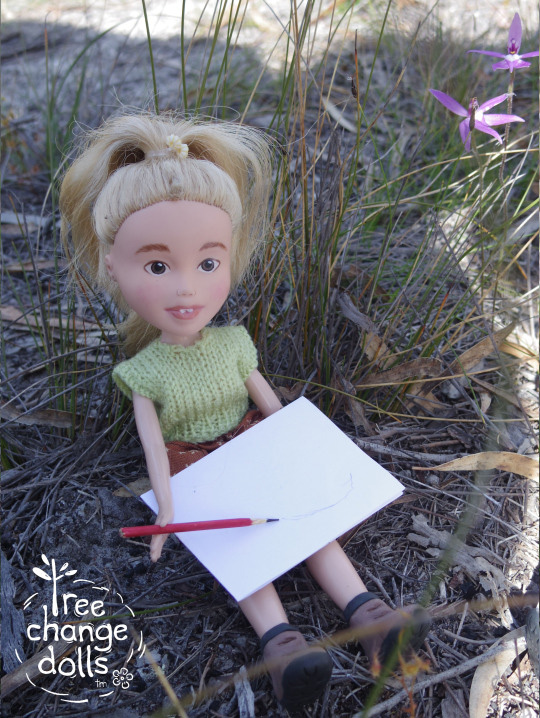
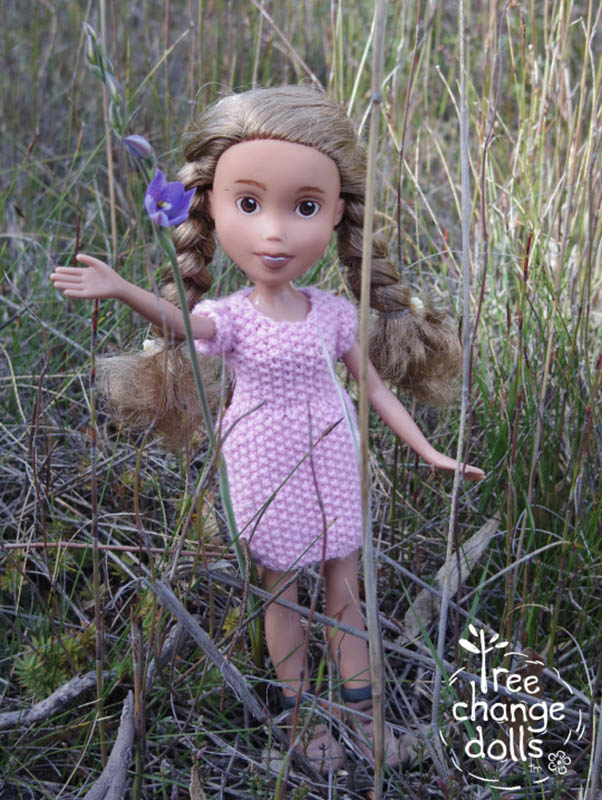
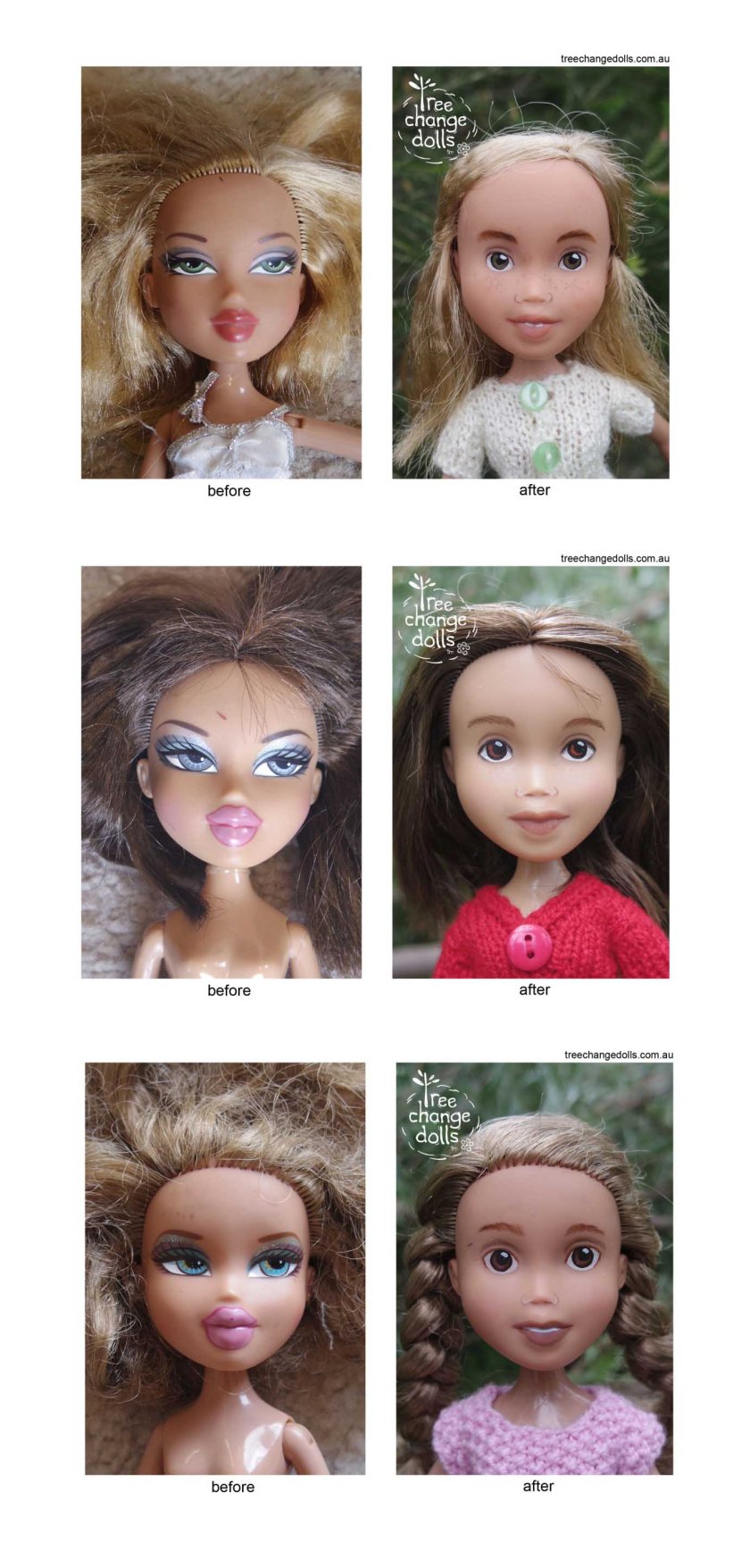
Sonia Singh, a Tasmanian artist, has been recycling old Bratz dolls giving them a down-to-earth style so different from their previous creation. She obviously loves nature and this is reflected in the transformation of the dolls.  The dolls are as appealing as the orchids she photographed them with.

Drawing lessons
Friends enjoying the orchids together
Between the Orchids
Just between you and me …
Just the right size
Ahh… Just the right size!
Ready to draw
Who needs an ipad when I have pencil and pad.
With Spotted Sun Orchid
Spotted Sun Orchid and me

Sonia uses some of the money from the sales of the dolls to support various charities.  In April 2016, she donated 10% of her sales to the Tasmanian Land Conservancy.

Keep up the good work Sonia. 🙂

BTW for those who are interested in the transformation, below are some before and after shots of the dolls featured in this post.

Before and After

To see other dolls, visit her site treechangdolls.com.au

Note: all images are from Sonia’s website.


Genes, seasonal conditions or pure chance?

Leo Davis is an orchid hunter.  He is meticulous in his observations and notes details that many of us may miss.  In this article he muses upon the variations that he sees in the field.

You, as I do, must occasionally come upon an orchid or an orchid event that is a little outside normal experience.  When I do, I wonder whether this is a purely chance event or is it caused by recent local environmental factors, or is it due to the genes of the plants.  Or a combination of these?

I’ve been watching a couple of patches of fire orchids (Pyrorchis nigricans) that many of you will be familiar with, one at Knott Hill N.F.R., the other at Monarto C.P., where a few plants flower every year, without the normally required stimulation by fire.  I need to check whether it is the same plants that flower each year.

Pyrorchis nigricans.jpg
Pyrorchis nigricans (Fire or Undertaker Orchid) Photo: Leo Davis

~~~~~~~~~~~~~~~~~~~~~~~~~~~~~~~~~~~~

The tall leek orchid (Prasophyllum elatum) puts up leaves at Scott Creek C.P. every year but does not flower. A fire swept through in early 2014 and most plants flowered in October.  They’ve not flowered since.  But over at Ramsay Way, west of Pt. Vincent, a few plants flower each year without fire.  I assume genes are involved.

Prasophyllum elatum
Prasophyllum elatum (Tall Leek Orchid) Photo: Leo Davis

 ~~~~~~~~~~~~~~~~~~~~~~~~~~~~~~~~~~~~

In April 2014 I chanced upon a patch of Adelaide Hills parson’s bands (Eriochilus collinus), along Moore’s Road, at Morialta C.P., in which the majority of plants had three flowers per stem. Was this because of favourable conditions or genes? Over the next two seasons I saw only the occasional double header and mainly single flowered plants. I will continue observations and records.   

 Eriochilus collinus

~~~~~~~~~~~~~~~~~~~~~~~~~~~~~~~~~~~~

In July 2015 I found a dense patch, about 3 m2 in area, of hundreds the common mallee shell orchid (Diplodium dolichochilum), in Ferries-McDonald C.P. As usual less than ten plants were in flower, but two of them were double headers.  I’ll be checking this season and expect this not to be a chance event but one due to genes.

Diplodium dolichochilum
Diplodium dolichochilum syn. Pterostylis dolichochila (Slim Tongued Shell or Common Mallee Shell Orchid) Photo: Leo Davis

 ~~~~~~~~~~~~~~~~~~~~~~~~~~~~~~~~~~~~

On May 27, 2012, Bob Bates led a NOSSA outing to Scott Creek C.P. and as ever, when he leads, we saw and learned a lot.  He showed us a patch of fringed hare-orchids (Leporella fimbriata) that he assured us should not be growing there on that steep rocky site and that the plants would not flower most years.  Unfortunately he was right, as usual.   I could not find plants in 2013 and 2014 and it took three searches in 2015 to find a very few leaves. On May 10 this year, over an area of less than 10 m2, I found perhaps 50 leaves and just seven plants in flower.  Three of these had three flowers and a tiny unopened bud (check the photo) and the others were doubles.  I’ve never seen a triple flowered plant in hundreds I’ve seen at Knott Hill N.F.R.  Are genes in an isolated population at play here?  Given the paucity of flowering at this site, it may take me years to sort this one out.

Leporella fimbriata
Leporella fimbriata (Fringed Hare  or Ballerina Orchid) Photo: Leo Davis

Leo Davis.


April 2016 Winning Picture Competition

1604 sm CC T benthamaniana
Thelymitra benthamiana; Photographer: Claire Chesson

Five entries were received, again spanning the country from east to west. John Badger entered a Chiloglottis reflexa recently photographed in Tasmania, Pauline Meyers an unidentified Western Australian Spider orchid, Judy Sara had two entries from the latest field trip, Eriochilus collinus (previously phrase name Adelaide Hills) and Leporella fimbriata and Claire Chesson’s Thelymitra benthamiana.

T. benthamiana, the winning picture, is a beautiful sun orchid that is found across the southern Australia from Western Australia through South Australia to Victoria and Flinders Island. More common in west than elsewhere it is the only one of the seven species in the T. fuscolutea complex to be found in the east.

It would appear that this complex has been a problematic as indicated by Jeanes (2006) in his article Resolution of the Thelymitra fuscolutea (Orchidaceae) complex of southern Australia published Muelleria; the Royal Botanic Gardens of Victoria research journal.

Since the early days confusion, which persisted into this millennium, has occurred. In 1871 Reichenbach recognised 3 species one of which was T benthamiana but Bentham after whom the orchid was named disagreed and consider it but a synonym of T. fuscolutea. There were many twists and turns in the names but in effect, for over a hundred years, most authors followed Bentham’s taxonomy rather than Reichenbach’s until 1989 when Mark Clements after studying the drawings, literature and orchid type material came to the same conclusion as Reichenbach that T. benthamiana was a distinct species from T. fuscolutea. Since then, authors have followed Reichenbach/Clements taxonomy.

Over the decades, the number of species in this complex varied considerably. By 1938 three separate species were recognised, but between then and 1989 it fluctuated between recognizing one, three and four species and in 1998 the orchidologist were considering a possible seven species.  These were all confirmed and named in Jeans’ 2006 paper. Today, according to Orchids of Western Australia there is potentially an eighth member in this group.

Jeanes highlights some of the issues involved in determining which species is which. Some of the issues are lack of accurate/detailed information such as location, type of terrain, habitat, surrounding plants, date of collection, etc. Dried specimens by themselves are inadequate as important features may be lost in the drying process.

This complex is but an example of a widespread problem across many of our Australian orchids indicating not only the need for careful observations in the field but meticulous record keeping that others can access.

References

Jeans J A, Resolution of the Thelymitra fuscolutea R. Br. (Orchidaceae) complex of southern Australia. Muelleria 24: 3-24 (2006)

Brown A, et al, Field Guide to the Orchids of Western Australia, 2013

Thank you to Juergen Kellermann, (senior botanist for the State Herbarium) for critiquing this article.

Leptoceras and Leporella – Why are they in different genera?

QUESTION: Are there more than one species called Hare Orchid? This one [Leporella fimbriata] looks different from Leptoceras…?  Why are they in different genera?


ANSWER:

Originally they were described the genus Caladenia but as the knowledge information increased other genera were created.  Thus Leporella fimbriata was put into Eriochilus, as Eriochilus fimbriatus (1882), then Leptoceras fimbriata and finally into its own genus Leporella (A S George 1971).  Caladenia menziesii became Leptoceras menziesii.

This does not answer the why of the question which is about classification but Jones (2006) is helpful when he says:

“Plant classification systems rely on interpreting and measuring the features in one group of plants and comparing these with another group, either seeking difference or similarities.  Studies in orchids are usually biased heavily towards features of floral morphology but recent studies have revealed the importance of vegetative features in the roots, stems and leaves.  The most successful classification system is one that is balanced and based on a wide range of vegetative and floral features.”  To add to this list is the molecular studies being done on orchids.

This means the authors advocating change need to clearly show why a name change and/or a new species is warranted.

For instance, Fitzgerald gives the following reason for not including Leporella fimbriata in the Caladenia genus

“Leaves much more frequently observed than flowers.  It is with great reluctance I depart from the naming in ‘Flora Australiensis’ [author Bentham, 1863 – 1878], but I cannot concur with the inclusion of this with Caladenia, and have place it in Lindleys’ Leptoceras for the following reasons: Leaf or leaves not those of Caladenia.  In Caladenia I have never seen more than one leaf, always thin and usually hairy; in this plant leaf thick, hard and shining, occasionally two.  In Caladenia tubers are generally numerous, in L. fimbriata I have only observed one.  The labellum, is without the characteristic glans and is not of the form obtaining in Caladenia, the stigma is very different in form being triangular and deep sunk, the upper parts overhanging, not oval and shallow; and the flowers have the peculiarity of drying and continuing in a state hardly to be distinguished from the fresh flowers long after the seed has been shed.  It approaches C. menziesii only (so far as I can see) in having erect linear-clavate petals, in which C. menziesii is itself peculiar, L. firmbriata seems to come near to Eriochilus than to Caladenia but differs from it again” Quoted from Emily Pelloe Western Australian Orchids 1930

Concerning Leptoceras menziesii, Bates & Weber have made the following statement:

“True Caladenias have hairy scapes and hairy leaves.  (C. menziesii now believed to belong to a separate genus is glabrous)”.

Even though they are not Caladenia, why not have them in the same genus for both have glabous (without hairs) leaves, more leaves than flowers, erect spathulate (spoon shaped) glandular petals, colony forming, similar distribution.

Leporella fimbriata  in patch
Leporella fimbriata – note the absence of leaves and the dry sandy conditions [Photo: R Lawrence]
Leptoceras menziesii in patch
Leptoceras menziesii – note the abundance of leaves [Photo: R Lawrence]
There are similarities.  In fact, Bates (2011) calls them sister genera but despite the similarities there are enough differences to recognise them at genus level at present including “different flowering times, different mycorrhizal fungi associations and different pollination” some of which are detailed in the chart below.


Feature Leptoceras Leporella
Pollination Strategy Strategy unknown

Native Bee

Strategy pseudocopulation

Winged male ants (Myrmecia urens)

Myrmecophyte – lives in mutualistic association with colony of ants
Labellum Curved white with red stripes

Has calli

Wider than longer, purple and green

Has no calli

Flowering Time Spring (September to November) Autumn (March to May)
Habitat Shaded sites – moist gullies; scrub, heath, woodland and foret Open sites – acid sands, light scrub, stringybark
Leaf Emergence Leaves emerge before flowering Leaves emerge after flowering


Leptoceras menziesii (Rabbit Ears Orchid)
Leptoceras menziesii (Hare Orchid or Rabbit Ears Orchid) after a fire, [Photo: R Lawrence]

REFERENCES:

https://en.wikipedia.org/wiki/Myrmecophyte accessed May 13 2016

http://www.flora.sa.gov.au/cgi-bin/speciesfacts_display.cgi?form=speciesfacts&name=Leporella_fimbriata accessed May 13 2016

http://www.flora.sa.gov.au/cgi-bin/speciesfacts_display.cgi?form=speciesfacts&name=Caladenia_menziesii accessed May 13 2016

Pelloe E, Western Australian Orchids 1930

Bates R & Weber J, Orchids of South Australia, 1990

Bates R Editor, South Australia’s Native Orchids 2011

Martin A, The Vocabulary of Orchids: an Amateur Perspective 2005

Rogers R, South Australian Orchids 2nd Ed 1911

Jones D, A Complete Guide to Native Orchids of Australia including the Island Territories 2006