A very popular orchid grown in culture in South Australia is the epiphytic/lithophytic Dendrobium speciosum. It is a showy species with a heady perfume.
Dendrobium speciosum (Rock Lily, Rock Orchid) in culture
This species ranges along the eastern seaboard from Queensland just peeking into Victoria. There are nine variations each with its own unique distribution.
But not only is it popular in South Australia, it is popular throughout the country. The whole of the 2006 September issue of the Orchadian was devoted to a single article on D. speciosum. The March 2016 Orchadian has three articles plus references to D. speciosum in other articles.
And then there is Gerry Walsh who is so passionate about this species that he has a comprehensive website – The Rock Lily Man – devoted to it. Explore and enjoy his website.
In Part One, Leo Davis’ first article centred on the Large Flying Duck, this second part is about the lesser known Little Duck.
TAKING A DIFFERENT PERSPECTIVE 2 (The Small Flying Duck Orchid)
There are at least three speceis of flying duck orchids in SA, one in genus Caleana and two others having been moved from there to genus Paracaleana.
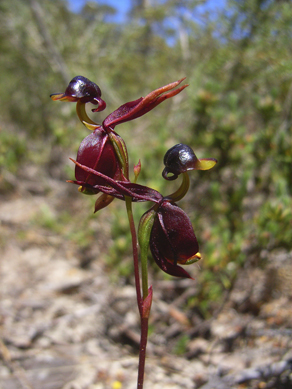
My favourite, of the two duck orchids that most of us see, is the small duck orchid (Paracaleana minor). It is actually rarer than the more popular species, can bear six or more flowers on a spike, and has a more delicate and quirky charm, to my eye.
As with the large flying duck the usual angle of photographing the smaller species is to emphasise the ‘flying’ nature. But again there is other detail to see and to be illustrated from other view-points.
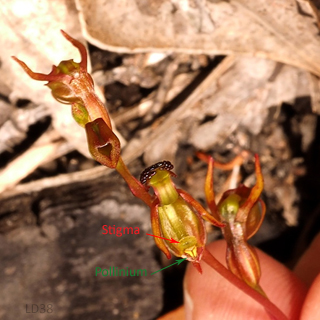
The accompanying image of the little duck flower, viewed from the front, shows variations on the same structures shown previously in the large duck orchid. Down at the bottom of the flower is the sticky stigma (♀ part), not white this time, and immediately below is the triangular yellow pollinium packet (♂ part). Again both structures sit in the bowl shaped column.
Paracalean minor (Little Flying Duck Orchid)
Note the three part symmetry of the pollinium, with a distinctive Mercedes Benz logo (or Mitsubishi if your budget only stretches that far) to tease us.
The location of the female (♀) and male (♂) organs, adjacent to each other, fused to form a column, is one of the main distinguishing characteristic features of the orchid family.
As an afterword let me remind you that the little duck (like the larger, collected in Sydney in 1803) started out as Caleana minor but was moved to a new genus, leaving the large duck as the only member of its genus. Rules of nomenclature mean that the small duck had to keep its specific name (minor), hence we now have Paracaleana minor but there is no, and never will be, Paracaleana major. But Caleana minor still appears in publications and some folks may still use that name.
Some of you choose to use different scientific names to some that others use. Recently some of us bought a propagation pack that Les Nesbitt produced, to grow the maroon banded greenhood (Pterostylis sanguinea.) In the unlikely event that my pack produces seedlings I will label them Urochilus sanguineus. And we can both justify our choice. And then, of course, some taxonomist could move the little duck back to its original genus one day.
Then, of course, there is the added complication that David Jones (Native Orchids of Australia Including the Island Territories. 2006, p148) calls the species Sullivania minor!
Leo Davis is an orchid enthusiast with an eye for detail. Everyone seems to be aware of and gets excited over the flower of the large flying duck orchid but in the article below, Leo takes a look at a more significant event – the rare fruiting of the duck in South Australia.
TAKING A DIFFERENT PERSPECTIVE 1(The Large Flying Duck Orchid)
Leo Davis
When approaching an iconic orchid like a flying duck orchid the obvious imperative is to emphasise the flying duck image. But as much fun as that can be, we can find and record some other significant aspects of this species. Do remember to look at all orchid flowers, with or without your camera, from different directions. And don’t forget the leaves.
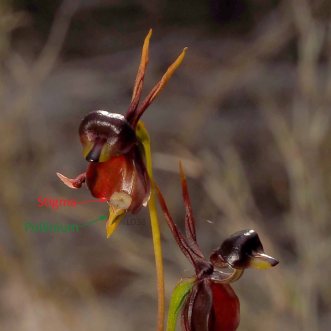
In the last flowering season at Knott Hill NFR (Oct-Dec 2015) I photographed a double flowered large flying duck (Caleana major) on November 14. At the bottom of the upper left hand side flower you can see a white stigma (♀ part), sitting at the base of the bowl shaped column. The sticky surface of the stigma is ready to trap a pollinium (a sack of pollen grains), if the correct pollinator arrives, with a pollinium attached. Immediately below is a three lobed the triangular yellow pollinium packet (♂ part), as yet not taken by a pollinator. The highly sensitive mobile duck shaped labellum, a modified petal, looms above, waiting to slam a visiting insect down onto the pollinium, so attaching it to the back of the insect.
Caleana major (Flying Duck Orchid) – note the location of the stigma and pollinium
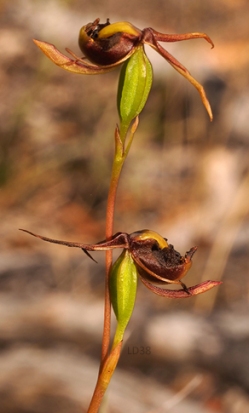
On December 10 I found the same plant, and one adjacent, in FRUIT. This is not often observed in South Australia and it has been suggested that the specific pollinator may be thin on the ground. I photographed both plants but that of the more advanced plant (shown), with fully withered flowers and plump developing ovaries, interested me more, because it suggested progress towards production of viable seed.
Success – Caleana major Fruiting Bodies
I went back on March 9, this year, and was delighted to find and photograph the fruit that had ripened, dried and split, so releasing the dust like seed. I was prepared for disappointment because the fate of seed pods of many orchid species is to be eaten. For example for the hyacinth orchid (Dipodiun roseum), across both the 2014-15 and 2015-16 flowering seasons, at Knott Hill, all plants that I found had their seed pods consumed. Kangaroos?
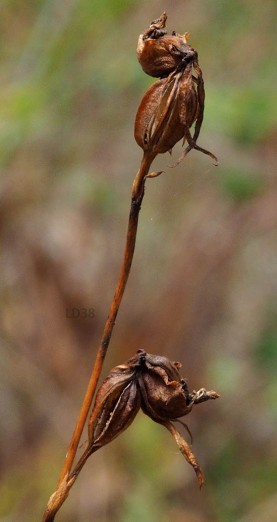
Dehiscent (splitting of the seed pod to allow dispersal of the seed) Caleana major
Robert Brown established the genus Caleana based upon his description of a specimen of Caleana major (1810). The type specimen was collected in 1803, at Bennilong Point, the site of the Opera House, so the species is extinct at that site now, of course.
Think of deserts and the image is that of a bleak barren landscape with little to see but this is not so. The conditions are harsh but there is a myriad, though not an abundance, of hardy fauna and flora if one but looks closely.
But concerning orchids – No orchids have been found in true deserts….. They also appear to be absent from the arid mountains of the far north-west, or at least no-one has ever found orchids there.
Orchids need moisture and so they do not grow on unstable soils such as dry sand-hills, gibber plains or the many saline areas of the far north but on the desert fringes there are micro-climates where the moisture, humidity and soil structure is just right (to quote Goldilocks) for orchids. This micro-climate is created by [s]hrubland [which] is … [an] … important dryland orchid habitat. Besides providing shade and shelter for the orchids, shrubs like the many species of wattles, Acacia and hop-bush Dodonea drop fine leaves which help to hold the soil together and slowly break down into humus rich with nutrient and water storing capability. These shrublands usually form in soils too dry or shallow for trees. Orchids of course have no need for deep soils as they are shallow rooted.
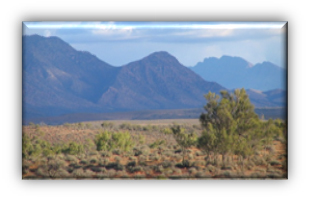
Semi-arid Shrublands, Flinders Ranges
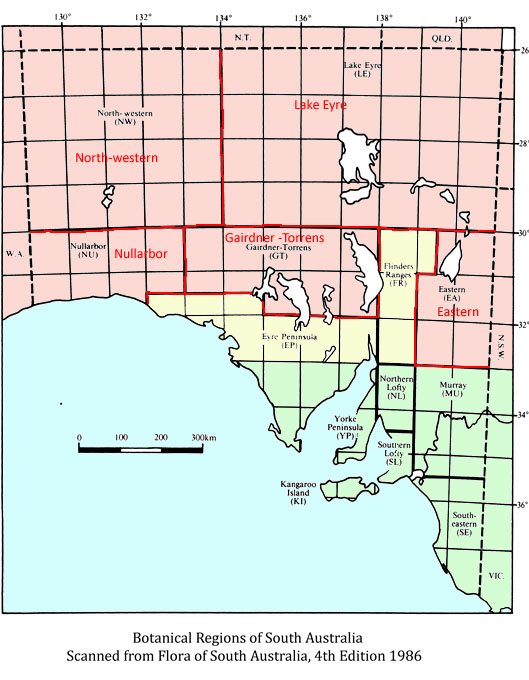
Of the five desert botanical regions, the Eastern region contains the most number of species with over a dozen species.
Colour added to indicate the desert regions (in red)
Orchids of the Eastern Region – this region is from the east of the Flinders Ranges to the New South Wales border and includes the Olary Spur and Lake Frome.
Arachnorchis toxochila – Dry Land Spider Orchid or Bow Lip Spider Orchid.
Corunastylis tepperi – Mallee Midge Orchid
Diplodium robustum – Common green shell-orchid.
Hymenochilus pagophilus – Mountain Shell-orchid
Microtis eremaea – Desert onion orchid
Microtis frutetorum – Common woodland onion orchid.
Oligochaetochilus bisetus species complex, Rusty rufous-hoods
Oligochaetochilus sp. Blue-bush Plain – Blue Bush rufous-hood (O. bisetus complex)
The Gairdner-Torrens region includes, besides the salt lakes it is named after, the Gawler Ranges and the southern part of the Great Victoria Desert. Though not as many species as the Eastern region, it contains some different species including a Sun Orchid.
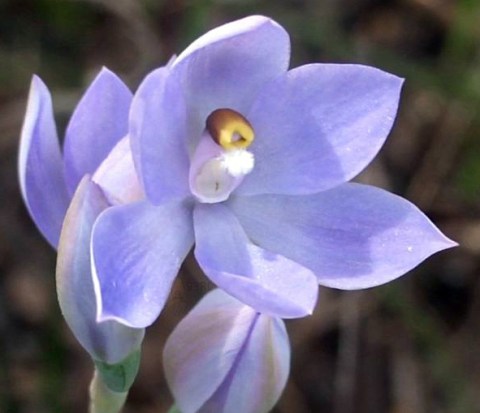
Thelymitra megcalyptra – Scented or Dryland Sun Orchid
Third of this group is the Nullabor region. Consisting of flat treeless limestone plains, this area, surprisingly, has two species both of which have been found close to the coast.
The final two regions Lake Eyre and North-Western contain the vast expanses of desert of the far north of South Australia. Definitely not a place to find orchids yet one specimen has been collected from each of these two regions.
Oligochaetochilus sp. Everard Range (L. Scott 173), Mimili Orchid (possibly O. woollsii complex) from North-Western Region.
Oligochaetochilus sp. Gammon Range (O excelusus complex) from the Lake Eyre region.
It is unusual to find orchids in the desert because they only grow when there have been good winter rains which isn’t very often. But nevertheless, here in South Australia we have over 20 possible species – an astonishingly high number for such a harsh area!
Reference:
Bates R J ed, South Australia’s Native Orchids, 2011 Native Orchid Society of South Australia
Map adapted from Flora of South Australia, Fourth Edition, 1986
Each year the Australian Orchid Foundation has an orchid essay competition. The topic for 2014 Essay Competition was Our Favourite Orchid. The orchid featured, unsuprisingly, was the Flying Duck Orchid, Caleana major. The authors were K Yin and Sau-wan Chan. It is an interesting story and well worth the read of their discovering the delights of this unique Australian orchid.
It all started with the arrival of an email from Sau-wan’s sister who lives in Hong Kong with an article about the Flying Duck Orchid. The article contained lovely pictures of this orchid taken from different angles. It stated that this orchid from Down Under was as unique to the Australian flora as the kangaroo and platypus were to the Australian fauna. The orchid even had a stamp from Australian Post released in its honour! The email ended with the question asking us if we had seen the orchid. This really presented a serious challenge to us and we were both embarrassed and curious by this – embarrassed because of the fact that we had neither seen nor even heard of this orchid after having lived in Australia for nearly 40 years. We love the Australian bush and regard ourselves as having at least above average knowledge of Australian flora and fauna amongst our friends. … Read More
[Primary source material is the NOSSA Journals. Direct quotes from the Journal in blue and additional information in black.]
Sometimes gleanings take much time and effort to locate but other times there is an abundance of information just waiting to be picked up. This was the case when searching the Journal for information on Harold Goldsack.
Upon the death of Dr R S Rogers, Harold Goldsack became the leading authority of South Australian orchids. To quote Peter Hornsby (1977), NOSSA’s first editor, “Harold is undoubtedly the most experienced of our native orchid botanists and knows more of the history of our orchids than anyone alive.”
Though not a foundational member, Harold was one of NOSSA’s early members, joining at the end of 1977. He was both a grower of epiphytes – winning the Champion epiphyte for 1982 (Dendrobium x gracillimum) and terrestrials – producing the first greenhood hybrid, Pterostylis Cutie (baptistii x cucullata) which was registered on 5th March, 1982. At the meetings he gave talks, plant commentaries and judged the orchids. Outside of the meetings he was active in advancing the cause of Australian orchids. His enthusiasm influenced many people, one person being a young Mark Clements, current Research Scientist, Centre for Australian National Biodiversity Research, CSIRO, Canberra.
It is not surprising than that in 1984 he was made NOSSA’s second life member.
Bob Bates wrote an informative biography in Harold’s obituary.
Journal 1989 Volume 13 No 4 May
Vale Harold Goldsack.
It is with sadness that we announce the passing of life member Harold Goldsack on April 25th. Our sympathies to his family.
Harold was born in East Bengal, India on 27th June 1908. He once told how he could remember epiphytic orchids blooming outside the bedroom window of his childhood home.
His family moved to Adelaide in 1916 and he attended Princes College as a boarding student.
He was introduced to South Australian orchids in bushland adjacent his family’s orchard at Coromandel Valley using Rogers “Introduction to the Study of South Australian Orchids” to identify these. Harold in 1924 introduced himself to Dr Rogers and they became good friends. Harold soon began to find orchids that were new to Dr Rogers and this fired his enthusiasm so that he began a serious study of our orchid flora.
One day in 1928 on a visit to Dr Rogers, Harold was shown the very first collection of the underground orchid Rhizanthella gardeneri. This was to be the subject of the last article Harold wrote over 50 years later.
With the passing of Dr Rogers in 1942 Harold became the foremost authority on South Australian orchids corresponding regularly with H M R Rupp, W H Nicholls and A W Dockrill. His extensive collection of pressed orchids was donated to the State Herbarium in 1978.
Harold wrote many articles on orchids his best known being “Common Orchids of South Australia” which appeared in the S Aust Naturalist in June 1944 and was used in “National Parks and Wild Life Reserves” book from 1965-1970. Harold also revised the orchid section of Black’s “Flora S Australia” in 1943.
Besides drawing and photographing the S Aust orchids Harold developed a large personal Orchid Library and cultivated many Australian orchids which he displayed at shows including our NOSSA shows. The first registered Pterostylis hybrid Ptst. Cutie was made by Harold and the name given to the original clone now grown by hundreds of orchid lovers is “Harolds Pride!”
His main interest was to enthuse others to see the beauty and value of our native orchids through his articles and the many illustrated talks he gave to natural history groups.
Harold was a member of the Royal Society of S Australia.
He was a Foundation Member of the Australian Native Orchid Society. (ANOS)
Ever ready for a challenge Harold at age 64 began studying for his Engineering and Surveying Certificate gaining distinctions in Maths, then working on the surveying of the S E Freeway.
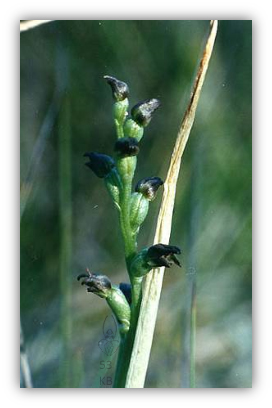
Harold Goldsack’s name is commemorated in the South Australian endemic orchid Prasophyllum goldsackii, a fitting tribute to a true orchid lover.
R Bates
Prasophyllum goldsackii – Photographer Ken Bayley
Bibliography of Papers by Harold Goldsack
Orchids of Coromandel Valley – SA Naturalist XIV, Nov 1932 PP 12 – 15
Notes on Caladenia Catifolia – R Br SA Naturalist XV, March 1934, pp 59 – 63
National Park of South Australia – Field Naturalists Sect. of Royal Soc of SA 1936, Being Vol XVII, Nos 1 to 4 of SA Naturalist pp 52 – 54 Orchids
Common Orchids of South Australia – SA Naturalist XXII June 1944 PP 1 – 12 with line drawings of 52 species
New Orchid Records for South Australia – SA Naturalist XXII June 1944, p 13
National Park and Reserves – Commissioners of the National Park, Sept 1956 pp 59 – 79 with line drawings of 52 species of Orchids, p 195 Distribution and flowering times of orchids in the National Park and Reserves
SA National Parks and Wild Life Reserves – Commissioners of the National Park and Wild Life Reserves, March 1964, pp 46 – 64 Orchids with line drawings of 52 species, pp 189 – 199. Distribution and Flowering times of Orchids in the National Park and Reserves
Orchids of the National Park and Wild Life Reserves – Reprinted 1965 by Field Naturalists Society, if (sic) SA from “SA National Parks and Wild Life Reserves” with permission of the Commissioners of the National Park and Wild Life Reserves
Blacks’ Flora of South Australia – Revised edition of p1, 1946 Assisted Rev H M R Rupp and W H Nicholls with the revision of the Orchidacea
Pollination of Caladenia deformis R Br – R S Rogers transactions of Royal Society of SA Volume LV Oct 1931 The pollination of Caladenia deformis as observed by H G was written up by Dr R S Rogers in an article for the Royal Society of SA
Rhizanthella gardnerii R S Rogers – The Orchadian p 113 Sept 1979 A note about the discovery of this orchid
Following is the article by Harold Goldsack referred to by Bob Bates in Harold’s obituary. Though he wrote for other publications, this was appears to be the only one in the NOSSA Journals.
Journal 1979 Volume 3 No 8 August
RHIZANTHELLA GARDNERI Rogers Harold Goldsack
Corrigin, Shackleton, Goomalling, Munglingup. Western Australia.
A new locality where the subterranean orchid Rhizanthelle gardneri Rogers has been found, as noted by Don Voigt in his letter to Roy Hargreaves to brings with it hope that after 50 years the secret life of the remarkable orchid may be unveiled. It also brings back memories of my first encounter with this plant.
As a young orchid enthusiast I had been collecting for, and writing to, Dr R.S. Rogers of Adelaide, who, at that time, was an extremely busy public personality. To my surprise, one day in 1928 I received a note from Dr Rogers inviting me to call at his house in Hutt Street after surgery hours as he had something to show me which he was sure would be of interest.
Naturally, I took the first opportunity to visit the Doctor, whereon he brought into the room a large jar with some white vegetable pickled in it. With a smile he said “Have you ever seen anything like this before?”
Well, there it was – this unique subterranean orchid from Corrigin, Western Australia, sent over by Mr C A Gardiner, the Government Botanist of Perth, who had realised the importance of this discovery.
The first plants were found in an area of virgin lane that had been rolled, burnt and then ploughed, which operation uncovered the white underground rhizomes. Mr John Trott, the discoverer, was puzzled by this strange plant growing around the stumps of Melaleucauncinata R Br, common in the area, and sent it to Mr C A Gardiner. He, realizing the orchidaceous nature of the plant, visited the area, made personal observations and then sent a specimen to Dr Rogers for study, which led to the description of a now sub-tribe, genus and species of orchid – Rhizanthella gardneri Rogers.
Soon after this the Field Naturalists Society were to hold their Wild Flower Show in the Adelaide Town hall and attempted to have this unique specimen displayed there. However, the plant was too valuable to risk and an artist – Mr Lyall Lush – made a black and white drawings which was exhibited instead.
Within three years, on the east coast of Australia at Bulahdelah, another subterranean orchid Cryptanthemis slateri Rupp was unearthed. Unearthed is the word, for this one was unearthed by Mr Slater who was digging up rhizomes of Dipodium punctatum, the “Wild Hyacinth”, to attempt to grow them. All plants of the new orchid were found growing in association Dipodium. The importance of this find was such that Rev H I R Rupp was given a grant to travel to Bulahdelah to make further studies. This second find aroused worldwide interest and a German botanist suggested that the flowers of Cryptanthemis slateri were underground spikes of Dipodium. The morphology of the flowers soon disproved that theory.
Regarding this orchid, which Rupp named in 1932, Dr Rogers commented to me that he was sure that Rev Rupp’s parishioners must have had a very brief sermon the week Rupp received the first specimen of Cryptanthemis!
Dr Rogers then lamented that the orchid hunter has to add a plough and a pick to his orchid collecting equipment!!
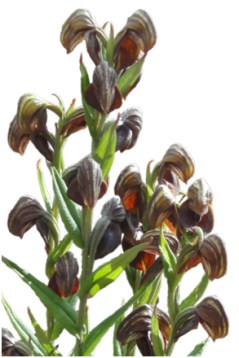
In the disc South Australia’s Native Orchids, 2011, no orchid has the common name of Christmas Orchid but there are several listed that could be a possible candidate. The ones that springs to mind are from the genus Dipodium. In South Australia, there are four species flowering at this time:
Dipodium pardalinum – Note the yellow staining on the bud and no stripes on the labellum
All four are in flower now – D. campanulatum and D. punctatum in the South East and D. roseum and D. pardalinum in the Southern Lofty Ranges.
There have been other orchids which would have flowered over the Christmas period but in recent days we are have been having an increasing number of dry year, especially this year (2015) which has resulted in the orchids flowering earlier. For example, Prasophyllum murfetii
Prasophyllum murfettii (Denzel’s Leek Orchid)
finished flowering in November instead of December and Thelymitra circumsepta
Thelymitra circumsepta (Naked Sun Orchid). This photograph was taken on the 28th December 2010
finished flowering in early December but has been seen in flower soon after Christmas Day.
So does South Australia have a Christmas Orchid? Until 1991, D. roseum was included under D. punctatum and the common name according to Bates and Weber 1990 was Christmas Orchid. It seems a pity that when the split was made that neither species retained the common name but nevertheless as they both flower at Christmas, we do have a Christmas Orchid or two!
Reference:
Bates R J, Ed, 2011 South Australia’s Native Orchids, NOSSA
Bates R J & Weber J Z, 1990 Orchids of South Australia
The following article written by Robert and Rosalie Lawrence is from the Volume 37 No 9 October 2013 Journal of the Native Orchid Society of South Australia
Orchids and the concrete jungle that makes up a city don’t seem together, particularly the terrestrial orchids. Yet in the heart of one of the world’s most well known capital cities such an orchid was found. On the 19th July 2013, the Telegraph reported that botanists from the Natural History Museum had found in the middle of London a white helleborine orchid (Cephalanthera damasonium) which had not been seen in that region since 1900. It was found in the Queen’s backyard, Buckingham Palace. Despite the building, demolishing, rebuilding, bombing and rebuilding that has been going on for the last 400 years, here is an orchid which has survived to surprise the botanist. (For details see Long Lost orchid found in Buckingham Palace Garden)
It is always heartening to hear good news about orchids but here in Adelaide we have our own encouraging story. Settlement in Adelaide is not as long as in London by a long shot but in our own short time we have managed to clear and cover some very good land with concrete and bitumen. The result has been that much of our native flora has been lost with many of our orchid species being the first to disappear.
In recent years effort has been made to bring back the bush with revegetation projects. This work has not tended to involve the orchids, the work of Heather Whiting and her team of volunteers at Vale Park being an exception. Consequently, any orchids found on such sites tend to be the more robust species principally Pterostylis pedunculata, Microtis sp. and in some cases Linguella sp.
Finding anything else will always be special; but that is what has happened at site where a Shell petrol station stood for decades on the corner of Portrush and Greenhill Roads. After the demolition of the service station the site was an area of bare clay for about a decade. Then in 2003, work began on restoring native vegetation incorporating a mini wetland in an area of 2,000 square metres that was given the name Linden “Bush Garden”. Indigenous flora was sourced from the local region and the site has been kept meticulously weed-free by dedicated workers.
Originally 60 local species were planted with several other species arriving by themselves. Among the latter group are five species of orchids. These include a Microtis species and Pterostylis pedunculata, but the other three are more surprizing – Arachnorchis tentaculata, a small blue-flowered Thelymitra species and a Caladenia (syn Petalochilus) species. How they came to be there is a mystery. The long term viability of them will depend upon the continued maintenance of this unique site.
The City of Burnside should be congratulated both for its foresight and initiative as well as its ongoing support of this project.
Natural regeneration at Linden Gardens includes three plants of Arachnorchis tentaculata (King spider Orchid) that are understood to have flowered for the first time this year (2013). The buildings of the council chambers can be seen in the background.
100 years ago on 15 July 1915, the state government declared Morialta a National Pleasure Resort. The Friends of Black Hill and Morialta have been holding a series of public events to celebrate the Centenary of Morialta. As part of the celebrations, the Native Orchid Society of South Australia has conducted some orchid walks in the park.
In 2004, an interim Flora Species List was produced by the then Department for Environment and Heritage and 39 orchid species were listed. It is an interim list and considering that the park is 5.33 square kilometres with a range of different habitats, it is possible that there are more species than originally listed.
One native species not included on the list is Caladenia latifolia but its presence is well known to members of the Native Orchid Society. Unfortunately the South African weed orchid Disa bracteata (Monadenia bracteata) hasalso been found in the park.
In this video most of the shots have not been taken at Morialta but it does showcase some of the orchids that can be found in the park.
One of the orchids currently flowering is Nemacianthus caudatus (syn Acianthus caudatus). The common name is Mayfly orchid. Robert Lawrence’s post in OrchidNotes gives an interesting background to the resemblance of the flower both to the Mayfly’s three tails and its mass swarming.
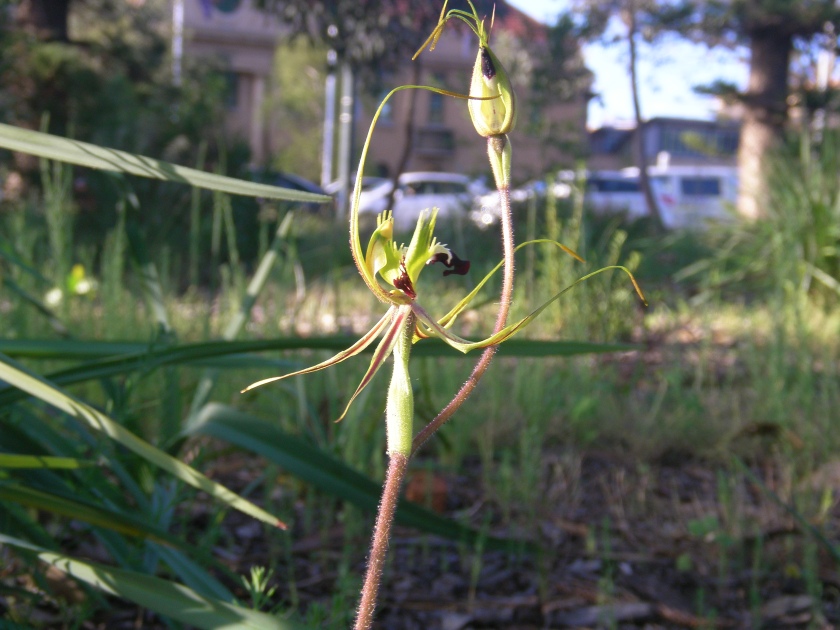
The Mayfly Orchid is a small orchid with very dark reddish brown flowers with long, hair-like sepals. It flowers from late July to August. One might question what sort of insect was behind the naming of this orchid, which does not even flower in May. Mayflies are an insect with which many of us are not acquainted.
Close view of a typical flowering Mayfly Orchid
One source attributed the naming or the orchid being similar to the long legs of a Mayfly. However, a quick search in the Internet revealed that Mayflies have fairly short legs, as in the image below:
It turns out that it is the appendages on the end of the abdomen that the sepals of the Mayfly Orchid resemble. Mayflies usually have three tails (two cerci, one middle filament), although the middle tail is rarely reduced or absent. …






 Close view of a typical flowering Mayfly Orchid
 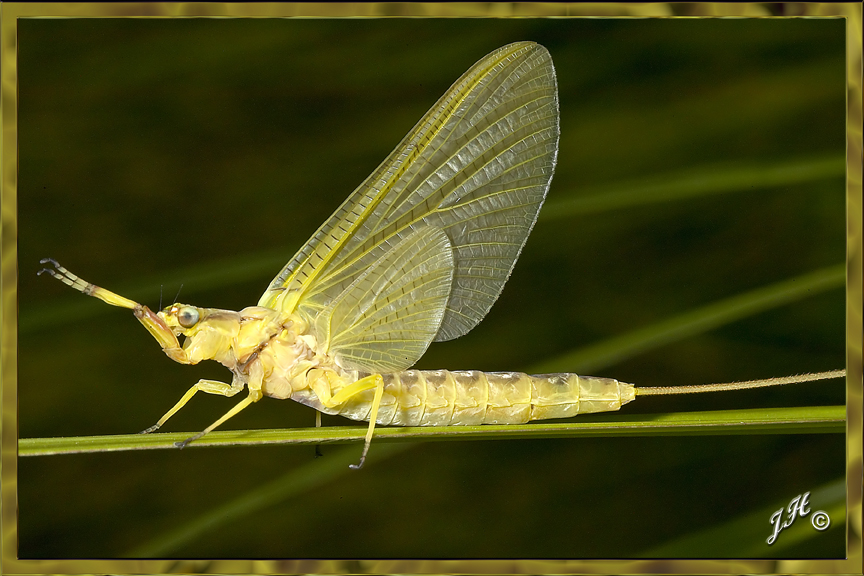 Mayflies have relatively short legs … Source:
  NOSSA
NOSSA 