‘Tis the Season … for Dipodium

For many with Christmas and New Year holidays it is a busy time but not so with the orchids here in the Adelaide region.  The vast majority of orchids have finished flowering for the year except for a few including one of our most showy orchids, the Hyacinth Orchids (Dipodium species).  Of the four species found in South Australia, two are found in Adelaide Hills –  D. roseum or Common Hyacinth Orchid and D. pardalinum or Small-spotted Hyacinth Orchid and these will be flowering across the whole of the summer period.

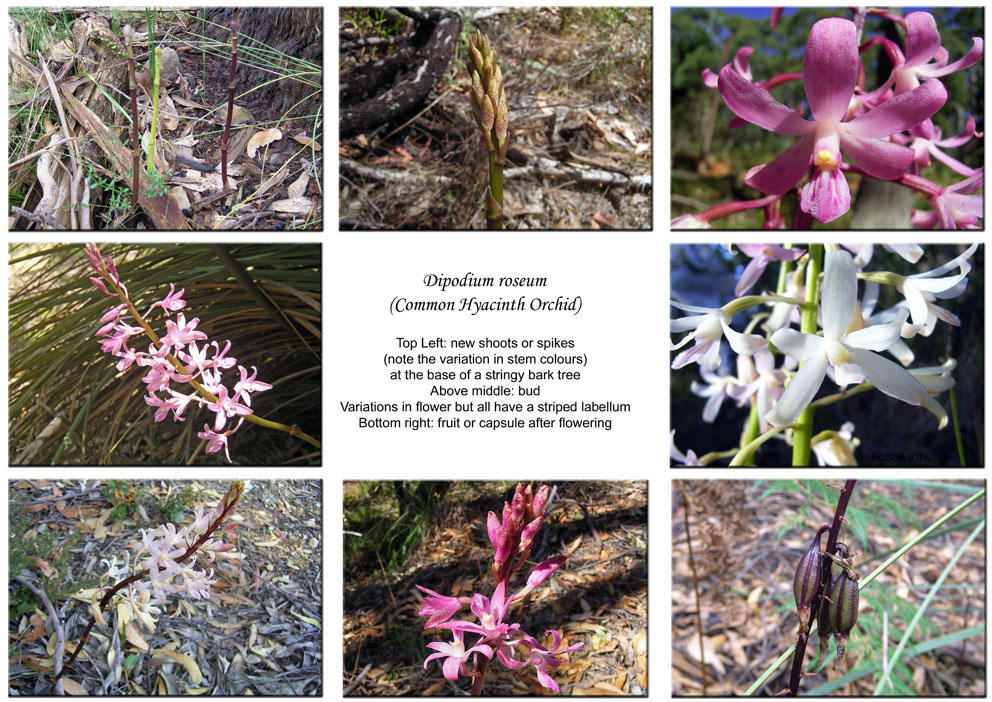
Both of these Dipodium species are leafless plants that are dependent upon mycorrhizal fungi associated with stringy bark trees, either Eucalyptus obliqua or E. baxteri.  This growth requirement makes it impossible to grow in cultivation.  (Stringy bark trees can’t be grown in pots!)  The emerging stem and buds resemble an asparagus shoot.  The stems can range from a light green through to a deep dark red.  At this stage it is difficult to tell the two species apart although if there are yellowing tips on white buds it may be a clue that the plant could be D. pardalinum.

Once in flower D. roseum has a surprising range of variation  from carmine (a lightly purplish deep red) through to pink to white, with suffused rather than clearly defined spots.  On paler or white flowers these blotches may appear pale mauve-pink rather than candy-pink.   It always has a distinctive striped labellum.

Dipodium roseum composite

This feature sets it apart from D. pardalinum which has a clearly spotted labellum and in contrast to D. roseum, the flowers lack variation of colour but are consistently white with small well-defined candy spots.  (There are other Dipodium species with larger spots.)

Note the yellow staining on the bud and no stripes on the labellum

And the final word, D. roseum is common but D. pardalinum is rated vulnerable in South Australia.


Reference: South Australia’s Native Orchids Bates 2011

2014 November Photograph Competition Part 1

11 sm CD Arachnorchis sp with hover fly

With a theme of Orchids and Insects for the November meeting it was hoped that there would be some entries with pollinators and therefore there would be two categories Insect Visitors and Pollinators. This month’s article will feature the Pollinator section and Insect Visitors in the next month.

In all there were four potential pollinator photographs. The insects were either scrounging around at the base of the column or else they had the pollinia attached to them. Unfortunately only one was a true pollinator so the category became Insects with Pollinia. The winning photograph of Arachnorchis brumalis with an unidentified hoverfly was taken by Chris Davey. Interestingly the other two pictures also featured Arachnorchis species with the hover fly Simosyrphus grandicornis. Resembling a wasp but minus the sting, this species is one of the common hover flies native to Australia.

Called Hover Flies owing to their ability to hover motionless in one spot, they are also known as Flower Flies because they are often found hovering around as well as pollinating flowers. It is not surprising, therefore, to find them around orchids. Yet instead of being called pollinators they are non-pollinators (Bates & Weber 1990). They visit the orchids, forage inside the flower and may even manage to collect some pollinia but that is all. They may not necessarily visit another flower of the same species but if they do, they will fail to deliver the pollinia to the stigma2.

Rudie Kuiter agrees with Bates that hover flies are not orchid pollinators but just when we think we have worked it out he adds “but we have at least one orchid in Victoria that is pollinated by hoverflies and witnessed now several times and this is Caladenia catenata” (synonym Petalochilus catenatus). Notwithstanding the case for this species, it would appear that in most cases hoverflies remove pollinia so that it is not available to a more specific pollinator.

Why then are the hover flies attracted to the orchids? Is it for food? An internet image search revealed that hover flies visit the flowers of many different genera including Thelymitra and Diuris. This is interesting because flowers are the food source for hover flies but though many orchids promise food, many species do not produce the nectar and pollen (as a food source) that they desire. Diuris and Thelymitra belong to this group of non-nectar producing flower. Other orchids that don’t produce nectar include Gastrodia, Dipodium and the Duck orchids. Again, there are orchids such as Crytostylis which produce minimal nectar and with Prasophyllum the nectar is hidden in cells that require puncturing – not a good food source!

Having discussed hover flies as non-pollinators, in this month’s competition, which photograph had a pollinator? – It came last and was Robert Lawrence’s photograph of a native bee on a Dipodium pardalinum, another non-nectar producing orchid. The story of this photograph was featured in Photographing Orchid Pollinators, April 2014 Journal as well as in a previous blog on Photographing Pollinators.

References:

Smith James, Information Centre, South Australian Museum, personal communications

Kuiter Rudie personal communications

Bates and Weber, Orchids of South Australia, 1990

Australian Museum, http://australianmuseum.net.au/Hover-flies Accessed 4th December 2014

Brown, et al, Field Guide to the Orchids of Western Australia, 2013

Jones, Native Orchids of Australia Including the Island Territories, 2006

Bates, South Australia’s Native Orchids 2011 DVD-ROM

Martin, The Vocabulary of Orchids: An Amateur’s Perspective, 2005

1Pollinia is basically a coherent compact mass of pollen that allows the pollen to be transported as a single unit

2The stigma is a sticky depression (or swelling) at the front of the column, the receiving surface for the pollinia that is necessary for germination.

Australian Orchids & the Doctors they Commemorate Part 13 of 20

Thomas Lane Bancroft (1860 – 1933) son and Joseph Bancroft (1836 -1894)  father

Thomas Lane Bancroft is one of Australia’s greatest doctor-naturalists; he elucidated the life cycle of the lungfish, Neoceratodus forsteri

Orchid Species

Sarcochilus dilatatus (= Sacrcochilus bancroftii) Brown Butterfly Orchid

Australian Orchids & the Doctors they Commenorate Part 12 of 20

Herman Beckler (1828 – 1914)

A general medical practitioner in Ipswich and Warwick (Queensland) and, after 1862, in Germany; in 1860, he travelled with the Burke and Wills expedition as a doctor–botanist and expeditioner in Victoria and New South Wales.

Orchid Species:

Dockrillia schoenina (= Dendrobium beckleri) or common name Pencil Orchid

Papillilabium beckleri or common name Imp Orchid

October 2014 Winning Photograph

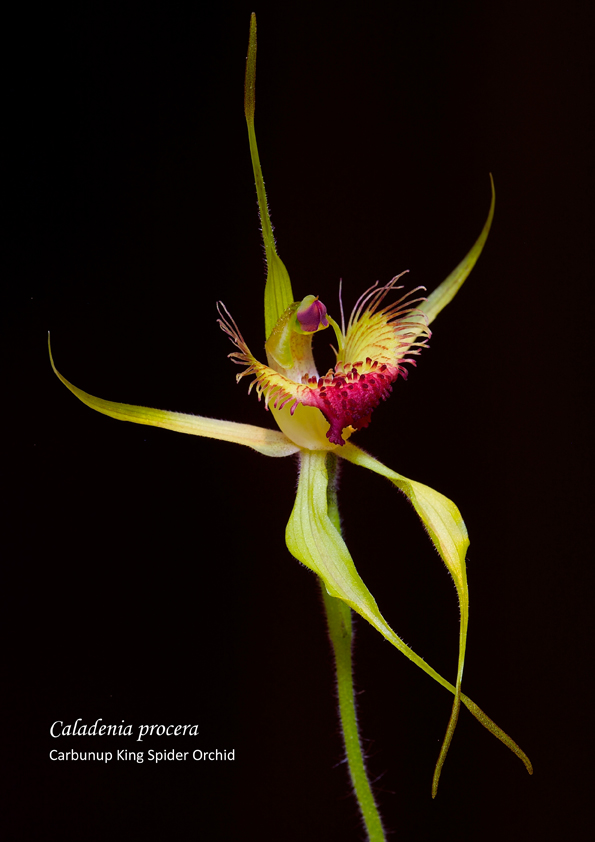
 Caladenia procera

This month’s entries of Oligochaetochilus arenicola, Caladenia flava, Calochilus robertsonii , Diuris palustris and Caladenia procera illustrated the variety of shapes to be found in orchids.

All but one are reasonably common; all but one were photographed in situ and that one was the winning picture by Kris Kopicki – Caladenia procera. Its common name, Carbunup King Spider Orchid, reflects its location near Busselton Western Australia. This species has a severely limited distribution with a small population and is threatened by land clearing for development. Consequently it is rated as critically endangered.

The other aspect of this plant is that it is a photograph of a plant in a pot not the bush. Kris benched the original plant at the September Tuesday meeting when it was still in bud. By Saturday it was in glorious flower.

This picture exemplifies the two objects of NOSSA which “are to promote and engage in activities for the promotion and furtherance of:

  1. the culture, propagation, conservation, knowledge and scientific study of the native orchids of Southern Australia and the Australasian region;
  2. the preservation of orchids as a species and their preservation within their native habitat.”

Some terrestrial orchids are relatively easy to grow but not this one. It takes time patience and skill to grow them. C procera is one of the fungi dependent species and though capable of living many years, it can take up to six years before flowering, although under ideal condition it could mature in as little as two years.

Being able to grow the different terrestrial orchids is one of the ways NOSSA can help in their conservation. NOSSA has a Growers’ Forum each meeting night where members can attend and learn from experienced growers how to grow both epiphytes and, importantly, the terrestrials.

Reference:

Native Orchid Society of South Australia Inc. (NOSSA) Rules of Association 2007

Caladenia procera – Carbunup King Spider, Orchid Species Profile and Threats Database (SPRAT) – http://www.environment.gov.au/cgi-bin/sprat/public/publicspecies.pl?taxon_id=68679 – access 6th November 2014

Remember November’s theme is Orchids and Insects (Spiders and other critters accepted as Honorary Insects)

NOSSA and the Lofty Block Threatened Orchid Recovery Project

In the NOSSA Constitution (2007) the aims of NOSSA “are to promote and engage in activities for the promotion and furtherance of :
  1. the culture, propagation, conservation, knowledge and scientific study of the native orchids of southern Australia and the Australasian region;
  2. the preservation of orchids as a species and their preservation within their native habitat.”

The article following is about one of the ongoing conservation activities with which NOSSA members were and are currently involved.  Quoted verbatim from SA Veg on the Edge, Vol 7, No. 1, 2007

Recovery Plan for 12 Threatened Orchids in the Lofty Block Region released
Since 1998, the Lofty Block Threatened Orchid Recovery Project (LBTORP) has been implementing recovery actions for threatened orchids in the Lofty Block region of SA. In late 2006, a draft recovery plan was completed for the following twelve species:
  • Caladenia argocalla (White Beauty Spider-orchid) – ENDANGERED (EPBC Act)
  • C. behrii (Pink-lipped Spider-orchid) – ENDANGERED (EPBC Act)
  • C. gladiolata (Bayonet Spider-orchid) – ENDANGERED (EPBC Act)
  • C. sp. ‘Brentwood’ (Ghost Spider-orchid) – Nominated as CRITICALLY ENDANGERED (EPBC Act)
  • C. macroclavia (Large-club Spider-orchid) – ENDANGERED (EPBC Act)
  • C. rigida (White Spider-orchid) – EPBC Act – ENDANGERED (EPBC Act)
  • C. woolcockiorum (Woolcock’s Spider-orchid) – VULNERABLE (EPBC Act)
  • C. xantholeuca (Flinders Ranges Spider-orchid) – ENDANGERED (EPBC Act)
  • Pterostylis bryophila (Hindmarsh Valley Greenhood) – CRITICALLY ENDANGERED (EPBC Act)
  • P. cucullata (Leafy Greenhood) – VULNERABLE (EPBC Act)
  • P. despectans (Lowly Greenhood) – ENDANGERED  (EPBC Act)
  • P. sp. ‘Halbury’ (Halbury Greenhood) – ENDANGERED (EPBC Act)
The recovery plan describes each of these twelve species in detail including their morphology, distribution, population size, habitat, and ecology.  Importantly, it also outlines the threats to each species and prescribes recovery objectives, targets, and actions for the next five years.
  • Determine population size and trends
  • Determine current extent of occurrence and number of sub-populations
  • Mitigate threats to sub-populations.
Recovery actions will be implemented for each of the twelve species in accordance with the recovery plan over the next five years by the LBTORP.  Community involvement is recognised as a key factor in the successful delivery of on-ground recovery actions.
Fact sheets and a webpage that provide up to date information on the program were recently completed … Joe Quarmby, Lofty Block Threatened Orchid Recovery Project Officer , SA DEH
(NB Joe Quramby now is the Threatened Flora Ecologist Natural Resources, Adelaide & Mount Lofty Ranges Partnerships and Stewardship and DEH is now Department of Environment, Water and Natural Resources, 2014)

The article may be seven years old but it is a good overview of some of the conservation work that NOSSA members have done with Joe Quarmby.

The full 176 page report can be found here.


Arachnorchis behrii (Pink Lipped Spider Orchid)


Orchid Season

South Australia has some very interesting and unique orchids but it is not always possible see them  either because one cannot get out to see them or the season has been poor with inadequate rain at the right time.  So, one of NOSSA’s member has produced a video.  It starts in autumn and goes through to summer.

So sit back and enjoy ……

PHOTOGRAPHING ORCHID POLLINATORS

The theme for the November Photograph Competition will be Orchids and Insects (spiders and other similar small critters will be honorary insects).  The April Journal of the Native Orchid Society of South Australia Vol 38 No3 had an article on how to photograph pollinators which is reprinted here below along with some pictures of orchid pollinators.


For most of us trying to photograph a pollinator is a hit or miss event.

Back in 2007 when Robert and I were still fairly new members, Bob Bates suggested we visit Talisker to photograph Dipodium – “and while you are there, photograph a bee pollinator” and “It has to be this weekend, or you will miss it” – from me “What is a bee pollinator?” So on a hot January day, the family spent the morning at Talisker. Robert busily photographing every Dipodium he saw. By early afternoon, the children were hot and tired but Robert wanted another half an hour. After more than a hundred photographs and in that last half hour Robert spotted a bee on one of the flowers only to have it disappear when it heard the shutter sound of the camera. Fortunately when we looked at the picture it showed the pollinia of the D. pardalinum on the head of a native bee – we had our bee pollinator!

Native Bee taking pollinium from Dipodium pardalinum (Spotted Hyacinth Orchid)

The lesson we learnt from that day was to turn the shutter sound off.

Talking to Rudie Kuiter and reading his book Orchid Pollinators of Victoria 2nd edition 2013, the other factors contributing to our success were:

  • a hot day,
  • flowers in the sun
  • after lunch

This is when the bee pollinator is most likely to be active, see page 110. Although, Rudie’s book is a compilation of his observations for specific Victorian species, there are many clues to help us successfully photograph pollinators; of which follows (direct quotes from his book are in quotation marks):

  • His most important point is observation.
    • “Working out how and when to catch the insects in the act of pollination is a question of finding the right flowers and figuring out about the insect’s likely visiting times. To observe the action means watching the plants for many hours and have some idea when the creatures are flying.” (Page 110)
    • “Temperature and air movement play a major role in the pollination processes. On windy days the pollinator is usually not active, whilst temperatures effect (sic) the flying ability of the insects and controls the scent produced by the orchids.” (Page 110)
  • Cryptostylis
    • His notes infer searching before 10 am. (Page 2) 
  • Thynniid Wasps
    • Most species become active when temperatures rise above 16⁰ C. Look for freshly opened flowers or visible pollinia. Check either the day before or in the morning. Several cool days preceding a warm day are more likely to aid success. (Page 10)
  • Green combed spider orchid
    • The best time seems to be a short period of not more than 30 minutes in the early morning between 10 and 11 am. In summer, the temperature can be a few degrees higher than the 16⁰ C of spring before the wasps are active. Also see note above for wasps. (Page 17)
  • Mictotis sp
    • “pollinators are rarely seen or photographed ….” (Page 54)
  • Acianthus
    • As temperature rises, the labellum develops a glossy surface which attracts the pollinator. Whilst still warm after dark, the pollinator remains active, suggesting at nocturnal pollination. See also Page 59. (Page 110)
  • Cyrtostylis
    • “The fungus gnats were usually seen during late mornings when temperatures rose above 11⁰ C.” (Page 64)
  • Gastrodia
    • “The smell becomes strongest above about 25⁰ C.” (Page 76)
  • Calochilus
    • “seems the wasp is only seen on the orchids when temperatures reach about 27⁰ or more.” (Page 79)
  • Thelymitra
    • “I watched a large number of Thelymitra peniculata on a very hot day in early November. It was coolish early in the morning and warming quickly. Flowers were still closed at 10 am, and by 11 am most were open. As a flower was about to open, one could wait for a small bee to arrive. It seemed every flower was visited within a few minutes.” (Page 80)
  • Dipodium spp
    • “One has to be very patient to wait for bees on these flowers. I’ve found a very hot day was best to see bees showing an interest.” (Page 84)
  • Pterostylis nutans
    • Pollinators are seen in the early afternoon when mid-day temperatures are 12⁰ C or more and the flowers are in the sun. (Page 94)
    • Pollinators are attracted to the fresh flowers and pollination takes place within half an hour of insects flying. Once inside the flower it may take 6 – 12 minutes before they are ready to leave. (Page 110)
  • Spiranthes australis
    • Requires temperatures of about 29⁰ C but need to be photographed from a distance as pollinators may be easily disturbed. (Page 106) 
  • When looking for pollinators and wanting to get close, insect repellents should not be used and also strong perfumes may be a problem as most insects are touchy to approach.

In summary, the most likely time to photograph pollinators is when they are most active, when:

  • There is a warm day following a few cooler days.
  • Day time temperature has risen (relative to the season), ie late morning to early afternoon but there are exceptions.
  • Flowers are freshly opened.
  • Flowers are in sun, not shade.
  • There is no wind.

Photographing pollinators takes planning, observation and patience but it is well worth the effort.

Rudie Kuiter’s book is available for loan from the NOSSA library.

Special thanks to Rudie for taking the time to read through and respond to this article.

Thank you to Rudie for allowing us to use two of his photographs showing pollinators.

NB The genus Genoplesium has also been known as Corunastylis.

Pollinator and Corunastylis archeri
Notice the yellow pollinia sacks, containing the pollen, on the head of the small vinegar fly. The orchid is Genoplesium archeri.
Corunastylis sp. Intermediate Billiat Conservation Park Photo: Rob Bates
Corunastylis sp. Intermediate
Billiat Conservation Park
Photo: Rob Bates
Pollinator and Corunastylis morris
The flowers of Genoplesium morris are only about 7 or 8 mm, but the pollinator is much smaller.

2014 September Winning Photograph

The winning picture was a single flower of Thelymitra epipactoides (Metallic Sun Orchid) taken by Rosalie Lawrence. This picture was cropped from a photograph taken on a mobile phone. Phones have come a long way since the days of Alexander Graham Bell!

Thelymitral epipactoides or Metallic Sun Orchid

T. epipactoides is a special orchid both in its beautiful colourings and that it is one of our rarest orchids. This endangered species has been well studied in an effort to prevent its demise with the result that there is an abundance of information about it. Recently, with the knowledge gained, Dr Nouska Reiter of the Australian Network for Plant Conservation (ANPC) and her team have managed to cultivate 3,000 plants with the plan to re-introduce them back into the bush in the Wimmera area.

Following are some interesting points from two good sources, which are the

  1. Biodiversity Information Resources Data page  (quotes in blue)
  2. Species Profile and Threats Database page  (quotes in brown)


Life Cycle

  • (2)……can remain dormant as a tuber in the soil for up to nine years ……….

(But once a plant has flowered)

  • (2)…….Plants can produce flowers from their second year of growth onwards for up to four consecutive years, but no more. Individual plants can remain dormant for up to two years then grow to produce flowers, but if dormant for four years or more, plants generally do not reappear. …..
  • (2)…… Detailed monitoring suggests that mature plants only live for about 10 years before dying (Cropper 1993). ……..
  • (2)……..flowers open when the relative humidity is lower than 52%, air temperature is above 15 °C, and there are clear skies ………….
  • (2)……..Flowers remain for up to four weeks but wither a week after pollination ……
  • (2)……. fungus is required to initiate successful seed germination (Calder et al. 1989) and seeds cannot survive more than two weeks without associating with the fungus ………

Plant Information

  • (1)…….Flower colour is highly variable, brown, copper, blue and green being the main colour groups which are determined by the proportion of red, blue and green epidermal cells, some of which are reflective giving a metallic appearance. …….
  • (2)….The leaf is loosely sheathing ………
  • (2)…Mature non-flowering plants have slightly narrower leaves to 51 cm long and not sheathing …
  • (1)………Flower colour is highly variable, brown, copper, blue and green being the main colour groups which are determined by the proportion of red, blue and green epidermal cells, some of which are reflective giving a metallic appearance. ………

Topography:

  • (2)…. is undulating plains, crests of hills, gentle slopes of low broad ridges and at the bottom of broad, shallow swales (Obst 2005). It grows in sandy soils over a clay subsoil, with these soils having a tendency to become waterlogged in winter and spring, and drying out in summer and autumn ……
  • (2)…..This species is a post-disturbance coloniser, utilising early successional stages after disturbance events such as human activities, fire, animal activities such as scratching of the soil, or associated vegetation disturbance. ……
  • (2)……..requires open sites for flowering and seedling recruitment (Calder et al. 1989). ………

Population Size

  • (1)……Population estimates vary from about 1050 plants in Australia (DEH 2006), to less than 3,000 plants (Coats et al 2002). More recent assessments suggest the population could be less than 1500 plants in the wild …….
  • (2)……In the Murray Darling Basin and South East Regions of South Australia there were ten populations of the Metallic Sun-orchid recorded in 2004 by Obst ……..


Reminder – November theme is Orchids and Insects (Spiders and other such critters are honorary insects)

The Role of Orchids

October is Orchid Month with the greatest number of species flowering throughout South Australia; so it is worth considering the role of orchids in the Australian bushland.  Hence this week’s blog is an article written by Belinda Newman, Western Australia.

Orchids: The Canary in the Coal Mine was published in the Friends of Kings Park magazine For Plants and People, Issue 70 p 22-24, 2010.  The article is both a good introduction to, and summary of, her 2009 thesis Orchids as Indicators of Ecosystem Health in Urban Bushland Fragments

Orchids: The Canary in the Coal Mine

Belinda Newman – Research Scientist BGPA

What could orchids and canaries possibly have in common?

Before occupational health and safety and ventilation systems were commonplace in the mining industry, a caged canary would be bought down to the coal seam by the miners.  Canaries are particularly sensitive to methane and carbon dioxide which made them excellent indicators for the build-up of dangerous gases.  A singing canary meant everything was fine, a dead canary spelt trouble and an immediate evacuation.

Although orchids can’t sing, they do possess a number of traits that make them sensitive ecological indicators.  The relationships that orchids have with their surroundings form part of a complex ecological web.  Orchids have specific relationships with mycorrhizal fungi, which they require both for germination of their dust-like seed and ongoing growth of plants in adulthood.  These fungi in turn rely on the appropriate soil moisture content and carbon sources.  Above ground, the majority of terrestrial orchids in the south west of Western Australia rely on pollinators for successful seed set.  For some orchids this plant-pollinator relationship has become so highly evolved that removal of the pollinator would spell the end of the orchid.  The pollinators also have specific requirements for habitat, appropriate food sources and nesting sites.  These above and below ground links to the ecosystem make orchids particularly sensitive to disturbances and changes in their surroundings.

The potential for orchids to be used as indicators of ecosystem health formed the basis of a study between Kings Park and Botanic Gardens and Murdoch University.  The coal seam was eleven urban reserves of varying condition on the Swan Coastal Plain.  The canaries were seven orchids common to Perth’s urban bushlands; the Carousel spider (Caladenia arenicola), Cowslip orchid (Caladenia flava), Pink Fairy orchid (Caladenia laitfolia), Pansy orchid (Diuris magnifica), Dark Banded Greenhood (Pteryostylis sanguinea), Purple Enamel Orchid (Elythranthera brunonis) and the Mignonette orchid (Microtis media).  Before it was possible to see which orchids made the best canaries, it was important to determine the health of each of the bushland sites.  A number of environmental variables were chosen that best reflected the health of the ecosystems.  Extensive surveys and analysis of species composition, plant functional groups against these environmental variables revealed a range of site conditions from close to pristine to highly degraded.  This provided the backdrop against which to determine the effectiveness of orchids as indicators through the measured responses of the orchid species.

Firstly orchid presence and abundance was measured across sites to determine if particular orchid species showed a preference for particular site conditions.  Diuris magnifica and Microtis media showed strong correlations and were most abundant in poor condition sites and Pteryostylis sanguinea showed strong correlations to sites in good condition.  While the abundance and presence of orchids appeared to correlate with site condition, we wanted to know what other aspects of the orchid we could measure as a means of judging the health of an ecosystem.

Successful seed set in plants reflects a healthy ecosystem and the reproductive success of the seven orchid species was investigated to determine the effects of declining site condition on seed set.  Pollination trials were set up to measure natural and artificial pollination events across all sites.  Widespread depression in pollination across all species and sites was found to be occurring, rendering seed set a poor measure of ecosystem health.

Investigations into the below-ground links orchids have with the ecosystem were undertaken by determining the presence and abundance of orchid mycorrhizal for the seven orchid study species across all sites.  Mycorrhizal distribution was found to be patchy within urban reserves and also revealed unoccupied niches capable of supporting orchid germination.  A greater abundance of Microtis media mycorrhizal at sites of poor condition supported earlier correlations of plant abundance at sites of poor condition.  The higher abundance of mycorrhizal symbionts for Caladenia arenicola at sites of very good condition also suggests its potential as an indicator species.

The study also looked at seedling growth in urban reserves.  This was the first time that biomass allocation in orchids has been investigated in light of ecosystem health.  In poor condition sites, Diuris magnifica and Caladenia arenicola increased growth effort to the above ground leaf. In sites of very good condition, these two species increased growth to the tuber to take advantage of being able to store starch as a result of both fungal and photosynthetic activity taking place.  Most importantly this shows a measurable change over a short period time.  Although it is effort intensive, planting orchid seedlings of a standardised size into the field may provide a useful and rapid measure of ecosystem health, much like caged canaries were used in the past.

This research into using orchids as an indicator species is the first of its kind and suggests that orchids can be used as an indicator of ecosystem health.  Future research will need to focus on the thresholds of the species identified as potential indicators in this study.  What aspect of the orchid’s ecology will give clear and repeatable data linked to ecosystem health?  Following the canary analogy, how long can orchids hold their breath? Future studies would need to focus on testing these thresholds.  The results of this study suggest that orchid presence and abundance, orchid growth and orchid symbionts can be used as indicators of ecosystem health, although work needs to be undertaken to refine the understanding of their response to specific disturbances.  This study provides a baseline for investigating the utility of orchids as indicators of ecosystem health in highly fragmented systems.  Perhaps orchids and canaries have more in common than first thought.