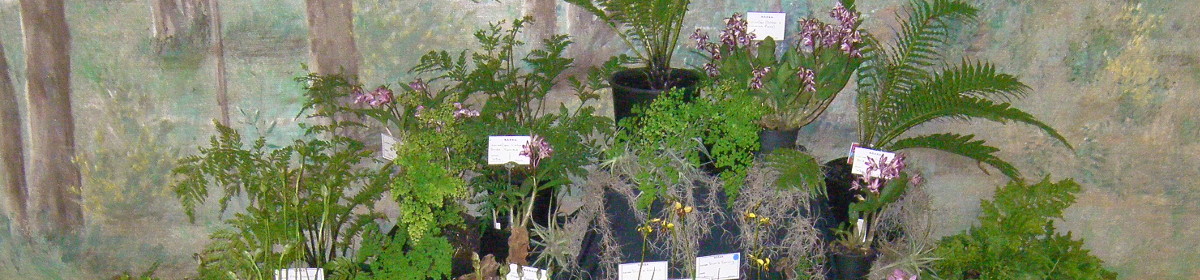
March 2015 Winning Photograph

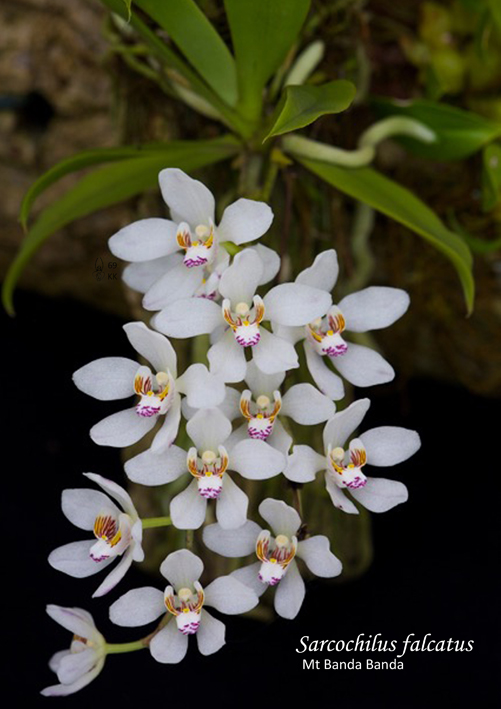
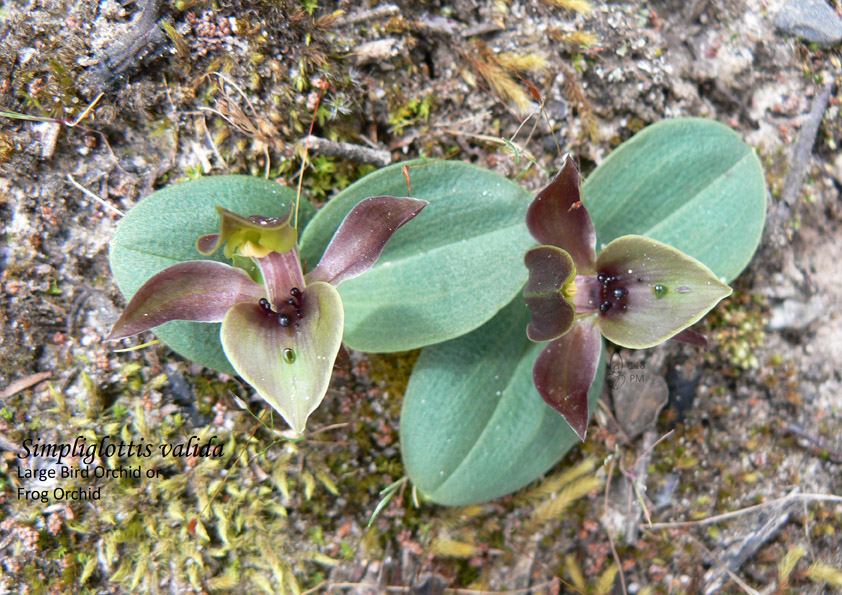
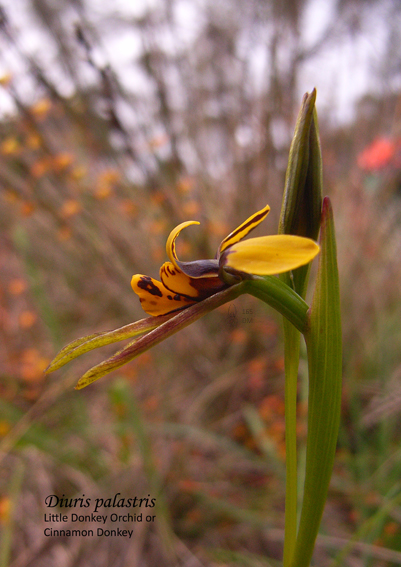
Three winners; three very different orchids but that is typical of Australian Orchids, there is no one species that you can point to and say that is a typical orchid as illustrated by the the winners which were Sarchochilus falcatus (Kris Kopicki), Diuris palustris (David Mangelsdorf) and Simpliglottis valida synonym Chiloglottis valida (Pauline Meyers).

Sarchochilus falcatus (common name Orange Blossom Orchid) is an epiphyte.  03 KK sm Sarcochilus falcatus Mt Banda BandaThe cultivated plant in this photo originated from the Blue Mountains just north of Macquarie.  Epiphytic/lithophytic orchids are found across northern Western Australia through the Top End and from a narrow band down the east coast to Tasmania; that is in all States except South Australia.  About a quarter of Australian orchids are epiphytes and despite the widespread distribution, 90% of epiphytic orchids are found primarily in the rainforests of northeastern Queensland.

S. valida (common name Large Bird Orchid or Frog Orchid) 03 sm PM Chiloglottis validaand D. palustris (common name Little Donkey Orchid or Cinnamon Donkey Orchid) are terrestrial, the larger of the two orchid groups.03 sm DM Diuris palustris  Terrestrials are mainly found across the southern part of the continent with some occurring in the north and tropics.  Their optimal habitat is the various types of sclerophyll forests found in Australia.

There is some distribution overlap but the two groups mainly occupy different habitats.

Concerning the habitat of the two terrestrials, S. valida ranges from tall moist closed forest to shaded places of drier open forests to sphagnum bogs and in the mature pine plantations of the South East.  Whereas D. palustris occurs in wet and swampy habitats in the Eastern states (hence it is named from the Latin palustre meaning swampy), in South Australia it is not so. Instead it is found in open terrain of grassland, grassy woodland, mallee and shrubland.

Some Odd Facts:

S. valida is a small ground hugging plant the scape (flowering stalk) of which elongates to 10cm or more after pollination.  Click on this video link to see these plants ‘talking’.  In New Zealand it is described as a vagrant having been introduced from Australia.

Sarchochilus falcatus is the most common and widely distributed species of this genus in Australia.  Occassionally it is lithophytic (grows on rocks). Though it had been rated Endangered and downgraded to Vulnerable in 2005, it is still under major threat from illegal collecting, trampling, water pollution, weeds and fire. New Zealand has epiphytes and the common name for them is Perching Orchids.

D. palustris is uncommon in South Australia and Tasmania; and rare in Victoria.  D. palustris was one of the subjects painted by Adelaide colonial artist and cartoonist Margaret Cochrane Scott in 1890s who had an affinity for native orchids.


References:

All internet references accessed on 31st March 2015

https://www.anbg.gov.au/cpbr/cd-keys/orchidkey/html/intro-c_habitat.html

http://anpsa.org.au/APOL19/sep00-1.html

http://www.nativeorchids.co.nz/Species/Simpliglottis_valida.html

http://data.rbg.vic.gov.au/vicflora/flora/taxon/4cebc1f9-38da-4c61-9c3c-37c2efc6da32

Mark Clements The Allure of Orchids 2014

http://www.iucnredlist.org/details/44392876/0

Bates 2011 South Australia’s Native Orchids DVD

2015 February Winning Photograph

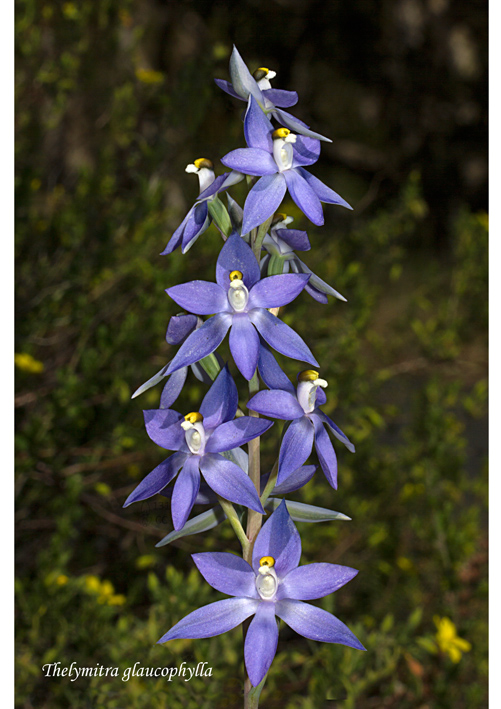
02 CC Thelymitra glaucophylla sm

The number of photographs may have been few but the quality was present. The clear winner was Claire Chesson’s Thelymitra glaucophylla (Glaucous Leaf Sun Orchid). Flowering from October to December, this endemic grassy woodland species of the ranges was only published in 2013 by Jeff Jeanes in the Mulleria 31:3 – 30 (2013) but it had been recognized much earlier by Bob Bates and has appeared with this name in his electronic Orchids of South Australia since 2005. It belongs to the T. nuda complex, of which there are 15 species, six of them having only been published in 2013. This complex is characterised by having large scented blue multiple flowers that open freely.

Not seen in this picture is the leaf and though the leaf is highly variable – 10-50cm long, 8-20mm wide, erect and short, long and flaccid, Jeanes mentions that T. glaucophylla “can be identified with a high degree of confidence from the mature leaves alone” (Page 4 Vol 31, 2013 Mulleria). The main features of the leaf are grey-green glaucous ie white bloom and is often senescent (withered) at anthesis (full flowered). Of the T. nuda complex, T. megcalyptra is the most similar but its leaf is never glaucous and has a red base, as well as an earlier flowering time and habitat of plains and rock outcrops.

For more details on the other orchids in the T. nuda group see the post titled Those Blue Orchids Again … posted 30th January 2015 with the link to Jeanes article in the Muelleria

Another Summer Orchid

Just on Christmas, NOSSA received an enquiry from Tim in the South East about an orchid he had photographed.  He knew about Dipodium roseum but in 20 years he had not seen one like this one.

From the photograph that he’d sent, it was obvious that it was a Gastrodia.  In South Australia there are three species ranging in size from the smaller G. vescula (Limp Potato Orchid) through to G. sesamoides (Cinnamon Bells or Common Potato Orchid) to the larger G. procera (Tall Potato Orchid).  Whilst G. vescula and G. procera are limited in South Australia to the South East, G. sesamoides is also found in the Southern Lofty and Kangaroo Island regions.

Tim’s orchid was G. procera.  The features that set it apart from the other two were the time of year – late December whereas both G. sesamoides and G. procera would have finished flowering (and for 2014 most orchids finished flowering earlier than usual); the spike was crowded and the plant was upright but G. sesamoides has a bent or droopy spike when in bud and G. vescula is small with very few flowers.

Though Tim considered the photographs to not be very good, he’d photographed the necessary features to help with identification. Another feature seen in his picture is the warty appearance of the plant compared with the photograph of the G. sesamoides.

Gastrodia procera or Tall Potato Orchid
Gastrodia procera (Tall Potato Orchid) Note the upright spike and the ‘wartiness’
Gastrodia sesamoides (Cinnamon Bells or Common Potato Orchid)


Although it is has no conservation rating federally and may even be considered secure in the Eastern States, in South Australia it is rated endangered, so well done to Tim for spotting it!

 It was possible to identify this orchid from the information found in South Australia’s Native Orchids, an electronic book produced and sold by the Native Orchid Society of South Australia.  Identification was confirmed by one of our most knowledgeable members.

2014 November Photograph Competition Part 1

11 sm CD Arachnorchis sp with hover fly

With a theme of Orchids and Insects for the November meeting it was hoped that there would be some entries with pollinators and therefore there would be two categories Insect Visitors and Pollinators. This month’s article will feature the Pollinator section and Insect Visitors in the next month.

In all there were four potential pollinator photographs. The insects were either scrounging around at the base of the column or else they had the pollinia attached to them. Unfortunately only one was a true pollinator so the category became Insects with Pollinia. The winning photograph of Arachnorchis brumalis with an unidentified hoverfly was taken by Chris Davey. Interestingly the other two pictures also featured Arachnorchis species with the hover fly Simosyrphus grandicornis. Resembling a wasp but minus the sting, this species is one of the common hover flies native to Australia.

Called Hover Flies owing to their ability to hover motionless in one spot, they are also known as Flower Flies because they are often found hovering around as well as pollinating flowers. It is not surprising, therefore, to find them around orchids. Yet instead of being called pollinators they are non-pollinators (Bates & Weber 1990). They visit the orchids, forage inside the flower and may even manage to collect some pollinia but that is all. They may not necessarily visit another flower of the same species but if they do, they will fail to deliver the pollinia to the stigma2.

Rudie Kuiter agrees with Bates that hover flies are not orchid pollinators but just when we think we have worked it out he adds “but we have at least one orchid in Victoria that is pollinated by hoverflies and witnessed now several times and this is Caladenia catenata” (synonym Petalochilus catenatus). Notwithstanding the case for this species, it would appear that in most cases hoverflies remove pollinia so that it is not available to a more specific pollinator.

Why then are the hover flies attracted to the orchids? Is it for food? An internet image search revealed that hover flies visit the flowers of many different genera including Thelymitra and Diuris. This is interesting because flowers are the food source for hover flies but though many orchids promise food, many species do not produce the nectar and pollen (as a food source) that they desire. Diuris and Thelymitra belong to this group of non-nectar producing flower. Other orchids that don’t produce nectar include Gastrodia, Dipodium and the Duck orchids. Again, there are orchids such as Crytostylis which produce minimal nectar and with Prasophyllum the nectar is hidden in cells that require puncturing – not a good food source!

Having discussed hover flies as non-pollinators, in this month’s competition, which photograph had a pollinator? – It came last and was Robert Lawrence’s photograph of a native bee on a Dipodium pardalinum, another non-nectar producing orchid. The story of this photograph was featured in Photographing Orchid Pollinators, April 2014 Journal as well as in a previous blog on Photographing Pollinators.

References:

Smith James, Information Centre, South Australian Museum, personal communications

Kuiter Rudie personal communications

Bates and Weber, Orchids of South Australia, 1990

Australian Museum, http://australianmuseum.net.au/Hover-flies Accessed 4th December 2014

Brown, et al, Field Guide to the Orchids of Western Australia, 2013

Jones, Native Orchids of Australia Including the Island Territories, 2006

Bates, South Australia’s Native Orchids 2011 DVD-ROM

Martin, The Vocabulary of Orchids: An Amateur’s Perspective, 2005

1Pollinia is basically a coherent compact mass of pollen that allows the pollen to be transported as a single unit

2The stigma is a sticky depression (or swelling) at the front of the column, the receiving surface for the pollinia that is necessary for germination.

PHOTOGRAPHING ORCHID POLLINATORS

The theme for the November Photograph Competition will be Orchids and Insects (spiders and other similar small critters will be honorary insects).  The April Journal of the Native Orchid Society of South Australia Vol 38 No3 had an article on how to photograph pollinators which is reprinted here below along with some pictures of orchid pollinators.


For most of us trying to photograph a pollinator is a hit or miss event.

Back in 2007 when Robert and I were still fairly new members, Bob Bates suggested we visit Talisker to photograph Dipodium – “and while you are there, photograph a bee pollinator” and “It has to be this weekend, or you will miss it” – from me “What is a bee pollinator?” So on a hot January day, the family spent the morning at Talisker. Robert busily photographing every Dipodium he saw. By early afternoon, the children were hot and tired but Robert wanted another half an hour. After more than a hundred photographs and in that last half hour Robert spotted a bee on one of the flowers only to have it disappear when it heard the shutter sound of the camera. Fortunately when we looked at the picture it showed the pollinia of the D. pardalinum on the head of a native bee – we had our bee pollinator!

Native Bee taking pollinium from Dipodium pardalinum (Spotted Hyacinth Orchid)

The lesson we learnt from that day was to turn the shutter sound off.

Talking to Rudie Kuiter and reading his book Orchid Pollinators of Victoria 2nd edition 2013, the other factors contributing to our success were:

  • a hot day,
  • flowers in the sun
  • after lunch

This is when the bee pollinator is most likely to be active, see page 110. Although, Rudie’s book is a compilation of his observations for specific Victorian species, there are many clues to help us successfully photograph pollinators; of which follows (direct quotes from his book are in quotation marks):

  • His most important point is observation.
    • “Working out how and when to catch the insects in the act of pollination is a question of finding the right flowers and figuring out about the insect’s likely visiting times. To observe the action means watching the plants for many hours and have some idea when the creatures are flying.” (Page 110)
    • “Temperature and air movement play a major role in the pollination processes. On windy days the pollinator is usually not active, whilst temperatures effect (sic) the flying ability of the insects and controls the scent produced by the orchids.” (Page 110)
  • Cryptostylis
    • His notes infer searching before 10 am. (Page 2) 
  • Thynniid Wasps
    • Most species become active when temperatures rise above 16⁰ C. Look for freshly opened flowers or visible pollinia. Check either the day before or in the morning. Several cool days preceding a warm day are more likely to aid success. (Page 10)
  • Green combed spider orchid
    • The best time seems to be a short period of not more than 30 minutes in the early morning between 10 and 11 am. In summer, the temperature can be a few degrees higher than the 16⁰ C of spring before the wasps are active. Also see note above for wasps. (Page 17)
  • Mictotis sp
    • “pollinators are rarely seen or photographed ….” (Page 54)
  • Acianthus
    • As temperature rises, the labellum develops a glossy surface which attracts the pollinator. Whilst still warm after dark, the pollinator remains active, suggesting at nocturnal pollination. See also Page 59. (Page 110)
  • Cyrtostylis
    • “The fungus gnats were usually seen during late mornings when temperatures rose above 11⁰ C.” (Page 64)
  • Gastrodia
    • “The smell becomes strongest above about 25⁰ C.” (Page 76)
  • Calochilus
    • “seems the wasp is only seen on the orchids when temperatures reach about 27⁰ or more.” (Page 79)
  • Thelymitra
    • “I watched a large number of Thelymitra peniculata on a very hot day in early November. It was coolish early in the morning and warming quickly. Flowers were still closed at 10 am, and by 11 am most were open. As a flower was about to open, one could wait for a small bee to arrive. It seemed every flower was visited within a few minutes.” (Page 80)
  • Dipodium spp
    • “One has to be very patient to wait for bees on these flowers. I’ve found a very hot day was best to see bees showing an interest.” (Page 84)
  • Pterostylis nutans
    • Pollinators are seen in the early afternoon when mid-day temperatures are 12⁰ C or more and the flowers are in the sun. (Page 94)
    • Pollinators are attracted to the fresh flowers and pollination takes place within half an hour of insects flying. Once inside the flower it may take 6 – 12 minutes before they are ready to leave. (Page 110)
  • Spiranthes australis
    • Requires temperatures of about 29⁰ C but need to be photographed from a distance as pollinators may be easily disturbed. (Page 106) 
  • When looking for pollinators and wanting to get close, insect repellents should not be used and also strong perfumes may be a problem as most insects are touchy to approach.

In summary, the most likely time to photograph pollinators is when they are most active, when:

  • There is a warm day following a few cooler days.
  • Day time temperature has risen (relative to the season), ie late morning to early afternoon but there are exceptions.
  • Flowers are freshly opened.
  • Flowers are in sun, not shade.
  • There is no wind.

Photographing pollinators takes planning, observation and patience but it is well worth the effort.

Rudie Kuiter’s book is available for loan from the NOSSA library.

Special thanks to Rudie for taking the time to read through and respond to this article.

Thank you to Rudie for allowing us to use two of his photographs showing pollinators.

NB The genus Genoplesium has also been known as Corunastylis.

Pollinator and Corunastylis archeri
Notice the yellow pollinia sacks, containing the pollen, on the head of the small vinegar fly. The orchid is Genoplesium archeri.
Corunastylis sp. Intermediate Billiat Conservation Park Photo: Rob Bates
Corunastylis sp. Intermediate
Billiat Conservation Park
Photo: Rob Bates
Pollinator and Corunastylis morris
The flowers of Genoplesium morris are only about 7 or 8 mm, but the pollinator is much smaller.

July 2014 Winning Photograph

07 JB T antennifera sm

A photograph of a  yellow sun orchid is July’s winning photograph and was taken by John Badger.

It is not difficult to identify a yellow sun orchid because amongst all of the Australian Thelymitras there are only two true yellow sun orchids.  These are Thelymitra antennifera and the less common and very different, smaller T. flexuosa.

T. antennifera has a distinctive column with two reddish brown appendages resembling rabbit’s ears henc the connom name of Rabbit Ears Sun Orchid.  Another common name Lemon Sun Orchid refers to the faint but recognisable lemon scent produced by the flower but as to why it should ever have been singled out from the other sun orchids to be called Women’s Caps1, I cannot tell.

Prior to flowering, the leaf distinguishes this sun orchid from others.  Though having a red base like some of the other sun orchid, it is thin and rounded ie filiform and terete.  Further, the closed buds are dark pink with lemon yellow margins of the sepals.

It should be noted that both T. carnea and T. rubra can on rare occasions produce a pale yellow variety but they will have all the features of their respective species.  Also a T antennifera hybrid, T. x macmillanii, can on occasions produce yellow flowers.

References

  •  R. Bates (2011) South Australia’s Native Orchids DVD
  • David L. Jones (2006) A Complete Guide to Native Orchids of Australia
  • 1The Australian Zoologist 1945 – 1951 Vol II Issued by the Royal Zoological Society of  NSW http://biodiversitylibrary.org/page/39059910#page/7/mode/1up accessed 1st August 2014

Australian Orchids and the Doctors they Commemorate Part 6 of 20

Archibald Menzies (1754 – 1842)

A British navy surgeon who circumnavigated the globe from west to east with Captain George Vancouver, in the tumultuous voyage of 1791 to 1974, explored extensively in south-west Western Australia, and was later president of the Linnean Society of London; his name is recorded in the names of banksias (including the firewood Banksia [Banksia menziesii]), orchids and mosses of the King George Sound hinterland which record his service to Australian botany.

Orchid species: Leptoceras menziesii (=Caladenia menziesii)


This orchid is the emblem of Native Orchid Society of South Australia

The Great Orchid Pretender

Actually there is more than one.

Frequently NOSSA receives a request to identify an orchid in someone’s garden.  Often, instead of an orchid (but occasionally there are orchids), it is the Ariasrum vulgare (common name Friar’s Cowl Lily or Cobra Lily).

Native to Asia and Europe, notably the Mediterranean and introduced to Australia, it is often mistaken for one of the flowers of the Pterostylis (Greenhood Orchids) or Diplodium (Shell Orchids).  Some have called it a Blackhood orchid others Snake Orchid.  It’s resemblance to the Greenhoods and Shell Orchids is superficial as they have none of the orchid features.  The dark purple hooded part is not the flower; it is a spathe (bract).  The flowers are minute hidden on deep down on the “tongue”.

The hood of the orchids is the combination of a deeply concave dorsal sepal interlocking with the lateral petals; and the fusing of the two lateral sepals.  Tucked away within the hood is the labellum (a modified petal) and the column (the reproductive organs of the flower).  The leaves of Ariasrum are quite large and distinctly different from any of the Greenhood orchids.

Friar's Cowl Lily 93RL
Arisarum vulgare amidst its large leaves
Pterostylis pedunculata 92RL
Pterostylis pedunculata (Maroonhood Orchid)
Diplodium robustum 92RL
Back view of a Diplodium robustum showing the dorsal sepal and two lateral petals that make up the hood of the flower


Diplodium robustum labellum and column 96HL
Looking into the Diplodium robustum – the labellum is the brown tip just visible at the front of the flower and the column is the brown white and yellow structure at the back
Pterostylis curta Labellum and column 92RL
Peering into the hood of a Pterostylis curta, the labellum is toward the front and the white and yellow structure to the back is the column
Friar's Cowl Lily open bract 93RL
The bract of the Arisarum vulgare has been split open to reveal the knobs which are the flowers. The flowers are so small a hand lens or microscope is needed to see them.


Confucius’ thoughts on Orchids

Confucius was an admirer of orchids and in this quote he captures the quality of the epiphytes in this eloquent translation*:

The orchid grows where others cannot enduring the hardships of hunger and thirst, and is loosely tied to the things that support it.  And, even with all the difficulty of its life, the orchid graces the world with beautiful colour and rare fragrance.  This is like the life of the true gentleman, who sets himself to learn self-discipline, and whose character shines no matter where he is or what he experiences.

Though he never saw an Australian epiphytic orchid, the description holds true as can be seen in these three pictures from among the many species found on the eastern seaboard.

Sarcochilus falcatus
Sarcochilus falcatus (Orange Blossom Orchid)
Dendrobium speciosum
Dendrobium speciosum (Sydney Rock Orchid)
Dockrilla linguiformis
Dockrilla linguiformis (Tongue Orchid)


*From The Fragrance of the Unread Poem by Jonathon Steffan http://www.jonathansteffen.com/the-fragrance-of-the-unread-poem/ Accessed 10:04pm 30th June 2014


May 2014 Winning Photo

05 PM T pulchemirra sm

Pauline Meyer’s winning photograph is a whole plant picture of Western Australia’s flamboyant Queen of Sheba Orchid.  It was taken at Eneabba, north of Perth and identified by a local as Thelymitra variegata but in consulting the books it would appear that it is the Northern Queen of Sheba, T. pulcherrima.  There are three species known as Queen of Sheba orchids in Western Australia – T. varigata, T. pulcherrima and T. speciosa.

T. variegata was originally named in 1839 by John Lindley but under the genus Macdonaldia.  In 1865 Ferdinand Mueller moved it to Thelymitra, later people began to separate it out to three different species* but it wasn’t until 2009 that Jeff Jeanes describeds T. pulcherrima and T. speciosa as distinct species from T. variegata.

All three species have a single thin spiral leaf and showy multi-coloured flowers.

T. pulcherrima and T. speciosa differ from T. variegata in the following points.

  • T. speciosa, begins flowering earlier, is a slightly shorter plant with fewer flowers (one, more rarely two) and although the flowers are a similar size to T. variegata they are even more colourful and the petals and sepals are distinctly different colours.
  • T pucherrima is similar in height to T. variegata but has smaller flowers with yellow, red, purple mauve sepals and pink purple mauve petals.  It too begins flowering earlier than T. variegata.
They all have distinct separate locations as reflected in the common names – Southern Queen of Sheba (T. variegata), Eastern Queen of Sheba (T. speciosa) and Northern Queen of Sheba (T. pulcherrima).  For some good images go to Retired Aussies or the Chookman
 
Finally there is one other species that is similar to these three and it is called Cleopatra’s Needle, T. apiculata.
 
  Thelymitra pulcherrima Theylmitra speciosa Thelymitra variegata
  Northern Queen of Sheba Eastern Queen of Sheba Southern Queen of Sheba
Distribution North of Perth between Lancelin and Dongara Between the Stirling Range and Condingup Between Perth & Albany with disjunct populations near Hyden
Flowering late June – early September late June – September August to September
Flower numbers 1 to 5 1 to 2 1 to 5
Flower height 150 – 350 100 – 200 mm 100 – 350 mm
Flower size 25 – – 35mm 30 – 50 mm 30 – 50 mm
Sepals Yellow, red, purple and mauve Yellow, red, purple and mauve Deep pink purple blotched
Petals Pink or purple and mauve Pink or purple and mauve Deep pink or purple and darker purple blotched
 
References:
Field Guide to the Orchids of Western Australia 2013, pages 425 & 427
I would like to thank Andrew Brown, co-author, for his help with this article.
 
* The name T. puchemirra is mentioned in the Western Australian Native Orchid Study and Conservation Group 2008 field trip report