Again this month was a varied selection of species with Pauline Myers’ Caladenia chapmanii (WA), Claire Chesson’s Thelymitra rubra, Jenny Pauley’s hybrid of Arachnorchis brumalis x conferta, David Hirst’s Caladenia discoidea and the winning entry, Rosalie Lawrence’s Diuris brevifolia.
This strikingly yellow flowered donkey orchid endemic to South Australia is listed as Endangered. Its range was once quite widespread in the southern Adelaide Mt Lofty Range region but now it is now restricted to pockets on the Fleurieu Peninsula and western Kangaroo Island in Heathy Woodland, Wetland and Riparian habitats.
There is interest today in cultivating orchids for conservation or ex situ conservation. With the reduced range of this species, can it be cultivated and thus continue to ensure its survival as a species? Some sources seem to suggest that it is an easy plant to cultivate, and some Diuris are easier than others, but Les Nesbitt points out that he has some plants from a rescue dig several years ago and that they have not multiplied very much in that time. This suggests that they may be dependent on a specific fungi. Though it has not been hugely successful in cultivation, it is worth noting that it has been used to produce hybrids with several other Diuris.
Reference
Bates, R. J. (2011) South Australia’s Native Orchids NOSSA DVD, Adelaide
Nesbitt, L personal communications
Adelaide and Mount Lofty Ranges South Australia Threatened Species Profile Fact Sheet – Diuris brevifolia
Of the five entries this month, three were spider orchids and the winner was from this group. It was Rob Pauley’s Arachnorchis cardiochila (syn Caladenia cardiochila), Heart Lip Spider Orchid which can be found across South Australia and into western Victoria. At one time a specimen was found on Flinders Island, Tasmania but as it was collected in 1947 it is considered extinct in that region.
This lovely flower is quite variable in colour and form.
The heart shape labellum is a distinctive feature of this spider orchid, so it is not surprising that this is reflected in the name. Cardio means heart and chila lip.
What probably is surprising is that the traditional heart shape symbol has come full circle. It had a botanical origin. According to cardiologist Professor Armin Dietz the symbol was originally a stylized vine/ivy leaf as evidenced from paintings on goblets from the 3rd millennium. In the Middle Ages, doctors and anatomists used the shape to represent the heart. As at that time Latin and Greek were both the international languages of scholars, including doctors, the word associated with the symbol was the Greek word kardia (ie cardio) meaning heart. Consequently, by the time Ralph Tate names this species in 1887, the shape has become intrinsically linked with the heart and so it must have appeared to him as an obvious descriptive name.
There are several field guides which give a detailed description of the species including South Australia’s Native Orchids DVD-ROM which is available for sale from NOSSA.
The texts published on this website are taken from his book “Ewige Herzen – Kleine Kulturgeschichte der Herzbestattungen” (“Eternal Hearts – a short cultural history of heart burials”), published 1998 in MMV Medien und Medizin Verlag, Munich. (English translation by Pauline Liesenfeld.)
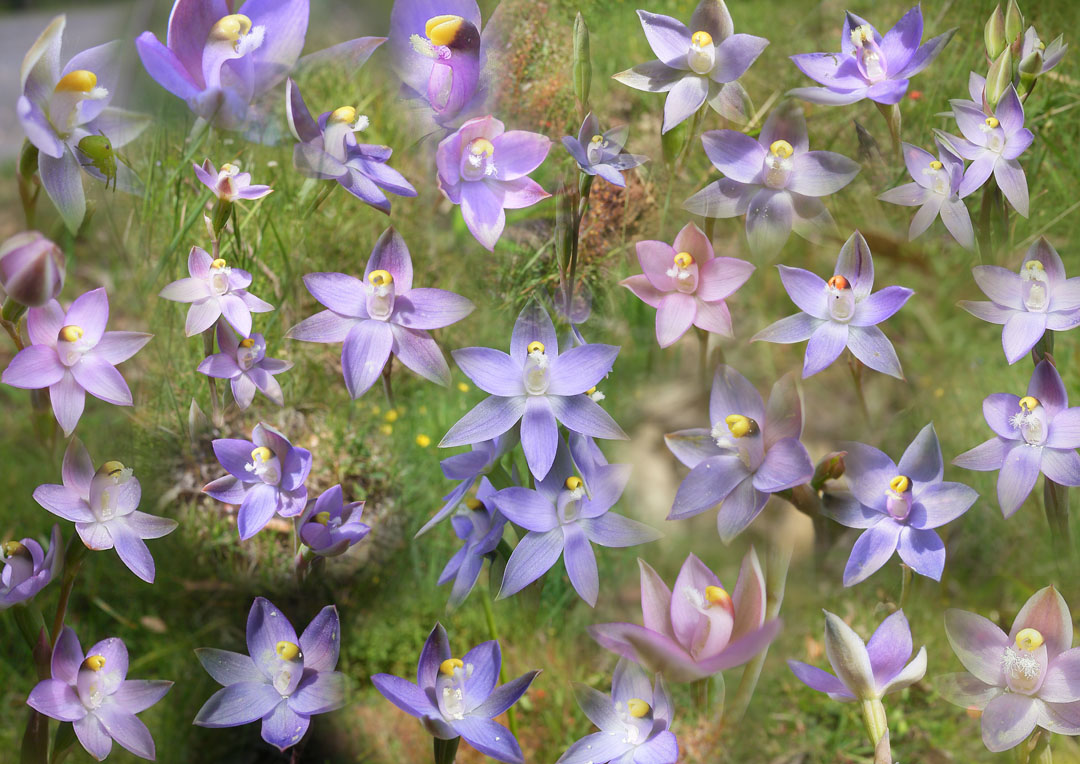
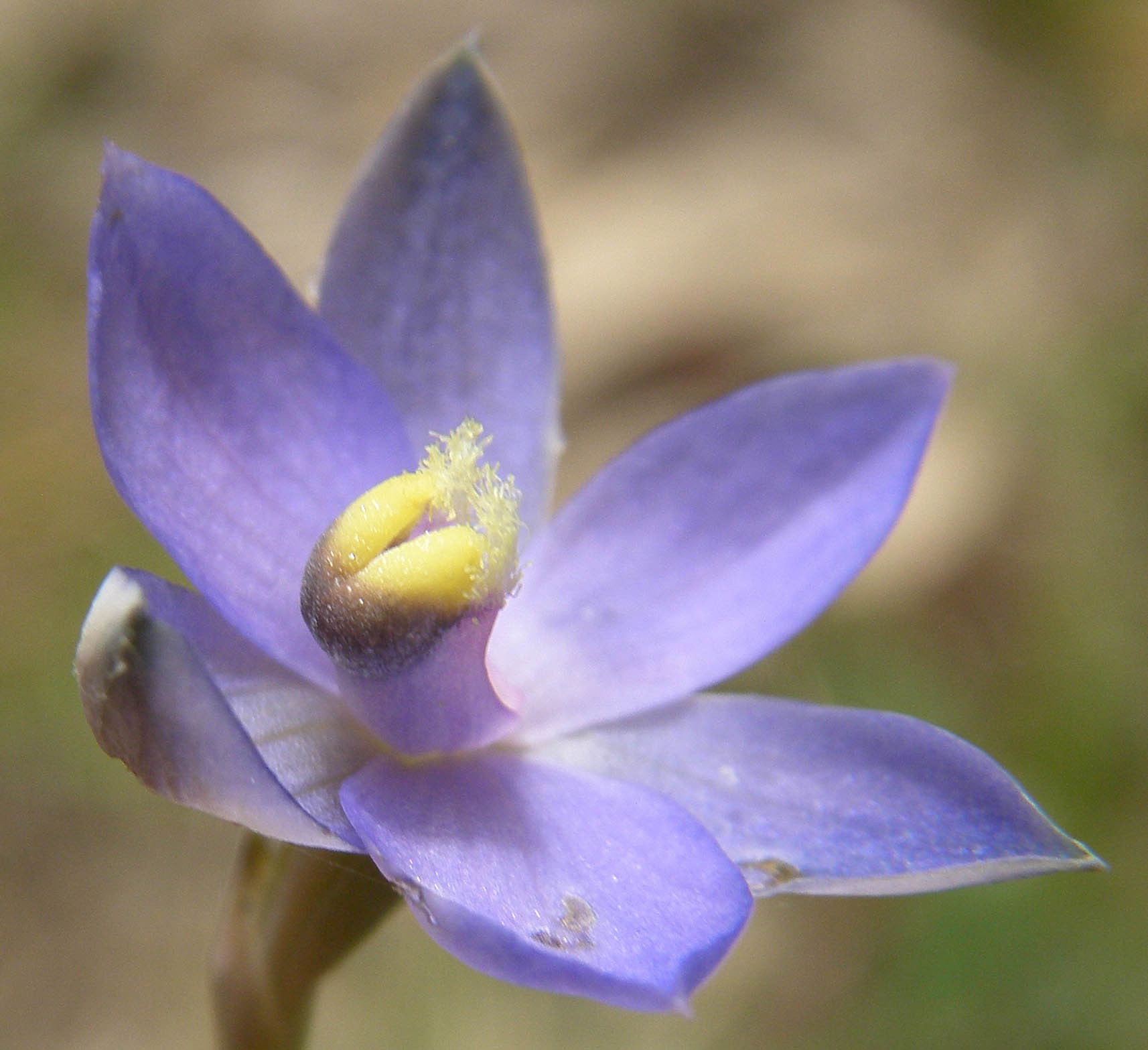
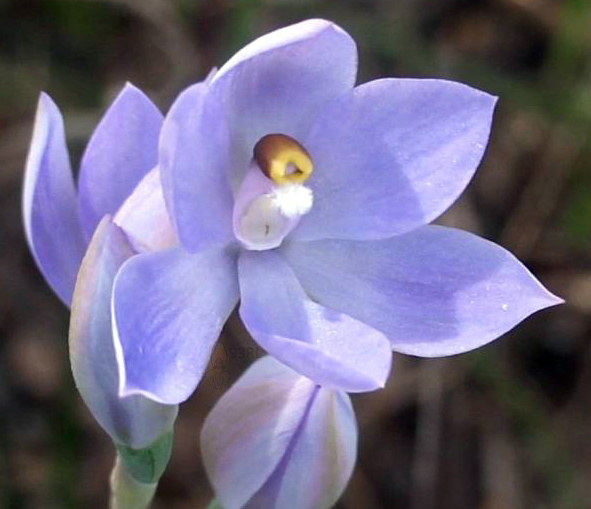
Orchids can be incredibly easy to identify or frustratingly difficult. For instance, the Flying Duck orchid is easily recognizable. The name says it all. But for many other orchids, particularly the ubiquitous blue sun orchids, it is necessary to make careful observations.
In this collage there are several species, but which is which?
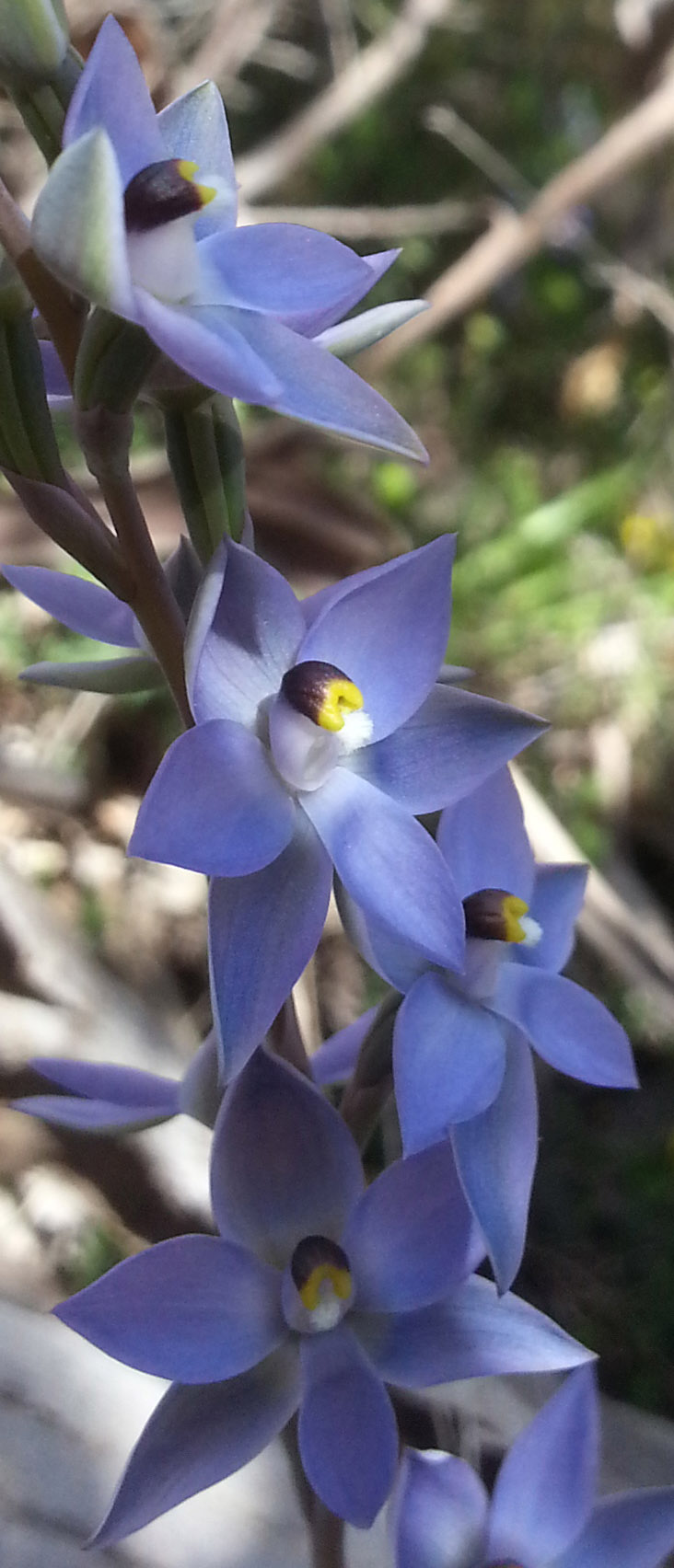
For sun orchids the most important distinguishing feature will often be the column, details of which are described or illustrated in orchid keys. For example Bates and Weber, Orchids of South Australia (1990) has an illustrated dichotomous keys showing the different types of columns.
Images from Bates & Weber, Orchids of South Australia, pages 147 to 150; courtesy of the Board of the Botanic Gardens and State Herbarium.
With today’s cameras, it is possible to photograph the column, preferably from front, side and above. This helps greatly with identification.
The following photographs illustrate the variety of columns.
Thelymitra megcalyptraThelymitra X truncata – a natural hybrid
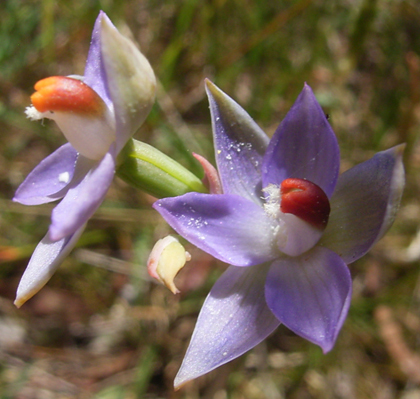
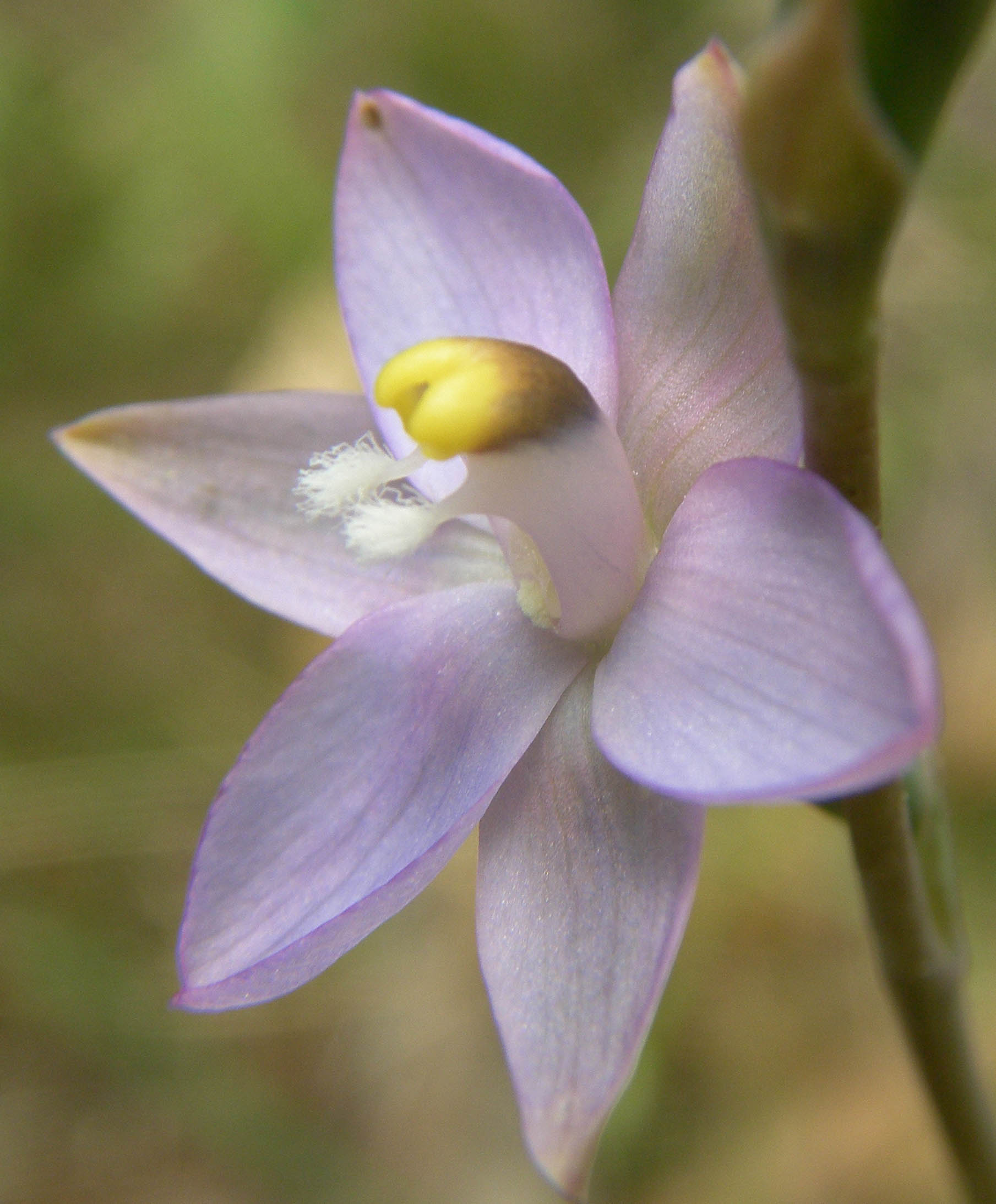
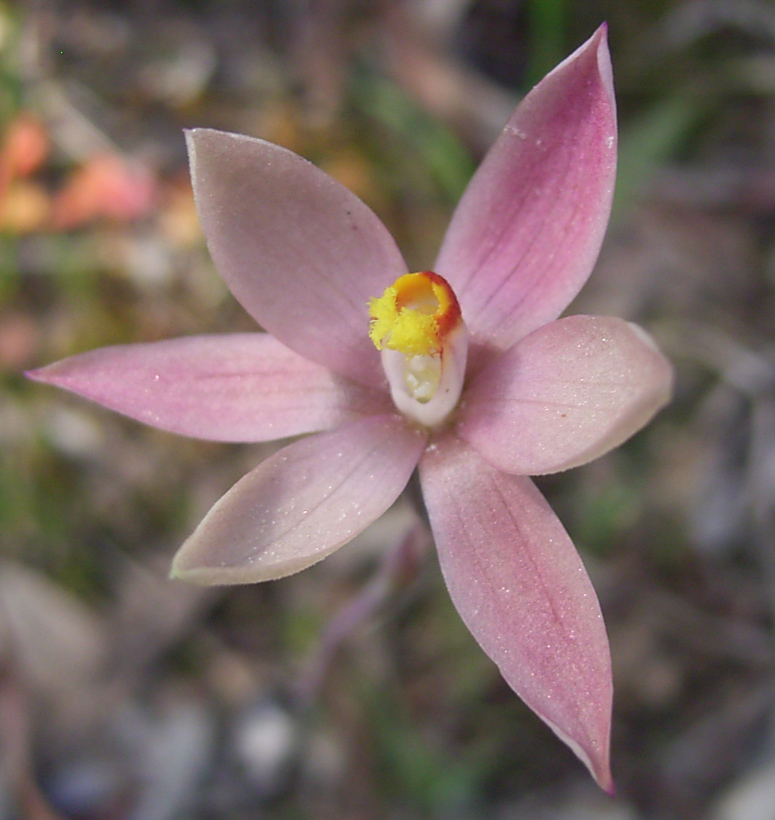
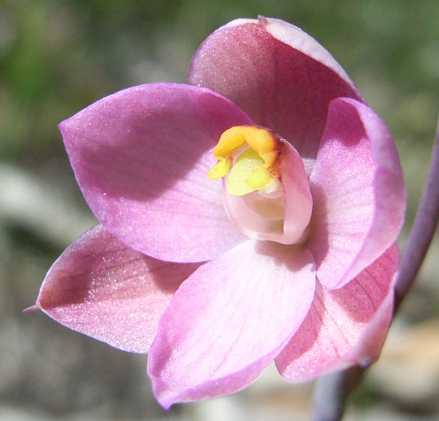
And it is not only the blue orchids that can be a problem, in South Australia; there are three pink orchids which are different in size and flowering time, features that are not obvious in a photograph, so the column is a helpful identification tool.
Thelymitra luteocilium – has tufted hairy column armsThelymitra rubra – has finger-like column arms and no tuftThelymitra carnea – has smooth column arms
And just what is the column? It is the reproductive organ of the orchid flower and is unique amongst plants because it is the fusion of the male (stamens) and female (pistil) parts. It is usually found in the centre of the flower and both releases and receives the pollen sac.
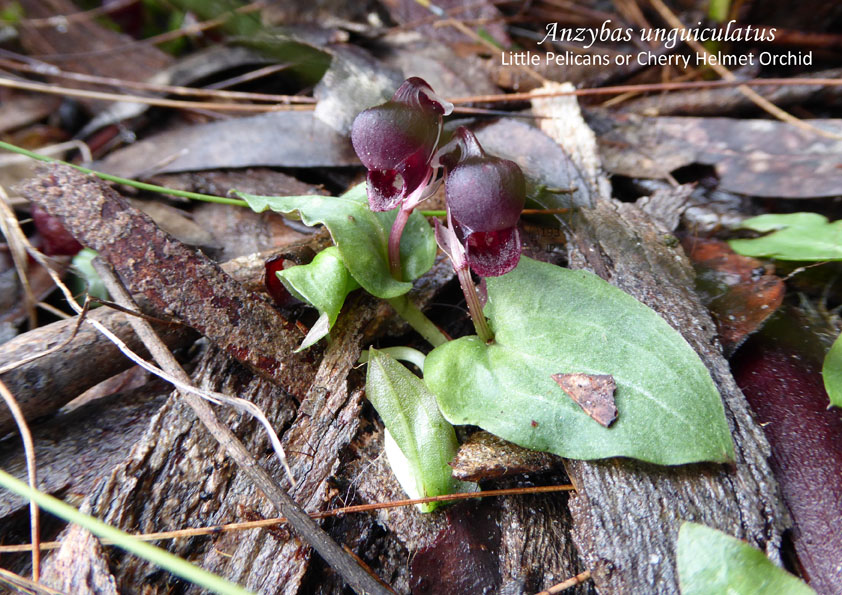
Anzybas unguiculatas (common name Little Pelican or Cherry Helmet Orchid) was the main focus for this month’s competition with three photographs of this diminutive flower.
The other photographs were Ed Lowrey’s close-up of a triggered Urochilus sanguineus labellum, John Badger’s first Diuris palustris sighting for this year and Pauline Meyer’s mass flowering of Leptoceras menziesii post fire. Of the Anzybas, Jenny Pauley entered two and Lorraine Badger one. Jenny Pauley’s photograph of two flowers was the outstanding winner.
Originally named Corysanthes unguiculata (1810), then Corybas unguiculatus (1871), the genus name was changed in 2002 to Anzybas in recognition of its distribution both in Australia in New Zealand. Since 1945 it had been recognised that the New Zealand species Corybas cheesemanii was a synonym for Corybas unguiculatas although the juvenile plant can have two leaves unlike the Australian species which is single leafed.
An interesting feature of this flower is the prominent white ears at the rear of the helmet (not clearly seen in this photograph) which are part of the labellum.
These plants are small. The gum leaves and twigs give an idea of size but the engagement ring shows it very clearly. Note also the prominent ‘white ears’ of the labellum.
An unusual aspect of this photograph is that the colour of the underside of one of the leaves. It lacks the characteristic distinguishing feature of the purple underside of the leaves. According to orchid growers, the light affects the leaf colour. Heavy shade produces green leaves. It is possible that the heavy leaf litter where this plant was growing provided enough deep shade to cause the colour loss.
Bates (1990) states that it (has) not proved amenable to cultivation, but it has, on rare occasions, been benched at NOSSA meetings with the most recent occurrence was in July 2010 but it remains a very difficult plant to cultivate. The electronic version Vol 34 No 7 has a photograph of the plant just visible within the moss.
It is not always easy to photograph this species as not only is it rare with limited numbers but there are very few sites where it can be found. Added to that is that the window of opportunity is short in South Australia with a flowering time from June to August compared with those interstate which can range from May to October.
There has always been an interest in Australian orchids. Over the years there have been many photographs of orchids. This stereographic postcard from 1928 is a study in beauty –
This postcard is held by the State Library of Victoria.
Although the distribution covers the Southern Lofty, Kangaroo Island and the South East regions of South Australia, it has become increasingly rare due to loss of habitat which consists of leaf litter on damp soils. As a result, there are very limited localities where they can now be found.
It is one of our earliest helmets to flower which is from June to July.
Rupp, HMR and Hatch, ED (1945) Relation of the Orchid Flora of Australia to that of New Zealand in Proceeding of the Linnean Society of New South Wales Vol 70 1945, pages 53 – 61
Of the five entries this month, four featured winter orchids. Lorraine Badger entered a Diplodium robustum, whilst Claire Chesson, Robert and Rosalie Lawrence all entered Urochilus sangineus. Though not the winning photographs it was interesting to see the differences between the U. sangineus with one being no taller than the small Acianthus pusillus next to it and another being taller than the rapier sedge.
But the winning photograph was the spring flowering Arachnorchis argocalla (White Beauty Spider Orchid) by Pauline Meyers. This is amongst our most threatened orchids and is dealt with in depth in the Recovery Plan For Twelve Threatened Orchids in the Lofty Block Region of South Australia 2010. This fungi dependent endemic orchid is rated Endangered both at State and National level.
Found in the Southern and Northern Lofty regions, it range has been severely reduced by possibly 80%. Since 1918 no plant has been found south of Adelaide.
Flowering from September to October, it is often found in grassy woodlands often growing on gentle southerly-facing hill slopes. The soil is a clay loam with a high humus content.
This beautiful orchid has one to two non-perfumed white flowers with thickened but not clubbed drooping lateral sepals and petals. The strongly recurved broad labellum is usually white, sometimes crimson, fringed with short teeth.
This is one of our larger spider orchids reaching a height of 60cms. The size of the plant flower and leaf help to distinguish it from other similar appearing orchids such as A. brumalis and albino flowers of A. behrii.
Like many of the spider orchids it takes 2 – 5 years to reach maturity and then has a potential reproductive life of 10 years. With an average pollination rate of less than 10%, the potential to increase the population is low and any threat to survival of the individual plants needs to taken seriously.
Some threats are obvious such as weed invasion including the garden escapees such as Topped lavender (Lavandula stoechas spp. stoechas) and action is being taken to curb the spread of weeds through targeted weeding programs.
Another threat is habitat loss. This has been the result of land clearing but sites are being protected either through conservation legislation or Heritage Agreements. Habitat loss can also occur indirectly and that is through Phytophthora being introduced into the sites. Although the direct effect of Phytophtora on the orchid is unknown, it is known that it can affect the plants that grow in association with this orchid. This threat can be reduced by all of us implementing good hygiene practices.
These were some of the threats noted in the Recovery Plan. This plan was not just defensive, ie attempt to halt and minimalize the damage; but it was also proactive with measures outlined to increase the population. These included seed and fungi collection eventually resulting in germination and cultivation with a view to re-introduction.
It is good to see that there is a plan and active steps are being taken to bring this orchid back from threat of extinction.
Photographers from L to R: Claire Chesson, Rosalie Lawrence, Lorraine Badger, Robert Lawrence
Western Australia produces a lovely array of orchids and so it is not surprising to find in NOSSA photograph competitions that when a Western Australian species is entered it can often be the winner. This month was no different with Pauline Myers beautiful picture of a mass of Diuris hazeliae which was kindly identified by Andrew Brown.
This species has only recently been named in 2013 and as a result finding information was a challenge. Obviously there was no information in Jones Native Orchids of Australia (2006); and surprisingly the definitive Field guide to the Orchids of Western Australia (2013) A Brown et al did not appear to have any information.
But
the Western Australian Herbarium’s FloraBase (Western Australian Flora), has a map of distribution which is roughly a diagonal line from east of Geraldton to the north of Esperance. It is not listed as threatened.
Distribution of Diuris hazeliae. Map taken from the Western Australian Flora Base
the Western Australian Herbarium lists the species as one of 59 new taxa added to their plant census in 2014.
from the Atlas of Living Australia it can be deduced that the flowering time is mainly August and September and is likely to be found in various types of shrublands margins including Eucalypt and mallee woodlands and appears to be mainly associated with rocky or granite outcrops.
and the National Species List APNI/APC yields the information that it was named after Hazel King, plant collector and conservationist with a special interest in orchids and was previously known by the phrase name Diuris ‘northern granite’ with a common name of Rosy-cheeked Donkey Orchid. It was found in a granite outcrop on her property Tampu (north of Beacon).
Fortunately Andrew Brown was able to help with extra information. It is listed in his book (page 212) but under the phrase name Diuris sp. Eastern Wheatbelt (Yellow Granite Donkey Orchid). Diuris sp. Northern Granite was found to be the same species and so the use of that name was discontinued but it does remain a synonym for Diuris hazeliae.
The following description is information updated from his book “Field Guide to the Orchids of Western Australia”
Diuris hazeliae D.L. Jones & C.J. French (yellow granite donkey orchid)
Flowering: August to September.
Description:
A common, inland donkey orchid 100 to 300 mm high with two to three basal leaves 50 to 150 mm long by 5 to 10 mm wide and up to seven predominantly yellow, brown marked flowers 20 to 40 mm across. Flowers are characterised by their broad petals, very broad dorsal sepal, narrow, reflexed, usually crossed lateral sepals and tri-lobed labellum with broad, spreading lateral lobes and a broad, flattened to convex mid lobe.
Distributionand habitat:
Found between Mullewa, Salmon Gums and Balladonia, growing in shallow soil pockets on granite outcrops and along drainage lines below rocky breakaways.
Notes:
Named in 2013 from specimens collected at Tampu, north of Beacon in September 1997. The species often forms very large colonies on granite outcrops.
Distinctive features:
Inland granite and breakaway habitat.
Very broad dorsal sepal.
Diuris hazeliae is part of the Diuris corymbosa complex of which, in 2013, there were only 10 of the 26 Western Australian species formally named. This situation has now changed with 14 now formally named. As a final word, Diuris orientis is South Australia’s only member of this complex.
Despite having five very different but high quality photographs, Helen Lawrence’s photograph of Calochilus cupreus (Aldinga Bearded Orchid) was the clear winner with the vast majority of votes.
In South Australia it is considered endemic and endangered. Researching it was interesting. For instance, there is no mention of it in Jones extensive book (2006) yet it was named by R S Rogers in 1918 with a description appearing in Black’s Flora of South Australia (1922 edition), including a drawing by Rosa Fiveash. Between then and now there was a shift. In the Third edition of Black’s (1978) C. cupreus is absent but C. campestris present. In Bates and Weber 1990 the authors describe C. campetris (C. cupreus). Currently, the eflora of South Australia (the electronic version of 1986 Flora of South Australia) considers it a synonym of C. campestris. This is reflected in the Census.
It would appear that as C. campestris was studied and its variations documented (e.g. article by Jones 1976 Orchadian 5:83) the distinction with C. cupreus was lost. Clements and Jones (2006) state “Calochilus cupreus R.S.Rogers = Calochilus campestris” which means that they are not using C. cupreus. But in Jones’ book an anomaly occurs – he does not include South Australia in the distribution of C. campestris and as result Bates, from 2008, states that it is not recognized as occurring in South Australia.
Though C. cupreus disappeared from the literature the name still continued to be discussed amongst orchid enthusiasts. So when in 1995 NOSSA members found a distinctively different colony at Aldinga they identified it as Rogers’ C. cupreus.
Below is a chart, based upon Dr Rogers’ description, of some of the differences that made him consider C. cupreus a separate species:
C. cupreus
C. campestris
C. robertsonii
Shorter leaf
Rather rigid or fleshy erect triangular section
Longer leaf
Crescentic section
Longer leaf
Crescentic section
Base of labellum oblong glabrous (without hairs) with several raised longitudinal line
Base of labellum round thickened, smooth no raised longitudinal lines
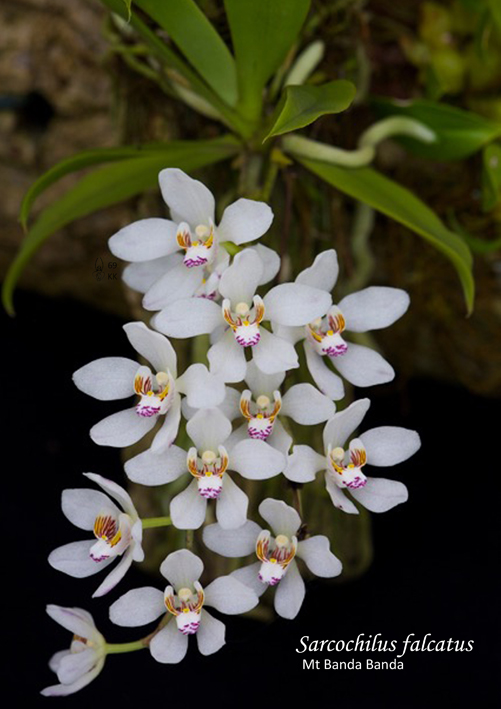
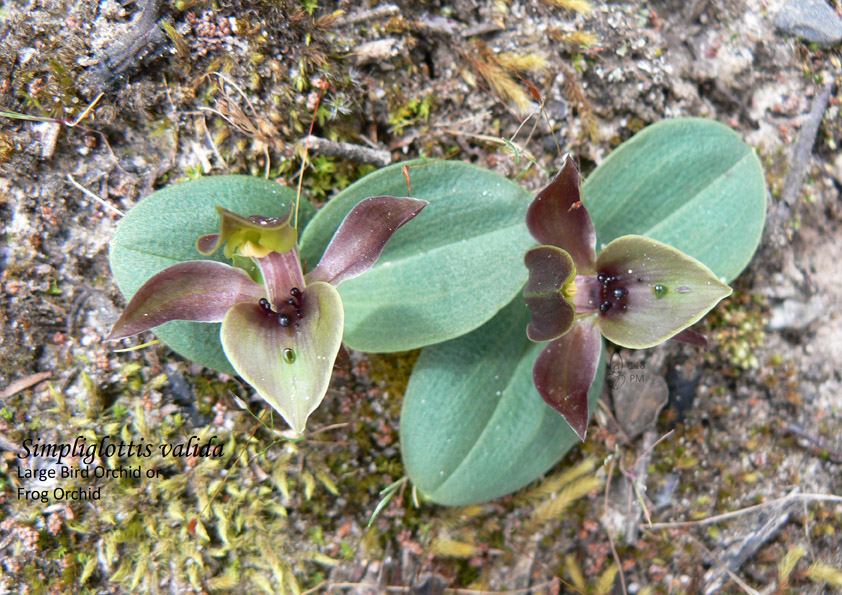
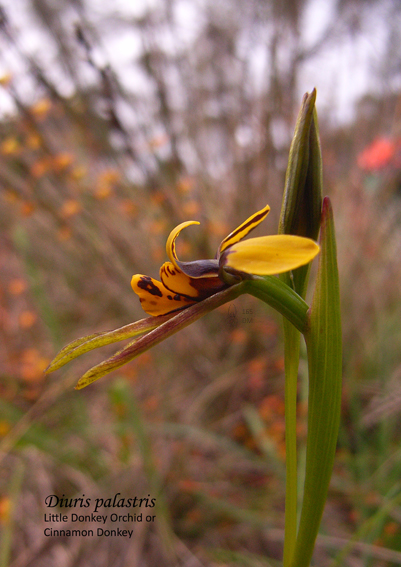
Three winners; three very different orchids but that is typical of Australian Orchids, there is no one species that you can point to and say that is a typical orchid as illustrated by the the winners which were Sarchochilus falcatus (Kris Kopicki), Diuris palustris (David Mangelsdorf) and Simpliglottis valida synonym Chiloglottis valida (Pauline Meyers).
Sarchochilus falcatus (common name Orange Blossom Orchid) is an epiphyte. The cultivated plant in this photo originated from the Blue Mountains just north of Macquarie. Epiphytic/lithophytic orchids are found across northern Western Australia through the Top End and from a narrow band down the east coast to Tasmania; that is in all States except South Australia. About a quarter of Australian orchids are epiphytes and despite the widespread distribution, 90% of epiphytic orchids are found primarily in the rainforests of northeastern Queensland.
S. valida (common name Large Bird Orchid or Frog Orchid) and D. palustris (common name Little Donkey Orchid or Cinnamon Donkey Orchid) are terrestrial, the larger of the two orchid groups. Terrestrials are mainly found across the southern part of the continent with some occurring in the north and tropics. Their optimal habitat is the various types of sclerophyll forests found in Australia.
There is some distribution overlap but the two groups mainly occupy different habitats.
Concerning the habitat of the two terrestrials, S. valida ranges from tall moist closed forest to shaded places of drier open forests to sphagnum bogs and in the mature pine plantations of the South East. Whereas D. palustris occurs in wet and swampy habitats in the Eastern states (hence it is named from the Latin palustre meaning swampy), in South Australia it is not so. Instead it is found in open terrain of grassland, grassy woodland, mallee and shrubland.
Some Odd Facts:
S. valida is a small ground hugging plant the scape (flowering stalk) of which elongates to 10cm or more after pollination. Click on this video link to see these plants ‘talking’. In New Zealand it is described as a vagrant having been introduced from Australia.
Sarchochilus falcatus is the most common and widely distributed species of this genus in Australia. Occassionally it is lithophytic (grows on rocks). Though it had been rated Endangered and downgraded to Vulnerable in 2005, it is still under major threat from illegal collecting, trampling, water pollution, weeds and fire. New Zealand has epiphytes and the common name for them is Perching Orchids.
D. palustris is uncommon in South Australia and Tasmania; and rare in Victoria. D. palustris was one of the subjects painted by Adelaide colonial artist and cartoonist Margaret Cochrane Scott in 1890s who had an affinity for native orchids.
References:
All internet references accessed on 31st March 2015
Part Two of the November competition consisted of photographs of insects on orchids. There was quite a range of insects but the winner was a draw between Cyrtostylis robusta (Winter Gnat Orchid) with an ant and Pterostylis curta (Blunt Greenhood) with a midge fly; both taken by Doug Castle.
With today’s technology it is not only easier to take crisp images but fine details can be seen particularly when enlarging the image. Hence when the pictures are enlarged it is possible to see hairs on the ant and feathered antennae on the midge fly.
With identifying orchids, it is often the detail that is important. Both of these orchids are distinctive and can be readily identified but it is good to examine why this is the case.
Pterostylis curta (Blunt Greenhood)
With the greenhood, there is enough detail to see that the dorsal sepal and lateral petals have united to form a galea, ie hood, and that the lateral sepals are semi-fused and erect resulting in lateral orifices (side gap) between the two structures. These are some of the features that separate Pterostylis* from the other greenhoods such as Diplodium, Speculantha and Taurantha. This becomes apparent when browsing through the greenhood photographs, pages 286 to 339, in Jones “A Complete Guide to Native Orchids of Australia”. Having established that the plant is a Pterostylis, the twisted labellum is diagnostic of a P.curta as it is the only one that is described with a twisted labellum. Although not all the identifying features are present, enough information is available in this picture for identification.
In contrast the photograph of the Cyrtostylis robusta only has sufficient data to confidently identify it as a Cyrtostylis species, having a distinctive labellum that is larger than the lateral sepals and petals. In South Australia there are only two species and according to Bates (2011), the distinguishing features between the two
Cyrtostylis robusta (Winter Gnat Orchid)
appear to be the leaf, the bud and the labellum. In this picture, the angle of the image does not give a clear view of the labellum (it could possibly be damaged) and of course there is no bud or leaf. It is possible that the pale edges of the dorsal sepal may give a clue to species identification as C. reniformis has mainly darker buds than C. robusta. Obviously Doug was able to identify it from his observations of the other features not present in this photograph.
In summary, one image is not always sufficient for identification. As was discussed on the night, to confirm identification, orchids should always be photographed from more than one angle, including pictures of other parts of the plant.
*In South Australia, Pterostylis foliata is a possible exception as it has no obvious lateral orifice.
References
Jones, D.L., T. Hopley, S.M. Duffy, K.J. Richards, M.A. Clements & X. Zhang (2006) Australian orchid genera. An information and identification system. CSIRO Publishing: Collingwood, Vic.
Bates, R.J. (2011) South Australia’s Native Orchids. DVD-ROM. Native Orchid Society of South Australia Inc.: Adelaide.
Jones, D.L. (2006) A complete guide to native orchids of Australia, including the island territories. New Holland Publishers: Sydney.
With a theme of Orchids and Insects for the November meeting it was hoped that there would be some entries with pollinators and therefore there would be two categories Insect Visitors and Pollinators. This month’s article will feature the Pollinator section and Insect Visitors in the next month.
In all there were four potential pollinator photographs. The insects were either scrounging around at the base of the column or else they had the pollinia attached to them. Unfortunately only one was a true pollinator so the category became Insects with Pollinia. The winning photograph of Arachnorchis brumalis with an unidentified hoverfly was taken by Chris Davey. Interestingly the other two pictures also featured Arachnorchis species with the hover fly Simosyrphus grandicornis. Resembling a wasp but minus the sting, this species is one of the common hover flies native to Australia.
Called Hover Flies owing to their ability to hover motionless in one spot, they are also known as Flower Flies because they are often found hovering around as well as pollinating flowers. It is not surprising, therefore, to find them around orchids. Yet instead of being called pollinators they are non-pollinators (Bates & Weber 1990). They visit the orchids, forage inside the flower and may even manage to collect some pollinia₁ but that is all. They may not necessarily visit another flower of the same species but if they do, they will fail to deliver the pollinia to the stigma2.
Rudie Kuiter agrees with Bates that hover flies are not orchid pollinators but just when we think we have worked it out he adds “but we have at least one orchid in Victoria that is pollinated by hoverflies and witnessed now several times and this is Caladenia catenata” (synonym Petalochilus catenatus). Notwithstanding the case for this species, it would appear that in most cases hoverflies remove pollinia so that it is not available to a more specific pollinator.
Why then are the hover flies attracted to the orchids? Is it for food? An internet image search revealed that hover flies visit the flowers of many different genera including Thelymitra and Diuris. This is interesting because flowers are the food source for hover flies but though many orchids promise food, many species do not produce the nectar and pollen (as a food source) that they desire. Diuris and Thelymitra belong to this group of non-nectar producing flower. Other orchids that don’t produce nectar include Gastrodia, Dipodium and the Duck orchids. Again, there are orchids such as Crytostylis which produce minimal nectar and with Prasophyllum the nectar is hidden in cells that require puncturing – not a good food source!
Having discussed hover flies as non-pollinators, in this month’s competition, which photograph had a pollinator? – It came last and was Robert Lawrence’s photograph of a native bee on a Dipodium pardalinum, another non-nectar producing orchid. The story of this photograph was featured in Photographing Orchid Pollinators, April 2014 Journal as well as in a previous blog on Photographing Pollinators.
References:
Smith James, Information Centre, South Australian Museum, personal communications















 NOSSA
NOSSA 