Leo Davis always has some interesting insights from his orchid observations. In this article he examines the position of the tepals (petals and sepals) in particular the Moose Orchid which he saw for the first time this year.
Have a close look, next season (winter to early summer) at some of our native lilies. Start with the jolly bulbine lily (Bulbine bulbosa), no longer a true lily incidentally, because it now resides in family Aspodelaceae, along with the grass trees. You will find three yellow petals at 12, 4 and 8 o’clock and closely behind them three almost identical sepals at 2, 6 and 10 o’clock, so at first sight you see six apparently identical tepals (sepals and petals). Move on to the rush fringe-lily (Thysanotus juncifolius), as described in Ann Prescott’s ‘It’s Blue With Five Petals’. Clive Chesson is more up to date and tells me it is now T. racemoides. Again it is no longer a true lily, now sitting in family Asparagaceae. Here the tepals are noticeably different. Three wide densely fringe edged petals will be found, if you view the flower face on, at 12, 4 and 8 o’clock. The narrow non fringed sepals sit close behind at 2, 6 and 10 o’clock. These are just a generalisations because if the flower turns only about 60o a sepal will be at the top.
Most orchids, while close relatives of the true lilies and the one time lilies, do not show these arrangements. Let’s start with some that do.
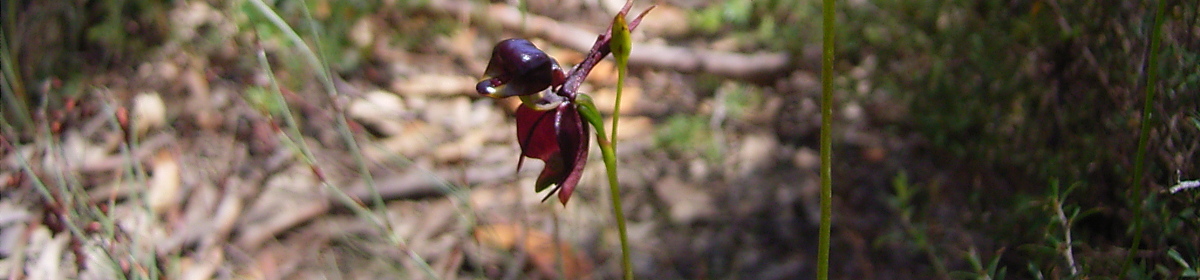
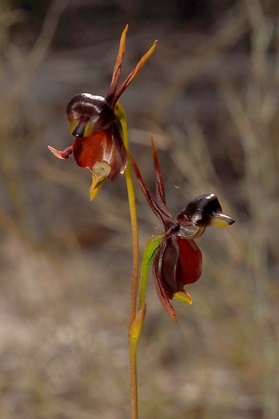
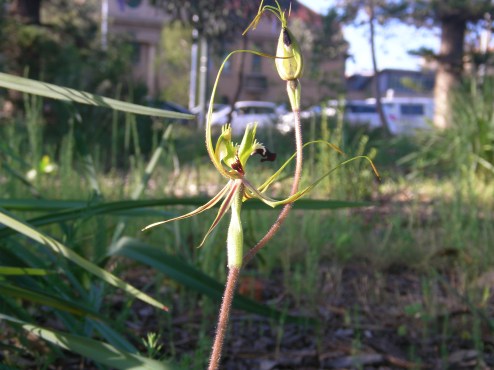
In the large duck orchid (Caleana major) the petal at 12 o’clock, the dorsal petal, is modified, as in most, but as usual, not all, orchids, to become a labellum. In this charmer the labellum takes the form of a duck’s head. Its function is to snap down trapping a pollinator insect in the cup shape column below it, forcing it into contact with the sticky off white stigma and/or the yellow pollinia below it. Look closely and you will find the other two narrow petals drooping at around 4 and 8 o’clock. Two folded, twisted sepals can be clearly seen at around 1 and 11 o’clock. The third sepal, at 6 o’clock, is tucked in behind the cup shaped column. Note that, as with lilies, the top tepal is a petal.
Caleana major, Knott Hill NFR Photographer: Leo Davis
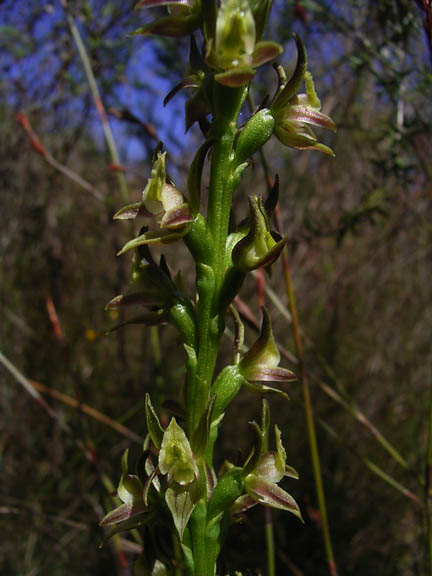
The leek orchids (genus Prasophyllum) follow this pattern and also have their labellum at around 12 o’clock. These orchid groups, which are up the right way, are said to be ‘not upside down’, using the technical term ‘non resupinate’.
Most orchids are ‘upside down’ and are called resupinate. The whole flower rotates 180o, clockwise or anti I don’t know, at the embryonic stage. But let’s start with somewhat of an exception with the sun orchids (genus Thelymitra) which do not have a petal modified as a labellum. But they are indeed upside down.
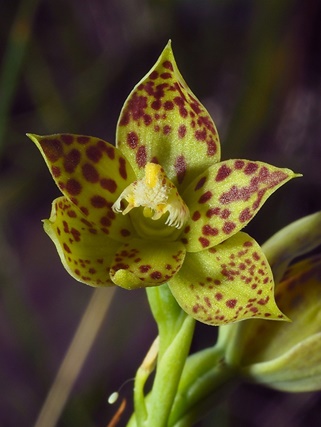
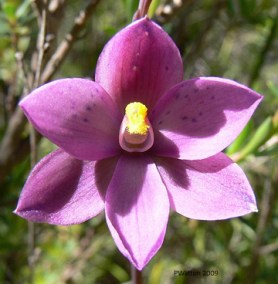
Have a close look at the Thelymitra benthamiana flower. Note that the three petals, at roughly 2, 6 and 10 o’clock, are in front of the three slightly larger but very similar sepals, at 12, 4 and 8 o’clock.
Note that the toptepal is a sepal. The flower is upside down, that is resupinate. In most orchids the petal at 6 o’clock would be modified to be a labellum.
Thelymitra benthamiana, Scott Creek CP; Photographer: Leo Davis
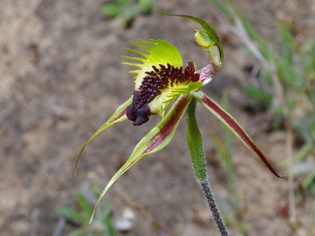
The Arachnorchis (possibly Caladenia to you) stricta, from Sherlock, out in the mallee, is more typical of terrestrial orchids in SA. It is upside down, that is resupinate, and has a petal modified to be a labellum.
The bottom petal has become a wide labellum, with fine edge combs and parallel rows of rich plum coloured calli covering its centre. Out at roughly 3 o’clock is a narrow petal, the other invisible on the other side. At the top, pressed tightly against the column, a sepal arches forward. Two larger sepals extend down at around 5 and 7 o’clock.
Arachnorchis stricta, Sherlock; Photographer: Leo Davis
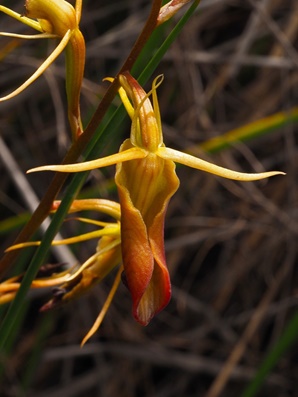
When I saw my first, my only, moose orchid, this season, I was in such a state of excitement that it looked to me to be up the right way, that is to say upside down.
Cryptostylis subulata, Stipiturus CP; Photographer: Leo Davis
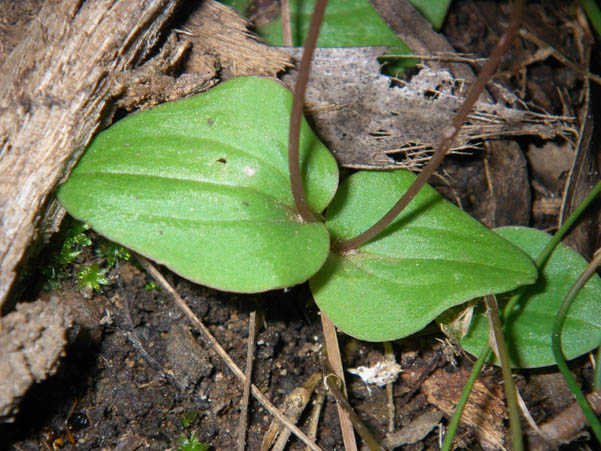
Have a look. Two narrow short roughly vertical petals at about 1 and 11 o’clock. There are two sepals at just past 3 and just before 9 o’clock. That’s OK but where is the other sepal? Are there it is, where it should be, at midday. But hang on, it’s behind the flower stem (peduncle) and where is the column?
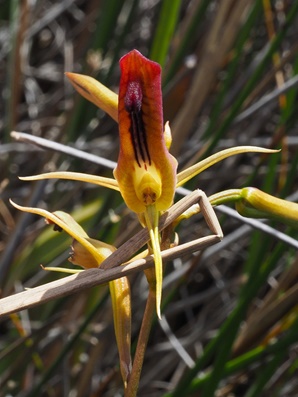
Cyrtostylis subulata with labellum lifted; Photographer: Leo Davis
Holding the labellum up with a stick I found the column, the stigma and the pollinia, underneath the labellum. The third sepal now appears to be at 6 o’clock. And it all became clear. This flower was up the right way (non resupinate) but it has turned forward, on its peduncle, by about 180o, to become upside down, but not in the manner of resupinate flowers, because it is back to front. It is an inverted non resupinate flower. Still with me?
Ten years ago, the then NOSSA secretary, Cathy Houston, wrote an article reflecting upon orchid name changes. Since then there have been more name changes. The issues she raised then are still pertinent today. Whilst we continue to learn more about our orchids, name changes are going to happen.
NOSSA Journal Volume 31 No 2 March 2007
HAVE OUR ORCHIDS CHANGED? Cathy Houston (Secretary)
This month the Native Orchid Society of South Australia celebrates its thirtieth “birthday”. A review of the first five years of the Society’s Newsletters/Journals (yes, they were newsletters in the earliest days) reveals some interesting points. By 1979 “A total of 110 species [of orchids] and 14 varieties” were accepted. The following are some interesting aspects about the knowledge of, and what was then current thinking about, our orchids at that time. It must be remembered that no comprehensive book on South Australian orchids existed in those days, especially not any field guides. The most useful “tools” the members had to work with were Blacks Flora of South Australia and W.H. Nicholls “Orchids of Australia”. In 1979 “A Checklist of Orchidaceae on South Australia” by J.Z. Weber: Changes introduced in the new ‘Black’s Flora” by R. Bates, appeared as a full issue of the Native Orchid Society of South Australia Journal.
Today we sometimes struggle to grasp all the fine differences when orchid species, or species groups, are split, but spare a thought for those wanting to identify with what they have seen in the field back in about 1979. An article by R. Bates describes the “Variations within the species Caladenia dilatata R.Br. in South Australia”. “There are, at present, two recognised varieties” viz. C. dilatata var. dilatata and C. dilatata var. concinna. Within these two varieties are further more divisions into distinct sub-varieties or races! At that time there were six distinct forms recognised; how much easier today, now that they are named as species. These would now include C. tentaculata, C. verrucosa, C. stricta, C. toxochila and C. conferta.
Arachnorchis tentaculata (King spider Orchid) syn Caladenia tentaculata
Recognition of what could be species has long been apparent. Take for example the article written in 1980 about two forms of Pterostylis nana, viz. what we commonly refer to as the ‘Hills’ form and the ‘Mallee’ form. This article documents the obvious morphological differences and illustrates this with line drawings and a map showing distributions of the two. Electronic Orchids of S.A. currently recognises five possible species of P. nana for South Australia. These are probably all un-named, since David Jones, in “Native Orchids of Australia”, does not recognise true P. nana in our state. Similarly, an article written in 1981 discusses the P. alata – scabra – robusta complex. The author recognises there are “at least four species of this group in South Australia”. This is the first time the authors acknowledge they should be elevated to species, not just accepted as varieties or forms. At that time P. robusta was treated at varietal level, viz. P. scabra var. robusta or P. alata var. robusta. Ultimately most of these have been elevated to species level (P. dolichochila, P. erythroconcha, P. robusta, and P. striata).
It was noted that in 1978 David Jones and Ray Nash were currently working on Pterostylis. Further to that Les Nesbitt notes that of the sixty or so Pterostylis in Australia, South Australia has twenty-two species. One wonders what the count is now. It is well known that David Jones is currently/still working on the Pterostylis group, with more species being recognised regularly.
Thelymitra x irregularis or Pink Spotted Sun Orchid was photographed in 2009 near Macclesfield
In a series of articles produced about “Our rarest orchids” in 1977 we find the comment “Very few of our orchids are thought to be extinct… . “One wonders what that number would be considered to be today. The same article talks about the demise of Pterostylis cucullata and the possibility that it may no longer exist in the wild. Certainly this is one of our highly endangered species for which recovery actions are being undertaken these days. [N.O.S.S.A. members have an opportunity to assist with this work starting on April 14th – see diary dates.] In 1977 there was excitement when, following a field trip to Belair National Park one member returned the following day and “the elusive Pterostylis cucullata” was seen “growing in association with P. curta”. In 1981, following a discussion and review of endangered orchids in South Australia, R. Bates writes “There are a number of endangered species in S.A. which have not yet been named. It is not unlikely that some of these will become extinct before they are even described properly.” With such a large number of as yet undescribed orchids in our state, let us hope this does not happen.
Naturally occurring hybrids and the naming of such, has been debated regularly within botanical circles. In 1978 this insight is shown by Ray Nash who “guided us to a nearby patch of Thelymitramacmillanii,…… Ray’s view is that this will probably turn out to be a hybrid, possibly between antennifera (which it closely resembles) and rubra or luteocilium.” In 1980 T. decora [T. x truncata] was featured as one of South Australia’s rarest orchids. It was thought to be of hybrid origin and three forms were recognised then. The probable parents were T. ixioides x T. longifolia, T. ixioides x T. pauciflora, and T. ixioides x T. mucida. Today with the naming of many species within the T. pauciflora complex, it is now being recognised that there are even more combinations producing similar type flowers, e.g. T. juncifolia, which gives rise to the spotted features, x T. brevifolia.
Name changes always raise controversy. A brief explanation giving some insight into this complex area can be picked up when an author is expanding on the front cover illustration of Corybas. “In fact, they should never have been called Corybas in the first place. They were discovered by Robert Brown during the Flinders Expedition (1801 – 1805), and illustrated by the Austrian Ferdinand Bauer, another of the members of the expedition. Brown called them Corysanthes from the Greek “korys” (a helmet) and “anthos” (a flower), and they were known for many years by that name. However, in this instance, justice was never truly done, because the decision was made to call them Corybas, the name previously allotted by R.A. Salisbury in 1805, on the strength of seeing Bauer’s illustrations.” More recent times have seen that injustice righted with the name reverting to Corysanthes, something brought about through the work of David Jones. Similarly, the latest naming of Corunastylis tepperi follows this, The International Code of Botanical Nomenclature, a name that was recognised by R. Bates in an article written in 1981! However, Bates concludes that P. tepperi and P. nigricans are synonymous, so the latter prevails, but “further work needs to be done”! He is also the author of an article depicting some name changes in 1980. If our readers are confused by “new” names, then just think what it was like for those in 1980 when, among others, Caladenia carnea, and all its five varieties, is changed to C. catenata, with all its varieties, two of which are C.catenata var. gigantea and C. catenata var. minor. Two others were elevated to C. pusilla and C. alba.
Corysanthes diemenica (Veined Helmet Orchid)
At one time our esteemed orchidologist was asked to comment on a list of name changes being proposed for the revision of Black’s Flora of S.A. “My first reaction was to state that everyone would be happiest if no changes were made”! However, in fairness to that gentleman, it must be said that by the time he had worked through a lengthy consultation with botanists covering much of Australasia, a revision of type specimens and other material and associated literature, he was clearly of the opinion that the changes were warranted.
Have our orchids changed? Maybe, but what has really changed is our knowledge and understanding of these unique plants. Based on that knowledge, opinions, attitudes and ideas have changed. Thirty years ago it was not “policy to differentiate between the numerous forms of C. patersonii in this State …” Today we have numerous named species in this complex, without actually any Caladenia patersonii as such.
The final word must come from Peter Hornsby when he said “The ultimate aim should be for the reader to know which plant is being discussed, rather than whether or not the title is absolutely correct.”
References:
Native Orchid Society of South Australia Journal.
1. 1977 Vol. 1 #5
2. Vol. 1 #9
3. 1978 Vol. 2 #2
4. Vol. 2 #6
5. Vol. 2 #7
6. 1979 Vol. 3 #1
7. Vol. 3 #6
8. Vol. 3 #9
10. 1980 Vol. 4. #3
11. Vol. 4 #4
12. Vol. 4 #6
13. Vol. 4 #7
14. 1981 Vol. 5 #1
15. Vol. 5 #3
16. Vol. 5 #4
17. Vol. 5 #6
Black J.M. 1978. Flora of South Australia, Part 1, Third Edition. Handbooks Committee, South Australia.
Jones David L. 2006. A Complete Guide to Native Orchids of Australia, Including the Island Territories. Reed New Holland, Australia.
Nicholls, W. H. 1969. Orchids of Australia; The Complete Edition. Thomas Nelson, Australia.
This week we continue with both Part Two and Part Three of Brendan Killen’s Rescuing Apparently ‘Dead’ Orchids which appeared in the Volume 31 No 9 October 2007 and Volume 31 Bi 11 December 2007, respectively.
Rescuing apparently ‘dead’ orchids. Part 2 By Brendan Killen
PLANT #2 – Dendrobium Alick Dockrill “Pale Face”
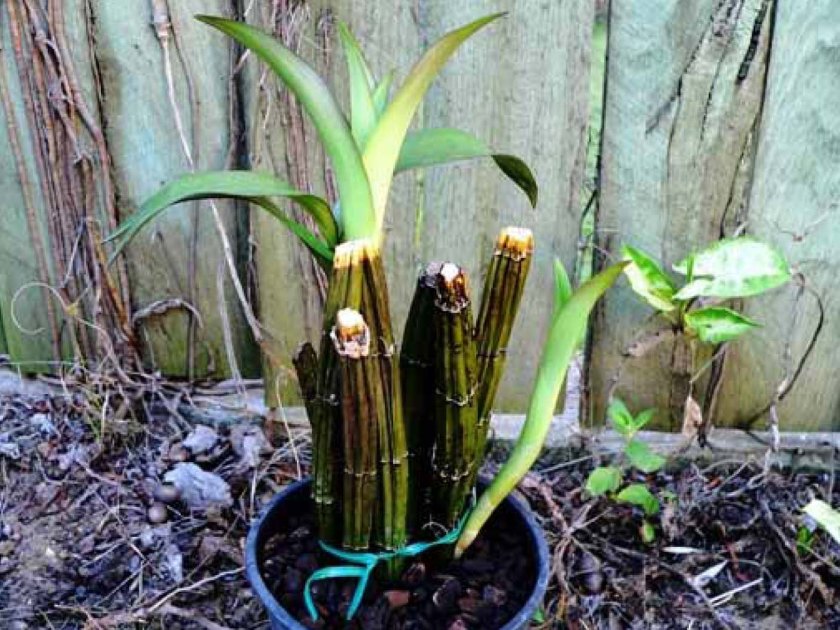
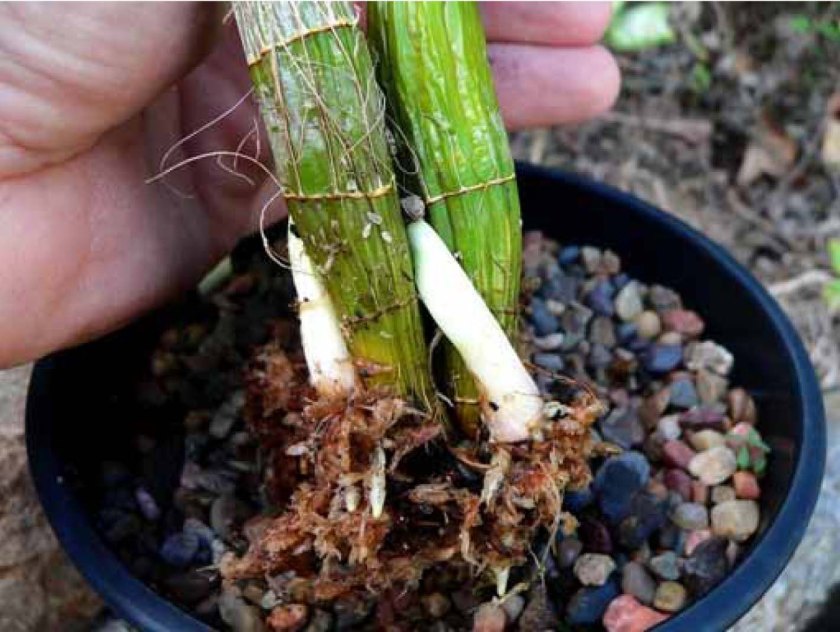
The cane pieces of this plant were inserted into a bark mix at the same time as the canes of Den. Jayden ‘JANE’ [See the July Journal] were inserted into sphagnum moss. The outcome is three healthy growths.
Note the dried ends of the canes where they were cut into separate pieces. As you can see from the photograph, I used a green twisty to hold the canes in the bark as a fairly solid bunch – I find this is the best way to keep the canes still whilst they are developing sensitive new growths. I have found that no matter how bunched-up the canes are, the new growths always find a way to the surface.
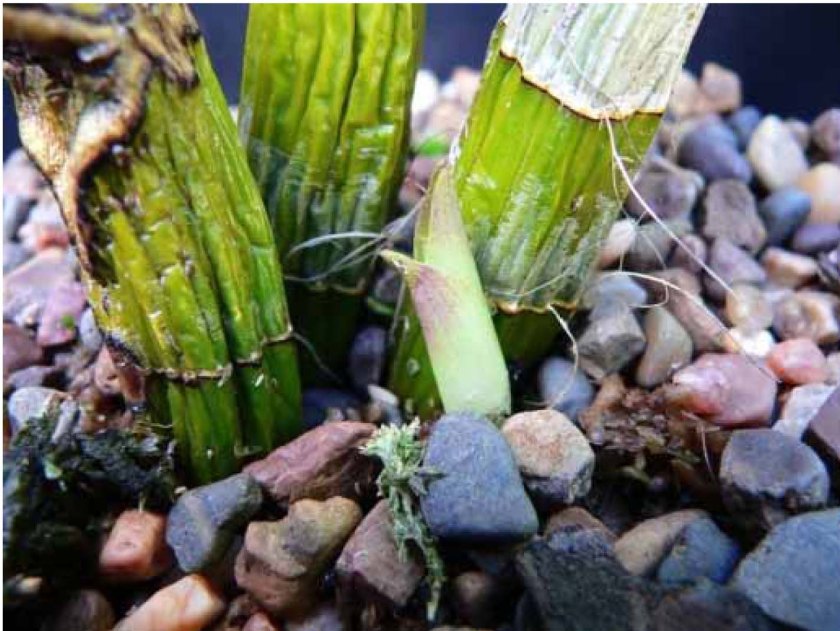
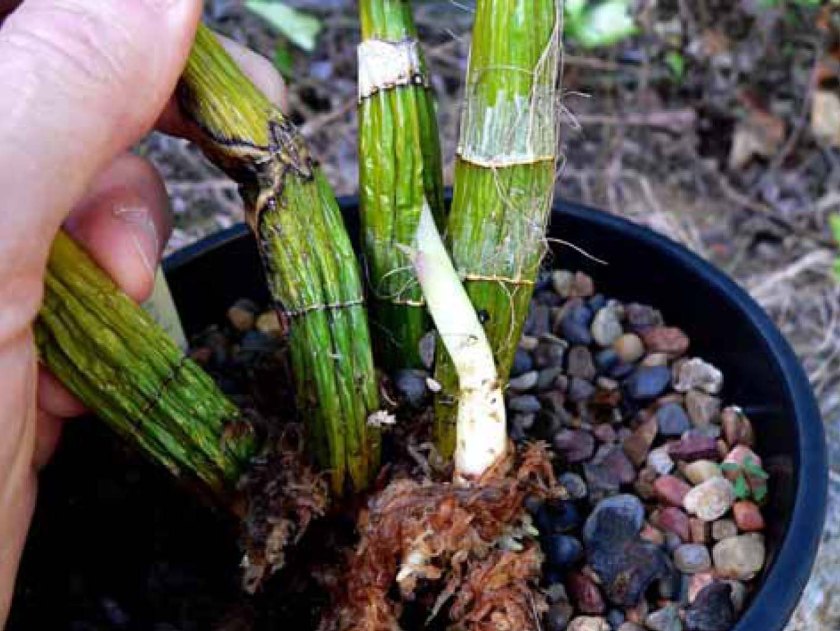
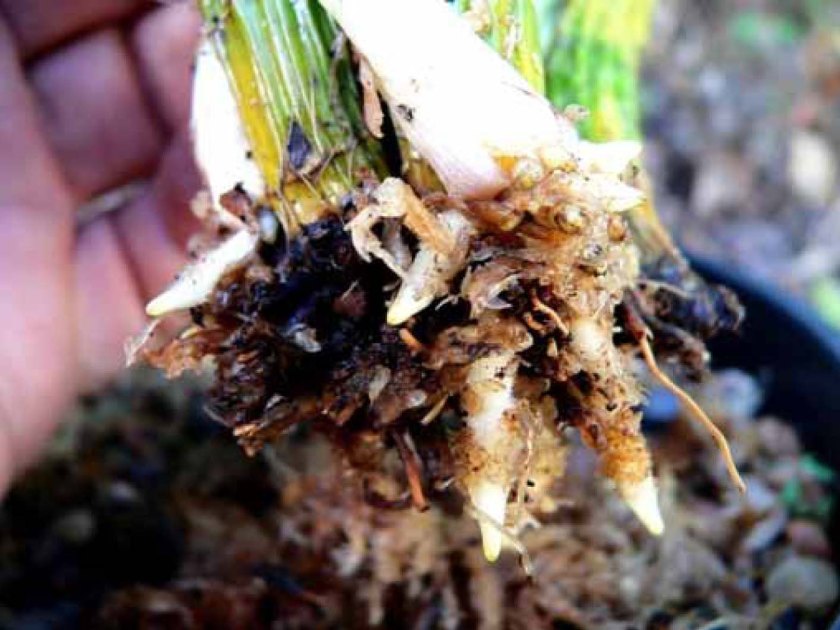
Here is a different angle on the new growths with my fingers providing some perspective on the size of the growths.
Note that they are significantly larger that those on the Den Jayden ‘JANE’, with the same time in the pots.
I do not consider this evidence of the worth of bark compared to sphagnum moss.
I find that different hybrids and species behave quite differently in terms of their speed and timing of production of new growths. I believe that it is a function of what species are in the background of these plants and the time of year the rescue is undertaken.
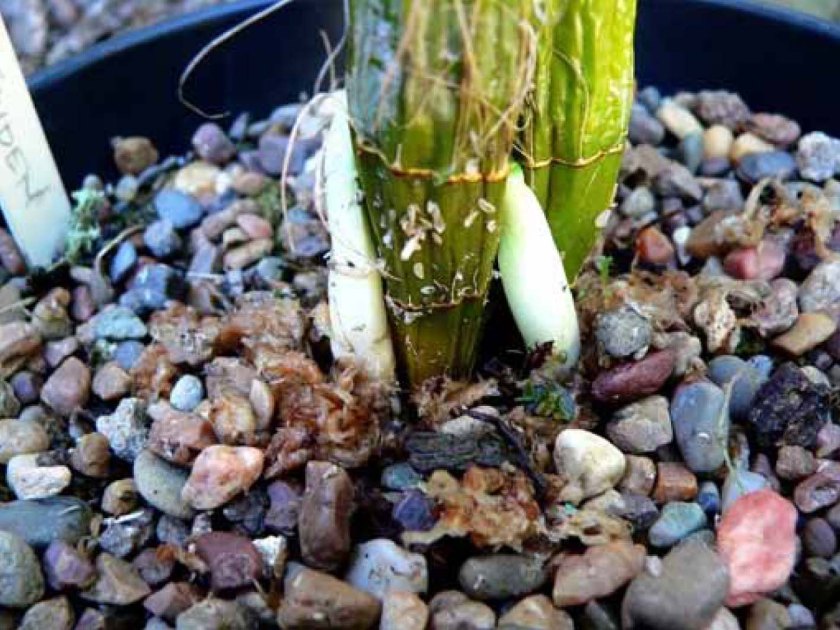
Here is the same plant 5 weeks later. The new roots are protruding from the pot and the new growths are extending themselves – all of this at a time where severe water restrictions limit me to two waterings each week by watering can!
A further 4 weeks of cultivation and bright, warm weather has fully extended and hardened the new growths.
The larger growth should produce a flower spike this Spring.
This is a plant that the late John Purvis gave me just before he passed away. Because it is a special plant to me, I cut an old cane into three pieces to produce a back-up plant, just in case my piece of the original fell foul of the orchid gremlins.
As you can see, it is the least developed of the three plants featured in this article. And yet, the parent plant has produced two magnificent new growths in the same period. I feel that the 12.5% of Den. bigibbum and 12.5% of the hot growing Den. tetragonum var. giganteum have influenced this. This new growth has probably been encouraged since the relocation from Adelaide to Brisbane where the temperature differences overnight are more subtle than in the Adelaide Hills where the plants were previously cultivated. The two hot growing species in the plant’s background were probably held back by Adelaide’s much cooler overnight temperatures. Anyway, this is purely conjecture on my behalf. What is important is that I now have a developing back-up plant for one that I treasure dearly.
Dendrobium Sarah Jane ‘Purvis’ (Photographer Josh Bridge)
SUMMARY
The thrust of what I have written is simple – don’t give up on treasured plants that look like they have expired, because there is always hope so long as the canes haven’t turned into fermented mush! The technique is as simple as cutting canes into lengths where you have at least three, preferably four, segments from which new growths will materialise. Use sterilized cutting tools to avoid contamination of the canes. Once the new growths have emerged, give them time to produce healthy root systems and let the new canes harden before potting-on. The best time I have found to pot-on the new growths is early autumn.
****************
Thank you to Josh Bridge for supplying images of the flowers of Dendrobium Alick Dockrill “Pale Face” and Dendrobium Sarah Jane ‘Purvis’ as they were not in the original articles.
***************
Another technique demonstrated by John Gay at one of the NOSSA meetings a couple of years ago was to take the apparently dead canes of an epiphytic orchid and seal them in a plastic bag with a small piece of damp sponge (or other cloth) and leave them in the shadehouse. Do not let the sponge dry out. So long as there was a bit of moisture, there was a chance for new growth on the shrivelled canes. Once the growth was obvious, pot on as normal.
The following is part of a three part series on reviving apparently dead epiphytic orchids from Volume 31 No6 July 2007
Rescuing Apparently ‘dead’ Orchids
By Brendan Killen
In late Spring 2006, I had an ‘open shade house’ event at my place in Belair, South Australia. As part of the programme, I demonstrated how I rescue orchids that have all but died. My demonstration was based on many years of experience in not giving in to the demons that cause orchids to expire.
I used two orchids that everyone attending agreed would normally be tossed into the rubbish bin or compost – all bare canes; heavily shrivelled; all new growth ‘eyes’ at the base of the canes chewed out by insects. In other words, an apparently hopeless situation. I’ve never given up on these terminal plants, believing that they still had life in the old canes along as they hadn’t turned to fermented mush.
I also used an apparently ‘dead’ cane from a treasured orchid that I was hoping would eventually produce a back-up plant using the method I describe in the following text.
In one case (Dendrobium Jayden), I cut the canes into a number of segments and stuck them into a pot with heavily compressed sphagnum moss, topped with river gravel to suppress the moss from growing and overtaking the pot. In the other two cases (Den. Alick Dockrill & Den. Sarah Jane), I cut the canes into segments and placed them in a pot of small composted bark.
The following photographs were taken about 3 months after the repotting demonstration and after the plants were relocated to Brisbane. They demonstrate the benefit of the right technique and a ‘don’t give up’ attitude. This technique has not failed me yet, allowing me to rescue many prized plants that have gone on to be show-bench winners.
PLANT #1 – Dendrobium Jayden “Jane”.
This photo illustrates the emerging new growth on a Den. Jayden “Jane”. This is the first evidence that success is at hand. It is also the first new growth discovered on this plant before I inspect the canes further to see if there are any other new growths buried within the sphagnum moss.
In this photo, you can see that the new growth is very pale from having emerged from deep in the sphagnum moss with little exposure to light. The juvenile roots can be seen emerging on the right hand side.
A closer inspection reveals another growth, on the other side. Note that both growths are not coming from the ‘eyes’ at the bottom of the canes – simply because they were cut off at potting time. They are emerging from the section that joins the cane segments.
Teasing away the sphagnum moss reveals even more of the young roots. Note how the new growths are lacking any colour substance at this stage.
If I were to ignore this plant for much longer, the new growths would have rotted in the very moist sphagnum moss, neutralising my efforts. So, the lesson here is to ensure that you monitor the plants for new growths and ensure that you elevate the new growths above the sphagnum moss to give them a chance to ‘harden off’ from their immersion deeper in the sphagnum.
This photo illustrates how I have re-seated the canes within the sphagnum moss, but much higher so that only the roots are exposed to the heavy moisture content of the moss. I choose to do this instead of placing them straight into a bark mix as I find that the plants tend to go into a shock at the relative lack of moisture in bark and can die quickly, or suffer from stunted growth. I wait until the new growths have matured with substantial green substance before I repot them in a bark mix. And, I tend to do this in late autumn when they are not under any temperature or light stress. By spring, they will be racing ahead in the bark mix with new root growth and, possibly new canes and/or flower spikes.
One Month Later……….
After one month from the re-seating described previously, note that the pale new growth is now mature and bright green. And, note how the roots are emerging from the growth above the sphagnum moss. This plant will be ready for potting-on into a bark medium in the next few weeks as autumn cools the air in Brisbane.
The following article is from the April 2016 Journal of the Native Orchid Society of South Australia. The article is complete in itself but Part Two of this post will illustrate how images can help with images of Crytostylis robusta and C. reniformis.
Orchids are beautiful plants and many of us like to capture that beauty on photographs. And there are many beautiful pictures around.
Many times NOSSA, the Herbarium and other specialist groups receive images requesting identification but the vital information is missing.
When photographing for identification, it is necessary to take more than one image, particularly if you are unable to easily return to the site for more images. When in doubt, take several shots from many different angles highlighting different features of the plant and its habitat.
Another very important point to remember is, when there are several of the same plant, to photograph the orchid that is most representative of the group, not the atypical or unusual plant.
General Guide
As a general guide, it is helpful to take a picture of each of the following
whole plant
individual flower – both from the front and the side, occasionally the back.
flower head
leaf or leaves
habitat
Other helpful things to consider photographing are:
capsules of the finished flower – sometimes it can yield useful information.
for some genera, the stem can also be a helpful feature as between some species there can be a difference in the hairiness of the stem.
It is also worth including in a photograph an indication of whether the plants are growing in colonies with others or as scattered individual plants.
Importance of Size
It is also good to give an idea of size, this can be as simple as using a thumb or hand, a coin (show the reverse not the head) or any item that had an easily recognized size. It is important to have the object next to the feature being photographed. For example, a coin on the ground next to a leaf or a hand immediately behind the flower gives a clear indication of size. Remember to take another photo without the hand or coin.
Some Specific Identifying Features
Some species are distinctive and easily recognised, eg the Flying Duck Orchid, but others are not and it is helpful to know what part of the plant to photograph as different genera will have different identifying features.
Spider orchids – the tips of the segments (petals and sepals) and details of the labellum are important
Sun orchids – the column in the middle, the ovary at the base of the flower, and the number of bracts (leaf-like growth) on the stems
Pink fingers – the length of the leaf in comparison with the length of the flower stalk; also the back of the flower is helpful
Gnat orchid – the leaf is the best identifying feature, but also the bud can be helpful
Hyacinth orchid (of the Adelaide Hills) – labellum
Mosquito, Mayfly and Helmet orchids when not in flower – both sides of the leaf
Gastrodia – the flower spike
Rufoushoods – side view of the flower and close up of the labellum as the hairs on or surrounding the labellum are important features.
Leek Orchids – the labellum is very important, as well as part if not all of the flower spike as the distance between the individual flowers aids identification
Greenhoods – if present, the non-flowering rosette of leaves
The Australian Virtual Herbarium has some good tips for photographing flower. Click here to visit the site
Spider Orchid Photo: Robert Lawrence
This image lacks the ends of the segments to determine the identification. The presence or absence of clubs on the ends of the segments (petals and sepals) can often be the distinguishing feature with many of the Arachnorchis (Spider Orchids).
These leaves are an unusual shape and by themselves are not suitable for identification
Leo Davis is an enthusiast about the natural world and shares his knowledge through different journals. He is a keen observer and meticulous in his record keeping. He is also very knowledgeable about orchids. The following is one such article of Leo’s.
GOOD NEWS FROM FERRIES-McDONALD CONSERVATION PARK Leo Davis
I was aware of the Star Spider Orchid from Bates who lists the species as ‘3E, critically endangered in South Australia, nationally rare’ (pp. 242–243). I knew that in the past it had been found at Monarto and Hartley and discussions with members of the Native Orchid Society of SA (NOSSA) suggested that it had been seen at Ferries-McDonald Conservation Park, but was now possibly extinct there. My searches over five years had all failed. On August 2, 2014, I ran into, then strangers, Len Stephens and his grandson Rickey Egel, in Monarto C.P. They had just come from Ferries-McDonald C.P., about 8 km further south. Rickey, who has a very good eye for spotting orchids, showed me an image, in his camera, of ‘the common spider orchid’. From my hurried glimpse I knew immediately it was far from ‘common’ and told him so. I headed straight for Ferries-McDonald C.P. for the first of many fruitless searches. On August 14, 2015 Rickey and Len showed me a few Star Spider Orchids in flower at Ferries-McDonald C.P. Because I was to lead the Botany Group of the FNSSA on an outing to Ferries-McDonald C.P. on September 5, I had been visiting the park almost weekly and so was able to spend many hours looking for the orchid. It is difficult to spot, being quite small. This year’s plants, perhaps not typical given the very dry June, are between 8 and 20 cm high with flowers only about 35 x 30 mm. Plants were only found in Broombush (Melaleuca uncinata) associations. As soon as Eucalyptus species were present the orchid was no longer found. Any survey, especially by a single person, will produce a lower count than the actual population. Leaves of non-flowering or beheaded (the fate of so many spider orchid flowers) plants will not be recognised, some flowers will not be spotted and some plants will flower before or after surveys, with some areas surveyed on different days. Between August 14 and September 5, 2015 just 18 flowering plants (Fig. 1) were positively identified (about the same number of likely leaves and buds, adjacent to these, were noted) over a narrow area of approximately 3,000 m2. The area searched was very much greater than this. Small as this tally is, it establishes a significant population other than the only other South Australian one that I know. That is on the private property of farmer […], at Hartley. With his kind permission I have counted over 100 flowering plants there during five visits from July 28 (buds only) to August 30 (Fig. 2). The actual population will be larger because I did not cover all of that location. My observations suggest the populations I know to be around 150 to 200 plants with other occurrences probably existing around Monarto and Hartley. Why have I avoided the scientific name? Many of you will follow the Electronic Flora of South Australia which lists the Star Spider Orchid as Caladenia stellata, as does Backhouse (pp. 456–457). I prefer to follow Jones (p. 76) (who does not recognise the species occurring in SA) and Bates (p. 242) (who says it does occur in SA), both of whom call it Arachnorchis stellata. Backhouse points out that the nearest other occurrence, the major one, is in central southern New South Wales, south of Rankin Springs, several hundred kilometres away, and that the plants there differ from our populations in having smaller flowers. He suggests that we are looking at a separate undescribed species, Caladenia sp. ‘Murray mallee’ (p. 484), but that it might indeed be co-specific with the Rock Star Orchid (sic), Caladenia saxatilis, which is similar and occurs further north, in the northern Mt Lofty and the southern Flinders Ranges. Bates told me in conversation, that he disagrees with Backhouse and believes the local plants are the same as those in NSW and distinct from A. saxatilis, which grows in soils of different pH (acidity).
Fig 1: Arachnorchis stellata, Ferries-McDonald CP, August 22, 2015. Photo: Leo Davis
Fig 2: Arachnorchis stellata Hartly, South Australia, August 5, 2015. Photo: Leo Davis
BIBLIOGRAPHY:
Backhouse, G. (2011). Spider-orchids – the genus Caladenia and its relatives in Australia. DVD/pdf, Backhouse, Melbourne. Bates, R.J. (2011). South Australia’s Native Orchids, DVD, NOSSA, Adelaide. eFlora SA. Electronic Flora of South Australia; last updated August 22, 2015. Jones, D.L. (2006). A complete guide to native orchids of Australia including the island territories. Reed New Holland, Sydney.
Used by permission, extract from The South Australian Naturalist Vol. 89 No 2 July-December 2015.
Sometimes a particular species of orchid is said to be rare or endangered, for instance Thelymitra circumsepta* is listed as endangered in South Australia but has no listing federally whilst the endemic Prasophyllym murfetii* is listed as Critically Endangered federally but only Endangered in South Australia.
Prasophyllum murfettii (Denzel’s Leek Orchid)
What do these listings mean and why are they different for the same species?
What are the Conservation Categories?
Conservation listing by governments gives species a legal status, which can then be used to determine the type of consideration to be given to individual species in decision-making processes for species conservation.
In South Australia, the two main legislations affecting native orchids are the state National Parks and Wildlife Act 1972 (NPW) and the national Environmental Protection and Biodiversity Conservation Act 1999 (EPB). There is also the International Union for Conservation of Nature (IUCN) Red List which is used for international treaties. Each has their own set of categories resulting in terms with slightly different meanings.
The IUCN classification is quite detailed but in summary the conservation status used are
Extinct – not seen for fifty years or despite intensive searching not seen at a previously known site
Extinct in the Wild – no natural populations exist; only surviving in cultivation
Critically Endangered – known only from a single non-viable population
Endangered – in danger of extinction unless the factors causing decline are arrested
Vulnerable – likely to become endangered if the only large populations is wiped out for whatever reason
Near Threatened – close to qualifying or likely to qualify for a threatened category in the near future
Least Concern
Data Deficient
Not Evaluated
The Australian Federal government, under Section 179 of the EPBC Act, has six categories
Extinct – no reasonable doubt that the species has died out
Extinct in the Wild – no natural population existing, surviving in cultivation
Critically Endangered – faces an extremely high risk of extinction in the wild in the immediate future
Endangered – faces a very high risk of extinction in the wild in the near future
Vulnerable – faces a high risk of extinction in the wild in the medium term future
Conservation Dependent – if the cessation of a specific conservation program ceased the species could become vulnerable, endangered or critically endangered
South Australia uses three categories based on the categories from the IUCN Red List Categories and Criteria.
Endangered (Schedule 7) – includes Critically Endangered Extinct in the Wild and Extinct
Vulnerable (Schedule 8)
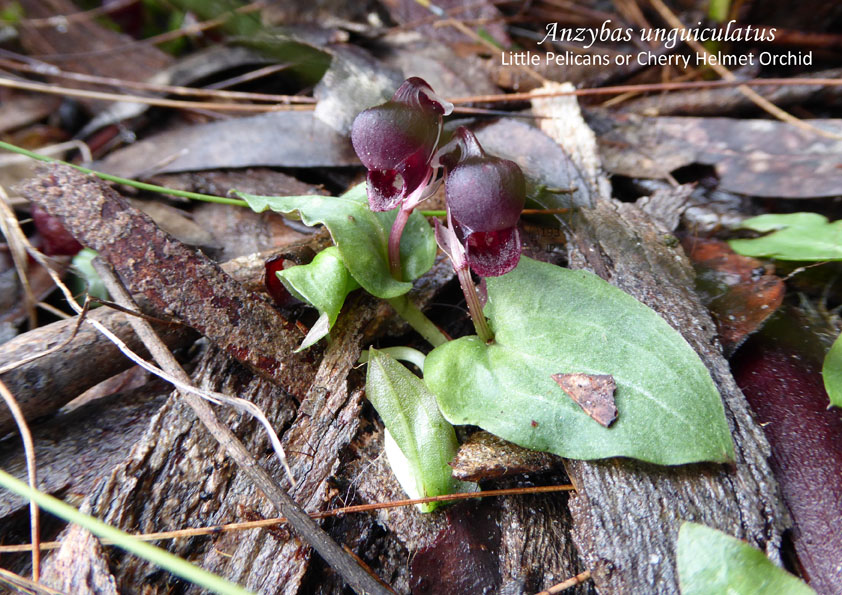
Rare (Schedule 9) – this is a South Australian term not recognised elsewhere but the criteria are consistent with the IUCN Near Threatened category and refers to uncommon species that are naturally limited in location or are in decline. Hence it is possible for a species to be common interstate but threatened in South Australia, for example Anzybas unguiculatus* is rated rare.
Anzybas unguiculatus (Little Pelican or Cherry Helmet Orchids)
Another term that is frequently used is Threatened. For the IUCN Threatened encompasses the three categories of Critically Endangered, Endangered and Vulnerable. It means that a species rated as threatened with extinction under these three categories may have different degrees of threat – note the adjectives in the IUCN definitions above. This serves as a guideline for its usage in South Australia. It should also be noted that Threatened and Rare are not interchangeable but a species rated Rare may be threatened by outside influences.
There is another level of conservation which is the regional status. This level does not have any legal standing but it is helpful in managing the species. The IUCN Red List Categories and Criteria are used to assign a regional conservation status. This is helpful in managing species at this level.
Why does a species have different Conservation Categories?
Looking through Part Two of South Australia’s Native Orchids 2011, it is not uncommon to find a species with two different conservation statuses. It is not surprising when they have the same status eg Arachnorchis behrii* is rated Endangered both state and nationally but why are the others different? Some of this is due to the different number of categories – six federally but only three at the state level so Diplodium bryophilum* is nationally Critically Endangered but only Endangered in South Australia as there is no critically Endangered category. Others have a state status but no national status, for example the endemic Diuris brevifolia* is rated Endangered. Curiously there are no endemic species with the combination of a national status but no state status, although there are five non-endemic species found in South Australia that do have this combination.
Diuris brevifolia (Late Donkey Orchid)
This comes about because there are two different bodies determining the statuses through two very different processes.
Nationally under the EPBC Act any individual can nominate a species which is assessed by the Threatened Species Scientific Committee, put out for public comment, changes adjusted as necessary and then the recommendations are passed onto the Minister who approves or rejects the nomination.
In South Australia, DEWNR (Department Environment Water and Natural Resources) initiates the process by asking the experts, compiling data, holding workshops with the experts. A report is written for the National Parks and Wildlife Council outlining the changes under the NPW Threatened Species Schedules. Once the changes are approved, it is sent to the Minister for approval before being released for public comment. After any necessary adjustments the report is then sent to the South Australian Parliamentary Cabinet for final approval.
Both processes check the species under consideration against the IUCN criteria.
How many South Australian orchids are under threat?
On 22nd July 2014, Doug Bickerton presented a talk at the Native Orchid Society on the conservation status of South Australian orchids. The comparison between the State and Federal listings was as follows:
Number of Orchids with a Conservation Status under the NPW Act (State)
77 species Endangered
33 species Vulnerable
32 species Rare
A total of 142 species or 49% of all South Australian orchids are recognised to be under threat.
Number of Orchids with a Conservation Status under the EPBC Act (Federal)
4 Critically Endangered
22 Endangered
19 Vulnerable
A total of 45 species for the State have a Federal government legal conservation status.
The fact that one authority recognises a species and the other authority does not doesn’t mitigate against the seriousness of the threat to that species. The fact that a species does not have a conservation status from either authority does not mean that it is not under threat. It could still be in danger of extinction.
Cryptostylis subulata (Moose Orchid) State Conservation Status: Vulnerable National Conservation Status: not listed
Currently in South Australian there is a State-wide assessment underway and the results will be published in 2016.
This article was inspired and is based upon notes taken from a talk given by Doug Bickerton in 2014 at the Native Orchid Society of South Australia. I would like to thank Thelma Bridle, Conservation Officer, Native Orchid Society of South Australia, for her help.
*Based on information found in South Australia’s Native Orchids 2011
IUCN RED LIST CATEGORIES AND CRITERIA Version 3.1 Second edition Prepared by the IUCN Species Survival Commission As approved by the 51st meeting of the IUCN Council Gland, Switzerland 9 February 2000
Part One – Attracting Pollinators looked at pollination strategy, but the fourth aim of the paper was to establish that Corunastylis littoralis reproduced by xenogamy or geitonogamy and that the species was not autogamous or apomictic, that is, pollinated, self pollinating or non pollinating plants.
Xenogamy or geitonogamy that is vector mediated pollination or out-crossing is when fertilization occurs by the transfer of pollen from one flower to another flower usually by the means of insect.
Autogamy or self-pollinating is when the flower is pollinated by its own pollen.
Apoximis is when reproduction occurs without pollination, that is, vegetative reproduction.
As explained in the paper, there are visual clues for determining which process is used by the plant.
Xenogmay
Autogamy
Apoximis
Pollinia removal and pollen deposition
Pollinia not removed
Lacks pollen or it is tightly bound
Pollinia weakly attached to the viscidium
If pollinia present, then unable to be removed
Not all the ovaries are fertilized
All the ovaries are fertilized and have viable seeds
Swelling of the ovaries can occur whilst in bud
Perfumed
Likely to have no perfume
Attracts insects
Flowers short lived
More detailed information was gained by dissecting the flower.
Because of their details, research papers can contain some very interesting facts of interest to a wide range of readers. This paper was no different. The aim of the paper was to identify the pollinator(s), how the attractant worked, confirm that C. littoralis was not autogamous (self-fertilizing) or apomictic (reproduction without pollination) and to assess the requirements & long-term viability of the pollinator.
The following summary notes have been drawn from both the research paper and the consultancy report. Note that Corunastylis littoralis is a synonym of Genoplesium littorale.
One of the interesting issues discussed was the different types of pollination strategies employed by orchids. It is commonly accepted that about one third of orchids use deceptive practices to attract a pollinator whereby they promise but don’t deliver. Some of these strategies are quite unusual. It would appear that there are at least four strategies now known. In order of frequency they are
Food mimicry
Sexual mimicry
Brood-site mimicry
Prey/carrion mimicry
The first two are well known to many orchid lovers. The orchid promises food such as nectar but does not produce any nectar or it has the appearance and even odour of the female insect pollinator so that it fools the male. The lesser known deception is brood-site mimicry where the female insect pollinator is tricked into laying the eggs on the flower but there is no chance for survival of the off-spring. Finally the most uncommon and unusual deception of prey or carrion mimicry, known as kleptomyiophily.
This method was discussed in detail in the report and made for fascinating reading although it was helpful to have a dictionary on hand.
Some insects are kleptoparasitic that is they feed on the haemolymph (roughly similar to blood) but from freshly killed insects. The researchers established that the pollinator for C. littoralis was not Drosophilidae (vinegar fly) but were instead from the families Chloropidae and Milichiidae known kleptoparasitic flies.
It has been observed that the pollinators swarm around the Corunastylis. This is a known behavioural pattern of kleptoparasitic flies that are attracted to the prey of other predators such as spiders, robber flies and other predatory insects.
It was noted that the pollinators were dominated by females. This precludes sexual deception and suggests that the females may require the haemolymph, which is protein rich, for egg maturation. It was also noted that C littoralis is a nectar producing orchid. It was considered that the nectar contained properties that mimic haemolymph.
Based upon these observations it was hypothesized that prey mimicry pollination syndrome was the best fit for the Corunastylis. Though this syndrome has been observed in orchids in the northern hemisphere, this would be the first time that this has been demonstrated as a possibility for Australian orchids.
Photo: Colin Bower
Part two will consider the fourth aim of the paper which was to determine the method of reproduction.
Thank you to Colin Bower for checking this post and for allowing the use of his photographs.
The following article titled Moving Lablellums written by Helen Lawrence is reproduced from the NOSSA Journal Volume 36 (1) February 2012
Labellums are fascinating. Well I think they are fascinating, especially the ones that move.
Bunochilus viriosus with the labellum down
Why do these labellum move? You may have observed that the orchids which have labellums often have “hoods” and inside these “hoods” are the pollen. It is quite simple, the pollinator lands on the labellum, triggers it and is held captive by the labellum. As it struggles to free itself it pollinates the orchid. Clever, isn’t it?
Bunochilus viriosus with the labellum up
So that these labellums can capture the insect they need to be sensitive. Consequently they can easily be “set off.” This can happen with of a gust of wind, or if the plant is in a pot, the labellum may trigger if the plant is moved/knocked.
It is easy to see these labellums as they move up into their “triggered position.” They move reasonably quickly, so the insect does not have time to respond.
However, how does the labellum return to its “normal” position? Does it slowly return to the position, or does it happen in a sudden movement in the same manner as when it is triggered?
One day when I was travelling in the car with a Pterostylis curta (Blunt Greenhood), I observed something very interesting. When I looked at the flower, the labellum was up, but then when I looked at it a minute or two later, the labellum was down. The labellum had to move quickly. However was it the bumps in the road which caused it to move? I had to find out.
I devised an experiment to satisfy my curiosity, and find out what these fascinating labellums actually do.
First I had to find an orchid with a labellum that could be triggered. I ended up using an Oligochaetochhilus bisetus (Two-bristle Greenhood).
Oligochaetochilus arenicola
Second I had found a good camera that could take high definition video. I placed it on a “tripod” (a pile of books).
So I had set up my apparatus, set the camera rolling, triggered the labellum, and left the room.
So what happened?
For the first six minutes after I had triggered the flowers nothing happened. There was no movement that I could see.
In the next five minutes, the labellums of the two flowers slowly moved downwards until they were half way down.
After twelve minutes of the flower being triggered, the labellum returned rapidly to its original position. This final stage of the labellum moving lasted for less than five seconds, and appeared to move at the same speed as when it was triggered.
So it looks like the labellum returns to it normal position first moving slowly and then in a rapid final movement which returns the labellum to its original position.
Urochilus sanguineus
If I thought it would be that simple, I was mistaken.
As I briefly looked through the fifty minute video I took, I came upon something that made no sense to me.
A minute after the labellum had returned to its resting position, one of the labellums suddenly returned to its “triggered” position. What’s more, there was nothing in the room to trigger the labellum: no wind, no insects, and no people. So what triggered the flower?
I do not know. Six minutes after the labellum was triggered it returned to its original position, and then two minutes later the other flower’s labellum moved into the triggered position. The first flower was triggered again for no apparent reason at all, four minutes after the second flower was triggered and still remained up.
Once the labellums returned to their original position, there was no more movement.
Maybe triggering the labellum causes a chain reaction. Maybe the labellums periodically “trigger themselves.” Well, I can’t give you any answers, all I can tell you is that it looks like this is an example of how we barely know anything about these wild gems. They are beautiful but bizarre and of course fascinating!
After 7 minutes, just before the labellum movedAfter 12 minutes, labellum about to fallAfter 13 minutes, labellum in original position
As a 50 minute video is a bit long to watch, Helen has produced a four minute video, so watch and enjoy the music!









 NOSSA
NOSSA 