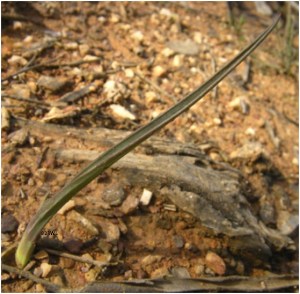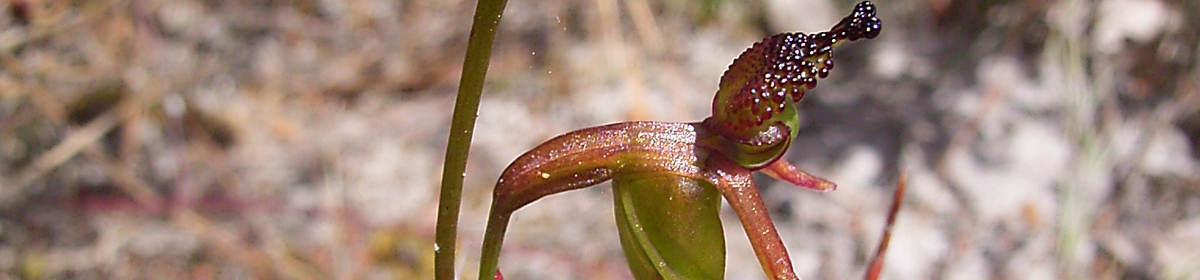
Leptoceras and Leporella – Why are they in different genera?

QUESTION: Are there more than one species called Hare Orchid? This one [Leporella fimbriata] looks different from Leptoceras…?  Why are they in different genera?


ANSWER:

Originally they were described the genus Caladenia but as the knowledge information increased other genera were created.  Thus Leporella fimbriata was put into Eriochilus, as Eriochilus fimbriatus (1882), then Leptoceras fimbriata and finally into its own genus Leporella (A S George 1971).  Caladenia menziesii became Leptoceras menziesii.

This does not answer the why of the question which is about classification but Jones (2006) is helpful when he says:

“Plant classification systems rely on interpreting and measuring the features in one group of plants and comparing these with another group, either seeking difference or similarities.  Studies in orchids are usually biased heavily towards features of floral morphology but recent studies have revealed the importance of vegetative features in the roots, stems and leaves.  The most successful classification system is one that is balanced and based on a wide range of vegetative and floral features.”  To add to this list is the molecular studies being done on orchids.

This means the authors advocating change need to clearly show why a name change and/or a new species is warranted.

For instance, Fitzgerald gives the following reason for not including Leporella fimbriata in the Caladenia genus

“Leaves much more frequently observed than flowers.  It is with great reluctance I depart from the naming in ‘Flora Australiensis’ [author Bentham, 1863 – 1878], but I cannot concur with the inclusion of this with Caladenia, and have place it in Lindleys’ Leptoceras for the following reasons: Leaf or leaves not those of Caladenia.  In Caladenia I have never seen more than one leaf, always thin and usually hairy; in this plant leaf thick, hard and shining, occasionally two.  In Caladenia tubers are generally numerous, in L. fimbriata I have only observed one.  The labellum, is without the characteristic glans and is not of the form obtaining in Caladenia, the stigma is very different in form being triangular and deep sunk, the upper parts overhanging, not oval and shallow; and the flowers have the peculiarity of drying and continuing in a state hardly to be distinguished from the fresh flowers long after the seed has been shed.  It approaches C. menziesii only (so far as I can see) in having erect linear-clavate petals, in which C. menziesii is itself peculiar, L. firmbriata seems to come near to Eriochilus than to Caladenia but differs from it again” Quoted from Emily Pelloe Western Australian Orchids 1930

Concerning Leptoceras menziesii, Bates & Weber have made the following statement:

“True Caladenias have hairy scapes and hairy leaves.  (C. menziesii now believed to belong to a separate genus is glabrous)”.

Even though they are not Caladenia, why not have them in the same genus for both have glabous (without hairs) leaves, more leaves than flowers, erect spathulate (spoon shaped) glandular petals, colony forming, similar distribution.

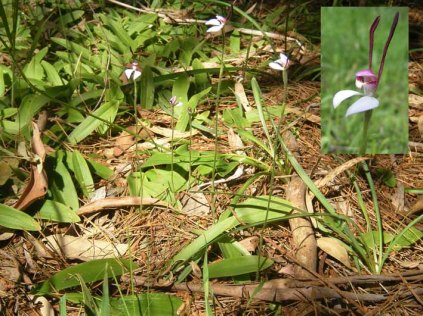
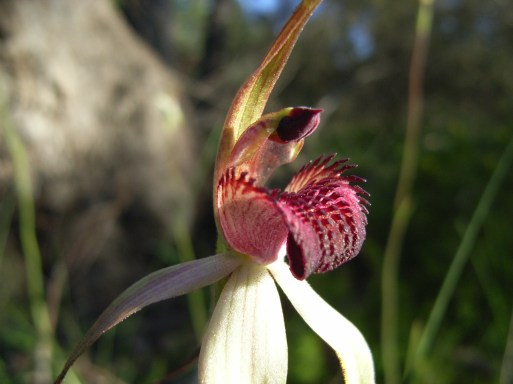
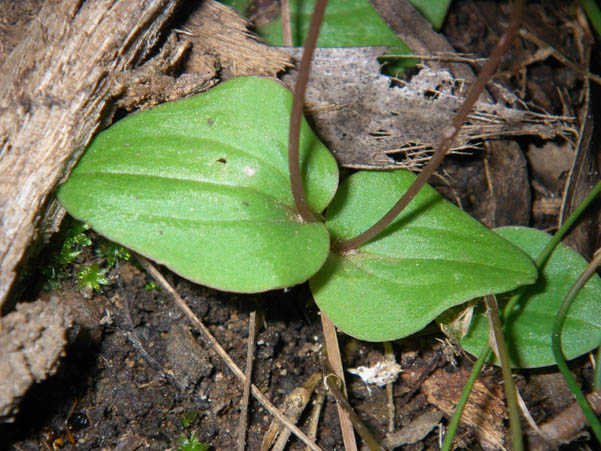
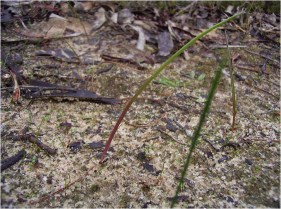
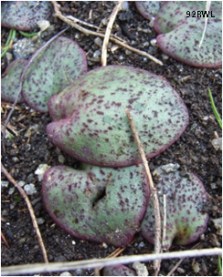
Leporella fimbriata  in patch
Leporella fimbriata – note the absence of leaves and the dry sandy conditions [Photo: R Lawrence]
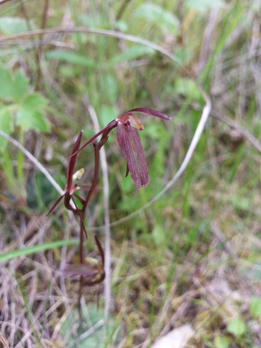
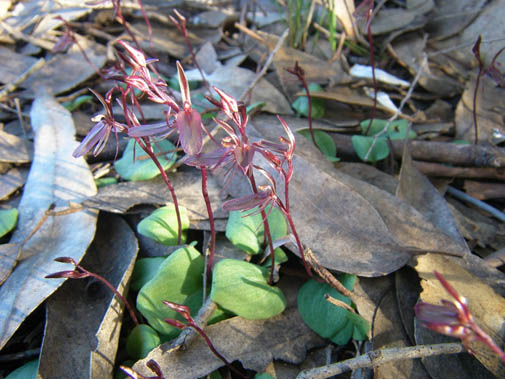
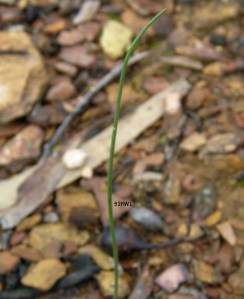
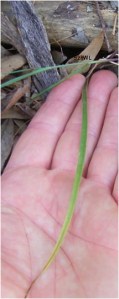
Leptoceras menziesii in patch
Leptoceras menziesii – note the abundance of leaves [Photo: R Lawrence]
There are similarities.  In fact, Bates (2011) calls them sister genera but despite the similarities there are enough differences to recognise them at genus level at present including “different flowering times, different mycorrhizal fungi associations and different pollination” some of which are detailed in the chart below.


Feature Leptoceras Leporella
Pollination Strategy Strategy unknown

Native Bee

Strategy pseudocopulation

Winged male ants (Myrmecia urens)

Myrmecophyte – lives in mutualistic association with colony of ants
Labellum Curved white with red stripes

Has calli

Wider than longer, purple and green

Has no calli

Flowering Time Spring (September to November) Autumn (March to May)
Habitat Shaded sites – moist gullies; scrub, heath, woodland and foret Open sites – acid sands, light scrub, stringybark
Leaf Emergence Leaves emerge before flowering Leaves emerge after flowering


Leptoceras menziesii (Rabbit Ears Orchid)
Leptoceras menziesii (Hare Orchid or Rabbit Ears Orchid) after a fire, [Photo: R Lawrence]

REFERENCES:

https://en.wikipedia.org/wiki/Myrmecophyte accessed May 13 2016

http://www.flora.sa.gov.au/cgi-bin/speciesfacts_display.cgi?form=speciesfacts&name=Leporella_fimbriata accessed May 13 2016

http://www.flora.sa.gov.au/cgi-bin/speciesfacts_display.cgi?form=speciesfacts&name=Caladenia_menziesii accessed May 13 2016

Pelloe E, Western Australian Orchids 1930

Bates R & Weber J, Orchids of South Australia, 1990

Bates R Editor, South Australia’s Native Orchids 2011

Martin A, The Vocabulary of Orchids: an Amateur Perspective 2005

Rogers R, South Australian Orchids 2nd Ed 1911

Jones D, A Complete Guide to Native Orchids of Australia including the Island Territories 2006
WHAT ORCHID IS THIS? HOW PHOTOS CAN HELP! – Part Two of Two Parts

Part One covered hints for photographing orchids so as to be able to identify the plant.  Part Two gives an example with Cyrtostylis robusta (Winter Gnat Orchid) and C. reniformis (Small Gnat Orchid).

Although the flowering times are different – C reniformis is spring flowering and C. robusta is winter flowering – there is a slight overlap in August when it is possible for both to be flowering at the same time and in the same place.

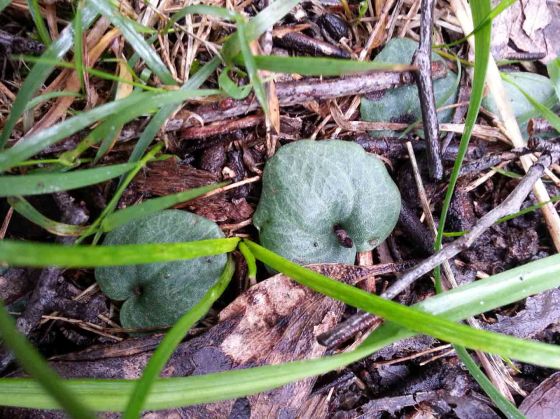
The flowers are very similar but major difference between the two species is the leaf.  Both leaves are roughly kidney shape but C. robusta is pale green with pale , almost undistinguished veins, silvery underneath whilst  C. reniformis is heavily veined, blue-green above and green below.

Cyrtostylis reniformis (4)
C. reniformis, easily identified by the leaf, even when in bud.

The other differences are more subtle.

  • C. reniformis has dark buds and the apex of the labellum tends to be rounded rather than pointed
  • C. robusta has pale reddish buds and larger flowers, labellum crenulated (slightly wavy) and a fine point at the apex.
Cyrtostylis reniformis
C. reniformis – This is not a good identification picture because though the leaf is present, it is too blurry for identifying the species and the angle of the flower obscures the labellum  details

Consequently, it is important that photographs of the flowers clearly show the labellum – pointed labellum apex for C. robusta compared with the rounded labellum tip of C. reniformis.


Cyrtostylis robusta
In this photograph it is possible to identify the plants as C. robusta because of the leaves even though there are no clear views of the labellum.

March 2016 Winning Photograph

1603 sm JS Arachnorchis sp

We frequently receive entries from Western Australia but this month our entries were from both the west and the east. Allen Jennings entered a Calanthe triplicata (Christmas Orchid) from New South Wales. Pauline Meyer’s was from the west, (Western) Flying Duck Orchid, Paracaleana nigrita. The other entries were South Australian, Jenny Pauley’s recently photographed Leporella fimbriata (Fringed Hare Orchid), Greg Sara’s Thelymitra rubra (Common Pink Sun Orchid) and Judy Sara’s Plumatochilos sp. (Bearded Orchid) and Arachnorchis sp. (Spider Orchid).

The winning photograph was Judy’s Spider Orchid. Obviously it was one of the Green Comb Spider Orchids – A. dilatata complex. Of this group there are about a dozen possibilities. Knowing the location, Mt Boothby, helped to narrow the options with the most likely candidate being Arachnorchis stricta but it wasn’t convincing. It would appear that the tips of the sepals may have been chewed off when in bud.

A distinguishing feature of this species is that there are no clubs or osmophores on the sepals. Other species of this complex have clubs. Another feature is that the dorsal sepal is bent over the column unlike many other green combs which have an erect dorsal sepal. The features that caused doubt were lateral sepals looking droopy instead of being characteristically stiffly held out but dry conditions could cause this. The other was that the labellum did not strictly fit the description of A. stricta but then again it is a variable species.

The conclusion was a possible hybrid but there is no information on the likely parents or that is an atypical A. stricta that may have been damaged in bud.

This is an example of the difficulties that can occur when attempting to identify a plant from one photograph.

Reference:

Personal communications Thelma Bridle (NOSSA Conservation Officer)

Personal communications Bob Bates

Bates, R. J., ed. (2011). South Australian Native Orchids. Electronic version, 2011. NOSSA

Rules of entry:

The subject matter must have something to do with Australian orchids.  Any format is acceptable including Photo shopped images, artwork, etc

How to enter:

Email nossa.enquiries@gmail.com – jpg as large as you are able to send it, preferably A4 ratio for printing

Post: PO Box 565, Unley, 5061

Bring in to the meeting

WHAT ORCHID IS THIS? HOW PHOTOS CAN HELP! – Part One of Two Parts

The following article is from the April 2016 Journal of the Native Orchid Society of South Australia.  The article is complete in itself but Part Two of this post will illustrate how images can help with images of Crytostylis robusta and C. reniformis.

Orchids are beautiful plants and many of us like to capture that beauty on photographs. And there are many beautiful pictures around.

Many times NOSSA, the Herbarium and other specialist groups receive images requesting identification but the vital information is missing.

When photographing for identification, it is necessary to take more than one image, particularly if you are unable to easily return to the site for more images. When in doubt, take several shots from many different angles highlighting different features of the plant and its habitat.

Another very important point to remember is, when there are several of the same plant, to photograph the orchid that is most representative of the group, not the atypical or unusual plant.

General Guide

As a general guide, it is helpful to take a picture of each of the following

  • whole plant
  • individual flower – both from the front and the side, occasionally the back.
  • flower head
  • leaf or leaves
  • habitat

Other helpful things to consider photographing are:

  • capsules of the finished flower – sometimes it can yield useful information.
  • for some genera, the stem can also be a helpful feature as between some species there can be a difference in the hairiness of the stem.
  • It is also worth including in a photograph an indication of whether the plants are growing in colonies with others or as scattered individual plants.

Importance of Size

It is also good to give an idea of size, this can be as simple as using a thumb or hand, a coin (show the reverse not the head) or any item that had an easily recognized size. It is important to have the object next to the feature being photographed. For example, a coin on the ground next to a leaf or a hand immediately behind the flower gives a clear indication of size. Remember to take another photo without the hand or coin.

Some Specific Identifying Features

Some species are distinctive and easily recognised, eg the Flying Duck Orchid, but others are not and it is helpful to know what part of the plant to photograph as different genera will have different identifying features.

  • Spider orchids – the tips of the segments (petals and sepals) and details of the labellum are important
  • Sun orchids – the column in the middle, the ovary at the base of the flower, and the number of bracts (leaf-like growth) on the stems
  • Pink fingers – the length of the leaf in comparison with the length of the flower stalk; also the back of the flower is helpful
  • Gnat orchid – the leaf is the best identifying feature, but also the bud can be helpful
  • Hyacinth orchid (of the Adelaide Hills) – labellum
  • Mosquito, Mayfly and Helmet orchids when not in flower – both sides of the leaf
  • Gastrodia – the flower spike
  • Rufoushoods – side view of the flower and close up of the labellum as the hairs on or surrounding the labellum are important features.
  • Leek Orchids – the labellum is very important, as well as part if not all of the flower spike as the distance between the individual flowers aids identification
  • Greenhoods – if present, the non-flowering rosette of leaves

The Australian Virtual Herbarium has some good tips for photographing flower. Click here to visit the site


Spider Orchid
Spider Orchid Photo: Robert Lawrence

This image lacks the ends of the segments to determine the identification.  The presence or absence of  clubs on the ends of the segments (petals and sepals) can often be the distinguishing feature with many of the Arachnorchis (Spider Orchids).

Atypical Cyrtostylis leaves

These leaves are an unusual shape and by themselves are not suitable for identification

CLUES TO ORCHID IDENTIFICATION – Prasophyllum & Microtis Leaves

Orchids are attractive and abound in variety. It is the variety that often provides the challenge of identification. As a novice it can be a bit overwhelming. In the eye of the beginner, the experienced orchid hunters appear to have no difficulty with identification. Over the years they have accumulated various clues that guide them toward accurate identification.

This series aims to document the clues that orchid hunters use.

Prasophyllum and Microtis Leaves

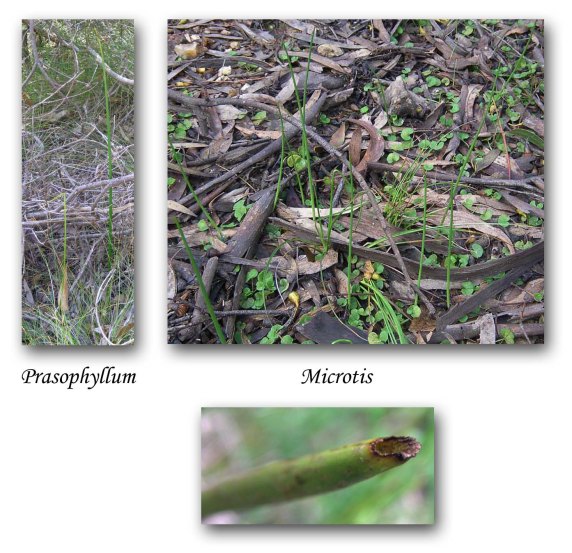
The first in the series relates to distinguishing between Microtis and Prasophyllum leaves. When in flower it is easy to see which is which but not so when only in leaf; and as they do not always produce flowers it is helpful to be able to separate them out at leaf stage.

Both leaves are green. Both are cylindrical. Both are hollow. Both resemble onion leaves.

M & P Leaves
Both types of leaves are long, thin and green.  The damaged Microtis leaf (below) shows the hollow.

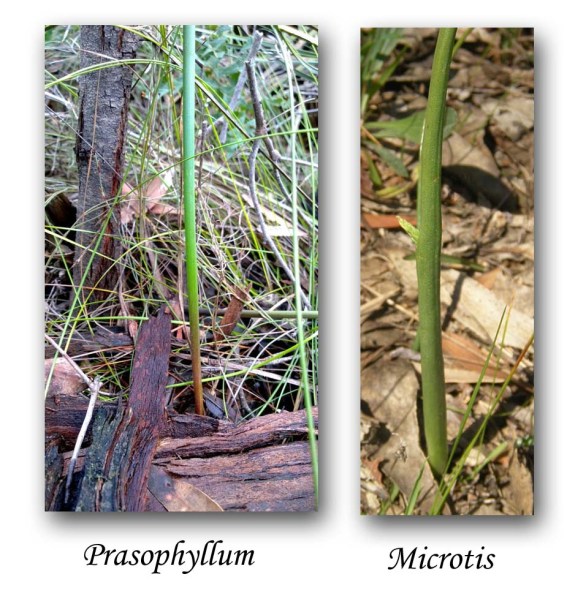
The differences can be found in one or two areas. Microtis leaves are always green at the base whereas Prasophyllum leaves usually but not always will have a red or purplish coloured base. To help in identification, it is necessary to examine the base by moving the leaf litter aside to see where the plant emerges from the soil.

M & P Leaf Bases
The bases reveal the difference between the two genera.

Prasophyllum species that could have a green base are P. laxum, P. occulatans, P. sp Jip Jip, P. elatum, P. sp Sandplain, P. pallidum (although this is short and usually in bud when noticed), P. spicatum, P validum.  So further observations are necessary.

Another other area of difference is that the broken leaf of a Microtis yields a mucilaginous (thick sticky) sap; the Prasophyllum leaf does not.

Within the segregate genera used by many NOSSA members, there are two other genera with similar leaves. They are Microtidium and Hydrorchis. Again they are green, cylindrical, hollow but only hollow in the lower half. The top half is solid.

It should also be noted that Microtis can form dense colonies but Prasophyllum will never form more than loose colonies.

Finally, if upon gently feeling the base of these leaves it feels solid, that will indicate that there is a bud and it will most likely flower this season.

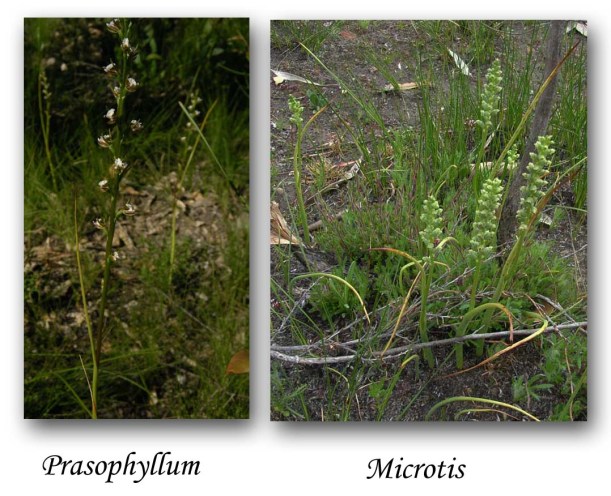
M & P Flowers
Once in flower, the differences between the two genera is obvious.

Clues to Orchid Identification – Columns

Orchids can be incredibly easy to identify or frustratingly difficult.  For instance, the Flying Duck orchid is easily recognizable.  The name says it all. But for many other orchids, particularly the ubiquitous blue sun orchids, it is necessary to make careful observations.


Which is which
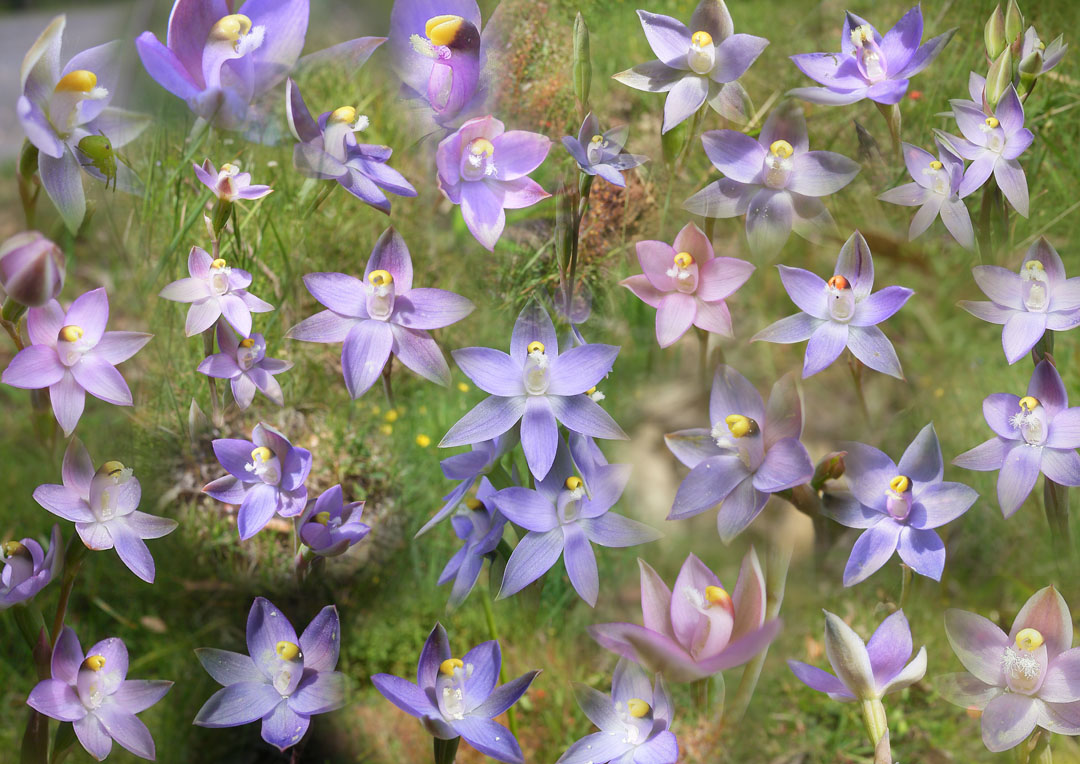
In this collage there are several species, but which is which?


For sun orchids the most important distinguishing feature will often be the column, details of which are described or illustrated in orchid keys.  For example Bates and Weber, Orchids of South Australia (1990) has an illustrated dichotomous keys showing the different types of columns.

As part of the key, drawings of the column were included
Images from Bates & Weber, Orchids of South Australia, pages 147 to 150; courtesy of the Board of the Botanic Gardens and State Herbarium.

With today’s cameras, it is possible to photograph the column, preferably from front, side and above.  This helps greatly with identification.

The following photographs illustrate the variety of columns.

Thelymitra alcockiae


Thelymitra grandiflora
Thelymitra brevifolia
Thelymitra cyanea
Thelymitra cyanea
Thelymitra peniculata
Thelymitra pallidifructus
Thelymitra juncifolia
Thelymitra inflata
Thelymitra inflata
Thelymitra arenaria
Thelymitra arenaria


Thelymitra megcalyptra
Thelymitra X truncata - a natural hybrid
Thelymitra X truncata – a natural hybrid

And it is not only the blue orchids that can be a problem, in South Australia; there are three pink orchids which are different in size and flowering time, features that are not obvious in a photograph,  so the column is a helpful identification tool.

Thelymitra luteocilium
Thelymitra luteocilium – has tufted hairy column arms
Thelymitra rubra
Thelymitra rubra – has finger-like column arms and no tuft
Thelymitra carnea
Thelymitra carnea – has smooth column arms


And just what is the column? It is the reproductive organ of the orchid flower and is unique amongst plants because it is the fusion of the male (stamens) and female (pistil) parts.  It is usually found in the centre of the flower and both releases and receives the pollen sac.


Orchid Identification Quiz #1

In 2006 the electronic version of the Journal of the Native Orchid Society of South Australia Volume 30 No 2 March contained a quiz – Do you Know Your Leaves? It featured photographs of the leaves of 15 different orchid. In 2011 Robert Lawrence produced a book titled Start With the Leaves which was based upon the premise that the flower is not always present but identification is still possible.
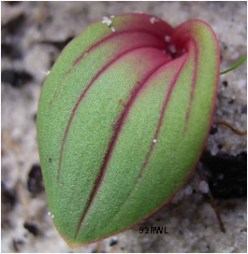
Many but not all can be identified to species level by the leaf alone.

So here is the web version of the original quiz – how well do you know your leaves?

Hint – 20 of them are South Australian, more specifically, the Mount Lofty Ranges region.  One is a weed.

Arachnorchis tentaculataThelymitra benthamiana Thelymitra antennifera Pyrorchis nigricans Plumatochilus sp Woodland Bearded Greenhood  Oligochaetochilus bisetusOrthoceras strictum Nemacianthus caudatus Eriochilus sp Hills Woodland  Leporella fimbriata Diuris palustrisGlossodia major

Diuris orientis

Diuris behrii

Cyrtostylis reniformisDisa bracteata - weed  Corunastylis spCaladenia prolata Calochilus robertsonii  Bunochilus sp non-fertile plant

Corysanthes diemenica

Did you get them?  Click on the image to go to the name and pictures of the flower. As a couple of the links are not working and until I have time to rectify them, click here to find the all answers in the Journal.
It will be on the last page.

More to come another time ………

2015 June Winning Photograph

06 sm PM Arachnorchis argocallaOf the five entries this month, four featured winter orchids. Lorraine Badger entered a Diplodium robustum, whilst Claire Chesson, Robert and Rosalie Lawrence all entered Urochilus sangineus. Though not the winning photographs it was interesting to see the differences between the U. sangineus with one being no taller than the small Acianthus pusillus next to it and another being taller than the rapier sedge.

But the winning photograph was the spring flowering Arachnorchis argocalla (White Beauty Spider Orchid) by Pauline Meyers. This is amongst our most threatened orchids and is dealt with in depth in the Recovery Plan For Twelve Threatened Orchids in the Lofty Block Region of South Australia 2010. This fungi dependent endemic orchid is rated Endangered both at State and National level.

Found in the Southern and Northern Lofty regions, it range has been severely reduced by possibly 80%. Since 1918 no plant has been found south of Adelaide.

Flowering from September to October, it is often found in grassy woodlands often growing on gentle southerly-facing hill slopes. The soil is a clay loam with a high humus content.

This beautiful orchid has one to two non-perfumed white flowers with thickened but not clubbed drooping lateral sepals and petals. The strongly recurved broad labellum is usually white, sometimes crimson, fringed with short teeth.

This is one of our larger spider orchids reaching a height of 60cms. The size of the plant flower and leaf help to distinguish it from other similar appearing orchids such as A. brumalis and albino flowers of A. behrii.

Like many of the spider orchids it takes 2 – 5 years to reach maturity and then has a potential reproductive life of 10 years. With an average pollination rate of less than 10%, the potential to increase the population is low and any threat to survival of the individual plants needs to taken seriously.

Some threats are obvious such as weed invasion including the garden escapees such as Topped lavender (Lavandula stoechas spp. stoechas) and action is being taken to curb the spread of weeds through targeted weeding programs.

Another threat is habitat loss. This has been the result of land clearing but sites are being protected either through conservation legislation or Heritage Agreements. Habitat loss can also occur indirectly and that is through Phytophthora being introduced into the sites. Although the direct effect of Phytophtora on the orchid is unknown, it is known that it can affect the plants that grow in association with this orchid. This threat can be reduced by all of us implementing good hygiene practices.

These were some of the threats noted in the Recovery Plan. This plan was not just defensive, ie attempt to halt and minimalize the damage; but it was also proactive with measures outlined to increase the population. These included seed and fungi collection eventually resulting in germination and cultivation with a view to re-introduction.

It is good to see that there is a plan and active steps are being taken to bring this orchid back from threat of extinction.

June 2015 other entrants
Photographers from L to R: Claire Chesson, Rosalie Lawrence, Lorraine Badger, Robert Lawrence

References

Websites accessed 1 July 2015

White Beauty Spider Orchid (Caladenia argocalla) Recovery Plan
http://www.environment.gov.au/archive/biodiversity/threatened/publications/recovery/c-argocalla/index.html
Caladenia argocalla – White-beauty spider-orchid, biodiversity species Profile and Threats Database
http://www.environment.gov.au/cgi-bin/sprat/public/publicspecies.pl?taxon_id=54991
Recovery Plan For twelve threatened Orchids in the Lofty Block Region of South Australia
http://www.environment.gov.au/system/files/resources/e362cfd2-a37b-443a-b007-db3a2b7b64dd/files/lofty-block-orchids-recovery-plan.pdf

Bates R J, South Australia’s Native Orchids 2011 DVD

An Examination of Two Rufoushoods

This week’s post is taking a brief look at a paper by Noushka Reiter, Mark Clements and Kate Vlcek which appeared in Muelleria, Volume 31: 69 – 76, 2013.

Titled “An examination of Pterostylis xerophila (Orchidaceae) and the confirmation of P. lingua as a new species in Victoria” this paper seeks to ascertain whether the records collected are correctly identified, that there are differences between them both in morphology and associated vegetation.

Both P. xerophila and P. lingua are found in South Australia where they are known, respectively, by the synonyms Oligochaetochilus xerophilus and O. linguus. In fact the type specimen for O. xerophilus is from South Australia.

In the introduction, the authors give a detailed description of Oligochaetochilus otherwise known as the ‘rufa group’ which differs from Pterostylis, in the strict sense, in several features. Some of the main features of this group are:

  • Basal rosette of overlapping stemless leaves
  • Leaves senesced, withered and died, by flowering
  • Erect multi-flowered
  • Flowers
    • Lateral sepals
      • hang down
      • basal half joined
      • tips become long and threadlike
    • Labellum
      • is very mobile
      • has obvious long white hairs and often short hairs as well
Typical of the rufus hood this Oligochaetochilus arenicola shows the sencesing leaves, pendent petals and hairs on the labellum. Photographer: H Lawrence
Typical of the rufus hood, this Oligochaetochilus arenicola shows the sencesing leaves, pendent petals and hairs on the labellum.
Photographer: H Lawrence

Later in the articles, the differences between the two species are discussed. There is much of interest concerning the two species but one outcome of the research was to establish that P. lingua (O. linguus) had been incorrectly identified in the records and by correcting the names of the specimens the authors were able to confirm that it did occur in Victoria.

To find the answer to the authors other questions, read the paper

And for those that need a glossary of the terminology used, click here

For images of P. xerophila (O. xerophilus) click here

For images of P. lingua (O. linguus) click here

2015 April Winning Photograph: Calochilus cupreus

04 sm HL Calochilus cupreusDespite having five very different but high quality photographs, Helen Lawrence’s photograph of Calochilus cupreus (Aldinga Bearded Orchid) was the clear winner with the vast majority of votes.

In South Australia it is considered endemic and endangered. Researching it was interesting. For instance, there is no mention of it in Jones extensive book (2006) yet it was named by R S Rogers in 1918 with a description appearing in Black’s Flora of South Australia (1922 edition), including a drawing by Rosa Fiveash. Between then and now there was a shift. In the Third edition of Black’s (1978) C. cupreus is absent but C. campestris present. In Bates and Weber 1990 the authors describe C. campetris (C. cupreus). Currently, the eflora of South Australia (the electronic version of 1986 Flora of South Australia) considers it a synonym of C. campestris. This is reflected in the Census.

It would appear that as C. campestris was studied and its variations documented (e.g. article by Jones 1976 Orchadian 5:83) the distinction with C. cupreus was lost. Clements and Jones (2006) state “Calochilus cupreus R.S.Rogers = Calochilus campestris” which means that they are not using C. cupreus. But in Jones’ book an anomaly occurs – he does not include South Australia in the distribution of C. campestris and as result Bates, from 2008, states that it is not recognized as occurring in South Australia.

Though C. cupreus disappeared from the literature the name still continued to be discussed amongst orchid enthusiasts. So when in 1995 NOSSA members found a distinctively different colony at Aldinga they identified it as Rogers’ C. cupreus.

Below is a chart, based upon Dr Rogers’ description, of some of the differences that made him consider C. cupreus a separate species:

C. cupreus C. campestris C. robertsonii
Shorter leaf

Rather rigid or fleshy erect triangular section

Longer leaf

Crescentic section

Longer leaf

Crescentic section

Base of labellum oblong glabrous (without hairs) with several raised longitudinal line Base of labellum round thickened, smooth no raised longitudinal lines Whole of labellum hirsute (hairy)
8 – 15 flowers About 8 flowers maximum About 8 flowers maximum

It will be interesting to watch what happens.

References

Bates personal communications

Bates & Weber (1990) Orchids of South Australia

Bates (2011) NOSSA South Australia’s Native Orchids

Bates (2005 to present) Orchids of South Australia CDs various editions

Clements and Jones An Australian Orchid Name Index (27/4/2006)

https://www.anbg.gov.au/cpbr/cd-keys/orchidkey/html/AustralianOrchidNameIndex.pdf

Jones (2006) A Complete Guide to Native Orchids of Australia

NOSSA Journal Vol 25 No 10 November 2001

Rogers R S Transactions of the Royal Society of South Australia V42 (1918) Pages 24, 25

http://www.biodiversitylibrary.org/item/113409#page/40/mode/1up