Orchid Basics – A Beginner’s Guide to South Australian Orchid Name Usage

For the novice or beginner, orchid names can be a bit overwhelming.  To add to their confusion, the more knowledgeable people tend to use abbreviated terms often switching between common and botanical names & their synonyms.

This week’s post will be a brief introduction to the most common names used for the South Australian orchids and how they relate to each other.  It will not be comprehensive and it will not be a detailed discussion of orchid nomenclature but hopefully it might help the novice learn some of the names in current use.

In the past attempts have been made to split some genera.  Not everyone has agreed with the splits but there are many who find it more convenient  to use the alternate genus when working in the field.  This tends to be the case with the larger genera such as Caladenia, Corybas and Pterostylis.  Unfortunately, this has contributed to the confusion.

The names in this list are compiled from South Australia’s Native Orchids 2011 DVD.  Even with this list the use of the names varies quite a bit with some being used rarely.  Rather than considering each individual species, the list is centred around the genus name.

GENUS

ALTERNATE

GENUS NAME

or

SYNONYM


COMMON NAME

Acianthus  

Acianthus

Acianthus Mosquito

Acianthus

Nemacianthus Mayfly
Caladenia  

Caladenia

Caladenia Pink Fairy

Caladenia

Arachnorchis Spider

Caladenia

Jonesiopsis Daddy Longlegs

Wispy Spider

Caladenia

Petalochilus Pink Fingers

Caladenia

Pheladenia Bluebeard

Blue Fairy

Caladenia

Stegostyla Gremlin
Caleana  

Caleana

Caleana Duck

Caleana

Paracaleana Little Duck
Calochilus   Bearded

Beardies

Chiloglottis

Chiloglottis

Chiloglottis Bird

Chiloglottis

Myrmechila Ant

Chiloglottis

Simpliglottis Frog
Corybas  

Corybas

Corybas Helmet

Corybas

Corysanthes Helmet

Corybas

Anyzbas Pelican
Genoplesium Corunastylis Midge
Cryptostylis   Tongue

Moose

Cyrtostylis   Gnat
Dipodium   Hyacinth
Diuris   Donkey
Eriochilus   Parson’s Bands

Autumn Bunnies

Gastrodia   Potato

Cinnamon Bells

Glossodia   Purple Cockatoo

Waxlip

Leporella   Fringed Hare
Leptoceras   Rabbit Ears

Hare Orchid

Microtis  

Microtis

Microtis Onion

Microtis

Hydrorchis Mignonette

Microtis

Microtidium Yellow Onion
Orthoceras   Horned

Crucifix

Prasophyllum   Leek
Pterostylis    

Pterostylis

Pterostylis Greenhood

Pterostylis

Bunochilus Banded Greenhood

Pterostylis

Diplodium Shell

Pterostylis

Hymenochilus Tiny Shell

Pterostylis

Linguella Little Greenhoods

Nana

Pterostylis

Oligochaetochilus Rufoushoods

Pterostylis

Plumatochilos Bearded Greenhood

Pterostylis

Speculantha Tiny Greenhood

Pterostylis

Taurantha Cobra Greenhood

Pterostylis

Urochilus Maroonbanded Greenhood

Sanguinea

Blood Greenhood

Pyrorchis   Fire

Undertaker

Spiranthes   Ladies Tresses

Spiral

Thelymitra   Sun Orchid

A detailed list of SA orchid species names and their synonyms can be found here .

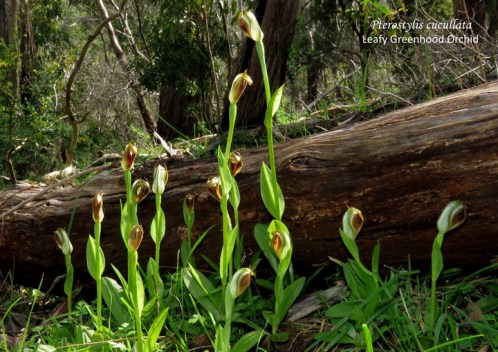
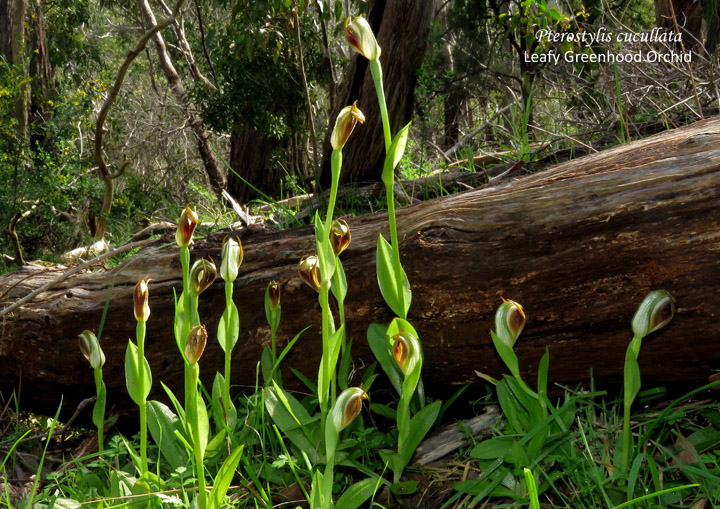
The following are all Pterostylis but not all of them are Greenhoods.  This first image is a Pterostylis Greenhood.

1609-sm-bs-pterostylis-cucullata
Pterostylis cucullata

This one is a Shell Orchid or alternately Diplodium

Diplodium dolichochilum

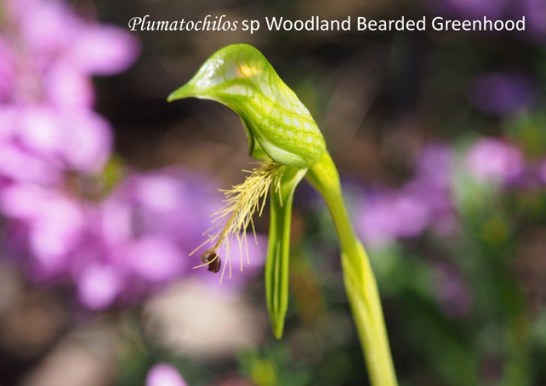
Whilst this Pterostylis is a Bearded Greenhood or Plumatochilos

09 sm JMcP Plumatochilus sp Woodlands
Plumatichilos sp Woodland Bearded Greenhood

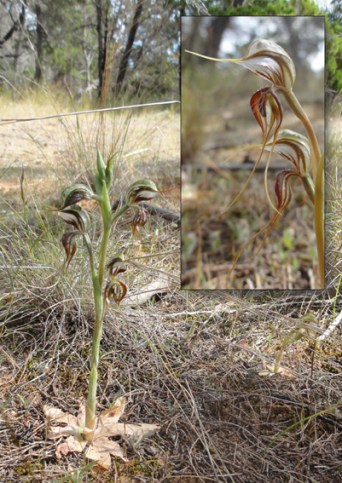
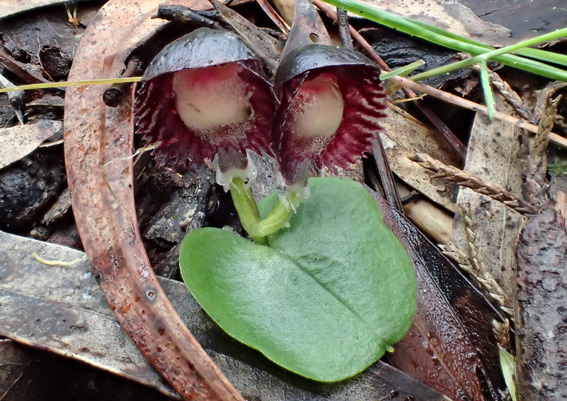
The final Pterostylis example is a Rufoushood, or Oligochaetochilus

Oligochaetochilus arenicolaHL
Typical of the Rufoushood this Oligochaetochilus arenicola shows the sencesing leaves, pendent petals and hairs on the labellum. Photographer: H Lawrence

So they could all be referred to Pterostylis or any of the other possible names whether the common name or a synonym.

Gleanings From the Journal: Rescuing apparently ‘dead’ orchids Parts 2 & 3 of Three Parts

This week we continue with both Part Two and Part Three of Brendan Killen’s Rescuing Apparently ‘Dead’ Orchids  which appeared in the Volume 31 No 9 October 2007 and Volume 31 Bi 11 December 2007, respectively.

Rescuing apparently ‘dead’ orchids. Part 2 By Brendan Killen

PLANT #2 – Dendrobium Alick Dockrill “Pale Face”

untitled

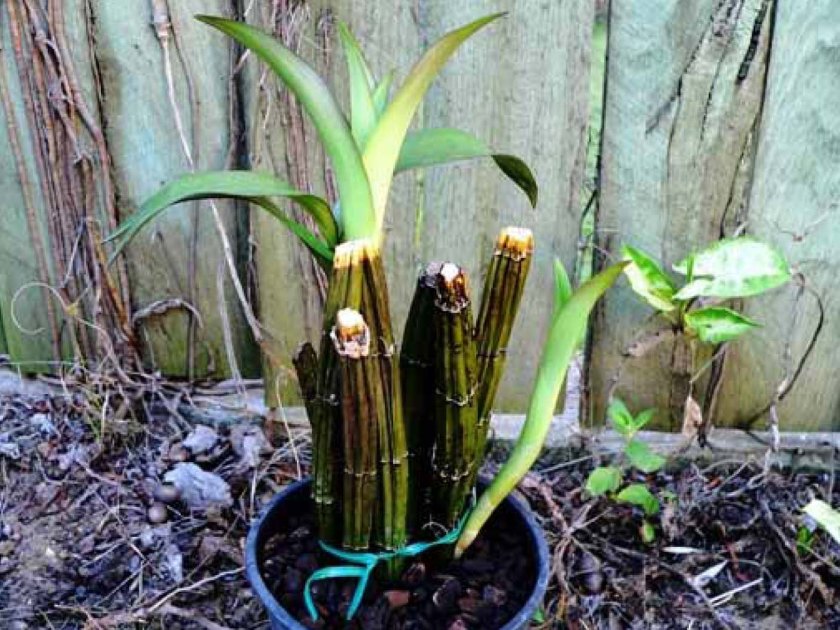
The cane pieces of this plant were inserted into a bark mix at the same time as the canes of Den. Jayden ‘JANE’ [See the July Journal] were inserted into sphagnum moss. The outcome is three healthy growths.

Note the dried ends of the canes where they were cut into separate pieces. As you can see from the photograph, I used a green twisty to hold the canes in the bark as a fairly solid bunch – I find this is the best way to keep the canes still whilst they are developing sensitive new growths. I have found that no matter how bunched-up the canes are, the new growths always find a way to the surface.

untitled

Here is a different angle on the new growths with my fingers providing some perspective on the size of the growths.

Note that they are significantly larger that those on the Den Jayden ‘JANE’, with the same time in the pots.

I do not consider this evidence of the worth of bark compared to sphagnum moss.

I find that different hybrids and species behave quite differently in terms of their speed and timing of production of new growths. I believe that it is a function of what species are in the background of these plants and the time of year the rescue is undertaken.

Here is the same plant 5 weeks later. The new roots are protruding from the pot and the new growths are extending themselves – all of this at a time where severe water restrictions limit me to two waterings each week by watering can!

Plant 2-3 Den Alick dockrill 'Pale Face'.jpg

Plant 2-4 Den Alick dockrill 'Pale Face'.jpg

A further 4 weeks of cultivation and bright, warm weather has fully extended and hardened the new growths.

The larger growth should produce a flower spike this Spring.

Dendrobium Alick Docrill “Pale Face” (Photographer: Josh Bridge)

TO BE CONTINUED

 *********************

 Rescuing apparently ‘dead’ orchids. Part 3

By Brendan Killen

Plant #3 – Dendrobium Sarah Jane ‘Purvis’

This is a plant that the late John Purvis gave me just before he passed away. Because it is a special plant to me, I cut an old cane into three pieces to produce a back-up plant, just in case my piece of the original fell foul of the orchid gremlins.

Journal

As you can see, it is the least developed of the three plants featured in this article. And yet, the parent plant has produced two magnificent new growths in the same period. I feel that the 12.5% of Den. bigibbum and 12.5% of the hot growing Den. tetragonum var. giganteum have influenced this. This new growth has probably been encouraged since the relocation from Adelaide to Brisbane where the temperature differences overnight are more subtle than in the Adelaide Hills where the plants were previously cultivated. The two hot growing species in the plant’s background were probably held back by Adelaide’s much cooler overnight temperatures. Anyway, this is purely conjecture on my behalf. What is important is that I now have a developing back-up plant for one that I treasure dearly.

Dendrobium Sarah Jane ‘Purvis’ (Photographer Josh Bridge)

SUMMARY

The thrust of what I have written is simple – don’t give up on treasured plants that look like they have expired, because there is always hope so long as the canes haven’t turned into fermented mush! The technique is as simple as cutting canes into lengths where you have at least three, preferably four, segments from which new growths will materialise. Use sterilized cutting tools to avoid contamination of the canes. Once the new growths have emerged, give them time to produce healthy root systems and let the new canes harden before potting-on. The best time I have found to pot-on the new growths is early autumn.

****************

Thank you to Josh Bridge for supplying images of the flowers of Dendrobium Alick Dockrill “Pale Face” and Dendrobium Sarah Jane ‘Purvis’ as they were not in the original articles.

***************

Another technique demonstrated by John Gay at one of the NOSSA meetings a couple of years ago was to take the apparently dead canes of an epiphytic orchid and seal them in a plastic bag with a small piece of damp sponge (or other cloth) and leave them in the shadehouse.  Do not let the sponge dry out.  So long as there was a bit of moisture, there was a chance for new growth on the shrivelled canes.  Once the growth was obvious, pot on as normal.

GLEANINGS FROM THE JOURNALS: Part 1 of 3 parts Rescuing apparently ‘dead’ orchids

The following is part of a three part series on reviving apparently dead epiphytic orchids from Volume 31 No6 July 2007


Rescuing Apparently ‘dead’ Orchids

By Brendan Killen

In late Spring 2006, I had an ‘open shade house’ event at my place in Belair, South Australia. As part of the programme, I demonstrated how I rescue orchids that have all but died. My demonstration was based on many years of experience in not giving in to the demons that cause orchids to expire.

I used two orchids that everyone attending agreed would normally be tossed into the rubbish bin or compost – all bare canes; heavily shrivelled; all new growth ‘eyes’ at the base of the canes chewed out by insects. In other words, an apparently hopeless situation. I’ve never given up on these terminal plants, believing that they still had life in the old canes along as they hadn’t turned to fermented mush.

I also used an apparently ‘dead’ cane from a treasured orchid that I was hoping would eventually produce a back-up plant using the method I describe in the following text.

In one case (Dendrobium Jayden), I cut the canes into a number of segments and stuck them into a pot with heavily compressed sphagnum moss, topped with river gravel to suppress the moss from growing and overtaking the pot. In the other two cases (Den. Alick Dockrill & Den. Sarah Jane), I cut the canes into segments and placed them in a pot of small composted bark.

The following photographs were taken about 3 months after the repotting demonstration and after the plants were relocated to Brisbane. They demonstrate the benefit of the right technique and a ‘don’t give up’ attitude. This technique has not failed me yet, allowing me to rescue many prized plants that have gone on to be show-bench winners.

PLANT #1 – Dendrobium Jayden “Jane”.

Plant 1-1 Den Jayden 'Jane'.jpg

This photo illustrates the emerging new growth on a Den. Jayden “Jane”. This is the first evidence that success is at hand. It is also the first new growth discovered on this plant before I inspect the canes further to see if there are any other new growths buried within the sphagnum moss.

Plant 1-2 Den Jayden 'Jane'.jpg

In this photo, you can see that the new growth is very pale from having emerged from deep in the sphagnum moss with little exposure to light. The juvenile roots can be seen emerging on the right hand side.

Plant 1-2-2 Den Jayden 'Jane'.jpg

A closer inspection reveals another growth, on the other side. Note that both growths are not coming from the ‘eyes’ at the bottom of the canes – simply because they were cut off at potting time. They are emerging from the section that joins the cane segments.

Plant 1-3 Den Jayden 'Jane'.jpg

Teasing away the sphagnum moss reveals even more of the young roots. Note how the new growths are lacking any colour substance at this stage.

If I were to ignore this plant for much longer, the new growths would have rotted in the very moist sphagnum moss, neutralising my efforts. So, the lesson here is to ensure that you monitor the plants for new growths and ensure that you elevate the new growths above the sphagnum moss to give them a chance to ‘harden off’ from their immersion deeper in the sphagnum.

Plant 1-4 Den Jayden 'Jane'.jpg

This photo illustrates how I have re-seated the canes within the sphagnum moss, but much higher so that only the roots are exposed to the heavy moisture content of the moss. I choose to do this instead of placing them straight into a bark mix as I find that the plants tend to go into a shock at the relative lack of moisture in bark and can die quickly, or suffer from stunted growth. I wait until the new growths have matured with substantial green substance before I repot them in a bark mix. And, I tend to do this in late autumn when they are not under any temperature or light stress. By spring, they will be racing ahead in the bark mix with new root growth and, possibly new canes and/or flower spikes.

One Month Later……….

Plant 1-5 Den Jayden 'Jane'.jpg

After one month from the re-seating described previously, note that the pale new growth is now mature and bright green. And, note how the roots are emerging from the growth above the sphagnum moss. This plant will be ready for potting-on into a bark medium in the next few weeks as autumn cools the air in Brisbane.

Plant 1-6 Den Jayden 'Jane'.jpg
Den Jayden ‘JANE’ in flower

This is how I expect it to flower in spring

TO BE CONTINUED …..

ORCHID COLLECTING AND THE LAW

South Australia has some beautiful and delicate orchids.  Most are not showy.  Instead they have a subtle attractive beauty.  But they are declining; and for that reason, they are protected by the law, specifically the Native Vegetation Act 1991.  Picking the flower is illegal let alone digging up the whole plant.

The only situation where a person can legally remove an orchid or part thereof is when they hold a government authorised permit. Legitimate reasons for collecting orchid material include specimen for the State Herbarium, scientific research, rescue or salvage situations when a development is occurring, or collecting seed of threatened species to store with the Seed Conservation Centre.

Without a permit, no one can remove any part of a plant even if their reason is legitimate.

It behoves members to be cautious of any one that asks for assistance with collecting, transporting or photographing potted orchids.  Ask to see their permit.  So, what do you do if you suspect someone of picking the flowers or digging up the plants?  Contact the Department Environment and Natural Resources Investigation and Compliance Unit.

There is only a very small number of NOSSA members who hold such permits.  Thelma Bridle, NOSSA Conservation Officer, is the person who will know which members hold a permit.  For more information on plant collection permits, contact DEWNR at DEWNRresearchpermits@sa.gov.au or visit the website.

Thank you to Thelma Bridle and Doug Bickerton for their assistance and critiquing of this post.

Murray Mallee Midges_2007E_6Jun11
Corunastylis sp. Dark Midge Ngarkat Conservation Park Photo: June Niejalke

2016 Orchid Picture of the Year

For the final meeting of the year we chose the best of the 2016 monthly winners of the picture competition.

Here in Australia we are fortunate to have such a variety of orchids. They may not be as big and showy as some of the overseas orchids but the diversity of shapes fires the imagination as reflected in this year’s monthly winners, when put together. The common names of the winners – spider, leopard, flying duck, cowslip, zebra, helmet, bluebeard and greenhood – reinforce this theme of diversity.

Patterns and colours contribute to the variety of our orchids. Australian orchid colours run the gamut of the rainbow and more, with Australia being home to most of the naturally occurring blue orchids in the world. This colour fascinates and allures people around the world so much so that nurseries will dye a white orchid blue because it will sell. There is even a website devoted to the colour called, not surprisingly, Blue Orchid  and the popular band master Glenn Miller wrote a song titled Blue Orchids (1944).

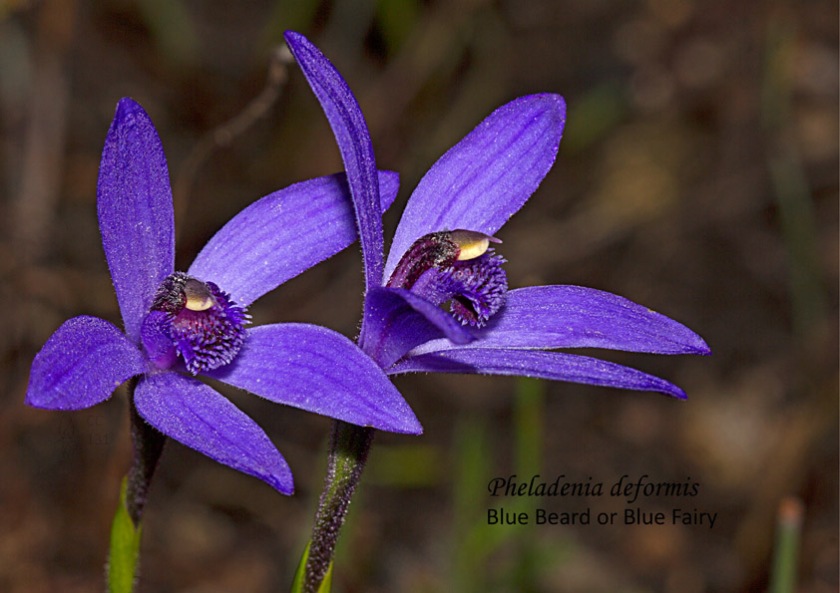
Could this be why the very clear winner for the year was Claire Chesson’s Pheladenia deformis common name Bluebeard or Blue Fairy?

  congratulations-clipart-k15686507

  Claire Chesson on your most beautiful picture.

1608-sm-cc-pheladenia-deformis
Pheladenia deformis

Claire won the August competition.

As a reminder, below are the other winners for the year.  Click on the image to see the related articles.

February 2016 Photographer: Pauline Meyers

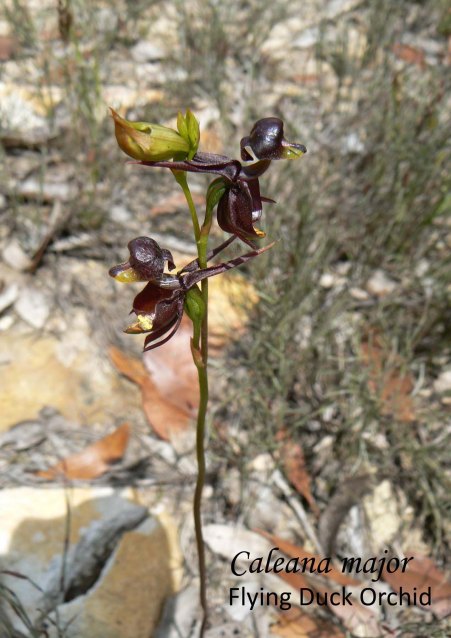
1602 sm PM Caleana major
Caleana major

March 2016 Photographer: Judy Sara

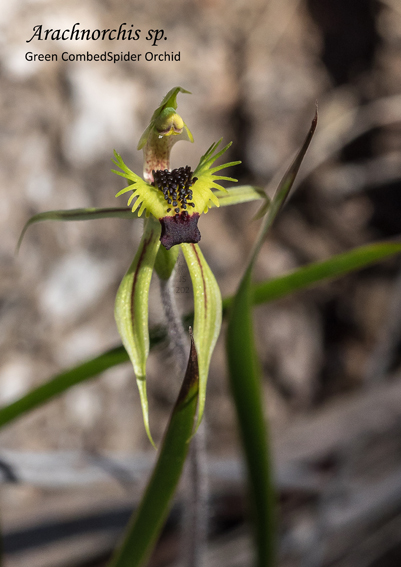
1603 sm JS Arachnorchis sp
Arachnorchis sp. (Green Combed Spider Orchid

April 2016 Photographer: Claire Chesson

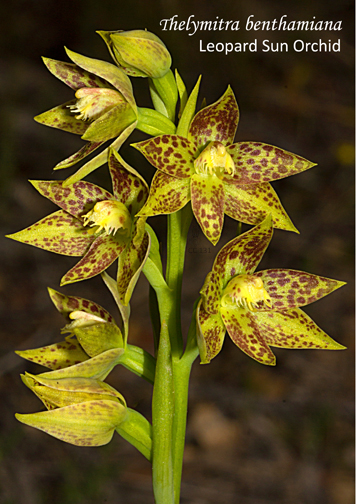
1604 sm CC T benthamaniana
Thelymitra benthamiana

May 2016 Photographer: Pauline Meyers

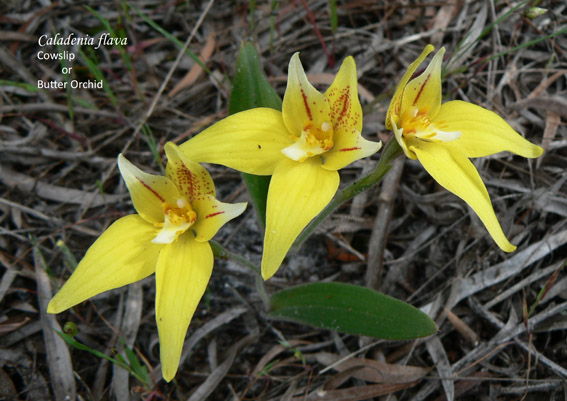
1605 sm PM Caladenia flava
Caladenia flava

2016 June Photographer: Ros Miller

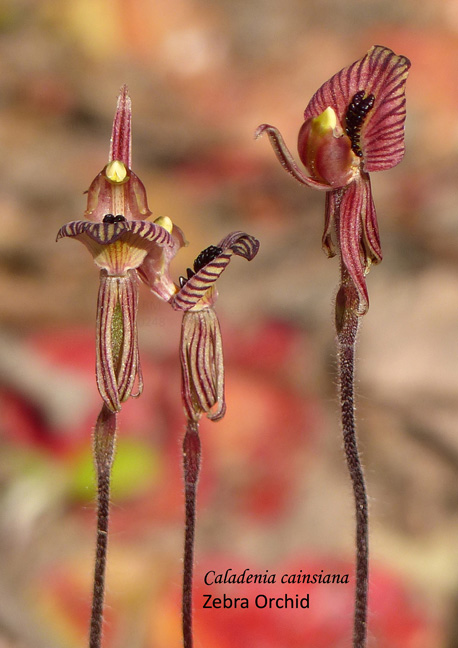
1606 sm RM Caladenia cairnsiana
Caladenia cairnsiana

2016 July Photographer: Robert Lawrence

1607 sm RWL Corysanthes diemenicus
Corysanthes diemenica (mutation)

2016 September Photographer: Bevin Scholz

1609-sm-bs-pterostylis-cucullata
Pterostylis cucullata

2016 October Photographer: Helen Lawrence

1610-hl-sm-arachnorchis-argocalla


When do orchids flower?

This is one of the most commonly asked question.

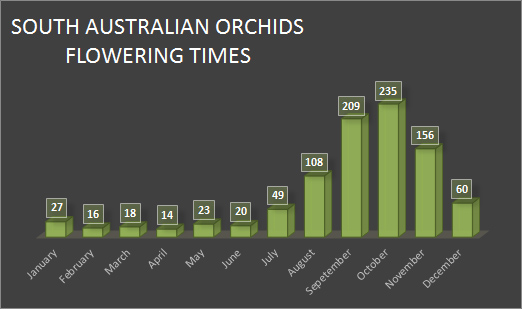
The short answer is that in South Australia there will be potentially an orchid flowering somewhere in any month of the year but the caveat is that in certain months specifically December, January, February, and March it is very difficult to find any as there are only a few flowering species and most of them are restricted to localised/sensitive sites.  The flowering times for the highest number of species occur in winter and spring with October being the most prolific month for flowering.


chart-south-australian-flowering-times

To see how this varies across the state for the individual regions see the charts below.

Another is question “Will I find orchids when I visit a particular park on a particular day?” is not such an easy question to answer because it DEPENDS on so many different factors.

The timing of the rains affects the flowering time, for instance, Autumn orchids appear about 6 – 8 weeks after the first autumn rains.  Normally the South East is the best place but this year the lower South East did not have a good flowering due to the storms and associated cold with the wet conditions.

Pollination affects the likelihood of finding flowers.  Flowers remain open until pollination occurs.  If the pollination is delayed the flower will be on display for a longer time until it runs out of energy and naturally shrivels up.  To illustrate this NOSSA visited Scott Creek Conservation Park one day and there was a beautiful display of sun orchids along with several spider orchids but on a visit to the same site one week later, there were hardly any flowers left.  Many had been pollinated as was evidenced by the swollen capsules.

So as a rough guide click here for the species flowering times of South Australian Orchids and here for month by month information.  This data is based upon information found in the 2011 South Australia’s Native Orchids disk.

For detailed information, it is necessary to consult with someone who knows the orchids in the area but it may not always be easy to find such a person.  In which case, contact NOSSA and we may be able to, through our network, find someone to help.

sa-regions-flowering-times-copy


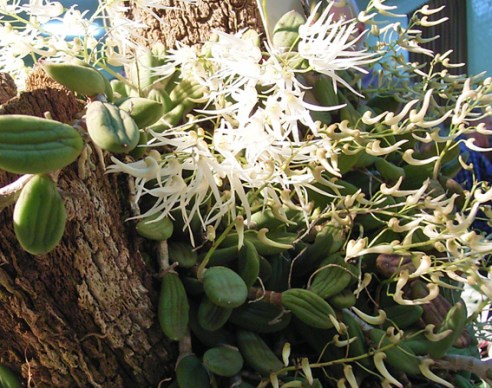
Gleanings from the Journals: Dockrillia linguiformis 2006

This week’s blog is an extract from Volume 30 No 10 November 2006.  In this article of Len Field he gives not only cultural notes but also some interesting background including an orchid link with the infamous Captain Bligh.

Dockrillia linguiformis (Sw) 1800 Brieger

Dockrilla linguiformis

Len Field
Common names Thumbnail orchid, Tongue orchid, and in North Queensland the Tick
orchid.
The name linguiforme is from the Latin lingu(a
) as in linguiforme (a tongue). It was also claimed for many years that this was the orchid that Olaf Peter Swartz the German botanist founded the genus Dendrobium in 1800, but this was wrong, although this was the first orchid seen by white man when they landed at the rocks area in Sydney cove, Port Jackson.  It was introduced into England by Rear Admiral Bligh of Bounty fame.
Other names it has been called are
Dendrobium linguiforme var. linguiforme Swartze 1800
Callista linguiforme (Swartze) Rev. Kuntze 1891
Dendrobium linguiforme (Swartze) var. huntianum Rupp 1942
There was another variety named from this species called var. huntianum by Rupp in 1942, which was named after T.E. Hunt and is a June or July flower and found near Ipswitch (sic) in Queensland, but as it reverts to type form it never reached true variety status and was considered just a variation of the type form.
This orchid has a huge range of habitat which stretches from almost the Victorian border up to North Queensland and West to the Great Dividing Range. It is very common throughout this area and equally happy as an epiphyte or a lithophyte but where as a epiphyte it likes swamp oaks (
Casuarina glauca), river oaks (Casuarina cunninghamiana), in fact it will grow on most trees that will hold there bark including the tea trees (Leptospermum species).  I have seen this orchid hundreds of kilometres inland from the coast still forming large mats on the rock faces, while in its more prolific growing areas these mats will cover huge areas of the rocks where it can survive and grow in extreme exposed conditions that would kill other orchids. In the dry times the leaves which are very thick, tough and numerous will shrivel and can last up to six months without water. This is a feature of a lot of Australian Dendrobium and Dockrillia
Flowering is from August to October with blooms that are long lasting, up to two weeks with one raceme per leaf.
Culture. If grown on slabs which is the usual way it should be hung up high and if grown in pots a very coarse open mix. In nature it likes plenty of sunlight although at times it will grow in shade. Whichever way it is grown it should have good light, humidity and air movement.
Den linguiforme drawing
Dendrobium linguiforme


Orchid Seed Conservation

There are many different activities involved with orchid conservation.  In situ conservation consists of looking after the orchids where they are growing; maintaining and protection of habitats and ecological systems.  On the other hand ex situ conservation is caring for the orchids in cultivation in a similar way that zoos maintain an animals species that is extinct in the wild.

For the orchids one form of ex situ conservation is via seed collection and the propagation of new plants. With many of our terrestrial orchids this is not an easy task but here in South Australia an attempt is being made with four of our endangered orchids.

Unlike some of our terrestrial orchids these are ones which we have not been able to grow.  There is a collaborative effort co-ordinated through the South Australian Seed Conservation Centre (Seedbank) to change this.  Amongst the people helping the Seedbank are members of the Native Orchid Society of South Australia, students from Kildare College and Dr Noushka Reiter of the Royal Botanic Gardens Melbourne.

On July 30 2016, Dan Duval of the Seedbank was interviewed by Jon Lamb on Ashley Walsh’s ABC 891 Adelaide Talkback Gardening program.  It is an informative interview and well worth the listen.

For more information on the work of the Seedbank, visit their website

Video as heard on Talkback Gardening with Jon Lamb and Ashley Walsh – Saturdays from 8.30 on 891 ABC Adelaide.

2016 October Winning Picture


Quite a few pictures were entered this month.

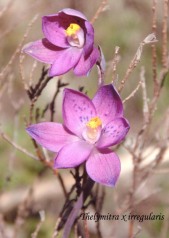
Ricky Egel’s Thelymitra x irregularis, 1610-re-sm-thelymitra-x-irregularis

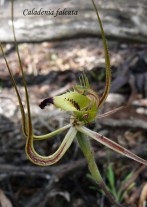
Pauline Myer’s Caladenia falcata and Caladenia carinsiana; 1610-pm-sm-caladenia-falcata

1610-pm-sm-caladenia-cairnsiana

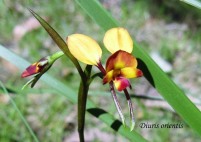
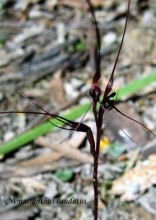
Margaret Lee’s Diuris orientis and Nemacianthus caudatus;

1610-ml-sm-diuris-orientis

1610-ml-sm-nemacianthus-caudatus

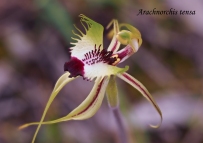
Judy Sara’s Arachnorchis tensa;

1610 JS A4 Arachnorchis tensa.jpg

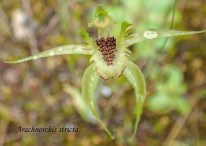
Greg Sara’s Arachnorchis stricta which had an unusual green coloured flower;

1610-gs-sm-arachnorchis-stricta

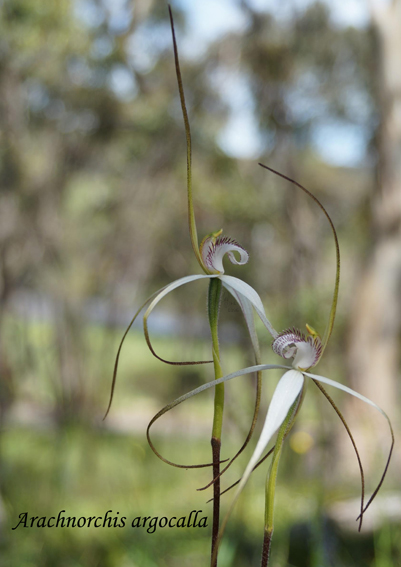
and Helen Lawrence’s Arachnorchis argocalla.

1610-hl-sm-arachnorchis-argocalla

Helen’s picture of the nationally endangered A. argocalla was the outstanding winner.  Now known as the White Beauty Spider Orchid^, it was featured last year as a winner with Pauline Meyer’s June 2015 entry*.

This is one of our largest spider orchids. For size, beauty and delicacy it rivals the Western Australian Caladenia longicauda ssp. eminens (White Stark Spider Orchid) and A. venusta, syn. Caladenia venusta (Graceful Spider Orchid) from Victoria and the South East.

It shares many similarities with these two species in that they are reasonably good size white flowers with a stiffly hinged labellum that has long, thin teeth and the segments have threadlike tips without clubs.  It is separated both geographically and in the type of habitat from these two species. A. argocalla is a plant of the inland hills and valleys.

Though primarily a white flower and part of the A. patersonii complex, A. argocalla has red colouring in the labellum which according to Backhouse may possibly indicate genetic introgression (that is long term mixing of the gene pool) with either the A. reticulata or A. leptochila complexes. Certainly, the colour of the labellum was quite variable ranging from white through to a deep red.

^Previously known as Common White Spider Orchid because of its abundance but now only known to a limited number of locations.

*NOSSA Journal, July 2015

Reference:

Department of the Environment (2016). Caladenia argocalla in Species Profile and Threats Database, Department of the Environment, Canberra. Available from: http://www.environment.gov.au/sprat. Accessed Thu, 3 Nov 2016 16:31:39 +1100

Introgression https://en.wikipedia.org/wiki/Introgression Accessed 4 November 2016

Bates, R. J., ed. (2011). South Australian Native Orchids. Electronic version, 2011. NOSSA

Jones, David L (2006) A complete Guide to Native Orchids of Australia, Frenchs Forest, NSW: Reed New Holland

Backhouse, G (2011) Spider-orchids the Genus Caladenia and its Relatives in Australia


NB: November Competition will be judging the monthly winners from this year.

Mad Dogs and …. Orchidologists

Mad dogs and Englishmen are not the only ones to go out in the  midday sun.  For orchidologists to see Sun Orchids flowering, then it is out into the midday sun on a hot day because that is when they open.  There is no point going much before 11am and by 2pm most are closing and no point going out on a cool or windy day.

1604 sm CC T benthamaniana

But for those who don’t want to  go out (or cannot get out) into the midday sun, here is a video to be viewed in the cool of the shade.

This video features the Leopard Sun Orchid (Thelymitra benthamiana) an uncommon Sun Orchid in South Australia.  Unlike many sun orchids which requires a view of the flower to confirm identification, this one can be identified by the leaf alone.  At the beginning of the video take note of its distinctive leaf.

Thelymitra benthamiana