Rudie Kuiter et al have been observing orchid pollinators over many seasons spending hours watching and becoming familiar with pollinator interaction with the orchid, learning when to anticipate pollination activity.
Their observations of various Pterostylis species has been documented in Overview of Pterostylis Pollination (Orchidaceae) in Victoria. In all, they observed 53 Pterostylis species and 40 species of pollinators from several different genera. They noted that some pollinators species were active most of the day but others were only active in the late afternoon whilst others were “only seen on dusk and possibly are nocturnal as well”.
May’s theme was miniscule, or less than 10mm. Of the eight entries five were Corunastylis, two Spider orchids from Western Australia and one an epiphyte. The flowers of the two spiders, Caladenia pachychila (photographer Rob & Jenny Pauley) and Caladenia bryceana subsp. bryceana (Pauline Myers) were the largest of the group being about 10mm across whilst the Bulbophylum globuliforme (Ros Miller) and C. despectans (Rosalie Lawrence) were the smallest being only 2mm across.
Of the remaining Corunastyllis entries the flower size ranged from 3mm for C. pumila (Rob & Jenny Pauley), 4mm for C. tepperi (Ricky Egel), 7mm for C. ciliata (Rosalie Lawrence) and 8mm for C. morrisii (Rob & Jenny Pauley).
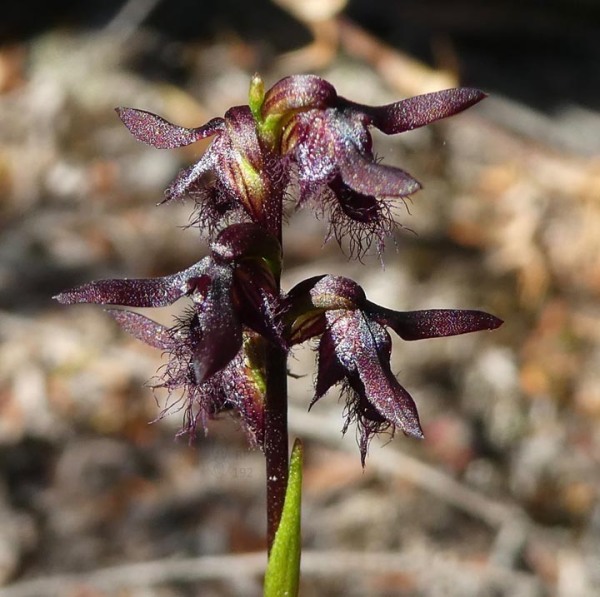
The winning picture C. morrisii (Bearded or Hairy Midge Orchid) is one of the larger midge orchids. Other synonyms are Prasophyllum morrisii and Genoplesium morrisii. This common species is mainly found in Victoria but it does extend into southern New South Wales in the east and in the west just spills 50 km over the border into South Australia where it is rated endangered. It also occurs in the south east of Tasmania.
Flowering Times: Nov – May
State
N
D
J
F
M
A
M
Tas
√
√
NSW
√
√
√
√
Vic
√
√
√
√
√
√
√
SA
√
√
With such a wide distribution range, it is not surprising to see quite a variation in flowering time from late spring through to autumn depending upon location.
Bates, R. J., ed. (2011). South Australian Native Orchids. Electronic version, 2011. NOSSA
Wapstra, M., Roberts, N., Wapstra, H. & Wapstra, A. (2012). Flowering Times of Tasmanian Orchids: A Practical Guide for Field Botanists. Self-published by the authors (May 2012
version).
Backhouse, G., Kosky, B., Rouse, D. & Turner, J. (2016). Bush Gems: A Guide to the Wild Orchids of Victoria. Self-published by the authors
April’s theme was yellow and orange. All of the entries proved to be spring flowering. There were several Diuris. Claire Chesson, Rob Pauley and John Fennel all entered D. orientis; Les Nesbitt and Rob Pauley D. behrii and Pauline Meyer D. corymbosa from Western Australia. Pauline also entered Caladenia caesaria subsp. maritima and John Thelymitra benthamiana.
The winning picture was Les Nesbitt’s D. behrii (Cowslip Orchid) which occurs in Victoria, New South Wales, Australian Capital Territory whilst in South Australia it is rated as vulnerable.
Les Nesbitt has been working on a recovery project of these orchids for Hillgrove Resource’s flagship, the Kanmantoo Copper Mine, located almost 55 KM from Adelaide. As this orchid is often mentioned in NOSSA Journals, it might be worthwhile looking at the person after whom this species was named.
First collected by German born Dr Hans Herman Behr (1818 – 1904) who first visited* South Australia in 1844 when the colony was barely 8 years old. During his two years in South Australia he became the first person to systematically study our botany and entomology sending reports and samples back home. The results of his observations were published in various journals, and many of his collections were named and described by other botanists including his friend, Diedreich von Schlechtendal (1794 – 1866) who named Diuris behrii after Hans.
Hans Behr was an interesting man. A man of many aptitudes; medical doctor, entomologist, anthropologist, botanist, duellist, socialist, poet, novelist, linguist, member of the Bohemian Club of San Francisco and a man of wit. From the many reminiscences written about him, it would appear that he was a likeable gentleman and a generous teacher.
Unfortunately, not everyone liked him because “he was a sworn enemy of all scientific humbug, of quacks and false pretenders” and “he never refrained from expressing his opinion of them, quite regardless of person or station” but his humour shone forth in dealing with them. Once he named a “particularly obnoxious louse” after one of his enemies.
Behr revisited South Australia in 1848 during which time he became acquainted with German-Australian botanist, Ferdinand von Meuller. He maintained friendship with many of the scientific men of the time including Ferdinand Mueller and it was through this friendship that many Australian plants were introduced into California where Behr later settled after his travels.
Though the study of butterflies was his first and enduring love, he is remembered and honoured in Australia for his botanical interests. Of the twenty-two plants named after Behr, two are orchids: Diuris behrii and Arachnorchis behrii (synonym Caladenia behrii).
*The Journal incorrectly stated that he visited South Australia with his friend, Diedreich von Schlechtendal. This did not happen. As far as I am aware Schlechtendal did not visit South Australia.
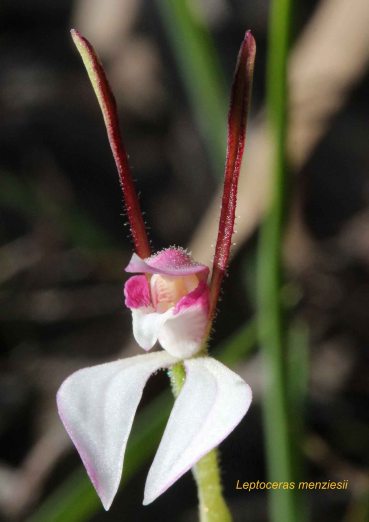
As part of 40th NOSSA anniversary, the theme for this month was Leptoceras menziesii (Hare Orchid or Rabbit Ears). Entries were received from John Badger, Pauline Meyers, Robert and Rosalie Lawrence, with John Badger’s being declared the winner.
In February 1978, it was announced that the nascent NOSSA society required an emblem. Members were invited to send in drawings, to be judged by members and then ratified by the committee. Mrs Chris Butler (Ron Robjohns’ daughter) was the winner. The first Leptoceras menziesii flowers to be benched at a NOSSA meeting were in September 1978. It appears to be an easy plant to grow but a most difficult one to flower.
This seems to be because it is fire dependent. In spring, it will flower profusely if there has been a summer fire such as occurred after the 2015 Sampson Flat (SA) fires. It is possible that the gas ethylene produced during a fire event may initiate the flowering response.
Otherwise, apart from the occasional flowering plant, it will be mainly leaves that are found when out in the field. The single leaf of this plant lying prostrate along the ground is distinctive. It is firm, boat-shaped, glabrous (no hairs), with a fine ‘snake-skin’ pattern. Interestingly, sterile plants can be mistaken for a plant with a developing bud as there will be at the leaf base a ligule (a thin membranous growth, often found on grass stems).
Reference
Backhouse, G, et al (2016) Bush Gems: A Guide to the Wild Orchids of Victoria Electronic version
Bates, R. J., ed. (2011). South Australian Native Orchids. Electronic version, 2011. NOSSA
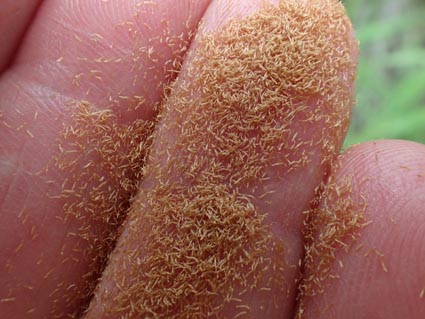
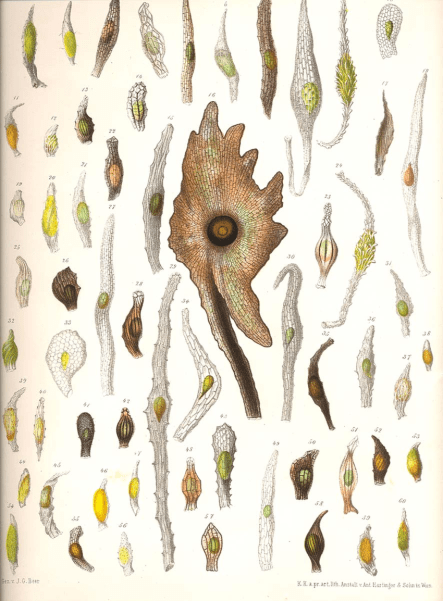
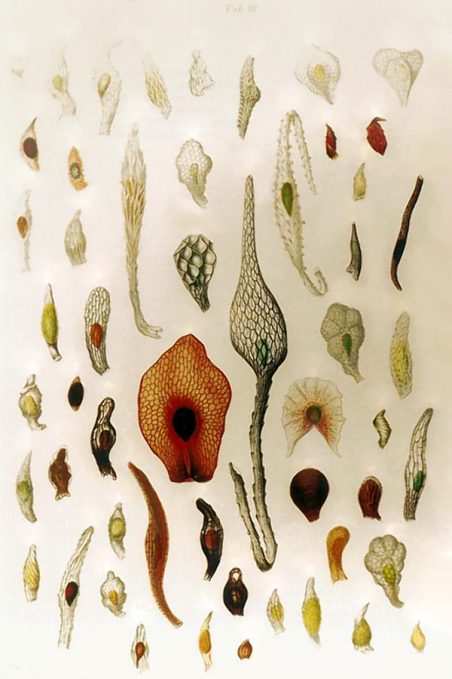
So what do they look like? Amazingly Johann Georg Beer (1803 – 1873), an Austro-Hungarian orchidologist and explorer published in 1863 Beitra ¨ge zur Morphologie und Biologie der Familie der Orchideen. In it, Beer had produced in exquisite detail illustrations of orchid seeds. Beer was not the first to draw orchid seeds but his “drawings are morphologically accurate and artistically magnificent. Beer’s artistic ability, patience, and botanical expertise are obvious. His are probably the first detailed colour renditions of orchid seeds and seedlings to be published.”*
Reference
*Arditti, J, 2008, An history of orchid hybridization, seed germination and tissue culture, Botanical Journal of the Linnean Society June 2008
A common question asked is when to water terrestrials. The short answer is to keep them dry over summer but there are variations such as was previously posted about the watering regime for Chiloglottis. In the March 2017 NOSSA Journal, Les Nesbitt’s article highlights another watering variation.
Blue Tags
Les Nesbitt
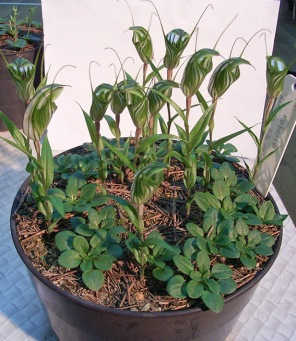
Jane Higgs’ lovely pot of the red form of Pterostylis coccina in flower had a blue tag. Jane explained that a blue tag meant that watering had to commence in January for that pot and not at the end of February as is normal for most terrestrials. Start watering later and there will be no flowers. Her pots are under a solid roof. She explained that in the ANOS Vic cultural booklet (Cultivation of Australian Native Orchids) there is a list of cauline type greenhoods which she tags with blue, and includes Pterostylis decurva, aestiva, laxa, coccina, revoluta, reflexa, truncata, robusta, alata, and fischii. To this list can be added abrupta and also the rosette types ophioglossa and baptistii which shoot early.
I have trouble growing and flowering this group of Autumn flowering greenhoods. I went home and dragged out my ANOS Vic booklet and brushed up on the notes. I found several old blue labels in the shed and cut them into strips. I now have blue labels in my pots and the pots are grouped together in the shadehouse where they get afternoon shade. They were given a thorough watering but it will be too late to expect flowers this year. I find large tubers of this group rot easily in Spring and the plants go dormant earlier than other greenhoods. I will try to remember to move the pots under cover in September to let them dry off.
Diplodium robustum – one of the cauline greenhoods
Having a visual reminder would certainly make it easier to know when and which pots to water. Obviously other coloured tags can be used instead of blue, so long as they stand out from the label.
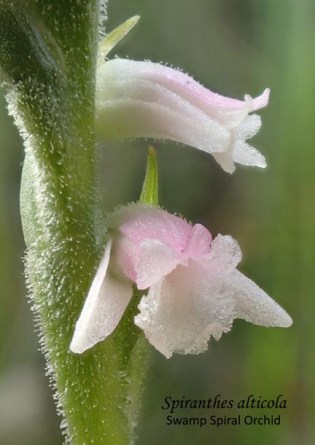
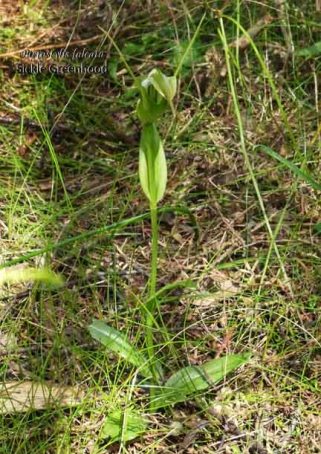
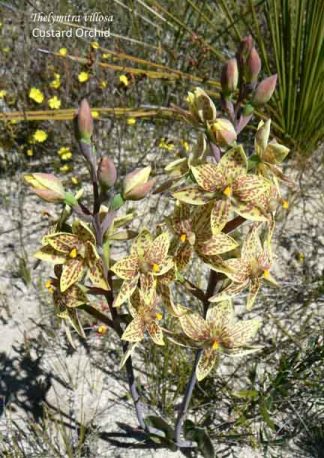
The first competition for the year followed a wet orchid theme with three of the orchids being South Australian swamp orchids and the fourth from Western Australia; though not a swamp dweller, it grows in shallow moist soil.
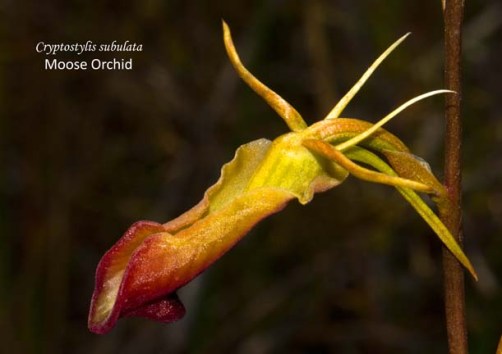
The outstanding winner was Claire Chesson’s Cryptostylis subulata, followed by Robert Lawrence’s Spiranthes alticola, Rosalie Lawrence’s Pterostylis falcata and Pauline Meyer’s Thelymitra villosa.
Known to South Australian’s as the Moose Orchid, elsewhere it is either Large Tongue Orchid or Cow Orchid. This tall (40 to 110 cms) evergreen orchid is common in the eastern states where it is commonly found in damp areas as well as swamps. but in South Australia it is limited to swamps and is rated as endangered.
Whilst not an easy orchid to grow it has been cultivated although seed set has not always occurred. Helen Richards, an experienced Victorian terrestrial orchid grower, shared in an email how she grows them.
“Cryptostylis species grow from brittle rhizomes which can be quite long and they resent frequent disturbance. Mine are potted into a pot therefore that is large enough for the long roots and which will accommodate further growth for several years. My mix is ANOS basic mix, the same as I use for Pterostylis and many other genera. They need to be kept moist all year round, especially in summer when they flower and new leaves appear, their active growing period. I grow them in an area of moderate light. Others have seen pollinators active on the flowers but I haven’t. However seed capsules frequently develop without my assistance with a toothpick. Richard Thomson says they haven’t had success germinating the seed.”
Though Melbourne and Adelaide conditions are very different, in cultivation the watering is similar with the warning that in Adelaide it is a harsher environment for this genus.
The following information has been kindly supplied by Richard Thomson, an experienced terrestrial grower from ANOS Victoria.
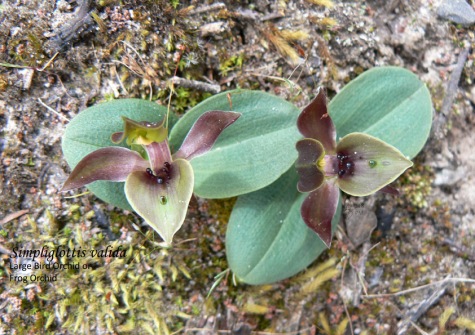
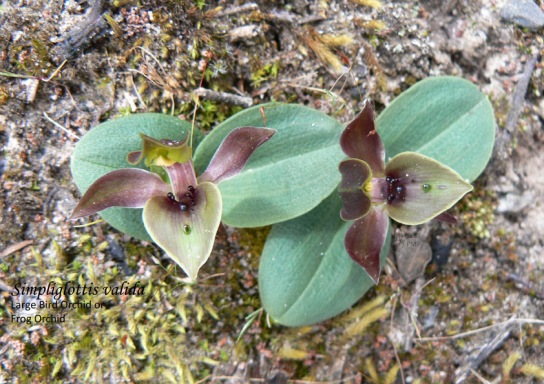
Chiloglottis valida
Generally, Chiloglottis are kept damper than Pterostylis, during the dormant period. As many Chiloglottis need the potting media and the tubers dampening in summer, the general action with water, is to have the tubers damp until leaves emerge. Then to commence normal pot watering.
Chiloglottis, can get infected with rust. The first thing usually noticed is some pairs of leaves sticking up in the air. When you look closely you will notice some whitish little lumps on the underside of the leaf. Please immediately take the pot away from your other orchids as it is contagious across Chiloglottis. There does not seem to be an effective way to treat the infection.
ANOS VICTORIA MEETINGS
CHILOGLOTTIS
Species
State / Location
Month Benched
BUSH FLOWERING
WATERING
chlorantha
NSW
July Aug Sept
Sept to Oct
Keep damper from early February. Water when leaves emerge
cornuta
S NSW Vic Tas SA
Nov Dec
Nov to Feb – altitude
Keep damp all year. Water when shoots emerge.
diphylla
Qld NSW
Feb Mar Apr May Jun Jul Aug
Feb to May
mid to late January
sp affin diphylla
Feb
Keep damper from early February. Water when leaves emerge
formicifera
NSW
Jul Aug Sept Oct Nov
Aug to Nov
keep damper from early February, Water when leaves emerge
sp affin formicifera
Jul
Keep damper from early February. Water when leaves emerge
gammata
Tas high
Oct to Feb
jeanesii
Vic
Nov Dec
Nov to Jan
Keep damp all year. Water when shoots emerge.
longiclavata
N Qld
Feb Mar Apr May Jun Jul Aug
April to June
mid to late January
palachila
N NSW
Aug Sept Oct Nov
Nov to Feb
keep damper from early February, Water when leaves emerge
x pescottiana
NSW ACT Vic
Jun Jul Aug Sept Oct
Aug to Nov
keep damper from early February, Water when leaves emerge
platypetala
Sept
Keep damper from early February. Water when leaves emerge
platyptera
N NSW
Jul Aug Sept Oct
July to Oct
keep damper from early February, Water when leaves emerge
reflexa
NSW Vic Tas
Feb Mar Apr
Dec to May
mid January
sp affin reflexa
Feb
mid January
seminuda
S NSW
Feb Mar Apr May
Jan to April
keep damp all year
spyrnoides
S Qld N NSW
Feb Apr Dec
Dec to April
Keep damp all year. Water when shoots emerge.
sp affin spyrnoides
Feb Oct Nov Dec
Dec to Feb
Keep damp all year. Water when shoots emerge.
sylvestris
Qld NSW
Feb Mar Apr May Jun Jul Aug
Dec to May
early to mid January
trapiziformis
Qld to Tas
Jul Aug Sept Oct Nov
Aug to Nov
keep damper from early February, Water when leaves emerge
triceretops
Tas
Oct
Aug to Dec
Keep damp all year. Water when shoots emerge.
trilabra
NSW ACT Vic
Feb May Dec
Dec to March
late December or earlier
trullata
Qld
Jul Aug Sept Oct
Winter
keep damper from early February, Water when leaves emerge
truncata
S Qld
Jun Jul Aug Sept Oct
July to Sept
Early to mid February
sp affin truncata
Jul Aug Sept
Autumn
Keep damper from early February. Water when leaves emerge
vallida
NSW ACT Vic
Sept Oct Nov
Sept to Jan – altitude
Keep damp all year. Water when shoots emerge.
(As there is no January meeting, there is no information on flowering in cultivation for this month.)
From the chart, it can be seen that the cultivated flowering time does not always match the bush flowering time.
A site, along Rarkang Rd, Silverton, leading into Talisker Conservation Park, was visited on December 29, 2012, January 2, 2014, January 16, 2015 and January 9, 2017.
In the earlier years about 20 specimens of Dipodium pardalinum were found with 18 (plus 3 beheaded) in 2015. A small number of D. roseum was located in 2012, none in 2014, one in 2015 and none at all in 2017.
In 2017 there was bumper crop of D. pardalinum and Ed Lowrey, Helen McKerral and I counted 124 flower spikes. This may represent only 122 plants because in two instances there were two spikes emerging from one tuber (see image). It is possible that other closely placed flowers were also growing from a single tuber. This same phenomenon was observed in two cases, with D. roseum, at Hender Reserve, Stirling, on January 12 this year.
All spikes of D. pardalinum this year were found on the verges of Rarkang Road or nearby inside private property in small holdings, with houses, adjoining the road, apart from two spikes only, just inside the Talisker Conservation Park, where Rarkang Road heads into it.
The genus Dipodium is much more varied than I realised. Our DVD, South Australia’s Native Orchids, only deals with the ‘leafless saprophytes, mycophytes or hemiparasites’. If you go to ‘Native Orchids of Australia’ (Jones, 2006), you will find that among the terrestrial species there are both leafless species (as with the local D. pardalinum and D. roseum), that are impossible to cultivate and one species with leaves (D. ensifolium), found from Cooktown to Ingham, in Qld. It is easy to grow in a pot. Bob Bates told me that it is grown here in Adelaide, preferring a heated glass house, but has been grown successfully in gardens. And then there is a leaved species, D. pandanum, of limited distribution in Qld, that can be either terrestrial or epiphytic, growing up to 5 m in length. Old pieces that break off and fall to the ground, nestle in the leaf litter and put out new shoots that eventually climb into the trees. It is easy to grow in a pot (in the right climate).
Leo Davis.
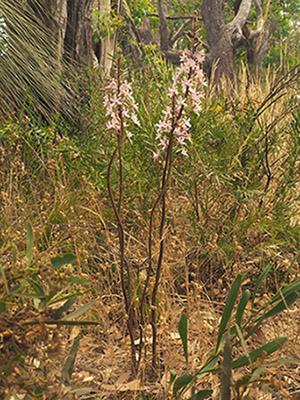
Dipodium pardalinum. Rarkang Rd, Silverton, Jan 9, 2017.
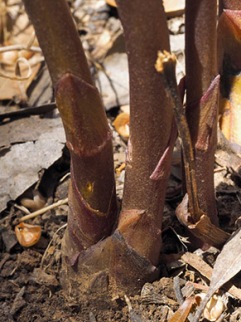
Two spikes of Dipodium pardalinum emerging from one tuber.
Rarkang Rd, Silverton, Jan 9, 2017.
A clump of Dipodum pardalinum spikes with at least two emerging from one tuber; see photo above.
Rarkang Rd, Silverton, Jan 9, 2017.
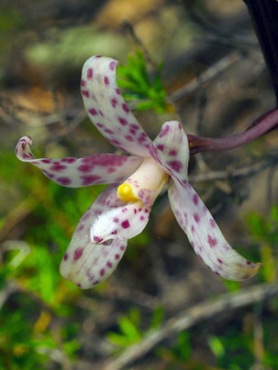
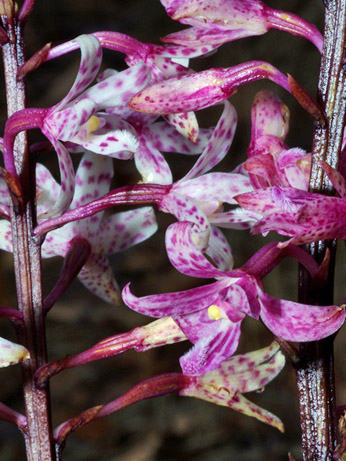
Dipodium pardalinum (labellum white with dark pink spots) growing intertwined with D. roseum, (labellum pale pink with dark pink stripes).
The following is part of a three part series on reviving apparently dead epiphytic orchids from Volume 31 No6 July 2007
Rescuing Apparently ‘dead’ Orchids
By Brendan Killen
In late Spring 2006, I had an ‘open shade house’ event at my place in Belair, South Australia. As part of the programme, I demonstrated how I rescue orchids that have all but died. My demonstration was based on many years of experience in not giving in to the demons that cause orchids to expire.
I used two orchids that everyone attending agreed would normally be tossed into the rubbish bin or compost – all bare canes; heavily shrivelled; all new growth ‘eyes’ at the base of the canes chewed out by insects. In other words, an apparently hopeless situation. I’ve never given up on these terminal plants, believing that they still had life in the old canes along as they hadn’t turned to fermented mush.
I also used an apparently ‘dead’ cane from a treasured orchid that I was hoping would eventually produce a back-up plant using the method I describe in the following text.
In one case (Dendrobium Jayden), I cut the canes into a number of segments and stuck them into a pot with heavily compressed sphagnum moss, topped with river gravel to suppress the moss from growing and overtaking the pot. In the other two cases (Den. Alick Dockrill & Den. Sarah Jane), I cut the canes into segments and placed them in a pot of small composted bark.
The following photographs were taken about 3 months after the repotting demonstration and after the plants were relocated to Brisbane. They demonstrate the benefit of the right technique and a ‘don’t give up’ attitude. This technique has not failed me yet, allowing me to rescue many prized plants that have gone on to be show-bench winners.
PLANT #1 – Dendrobium Jayden “Jane”.
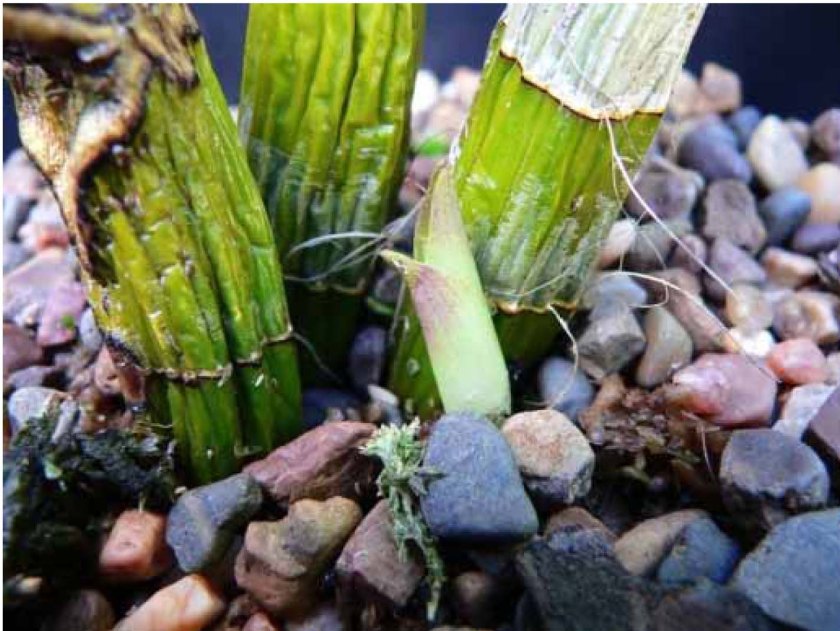
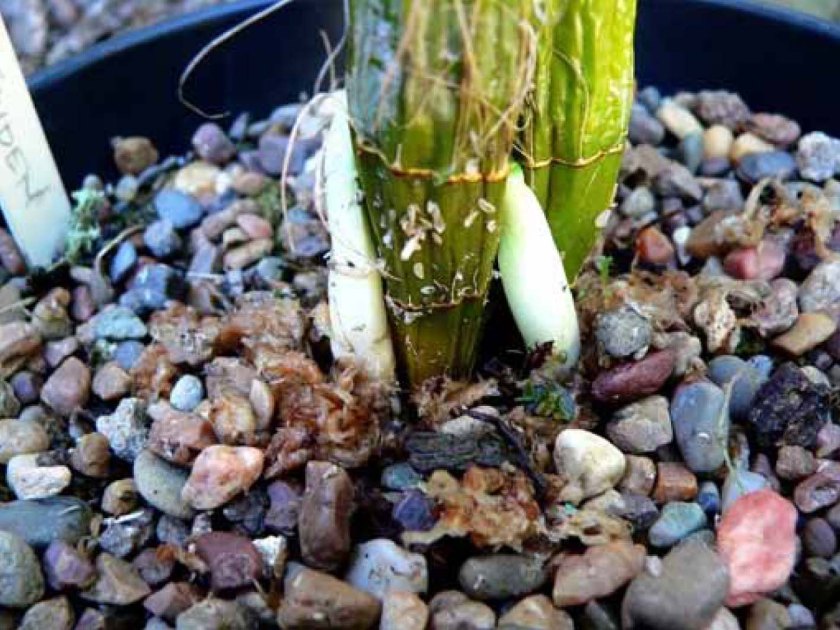
This photo illustrates the emerging new growth on a Den. Jayden “Jane”. This is the first evidence that success is at hand. It is also the first new growth discovered on this plant before I inspect the canes further to see if there are any other new growths buried within the sphagnum moss.
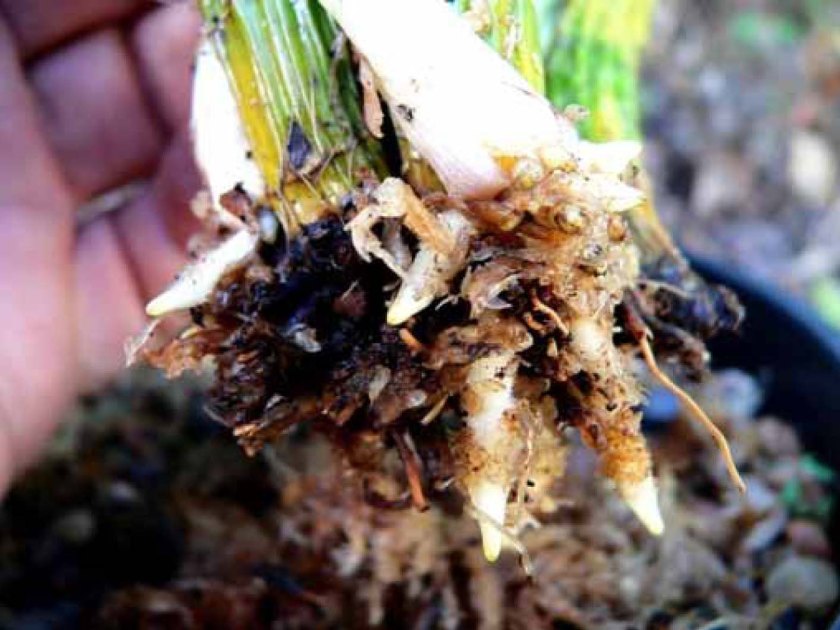
In this photo, you can see that the new growth is very pale from having emerged from deep in the sphagnum moss with little exposure to light. The juvenile roots can be seen emerging on the right hand side.
A closer inspection reveals another growth, on the other side. Note that both growths are not coming from the ‘eyes’ at the bottom of the canes – simply because they were cut off at potting time. They are emerging from the section that joins the cane segments.
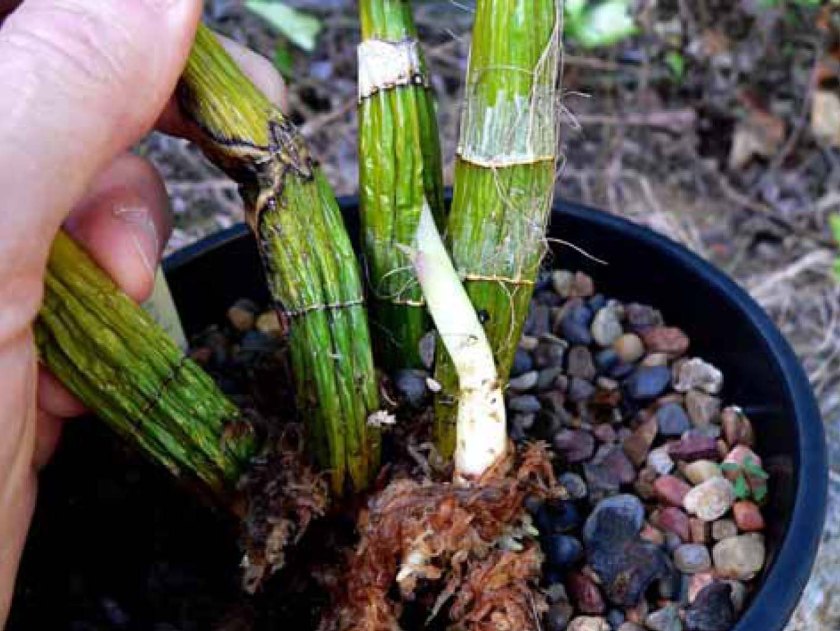
Teasing away the sphagnum moss reveals even more of the young roots. Note how the new growths are lacking any colour substance at this stage.
If I were to ignore this plant for much longer, the new growths would have rotted in the very moist sphagnum moss, neutralising my efforts. So, the lesson here is to ensure that you monitor the plants for new growths and ensure that you elevate the new growths above the sphagnum moss to give them a chance to ‘harden off’ from their immersion deeper in the sphagnum.
This photo illustrates how I have re-seated the canes within the sphagnum moss, but much higher so that only the roots are exposed to the heavy moisture content of the moss. I choose to do this instead of placing them straight into a bark mix as I find that the plants tend to go into a shock at the relative lack of moisture in bark and can die quickly, or suffer from stunted growth. I wait until the new growths have matured with substantial green substance before I repot them in a bark mix. And, I tend to do this in late autumn when they are not under any temperature or light stress. By spring, they will be racing ahead in the bark mix with new root growth and, possibly new canes and/or flower spikes.
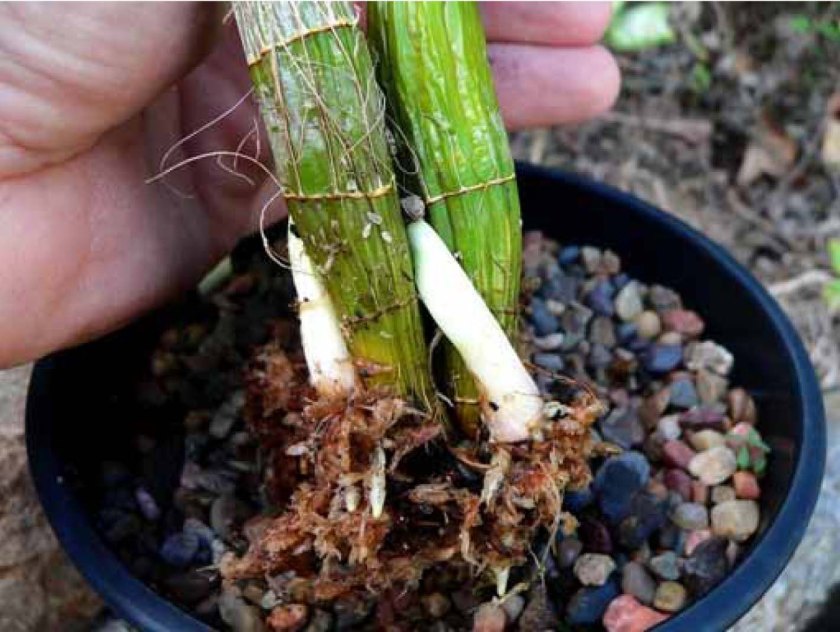
One Month Later……….
After one month from the re-seating described previously, note that the pale new growth is now mature and bright green. And, note how the roots are emerging from the growth above the sphagnum moss. This plant will be ready for potting-on into a bark medium in the next few weeks as autumn cools the air in Brisbane.





 NOSSA
NOSSA 