At this time of the year there are not many orchids flowering in South Australia but one that is just finishing is Spiranthes alticola. The genus Spiranthes, commonly known as Ladies Tresses, is found throughout Australia, Eurasisa and the Americas.The following description is an extract from South Australia’s Native Orchids 2011 DVD which is available from the Native Orchid Society of South Australi.
Spiranthes alticola D.L.Jones
Swamp Spiral Orchid
Etymology: The name alticola means high dweller, referring to its distribution in Eastern Australia, in west Victoria and South Australia’s South East. It also grows near sea level.
Synonyms: Previously included in Neottia australis R. Br., S. sinensis (Pers.) Ames and S. australis R.Br.
ASCII
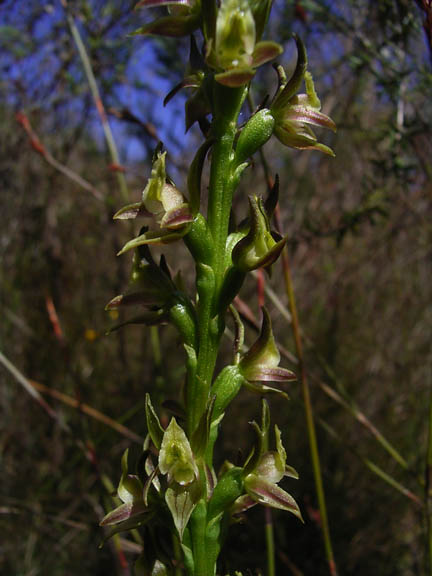
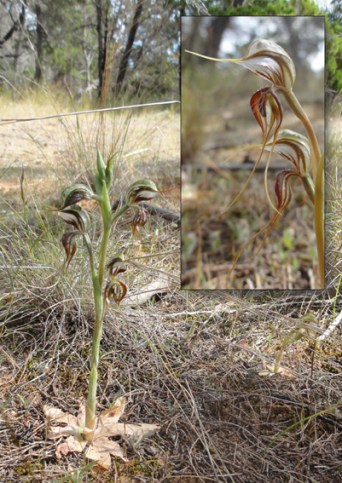
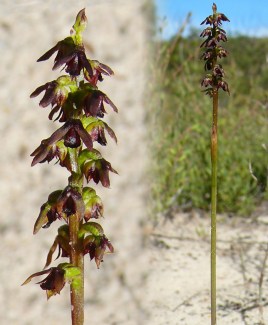
(These two pictures show the variation in colour.)
Description:Leaves 3-5, narrow lanceolate, shiny, erect at the base, to 15 cm long. Flowerstem to 45 cm tall, slender, flexible, with several sheathing bracts. The flowers are numerous in a dense spiral, pink with a white labellum, rarely all white. Segments are 6-10 mm long, sepals somewhat triangular, petals lanceolate, together forming a short tube, the tips free and recurved, and the lateral sepals divergent. Labellum with a broad, decurved crisped, pellucid mid-lobe, side-lobes erect small. The flowers are faintly fragrant.
(Leaves of Spiranthes alticola)
Flowering: Dec – Jan – Feb.
Similar Species:S. australis, S. sp. Late selfing-white.
Distribution:SL, KIx, SE; NSW, Vic, Tas.
Confined in South Australia to a few high rainfall, near coastal, often mountain locations, southward from the Adelaide Hills in the Southern Lofty region, extinct on Kangaroo Island, (one record only), and South East; also in New South Wales, Victoria and Tasmania.
Habitat: Restricted to peaty bogs and swampy creek-sides, often in locations that are inundated throughout winter; in some areas surviving in paddocks grazed by stock.
Distinguishing Features: S. australis, which is from the eastern states and is not strictly a swamp plant, has smaller darker pink flowers with a narrow labellum.
The two South Australian forms treated here are regarded as distinct species as where they are sympatric they begin flowering at different times and do not intergrade. S.alticola is the more delicate of the two.
Notes: The best specimens are found on mowed firebreaks adjacent to swamps.When vegetative reproduction produces two clonal plants next to each other the spiral arrangement of one is often a mirror image of the other. See Gallery.
Native bee pollinators work the spikes from the bottom upward but as the stigma becomes receptive well after the pollinia have matured this mechanism helps ensure outcrossing.
Plants do well in cultivation if kept moist over summer.
Conservation Status:
Status in Legislation: Not listed nationally, rare in South Australia.
Suggested Status: Rare in South Australia but more common in the Eastern States
Ten years ago, the then NOSSA secretary, Cathy Houston, wrote an article reflecting upon orchid name changes. Since then there have been more name changes. The issues she raised then are still pertinent today. Whilst we continue to learn more about our orchids, name changes are going to happen.
NOSSA Journal Volume 31 No 2 March 2007
HAVE OUR ORCHIDS CHANGED? Cathy Houston (Secretary)
This month the Native Orchid Society of South Australia celebrates its thirtieth “birthday”. A review of the first five years of the Society’s Newsletters/Journals (yes, they were newsletters in the earliest days) reveals some interesting points. By 1979 “A total of 110 species [of orchids] and 14 varieties” were accepted. The following are some interesting aspects about the knowledge of, and what was then current thinking about, our orchids at that time. It must be remembered that no comprehensive book on South Australian orchids existed in those days, especially not any field guides. The most useful “tools” the members had to work with were Blacks Flora of South Australia and W.H. Nicholls “Orchids of Australia”. In 1979 “A Checklist of Orchidaceae on South Australia” by J.Z. Weber: Changes introduced in the new ‘Black’s Flora” by R. Bates, appeared as a full issue of the Native Orchid Society of South Australia Journal.
Today we sometimes struggle to grasp all the fine differences when orchid species, or species groups, are split, but spare a thought for those wanting to identify with what they have seen in the field back in about 1979. An article by R. Bates describes the “Variations within the species Caladenia dilatata R.Br. in South Australia”. “There are, at present, two recognised varieties” viz. C. dilatata var. dilatata and C. dilatata var. concinna. Within these two varieties are further more divisions into distinct sub-varieties or races! At that time there were six distinct forms recognised; how much easier today, now that they are named as species. These would now include C. tentaculata, C. verrucosa, C. stricta, C. toxochila and C. conferta.
Arachnorchis tentaculata (King spider Orchid) syn Caladenia tentaculata
Recognition of what could be species has long been apparent. Take for example the article written in 1980 about two forms of Pterostylis nana, viz. what we commonly refer to as the ‘Hills’ form and the ‘Mallee’ form. This article documents the obvious morphological differences and illustrates this with line drawings and a map showing distributions of the two. Electronic Orchids of S.A. currently recognises five possible species of P. nana for South Australia. These are probably all un-named, since David Jones, in “Native Orchids of Australia”, does not recognise true P. nana in our state. Similarly, an article written in 1981 discusses the P. alata – scabra – robusta complex. The author recognises there are “at least four species of this group in South Australia”. This is the first time the authors acknowledge they should be elevated to species, not just accepted as varieties or forms. At that time P. robusta was treated at varietal level, viz. P. scabra var. robusta or P. alata var. robusta. Ultimately most of these have been elevated to species level (P. dolichochila, P. erythroconcha, P. robusta, and P. striata).
It was noted that in 1978 David Jones and Ray Nash were currently working on Pterostylis. Further to that Les Nesbitt notes that of the sixty or so Pterostylis in Australia, South Australia has twenty-two species. One wonders what the count is now. It is well known that David Jones is currently/still working on the Pterostylis group, with more species being recognised regularly.
Thelymitra x irregularis or Pink Spotted Sun Orchid was photographed in 2009 near Macclesfield
In a series of articles produced about “Our rarest orchids” in 1977 we find the comment “Very few of our orchids are thought to be extinct… . “One wonders what that number would be considered to be today. The same article talks about the demise of Pterostylis cucullata and the possibility that it may no longer exist in the wild. Certainly this is one of our highly endangered species for which recovery actions are being undertaken these days. [N.O.S.S.A. members have an opportunity to assist with this work starting on April 14th – see diary dates.] In 1977 there was excitement when, following a field trip to Belair National Park one member returned the following day and “the elusive Pterostylis cucullata” was seen “growing in association with P. curta”. In 1981, following a discussion and review of endangered orchids in South Australia, R. Bates writes “There are a number of endangered species in S.A. which have not yet been named. It is not unlikely that some of these will become extinct before they are even described properly.” With such a large number of as yet undescribed orchids in our state, let us hope this does not happen.
Naturally occurring hybrids and the naming of such, has been debated regularly within botanical circles. In 1978 this insight is shown by Ray Nash who “guided us to a nearby patch of Thelymitramacmillanii,…… Ray’s view is that this will probably turn out to be a hybrid, possibly between antennifera (which it closely resembles) and rubra or luteocilium.” In 1980 T. decora [T. x truncata] was featured as one of South Australia’s rarest orchids. It was thought to be of hybrid origin and three forms were recognised then. The probable parents were T. ixioides x T. longifolia, T. ixioides x T. pauciflora, and T. ixioides x T. mucida. Today with the naming of many species within the T. pauciflora complex, it is now being recognised that there are even more combinations producing similar type flowers, e.g. T. juncifolia, which gives rise to the spotted features, x T. brevifolia.
Name changes always raise controversy. A brief explanation giving some insight into this complex area can be picked up when an author is expanding on the front cover illustration of Corybas. “In fact, they should never have been called Corybas in the first place. They were discovered by Robert Brown during the Flinders Expedition (1801 – 1805), and illustrated by the Austrian Ferdinand Bauer, another of the members of the expedition. Brown called them Corysanthes from the Greek “korys” (a helmet) and “anthos” (a flower), and they were known for many years by that name. However, in this instance, justice was never truly done, because the decision was made to call them Corybas, the name previously allotted by R.A. Salisbury in 1805, on the strength of seeing Bauer’s illustrations.” More recent times have seen that injustice righted with the name reverting to Corysanthes, something brought about through the work of David Jones. Similarly, the latest naming of Corunastylis tepperi follows this, The International Code of Botanical Nomenclature, a name that was recognised by R. Bates in an article written in 1981! However, Bates concludes that P. tepperi and P. nigricans are synonymous, so the latter prevails, but “further work needs to be done”! He is also the author of an article depicting some name changes in 1980. If our readers are confused by “new” names, then just think what it was like for those in 1980 when, among others, Caladenia carnea, and all its five varieties, is changed to C. catenata, with all its varieties, two of which are C.catenata var. gigantea and C. catenata var. minor. Two others were elevated to C. pusilla and C. alba.
Corysanthes diemenica (Veined Helmet Orchid)
At one time our esteemed orchidologist was asked to comment on a list of name changes being proposed for the revision of Black’s Flora of S.A. “My first reaction was to state that everyone would be happiest if no changes were made”! However, in fairness to that gentleman, it must be said that by the time he had worked through a lengthy consultation with botanists covering much of Australasia, a revision of type specimens and other material and associated literature, he was clearly of the opinion that the changes were warranted.
Have our orchids changed? Maybe, but what has really changed is our knowledge and understanding of these unique plants. Based on that knowledge, opinions, attitudes and ideas have changed. Thirty years ago it was not “policy to differentiate between the numerous forms of C. patersonii in this State …” Today we have numerous named species in this complex, without actually any Caladenia patersonii as such.
The final word must come from Peter Hornsby when he said “The ultimate aim should be for the reader to know which plant is being discussed, rather than whether or not the title is absolutely correct.”
References:
Native Orchid Society of South Australia Journal.
1. 1977 Vol. 1 #5
2. Vol. 1 #9
3. 1978 Vol. 2 #2
4. Vol. 2 #6
5. Vol. 2 #7
6. 1979 Vol. 3 #1
7. Vol. 3 #6
8. Vol. 3 #9
10. 1980 Vol. 4. #3
11. Vol. 4 #4
12. Vol. 4 #6
13. Vol. 4 #7
14. 1981 Vol. 5 #1
15. Vol. 5 #3
16. Vol. 5 #4
17. Vol. 5 #6
Black J.M. 1978. Flora of South Australia, Part 1, Third Edition. Handbooks Committee, South Australia.
Jones David L. 2006. A Complete Guide to Native Orchids of Australia, Including the Island Territories. Reed New Holland, Australia.
Nicholls, W. H. 1969. Orchids of Australia; The Complete Edition. Thomas Nelson, Australia.
A site, along Rarkang Rd, Silverton, leading into Talisker Conservation Park, was visited on December 29, 2012, January 2, 2014, January 16, 2015 and January 9, 2017.
In the earlier years about 20 specimens of Dipodium pardalinum were found with 18 (plus 3 beheaded) in 2015. A small number of D. roseum was located in 2012, none in 2014, one in 2015 and none at all in 2017.
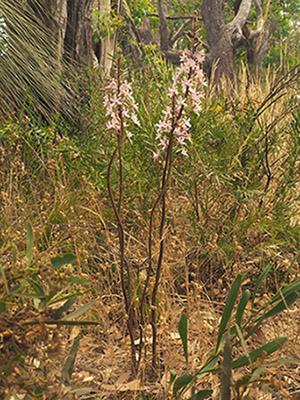
In 2017 there was bumper crop of D. pardalinum and Ed Lowrey, Helen McKerral and I counted 124 flower spikes. This may represent only 122 plants because in two instances there were two spikes emerging from one tuber (see image). It is possible that other closely placed flowers were also growing from a single tuber. This same phenomenon was observed in two cases, with D. roseum, at Hender Reserve, Stirling, on January 12 this year.
All spikes of D. pardalinum this year were found on the verges of Rarkang Road or nearby inside private property in small holdings, with houses, adjoining the road, apart from two spikes only, just inside the Talisker Conservation Park, where Rarkang Road heads into it.
The genus Dipodium is much more varied than I realised. Our DVD, South Australia’s Native Orchids, only deals with the ‘leafless saprophytes, mycophytes or hemiparasites’. If you go to ‘Native Orchids of Australia’ (Jones, 2006), you will find that among the terrestrial species there are both leafless species (as with the local D. pardalinum and D. roseum), that are impossible to cultivate and one species with leaves (D. ensifolium), found from Cooktown to Ingham, in Qld. It is easy to grow in a pot. Bob Bates told me that it is grown here in Adelaide, preferring a heated glass house, but has been grown successfully in gardens. And then there is a leaved species, D. pandanum, of limited distribution in Qld, that can be either terrestrial or epiphytic, growing up to 5 m in length. Old pieces that break off and fall to the ground, nestle in the leaf litter and put out new shoots that eventually climb into the trees. It is easy to grow in a pot (in the right climate).
Leo Davis.
Dipodium pardalinum. Rarkang Rd, Silverton, Jan 9, 2017.
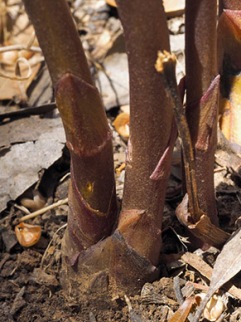
Two spikes of Dipodium pardalinum emerging from one tuber.
Rarkang Rd, Silverton, Jan 9, 2017.
A clump of Dipodum pardalinum spikes with at least two emerging from one tuber; see photo above.
Rarkang Rd, Silverton, Jan 9, 2017.
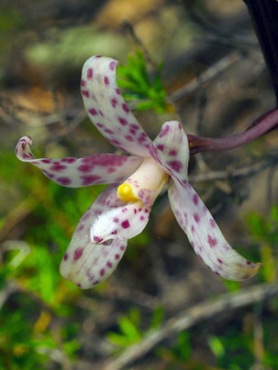
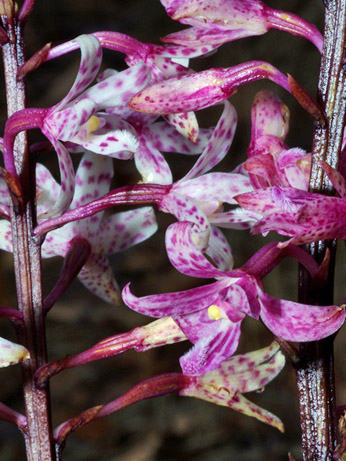
Dipodium pardalinum (labellum white with dark pink spots) growing intertwined with D. roseum, (labellum pale pink with dark pink stripes).
There is a lot of information on the web about treating scale, some relevant to a specific country, some accurate, some not and much that is contradictory.
The following information is based upon treatment methods that the Native Orchid Society of South Australia (NOSSA) growers have found most effective.
WHAT IS SCALE?
Scale are tiny sap sucking insects of which there are several species in Australia. The female adults build a shield-like cover for protection. The shields are often brown but can be white or red. The shield can be up to 3mm in size. Once a shield is built the adult does not move about but stays in the one position. Ants farm scale as they exude a honeydew sap, a food source for the ants.
Immature scale or crawlers do move about. These can be a different colour from the adult eg juvenile brown scale can be yellow, other species can have grey juveniles. They are lightweight no more than 1mm and easily windborne.
The life cycle is short, and for many species, within a month there is a new generation of scale. Scale multiply rapidly.
Scale tend to attack epiphytic orchids. Evergreen terrestrial orchids may be affected but not the deciduous ones.
EFFECTS OF NOT TREATING SCALE:
Apart from making the plants look ugly, scale left unchecked can
infect other plants
weaken the plant leading to death of the plant
make the plant worthless for shows
develop secondary infection of sooty mould
treating the scale will treat the mould
Left untreated the new growth will eventually become infected
Quarantine and treat new plants before introducing them to the orchid collection
newly acquired plant can be a major source of scale infestation
for thoroughness, use both a contact and systemic spray (see below Types of Sprays)
Preventive spraying
schedule spraying 2 – 4 times a year
Consider relocating ferns if they are under orchid benches as this can often be a host for brown scale.
Control ants
If free-standing bench or hanging pots are free of scale and plants are not touching any other surface than applying Vaseline around each of the feet/lower part of the hooks will prevent ants and crawlers from moving into the area.
Vaseline is waterproof and so will be effective for a long time.
SCALE PREDATORS:
Biological control alone appears to be ineffective but the following is a list of known predators
Crypotlaemus montrouzieri Native ladybird feed on mealybugs and felt scale
Mallada signata, Green Lace Wings, feed on aphids, spider mites, various scales, mealybugs, moth eggs and small caterpillars
Chilocorus beetles
Aphystis wasp species
TREATMENT:
Scale are hard to eliminate entirely. Vigilance and persistence are important factors in controlling scale.
Treatment works either by
a direct contact spray whereby the insect is suffocated by smothering. This is effective for all stages of the life cycle but particularly for the adult under its shield.
an application of a systemic chemical.
or a combination of both.
For treatment to be effective the leaves (both upper and underside), crevices, sheaths, pseudobulbs, stems must be thoroughly drenched with the spray of choice.
Types of Sprays
Contact Sprays
Whatever type of contact spray used, treat every 2 weeks for three treatments
Soapy Water (for those who like using home-made remedies)
Using pure soap (not detergent), suds up a bar in a bowl of water, and pour into a spray bottle.
The Native Orchid Society of SA has been involved with the Threatened Orchid Project which is attempting to propagate some of our most threatened orchids. There has been some success such as Thelymitra epicaptoides (Metallic Sun Orchids) but others are proving elusive. Marc Freestone, from the Orchid Conservation Project, Royal Botanic Gardens Victoria, is a PhD student who is researching one such difficult to grow orchid genus, the Prasophyllum.
Prasophyllum murfettii (Denzel’s Leek Orchid)
To assist with his research Marc has the sent the following request.
CAN ANYONE GROW LEEK ORCHIDS?
South Australia has about 40 species and Victoria about 74 species of the native Leek Orchids, Prasophyllum. Some are on the brink of extinction.
A major problem hampering efforts to prevent our Leek Orchids from going extinct is that they have proven next to impossible to grow in cultivation. They have proved extremely difficult, usually not germinating at all, or germinating but then dying soon after. Occasionally some success has been had (particularly with symbiotic germination) but successful germination trials to our knowledge have so far proved un-repeatable. Working out how to grow Prasophyllum is critical for the survival of many species at risk of extinction across southern Australia.
To try and change this, I will be studying Prasophyllum and their relationships with symbiotic mycorrhizal fungi.
But I need your help!
I am wanting to hear from as many people as possible who
have tried (either successfully or unsuccessfully) to grow Leek Orchids or the closely related Midge Orchids (Corunastylis).
have observed Leek Orchids (or Midge Orchids) recruiting from seed in the wild.
If you can help, or know of anyone who might be worth talking to, please contact me at: marc.freestone@rbg.vic.gov.au or 0428 304 299.
(Funding and support for this project: Australian National University, Federal Government National Environmental Science Programme, Royal Botanic Gardens Victoria, University of Tasmania).
I would encourage people to contact Marc with whatever information that you have, no matter how insignificant you may think it is. Every little bit helps including unsuccessful attempts.
His eventual aim is to be able to work out how to grow them reliably from seed in cultivation.
Orchid names are contentious. The reasons appear to be complex but whatever the reasons the situation exists whereby some orchidologists are naming species that may or may not be accepted by others. The result is that there are publications using different names for the same species. And of course, in the midst of it all, are those names that have been accepted for previous species with phrase names or manuscript names.
Whatever the name, it is helpful then to be able to match them up. Last week’s blog covered South Australian names but in the same week Andrew Brown published on the Western Australian Native Orchid Conservation Study Group Facebook an updated list of WA orchids whereby he has linked them with significant WA Orchid field guide books.
Andrew has kindly given permission for this list to be published. Other lists are also included and these are available on the NOSSA’s Orchid eBook page.
It is worth reading Andrew’s introduction in ALIGNMENT of WESTERN AUSTRALIAN DIURIS AND PTEROSTYLIS NAMES.
The object of this exercise is to align the phrase names in these three publications with names published in recent taxonomic papers. Please note that most, but not all, currently recognized (described and undescribed) Western Australian Diuris and Pterostylis are included. There are other taxa that may be considered worthy of recognition but have not been included at this time as we feel further research is required.
In the case of phrase names, these are added and removed for taxa as new information comes to hand and should not be thought of as the final view. Rather, these should be thought of as current thinking that may change in the future. Taxa are only formally recognized as being distinct once their scientific names are published. Even then, later thinking may result in further changes.
Given that phrase names are a work in progress, some may think that we should not be promoting their use and that they should not be included in popular books. However, I think it is worthwhile putting them out to the wider audience so that their distinctiveness can be debated. Having a large group of people looking for (and at) these taxa provides us with a great deal of information and opinion based on firsthand experience in the field, that we may not otherwise have obtained. Then, if and when the taxon is formally described, it will be done on a much more informed basis.
As I am sure you are aware, the naming plants is an evolving process and there will be further changes as new information comes to light.
For the novice or beginner, orchid names can be a bit overwhelming. To add to their confusion, the more knowledgeable people tend to use abbreviated terms often switching between common and botanical names & their synonyms.
This week’s post will be a brief introduction to the most common names used for the South Australian orchids and how they relate to each other. It will not be comprehensive and it will not be a detailed discussion of orchid nomenclature but hopefully it might help the novice learn some of the names in current use.
In the past attempts have been made to split some genera. Not everyone has agreed with the splits but there are many who find it more convenient to use the alternate genus when working in the field. This tends to be the case with the larger genera such as Caladenia, Corybas and Pterostylis. Unfortunately, this has contributed to the confusion.
The names in this list are compiled from South Australia’s Native Orchids 2011 DVD. Even with this list the use of the names varies quite a bit with some being used rarely. Rather than considering each individual species, the list is centred around the genus name.
GENUS
ALTERNATE
GENUS NAME
or
SYNONYM
COMMON NAME
Acianthus
Acianthus
Acianthus
Mosquito
Acianthus
Nemacianthus
Mayfly
Caladenia
Caladenia
Caladenia
Pink Fairy
Caladenia
Arachnorchis
Spider
Caladenia
Jonesiopsis
Daddy Longlegs
Wispy Spider
Caladenia
Petalochilus
Pink Fingers
Caladenia
Pheladenia
Bluebeard
Blue Fairy
Caladenia
Stegostyla
Gremlin
Caleana
Caleana
Caleana
Duck
Caleana
Paracaleana
Little Duck
Calochilus
Bearded
Beardies
Chiloglottis
Chiloglottis
Chiloglottis
Bird
Chiloglottis
Myrmechila
Ant
Chiloglottis
Simpliglottis
Frog
Corybas
Corybas
Corybas
Helmet
Corybas
Corysanthes
Helmet
Corybas
Anyzbas
Pelican
Genoplesium
Corunastylis
Midge
Cryptostylis
Tongue
Moose
Cyrtostylis
Gnat
Dipodium
Hyacinth
Diuris
Donkey
Eriochilus
Parson’s Bands
Autumn Bunnies
Gastrodia
Potato
Cinnamon Bells
Glossodia
Purple Cockatoo
Waxlip
Leporella
Fringed Hare
Leptoceras
Rabbit Ears
Hare Orchid
Microtis
Microtis
Microtis
Onion
Microtis
Hydrorchis
Mignonette
Microtis
Microtidium
Yellow Onion
Orthoceras
Horned
Crucifix
Prasophyllum
Leek
Pterostylis
Pterostylis
Pterostylis
Greenhood
Pterostylis
Bunochilus
Banded Greenhood
Pterostylis
Diplodium
Shell
Pterostylis
Hymenochilus
Tiny Shell
Pterostylis
Linguella
Little Greenhoods
Nana
Pterostylis
Oligochaetochilus
Rufoushoods
Pterostylis
Plumatochilos
Bearded Greenhood
Pterostylis
Speculantha
Tiny Greenhood
Pterostylis
Taurantha
Cobra Greenhood
Pterostylis
Urochilus
Maroonbanded Greenhood
Sanguinea
Blood Greenhood
Pyrorchis
Fire
Undertaker
Spiranthes
Ladies Tresses
Spiral
Thelymitra
Sun Orchid
A detailed list of SA orchid species names and their synonyms can be found here .
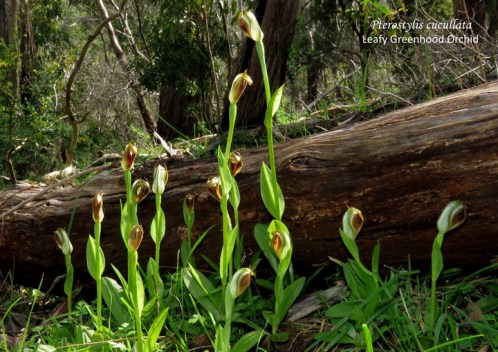
The following are all Pterostylis but not all of them are Greenhoods. This first image is a Pterostylis Greenhood.
Pterostylis cucullata
This one is a Shell Orchid or alternately Diplodium
Diplodium dolichochilum
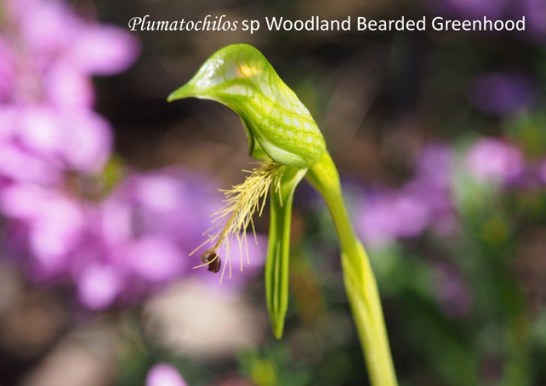
Whilst this Pterostylis is a Bearded Greenhood or Plumatochilos
Plumatichilos sp Woodland Bearded Greenhood
The final Pterostylis example is a Rufoushood, or Oligochaetochilus
Typical of the Rufoushood this Oligochaetochilus arenicola shows the sencesing leaves, pendent petals and hairs on the labellum. Photographer: H Lawrence
So they could all be referred to Pterostylis or any of the other possible names whether the common name or a synonym.
This week we continue with both Part Two and Part Three of Brendan Killen’s Rescuing Apparently ‘Dead’ Orchids which appeared in the Volume 31 No 9 October 2007 and Volume 31 Bi 11 December 2007, respectively.
Rescuing apparently ‘dead’ orchids. Part 2 By Brendan Killen
PLANT #2 – Dendrobium Alick Dockrill “Pale Face”
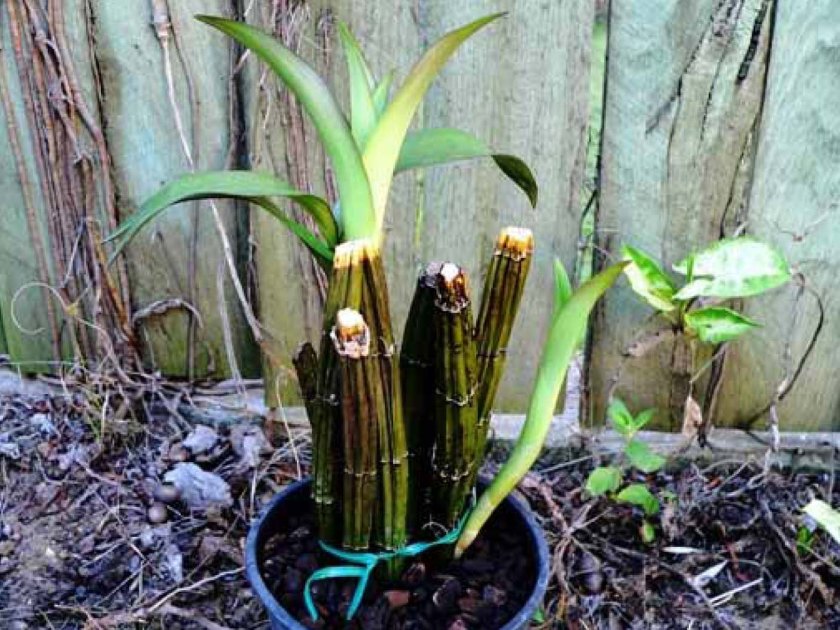
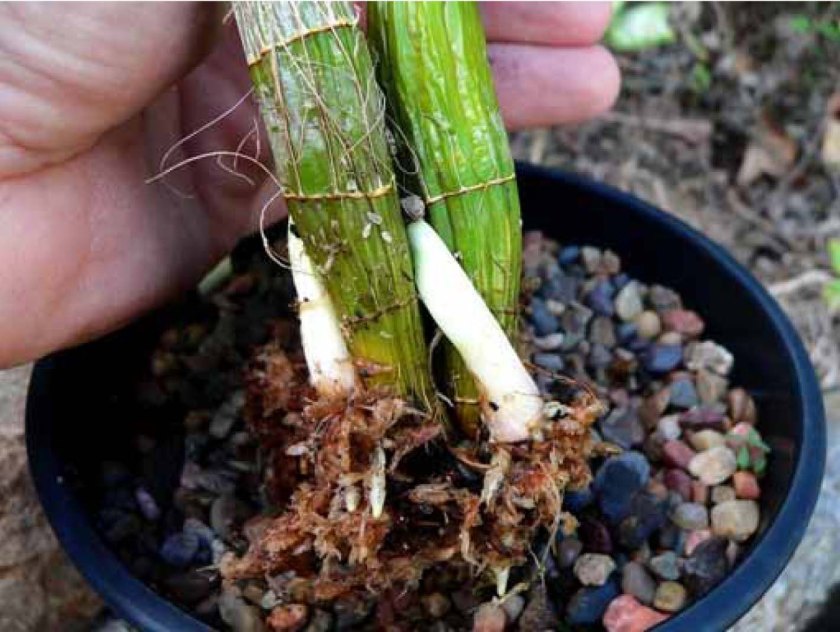
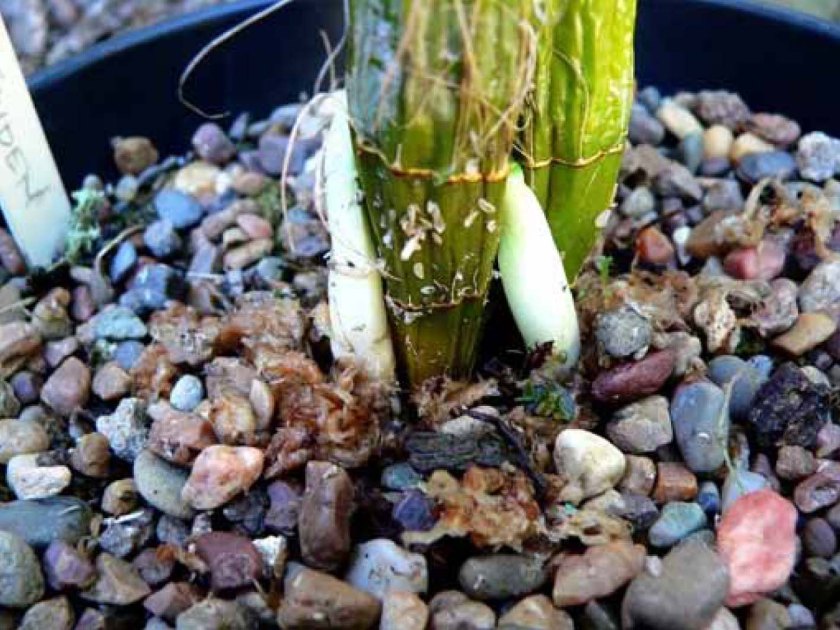
The cane pieces of this plant were inserted into a bark mix at the same time as the canes of Den. Jayden ‘JANE’ [See the July Journal] were inserted into sphagnum moss. The outcome is three healthy growths.
Note the dried ends of the canes where they were cut into separate pieces. As you can see from the photograph, I used a green twisty to hold the canes in the bark as a fairly solid bunch – I find this is the best way to keep the canes still whilst they are developing sensitive new growths. I have found that no matter how bunched-up the canes are, the new growths always find a way to the surface.
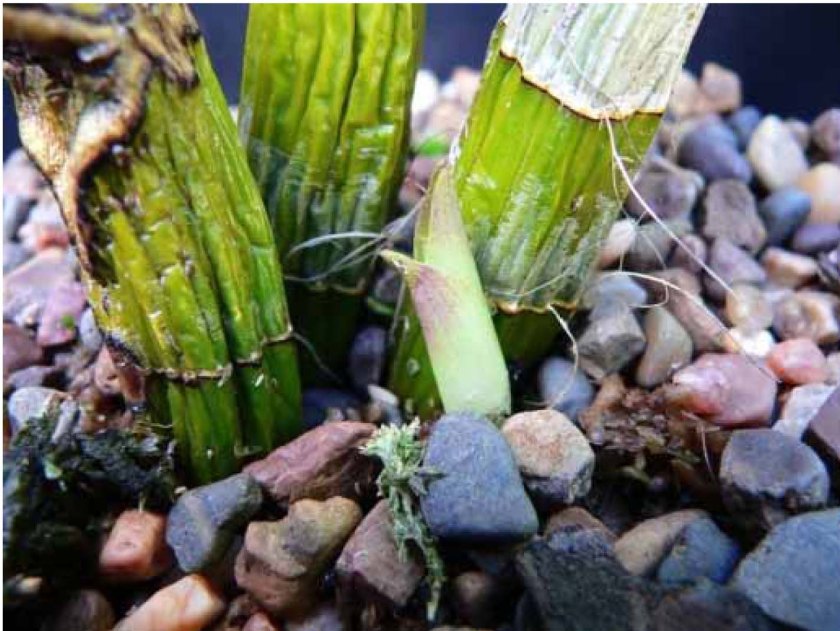
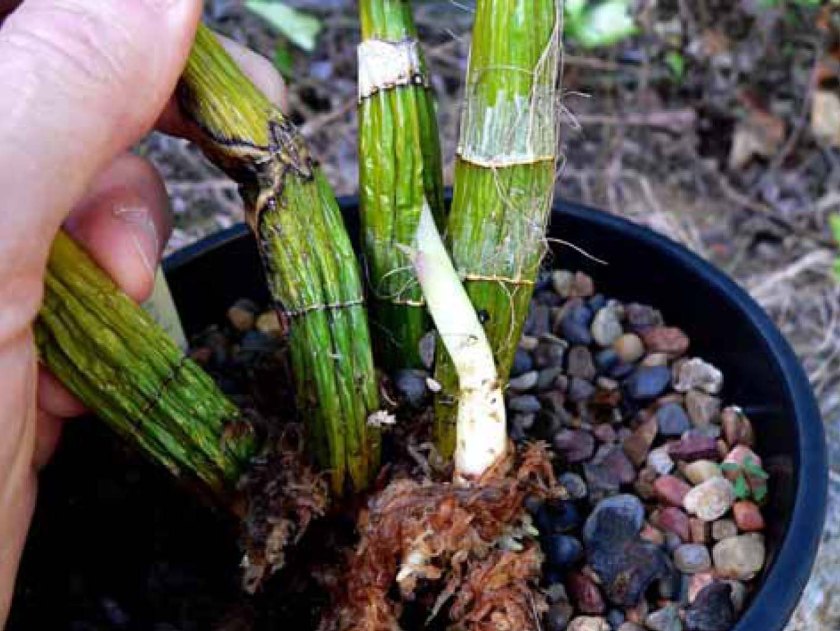
Here is a different angle on the new growths with my fingers providing some perspective on the size of the growths.
Note that they are significantly larger that those on the Den Jayden ‘JANE’, with the same time in the pots.
I do not consider this evidence of the worth of bark compared to sphagnum moss.
I find that different hybrids and species behave quite differently in terms of their speed and timing of production of new growths. I believe that it is a function of what species are in the background of these plants and the time of year the rescue is undertaken.
Here is the same plant 5 weeks later. The new roots are protruding from the pot and the new growths are extending themselves – all of this at a time where severe water restrictions limit me to two waterings each week by watering can!
A further 4 weeks of cultivation and bright, warm weather has fully extended and hardened the new growths.
The larger growth should produce a flower spike this Spring.
This is a plant that the late John Purvis gave me just before he passed away. Because it is a special plant to me, I cut an old cane into three pieces to produce a back-up plant, just in case my piece of the original fell foul of the orchid gremlins.
As you can see, it is the least developed of the three plants featured in this article. And yet, the parent plant has produced two magnificent new growths in the same period. I feel that the 12.5% of Den. bigibbum and 12.5% of the hot growing Den. tetragonum var. giganteum have influenced this. This new growth has probably been encouraged since the relocation from Adelaide to Brisbane where the temperature differences overnight are more subtle than in the Adelaide Hills where the plants were previously cultivated. The two hot growing species in the plant’s background were probably held back by Adelaide’s much cooler overnight temperatures. Anyway, this is purely conjecture on my behalf. What is important is that I now have a developing back-up plant for one that I treasure dearly.
Dendrobium Sarah Jane ‘Purvis’ (Photographer Josh Bridge)
SUMMARY
The thrust of what I have written is simple – don’t give up on treasured plants that look like they have expired, because there is always hope so long as the canes haven’t turned into fermented mush! The technique is as simple as cutting canes into lengths where you have at least three, preferably four, segments from which new growths will materialise. Use sterilized cutting tools to avoid contamination of the canes. Once the new growths have emerged, give them time to produce healthy root systems and let the new canes harden before potting-on. The best time I have found to pot-on the new growths is early autumn.
****************
Thank you to Josh Bridge for supplying images of the flowers of Dendrobium Alick Dockrill “Pale Face” and Dendrobium Sarah Jane ‘Purvis’ as they were not in the original articles.
***************
Another technique demonstrated by John Gay at one of the NOSSA meetings a couple of years ago was to take the apparently dead canes of an epiphytic orchid and seal them in a plastic bag with a small piece of damp sponge (or other cloth) and leave them in the shadehouse. Do not let the sponge dry out. So long as there was a bit of moisture, there was a chance for new growth on the shrivelled canes. Once the growth was obvious, pot on as normal.
The following is part of a three part series on reviving apparently dead epiphytic orchids from Volume 31 No6 July 2007
Rescuing Apparently ‘dead’ Orchids
By Brendan Killen
In late Spring 2006, I had an ‘open shade house’ event at my place in Belair, South Australia. As part of the programme, I demonstrated how I rescue orchids that have all but died. My demonstration was based on many years of experience in not giving in to the demons that cause orchids to expire.
I used two orchids that everyone attending agreed would normally be tossed into the rubbish bin or compost – all bare canes; heavily shrivelled; all new growth ‘eyes’ at the base of the canes chewed out by insects. In other words, an apparently hopeless situation. I’ve never given up on these terminal plants, believing that they still had life in the old canes along as they hadn’t turned to fermented mush.
I also used an apparently ‘dead’ cane from a treasured orchid that I was hoping would eventually produce a back-up plant using the method I describe in the following text.
In one case (Dendrobium Jayden), I cut the canes into a number of segments and stuck them into a pot with heavily compressed sphagnum moss, topped with river gravel to suppress the moss from growing and overtaking the pot. In the other two cases (Den. Alick Dockrill & Den. Sarah Jane), I cut the canes into segments and placed them in a pot of small composted bark.
The following photographs were taken about 3 months after the repotting demonstration and after the plants were relocated to Brisbane. They demonstrate the benefit of the right technique and a ‘don’t give up’ attitude. This technique has not failed me yet, allowing me to rescue many prized plants that have gone on to be show-bench winners.
PLANT #1 – Dendrobium Jayden “Jane”.
This photo illustrates the emerging new growth on a Den. Jayden “Jane”. This is the first evidence that success is at hand. It is also the first new growth discovered on this plant before I inspect the canes further to see if there are any other new growths buried within the sphagnum moss.
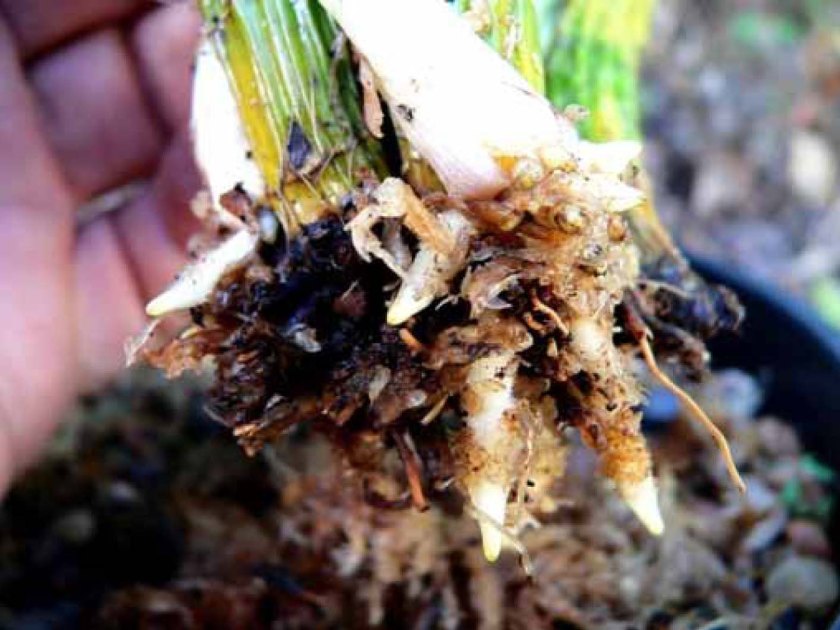
In this photo, you can see that the new growth is very pale from having emerged from deep in the sphagnum moss with little exposure to light. The juvenile roots can be seen emerging on the right hand side.
A closer inspection reveals another growth, on the other side. Note that both growths are not coming from the ‘eyes’ at the bottom of the canes – simply because they were cut off at potting time. They are emerging from the section that joins the cane segments.
Teasing away the sphagnum moss reveals even more of the young roots. Note how the new growths are lacking any colour substance at this stage.
If I were to ignore this plant for much longer, the new growths would have rotted in the very moist sphagnum moss, neutralising my efforts. So, the lesson here is to ensure that you monitor the plants for new growths and ensure that you elevate the new growths above the sphagnum moss to give them a chance to ‘harden off’ from their immersion deeper in the sphagnum.
This photo illustrates how I have re-seated the canes within the sphagnum moss, but much higher so that only the roots are exposed to the heavy moisture content of the moss. I choose to do this instead of placing them straight into a bark mix as I find that the plants tend to go into a shock at the relative lack of moisture in bark and can die quickly, or suffer from stunted growth. I wait until the new growths have matured with substantial green substance before I repot them in a bark mix. And, I tend to do this in late autumn when they are not under any temperature or light stress. By spring, they will be racing ahead in the bark mix with new root growth and, possibly new canes and/or flower spikes.
One Month Later……….
After one month from the re-seating described previously, note that the pale new growth is now mature and bright green. And, note how the roots are emerging from the growth above the sphagnum moss. This plant will be ready for potting-on into a bark medium in the next few weeks as autumn cools the air in Brisbane.
South Australia has some beautiful and delicate orchids. Most are not showy. Instead they have a subtle attractive beauty. But they are declining; and for that reason, they are protected by the law, specifically the Native Vegetation Act 1991. Picking the flower is illegal let alone digging up the whole plant.
The only situation where a person can legally remove an orchid or part thereof is when they hold a government authorised permit. Legitimate reasons for collecting orchid material include specimen for the State Herbarium, scientific research, rescue or salvage situations when a development is occurring, or collecting seed of threatened species to store with the Seed Conservation Centre.
Without a permit, no one can remove any part of a plant even if their reason is legitimate.
It behoves members to be cautious of any one that asks for assistance with collecting, transporting or photographing potted orchids. Ask to see their permit. So, what do you do if you suspect someone of picking the flowers or digging up the plants? Contact the Department Environment and Natural Resources Investigation and Compliance Unit.
There is only a very small number of NOSSA members who hold such permits. Thelma Bridle, NOSSA Conservation Officer, is the person who will know which members hold a permit. For more information on plant collection permits, contact DEWNR at DEWNRresearchpermits@sa.gov.au or visit the website.
Thank you to Thelma Bridle and Doug Bickerton for their assistance and critiquing of this post.
Corunastylis sp. Dark Midge Ngarkat Conservation Park Photo: June Niejalke











 NOSSA
NOSSA 