2017 September Cultural Notes

Steve Howard’s September Australian Epiphytes and Terrestrials Orchids Cultural Notes for Adelaide’s conditions.

Watering

Epiphytes

Mounts daily. Generally moistening roots only.

Pots weekly. Small pots twice weekly depending on weather.

Terrestrial

Pots can dry out faster on warmer days so keep a watch on conditions. Note some terrestrials will commence summer dormancy towards the end of the month. Those that do show signs can have water reduced somewhat.

Feeding

Terrestrials

Weak organics like Seasol and Powerfeed applied in low doses can benefit colony type greenhoods.

Epiphytes

Low nitrogen always best for native epiphytes. Top up epiphyte  pots with dolomite lime and a dash of blood and bone. Seasol a useful additive now as new seasons root start.

Pests and Disease

Epiphytes

Botrytis will rot new buds in cold damp weather as fast as it attacks new growths from now. Aphids will increase sharply this month and favour new growth and spikes.  Pyrethrum sprays eco friendly and work well, so does a hose but dry spike straight after.

Terrestrials

Some terrestrials will rot this month if conditions have been too wet or stagnant over winter. Note this for next season and add more drainage if this has been an issue.

General Advice

Keep flowering plants under cover to enjoy as can be rather wet and cold as well sunny and warm this month. Start repotting and division once flowering finished to give plants longest possible time to establish over new growing season.

Time to get busy and take note of the jobs of potting and division to be done. Sept and October are the best months to work on the collection before the hot weather sets in.

Do you have small slugs and snails in your pots?  Get a cheap coffee grinder and grind up your snail pellets. Sprinkle in the pot and water them in. Bite size for micro slugs and the baits get right into where they hide.

[Terrestrials are not repotted until summer – Steve will have more on that later]

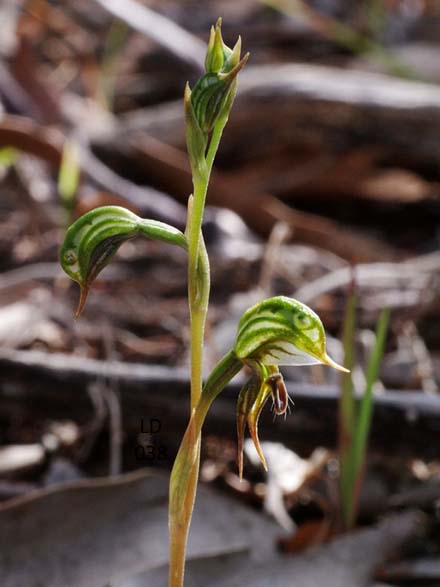
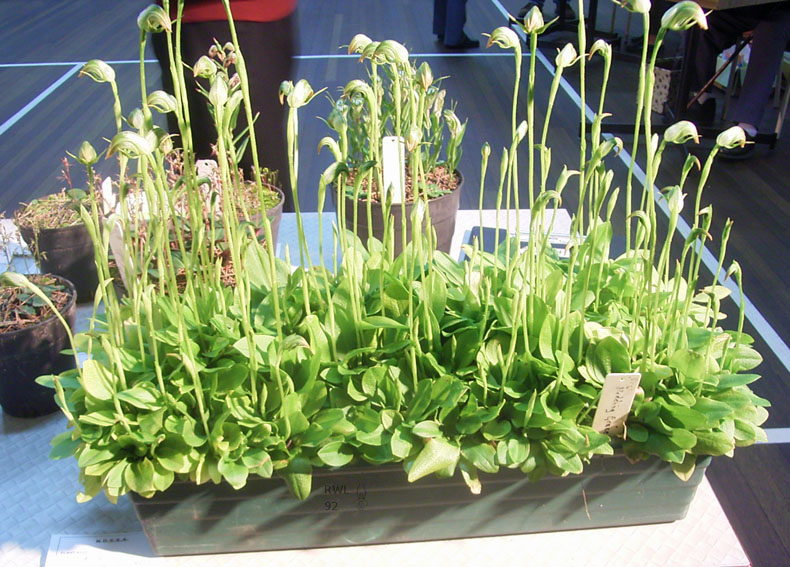
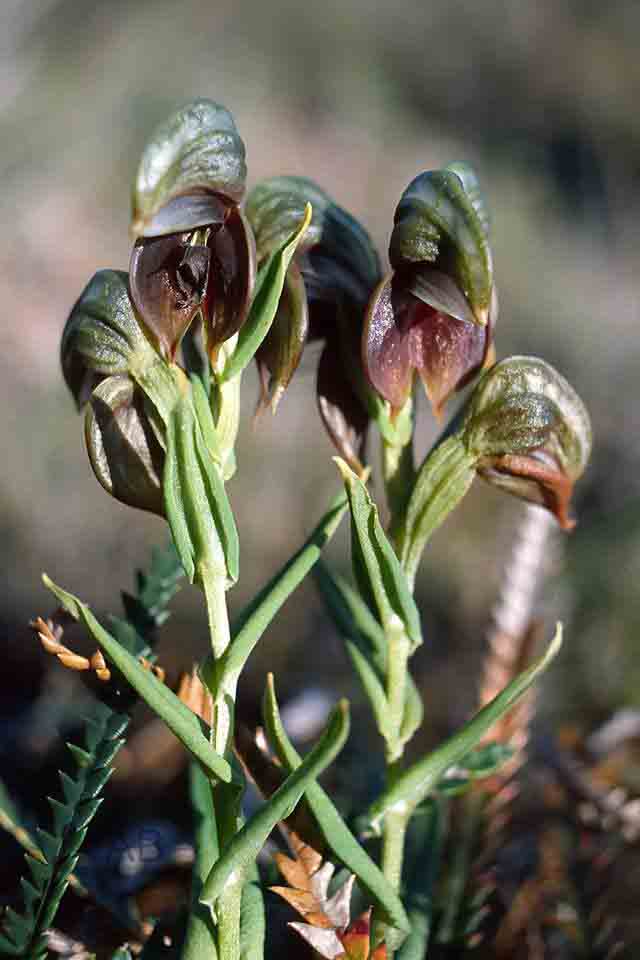
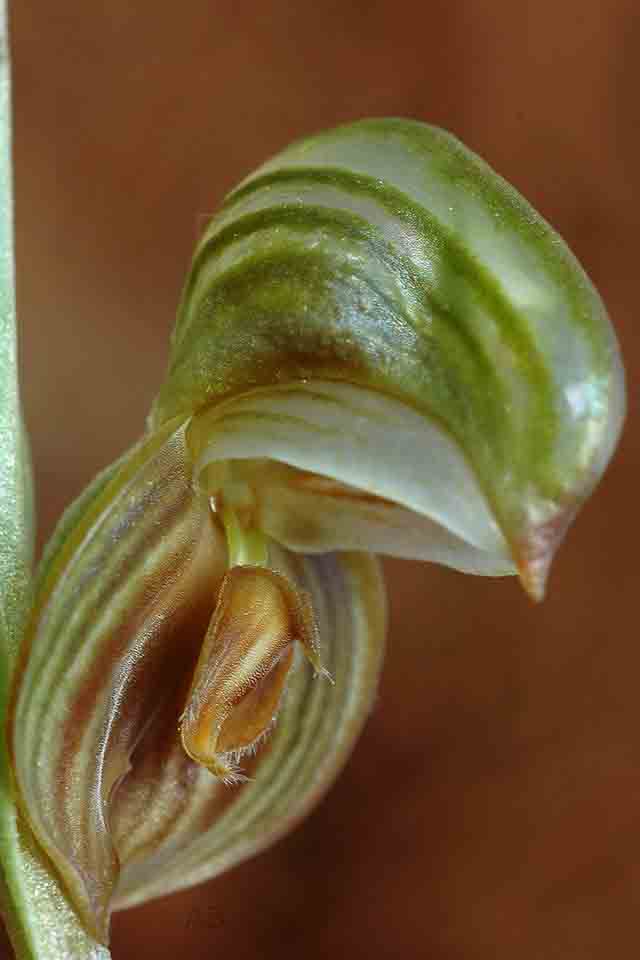
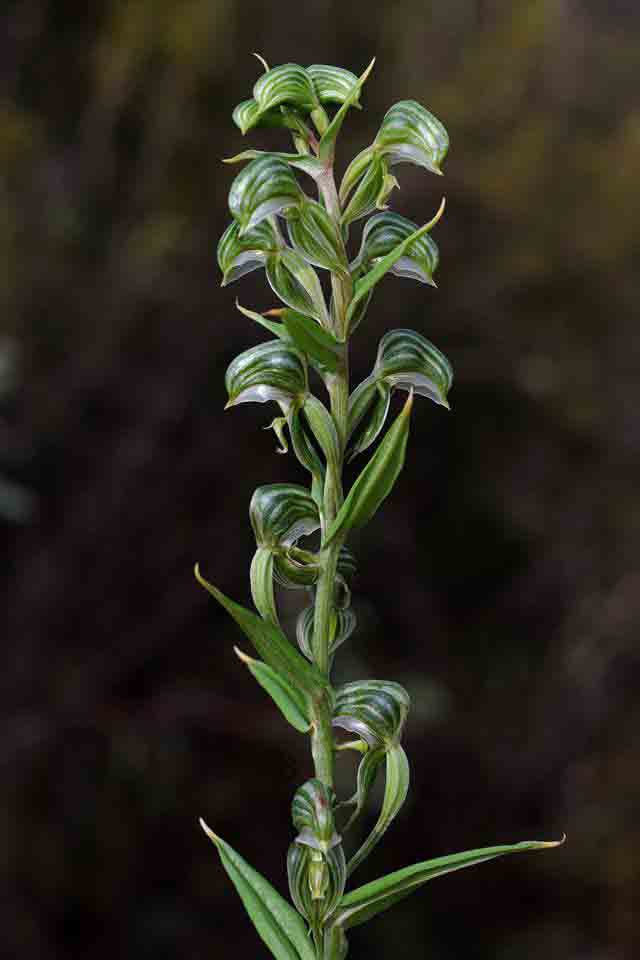
Pterostylis 'Nodding Grace'

2017 July Winning Picture

July Winning Photograph

Corybas demenicus

July is Helmet Orchid Season; and the theme for the July Picture Competition.

In Australia, the genus Corybas in the broad sense (sensu lato) has four segregate genera; three on the Australian mainland (Corybas, Corysanthes & Anzybas) and one (Nematoceras) on Macquarie Island. All three mainland segregate genera were represented this month. Robert Lawrence’s, Anzybas unguiculatus; Margaret Lee, Corybas aconitiflorus with Jane Higgs, Lorraine Badger and John Fennell all entering Corysanthes diemenica. Lorraine also entered Corysanthes despectans; and John an image of Corysanthes incurva. The clear winner was Jane Higgs’ Corysanthes diemenica (synonym Corybas diemenicus).

The flower of Corybas sensu lato is characterised by a large dominant dorsal sepal and an equally dominant labellum. The other features associated with an orchid are not so obvious. The column is short and not visible. Even the ovary is barely visible whilst the other petals and sepals are but short thin filaments near the ovary. The base of the labellum wraps around to form a tube which hides the column; and the upper portion of the labellum folds back on itself and flares out. With this structure, two new features are introduced, the boss in the centre of the labellum and the auricles, two earlike openings formed from folding at the base of the labellum. Two growth features that are different from many other orchids are that the bud and leaf grow concurrently and once pollination has occurred the stem elongates so that the ovary can be raised up to 20 to 30 cms, thus allowing for seed dispersal.

Jane’s picture clearly shows these features as in the labelled image below.

Corybas demenicus

Thank you to Greg Steenbeeke for reviewing this article.

Reference

Backhouse, G, et al (2016) Bush Gems: A Guide to the Wild Orchids of Victoria Electronic version

Bates, R. J., ed. (2011). South Australian Native Orchids. Electronic version, 2011. NOSSA

Jones, D. L., A Complete Guide to Native Orchids of Australia Including the Island Territories. Reed New Holland

Jones, D. L.; Hopely, T; Duffy, S. M.; Richards, K. J.; Clements, M. A and Zhang X, Australian Orchid Genera an information and identification system. Electronic version, 2006, CSIRO

Rules of entry:

The subject matter must have something to do with Australian orchids.  Any format is acceptable including Photo shopped images, artwork, etc

Orchid Basics – Labellums and Columns

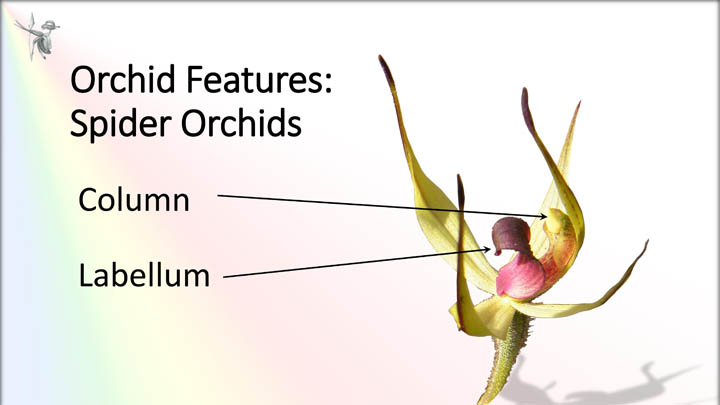
Orchids are unique in the floral world. Two distinctive characteristics that set orchids apart from other plants are the labellum and the column.

The labellum is a modified petal.  It is extremely varied in appearance; “often lobed, spurred, adorned with glands, appendages of calli (callus, a hardened swelling or thickening of the skin), sometimes mobile and highly irritable and often brightly coloured”. * The labellum is important for pollination.

The column (as described by Bates and Weber) “is a distinctive feature of all orchids and a unique structure in the plant kingdom. It is formed by fusion of the male parts ‘stamens’ and female organ ‘pistil’.”*

Below are examples of the various types of labellums and columns in some South Australian terrestrial orchids. Each genus has its own characteristic labellum and column.

Sun Orchid
Thelymitra – though the labellum is almost indistinguishable from the other petals and sepals, the column is quite complex.
Hyacinth Orchid
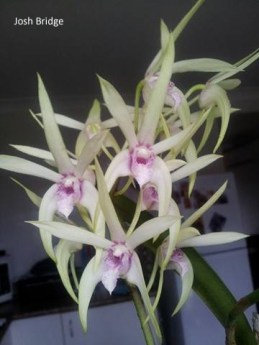
Dipodium or Hyacinth Orchid
Greenhood
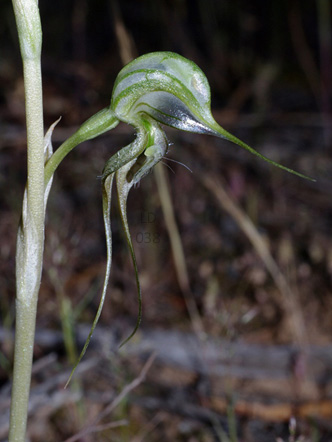
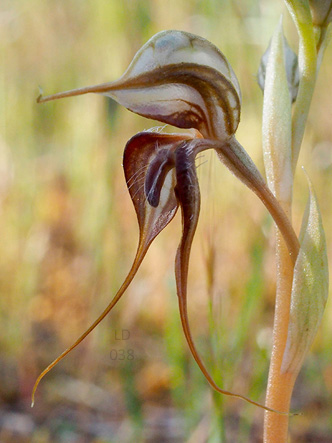
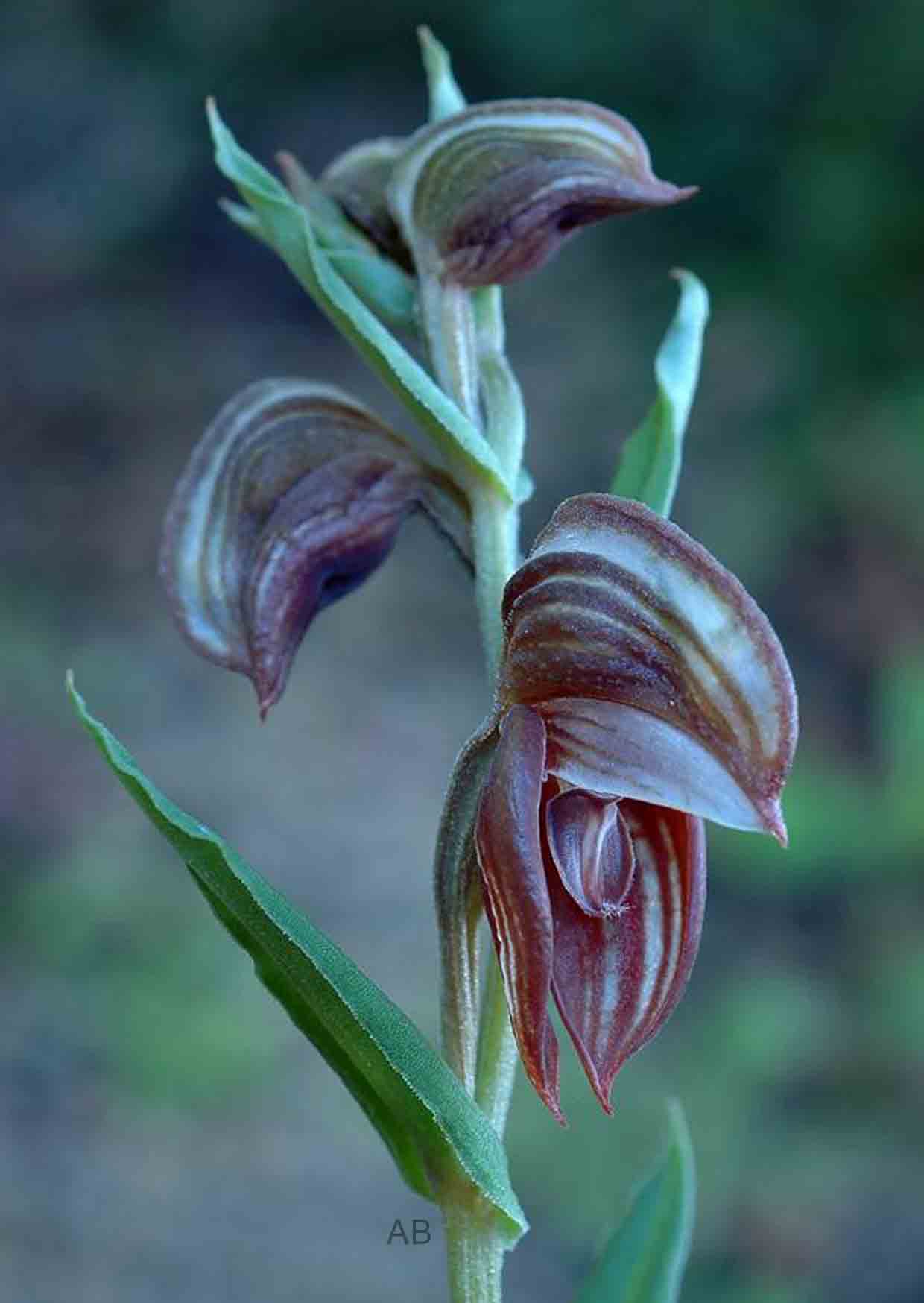
Pterostylis or Greenhoods – generally a simple labellum with the column hidden well back into the hood.
Spider Orchid
Arachnorchis (syn Caladenia) can have quite varied and complex, mobile labellums
Helmet Orchid
Corybas or Helmet Orchid – the labellum dominates and the column is hidden deep inside the flower.
Donkey Orchid
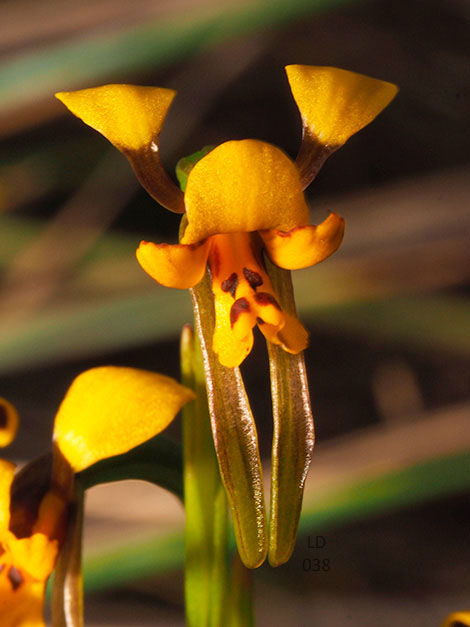
Diuris or Donkey Orchid – the labellum is divided giving the appearance of more than one structure.

*Bates and Weber Orchids of South Australia 1990


2017 August Cultural Notes

Steve Howard writes cultural notes for Adelaide conditions. These are his notes for August; for both epiphytes and terrestrials.

WATERING

Mounts daily.

Pots weekly. Small pots twice weekly depending on weather. Drier conditions for hot cold types. Terrestrial pots can dry out faster on warmer days so keep a watch on conditions.

FEEDING

Epiphytes: Recommending feeding towards months end as days lengthen. Many plants in strong spike growth and flowering now.

Terrestrials generally don’t need to be fed although weak organics like Seasol and Powerfeed applied in low doses can benefit colony type greenhoods.

PESTS AND DISEASES

Epiphytes: Botrytis will rot new buds in cold damp weather as fast as it attacks new growths from now. Aphids will increase sharply this month and favour new growth and spikes.  Pyrethrum sprays eco friendly and work well, so does a hose but dry spike straight after.

Some terrestrials will rot this month if conditions have been too wet or stagnant over winter. Note this for next season and add more drainage if this has been an issue.


GENERAL

Epiphytes: Keep flowering plants under cover  to enjoy. Soon will be the time to start thinking about re-potting and division as spring nears.

Keep flowering terrestrials out of strong winds and heavy rains as flower stems on some varieties are quite weak when grown in cultivation

Additional:

Later August will produce some warmer drying days as spring nears. Ensure small pots and plants don’t dry out at this time. Good time to check out seedling lists and prepare orders to ensure your plants arrive at the commencement of a new growing season.

den-alick-dockrill-paleface-jb-1

Save

Save

Save

Save

Save

Save

Blue – it just ain’t natural

2017 June Winning Picture: Blue & White Orchids

1706 sm RWL Thelymitra grandiflora 10

This month’s theme for the photo competition was blue and white. White flowers can occur as a result of lack of colour such as Rosalie Lawrence’s Caladenia latifolia (Pink Fairies) which is normally pink. White orchids can also occur naturally such as the Arachnorchis argocalla (White Beauty Spider Orchid) and Arachnorchis intuta (Ghost Spider Orchid) both photographed by John Fennel, or as a dominant colour such as Lorraine Badger’s Eriochilus collinius (syn Eriochilus sp Hills Woodland).

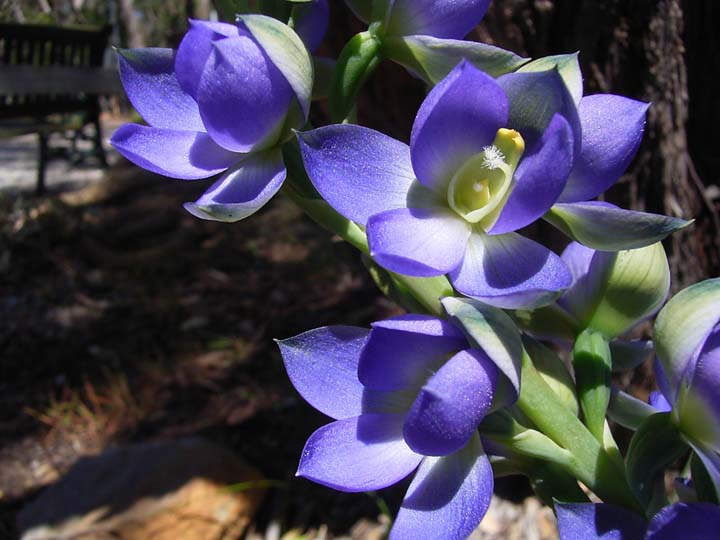
Of the blue orchids, both Ricky Egel and John Badger entered pictures of Thelymitra x truncata (Blue Spotted Hybrid Sun Orchid) whilst Robert Lawrence entered a Thelymitra grandiflora (Giant Sun Orchid) which was the outstanding winning picture.

Blue in the floral world is unusual colour in the floral world for it is not a naturally occurring colour. In fact, “[t}he key ingredient for making blue flowers are the red anthocyanin pigments. Less than 10 percent of the 280,000 species of flowering plants produce blue flowers.” (Lee, 2010 as cited in Oder 2014).

Whilst blue orchids occur outside of Australia, their “colour cannot rival” … “the intensely blue flowers” … “especially [are] unique in the orchid world” … “of their Australian counterparts. The sun orchids (Thelymitra) in particular are famous for their sky blue flowers.” (Ronse 2008: 103)

Based upon Jones 2006 tome, the following genera have true blue orchid species – Cyanicula (9 species), Pheladenia (1 species), Epiblema (1 species) and the largest group Thelymitra (about 65 out of potentially 118 species) plus one hybrid, XGlossodenia tutelata. Of the epiphytes, blue is almost non-existent except for three which Jones lists that rarely might be bluish and they are Vappodes bigibba, V. lithocola and V. phalaenopsis*.

With such rarity, is it any wonder then that the Chinese attached special significance to it as a plant that could cure lung disease and the Aztecs saw it as a symbol of strength.

*Names used as they appear in Jones 2006 tome

Reference

Jones, D. L., A Complete Guide to Native Orchids of Australia Including the Island Territories. Reed New Holland

Lee, David (2010), Nature’s Palette: The Science of Plant Color< Chicago, University of Chicago Press

Oder, T, The Science of Blue Flowers https://www.mnn.com/your-home/organic-farming-gardening/stories/the-science-of-blue-flowers accessed 6 July 2017

Pretty Zesty All About Blue Orchids http://www.prettyzesty.com/2012/11/all-about-blue-orchids.html accessed 6 July 2017

Pterostylis Pollinators

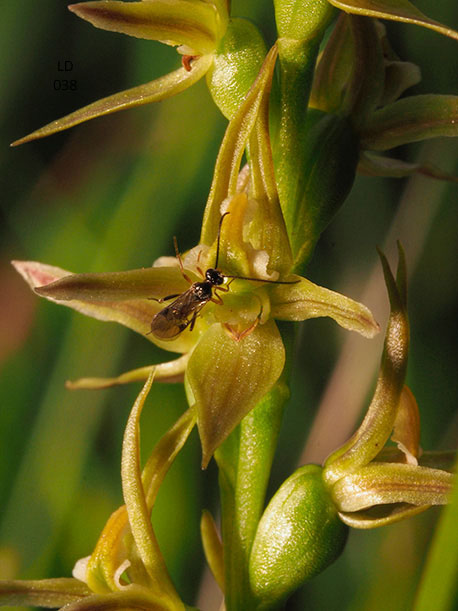
Rudie Kuiter et al have been observing orchid pollinators over many seasons spending hours watching and becoming familiar with pollinator interaction with the orchid, learning when to anticipate pollination activity.

Their observations of various Pterostylis species has been documented in Overview of Pterostylis Pollination (Orchidaceae) in Victoria. In all, they observed 53 Pterostylis species and 40 species of pollinators from several different genera. They noted that some pollinators species were active most of the day but others were only active in the late afternoon whilst others were “only seen on dusk and possibly are nocturnal as well”.


Banded Greenhoods Bundled Together

Here in South Australia we often have only one or two species of a complex or a genus but this is not necessarily the case in the rest of the country. One such instance is Urochilus sanguineus (syn Pterostylis sanguinea) or Maroon Banded Greenhood. It is possible that we may have a subspecies or possibly the Mallee form but nothing like the occurrence of  this species in Western Australia where it is but one of many in a complex of several – the Pterostylis vittata complex or Banded Greenhoods*.

Below, with permission, is Andrew Brown’s post on Facebook with notes and images about the complex as it is understood in Western Australia.

The Banded Greenhood complex in Western Australia

Members of this complex grow 150 to 450 mm high and have up to 20 green, brown or reddish-brown white banded flowers characterised by their, short, broad lateral sepals which are joined at the base and a small, insect-like labellum which flicks up when touched. In all species, flowering plants lack a basal rosette of leaves while non-flowering plants have a flattened, ground hugging, rosette of leaves.

Banded greenhoods are found over a wide geographic range between Binnu north of Geraldton and Eyre on the Great Australia Bight, growing in shrublands, woodlands, forests and shallow soil pockets on granite outcrops.

There are ten Western Australian species in this complex, seven of which are formally named. However, as two were named as species of Urochilus, a genus not recognised in Western Australia, only five of these names are currently recognised here. In Western Australia, all members of the complex are considered to be in the genus Pterostylis.

All are winter flowering.

Pterostylis concava

Pterostylis concava AB

Distinguished from other members of the complex by its prominently cupped lateral sepals and the upturned projection near the base of the labellum. Found between Bindoon and Mt Barker.

**********

Pterostylis crebriflora

Pterostylis crebriflora AB.jpg

Distinguished from the similar Pterostylis sanguinea by its often shorter stature and slightly larger flowers which are crowded in a dense spike near the top of the stem. Found on the Darling Scarp near Perth.

**********

Pterostylis sanguinea

Pterostylis sanguinea AB.jpg

A very common species that is also found in South Australia, Tasmania and Victoria. It was named from specimens collected in South Australia. The species is similar to Pterostylis crebriflora but is usually taller with smaller, more widely spaced flowers. Flower colour is variable and it is not uncommon to find brown and green flowered forms growing alongside one another. Found over a wide area between Mullewa and Eyre on the Great Australian Bight.

**********

Pterostylis sanguinea (Mallee form)

Pterostylis sanguinea mallee form AB.jpg

An unnamed member of the complex distinguished from Pterostylis sanguinea by its short stature and few flowered inflorescence. Found over a wide range from the Stirling Range to the north of Esperance.

**********

Pterostylis sp. Coastal

Pterostylis sp coastal AB.jpg

Some consider this to be a form of Pterostylis sp. small bands but it is usually taller with more widely spaced flowers. The sepals are also narrower and often slightly cupped. Found mostly in near coastal areas between Dongara and Bunbury. Similar looking plants have also been found further inland between Brookton and Mt Barker.

**********

Pterostylis sanguinea (green flowered form)

Pterostylis sanguinea green flowered form AB.jpg

**********

Pterostylis sargentii

Pterostylis sargentii AB

A common, widespread species, distinguished from other members of the complex by its smaller flowers and fleshy, tri-lobed, frog-like labellum. Found over a huge geographic range between Northampton and Mt Ney, north of Esperance.

**********

Pterostylis sp. Crowded

Pterostylis sp crowded AB


A widespread species named Urochilus atrosanguineus in June 2017. Distinguished from the similar Pterostylis sanguinea by its more robust habit and larger dark reddish-brown flowers. It is also similar to Pterostylis crebriflora but generally flowers earlier and has more widely spaced flowers in a longer spike. Found between Wongan Hills and Katanning with rare, scattered populations on the Swan Coastal Plain.

**********

Pterostylis sp. Eyre

Pterostylis sp Eyre AB

A distinctive member of the complex distinguished from others by its pale coloured flowers. Like Pterostylis sanguinea (mallee form) it has a short stature and few flowered inflorescence. Found along the coast between Toolinna Cove and Eyre on the on the Great Australian Bight.

**********

Pterostylis sp. small bands

Pterostylis sp small bands AB

A northern species named Urochilus orbiculatus in June 2017. It is regarded by some researchers to be a form of Pterostylis sp. coastal but is usually shorter with a more densely crowded spike of flowers. Its sepals are also broader, more rounded and flattened rather than slightly cupped. Found north of Perth between Cataby and Binnu.

**********

Pterostylis vittata

Pterostylis vittata AB.jpg

A widespread species distinguished from other members of the complex by its less fleshy, paler coloured, predominantly green flowers and narrower, elongated, slightly cupped sepals. The flowers also have a more translucent appearance. The typical form is found between Bindoon and Balladonia. There is a northern form with a shorter spike of often fawn coloured flowers found between Cataby and Binnu.

**********

It should be noted that in South Australia and Victoria U. sanguineus was originally called P. vittata but that species is now recognised as being endemic to Western Australia.

*As an aside, the common name Banded Greenhoods is used in South Australia for the subgenus Bunochilus (previously Pterostylis longifolia which is now considered endemic to New South Wales).


2017 July Cultural Notes

Steve Howard regularly writes orchid cultural notes for various orchid clubs in South Australia. His notes are tailored specifically conditions in Adelaide. The following are his notes for both epiphytes and terrestrials for the month of July.

Epiphytes

  • Water mounted native epiphytes daily; pots weekly and small pots twice weekly depending on the weather. Hot cold types require drier conditions. Generally none to once monthly for me.
  • Colder weather slows down their metabolism in winter. Foliar feeding is beneficial.
  • Keep water out of new growths to avoid rot. Clones prone to this need to be moved under hard roof cover to keep drier.
  • Check under leaves for scale.

Epiphytes in flower (1)
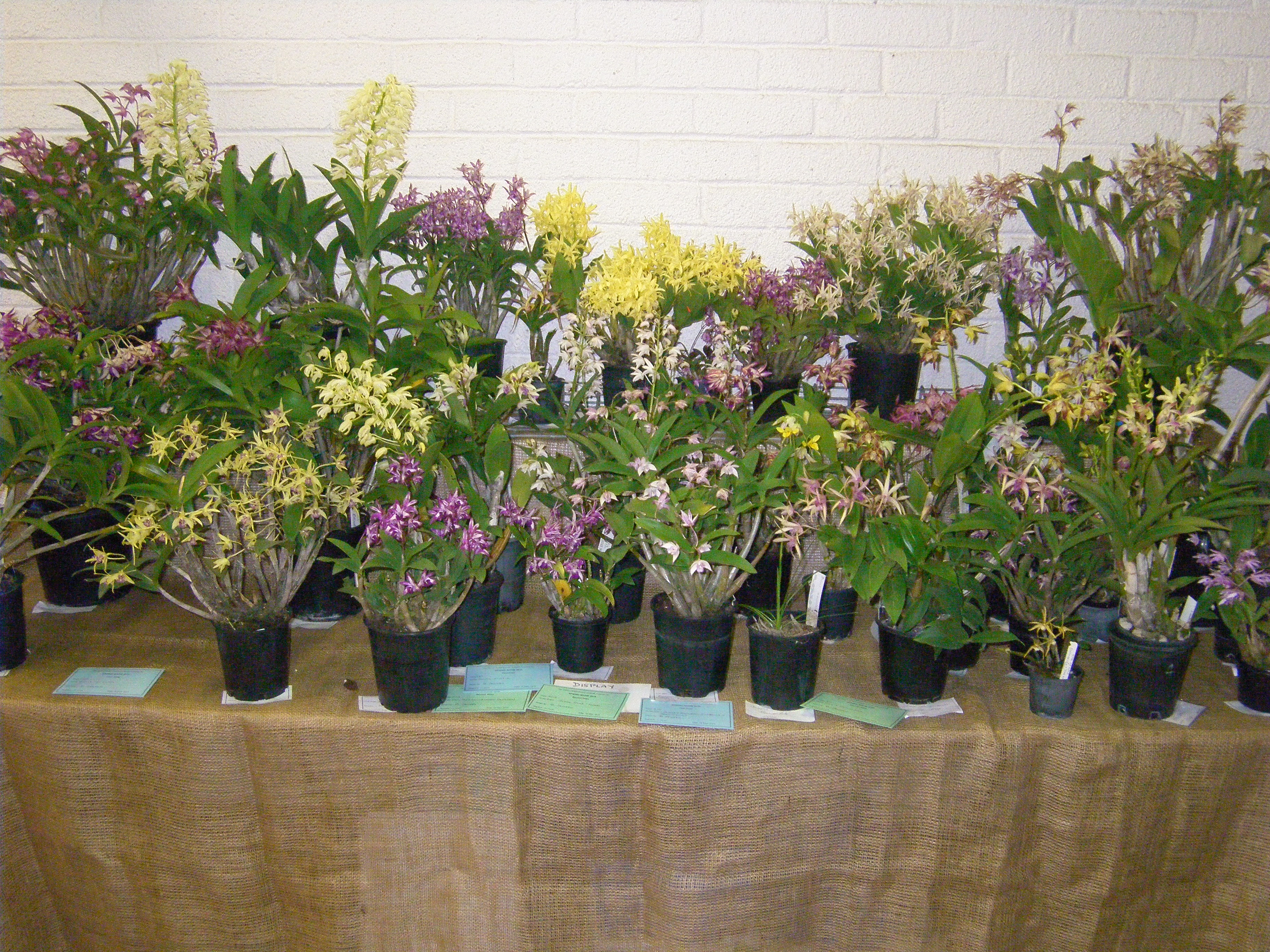
Annual NOSSA Spring Show

Terrestrials

  • Weed pots as the weeds appear and ensure that they don’t get too wet.
  • Remove rotted growths.
  • Start baiting for slugs and snails as spikes emerge from protective sheaths.
  • Provide hard cover during wet weather to stop botrytis spotting and rotting out spikes.

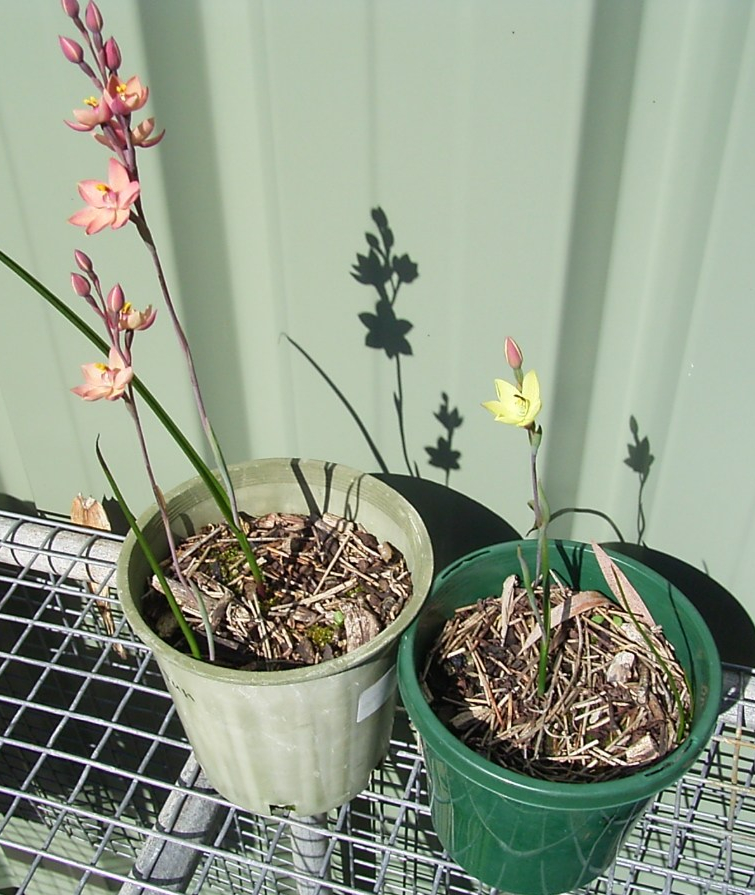
Thelymitra plants in pots

2017 May Winning Picture

Corunastylis morrisii @ Simpson 25/2/2017

May’s theme was miniscule, or less than 10mm. Of the eight entries five were Corunastylis, two Spider orchids from Western Australia and one an epiphyte. The flowers of the two spiders, Caladenia pachychila (photographer Rob & Jenny Pauley) and Caladenia bryceana subsp. bryceana (Pauline Myers) were the largest of the group being about 10mm across whilst the Bulbophylum globuliforme (Ros Miller) and C. despectans (Rosalie Lawrence) were the smallest being only 2mm across.

Of the remaining Corunastyllis entries the flower size ranged from 3mm for C. pumila (Rob & Jenny Pauley), 4mm for C. tepperi (Ricky Egel), 7mm for C. ciliata (Rosalie Lawrence) and 8mm for C. morrisii (Rob & Jenny Pauley).

The winning picture C. morrisii (Bearded or Hairy Midge Orchid) is one of the larger midge orchids. Other synonyms are Prasophyllum morrisii and Genoplesium morrisii. This common species is mainly found in Victoria but it does extend into southern New South Wales in the east and in the west just spills 50 km over the border into South Australia where it is rated endangered. It also occurs in the south east of Tasmania.

Flowering Times: Nov – May

 
 State N D J F M A M
Tas        
NSW      
Vic
SA          √

With such a wide distribution range, it is not surprising to see quite a variation in flowering time from late spring through to autumn depending upon location.

Reference

http://plantnet.rbgsyd.nsw.gov.au/cgi-bin/NSWfl.pl?page=nswfl&lvl=sp&name=Genoplesium~morrisii

https://en.wikipedia.org/wiki/Caladenia_pachychila

https://en.wikipedia.org/wiki/Caladenia_bryceana_subsp._cracens

http://plantnet.rbgsyd.nsw.gov.au/cgi-bin/NSWfl.pl?page=nswfl&lvl=sp&name=Genoplesium~pumilum

Bates, R. J., ed. (2011). South Australian Native Orchids. Electronic version, 2011. NOSSA

Wapstra, M., Roberts, N., Wapstra, H. & Wapstra, A. (2012). Flowering Times of Tasmanian Orchids: A Practical Guide for Field Botanists. Self-published by the authors (May 2012
version).

Backhouse, G., Kosky, B., Rouse, D. & Turner, J. (2016). Bush Gems: A Guide to the Wild Orchids of Victoria. Self-published by the authors

Gleanings from the Journals: Terrestrial Potting Mixes

The following article by Les Nesbitt was published in May 2017 Native Orchid Society of South Australia Journal Volume 41 No 4. The article relates to Australian Native Orchids.

Suggested potting mixes for potted native terrestrial orchids have changed greatly over the years as some ingredients such as peat moss have become too expensive or difficult to obtain. Basic requirements are that the mix should be free draining yet retain moisture and should have an organic component that breaks down slowly and does not go mushy in winter. Most species are not too fussy and will grow in a variety of mixes.

Those tubers that desiccate in summer do better in a heavy mix that contains clay. Examples are Diurus behrii, D. punctata and Pterostylis nutans.

Tubers that rot easily in wet soil in Spring prefer an open coarse sandy mix. An example is Thelymitra antennifera.

A dry mix containing a higher proportion of sand is usually recommended for Caladenia and Glossodia species grown in pots. In contrast these orchids grow in clay soil on my property in the Adelaide Hills but there excess water can run off. In pots, excess water has to drain through the potting mix.

An organic component is vital to feed orchid fungi.

Some Basic Ingredients:

  • Washed sand with rounded particles. (Not sharp sand as this sets hard in summer.)
  • Soil (sandy loam, clay based loam, mountain soil)
  • Native seedling mix (Bark based – sieve to remove splinters)
  • Native potting mix (can be sieve* to remove larger particles)
  • Chopped and sieved* gum leaves
  • Perlite or isolite (but will make tubers harder to identify at repotting time)
  • Composted leaf mould & buzzer chips (but needs to be gathered now for use next summer)
  • Cauarina (She-oak) needles chopped for surface mulch

Some Suggested Potting Mixes

  1. ANOS-Vic dry mix – 2 parts coarse sand, 1 part coastal sandy loam, 1 part composted buzzer chips, 1 part leaf mould
  2. 100% native potting mix. (Works for drought resistant tubers, viz. Pterostylis curta & P. pedunculata)
  3. Native potting mix (sieved*) and isolite
  4. Native potting mix and sand
  5. Les Nesbitt’s current mix of 50% sand, 20% hills soil, 25% seedling potting mix (sieved), and 5% chopped & sieved* string bark gum leaves.
  6. Dry mix, 50% coarse sand, 25% perlite & 25% native potting mix
  7. Heavy mix, 50% clay soil, 30% sand and 20% organic matter

* Use a 5mm sieve

thelymitra-plants-1.jpg

Thelymitra in cultivation